Taxus care knowledge: this one article is all you need
1. “Care of newly purchased bonsai” For a newly purchased Taxus bonsai, it is best to spray the leaves with a 800- to 1000-fold dilution of potassium dihydrogen phosphate solution about every three or four days, generally before 10 a.m., or around 4 p.m. After spraying three to four times in a row, gradually reduce to spraying about once a month.
2. “Light requirements” Taxus is a shade-loving plant and is suitable for indoor placement, but note that it needs proper shading in summer, and it should not be placed in a room with west-facing sunlight.
3. “Soil selection” The soil used for planting Taxus should be loose, rich in humus, fertile, and slightly acidic (pH=5~6.5).
4. “Water requirements” When the surface of the potting soil turns slightly yellowish-white and the leaves curl slightly, the potting soil does not need watering; simply mist the leaves. When the soil in the pot turns white, the potting soil should be watered. Note that when watering, water thoroughly in one go so that the potting soil fully absorbs enough water.
5. “Soil fertility” The three essential elements for plant growth are nitrogen, phosphorus and potassium fertilizers. Nitrogen fertilizer can promote the growth of flowers, grass, branches and leaves; phosphorus fertilizer can promote the formation of flowers and fruits; potassium fertilizer can promote the growth of stems and roots. Since the newly purchased Taxus bonsai already uses a prepared nutrient soil, no fertilization is needed for 3 months; afterwards, fertilize once every 2 to 3 months, and cake fertilizer is preferable. When fertilizing, take care to apply it along the edge of the pot and avoid touching the roots of the bonsai. “Flower pot selection” Choose a suitably larger flower pot, and several more holes need to be made in the bottom of the pot, mainly to enhance the pot's water permeability and air permeability.
6. “Requirements for transplanting and repotting” Half a year after purchasing the bonsai, the sapling gradually grows larger and its root system becomes well developed. To ensure its normal growth, users are advised to transplant and repot it. When repotting, it is best to break the old pot rather than damage the original soil ball, slowly move it into the new pot, and water it to settle the roots and ensure survival.
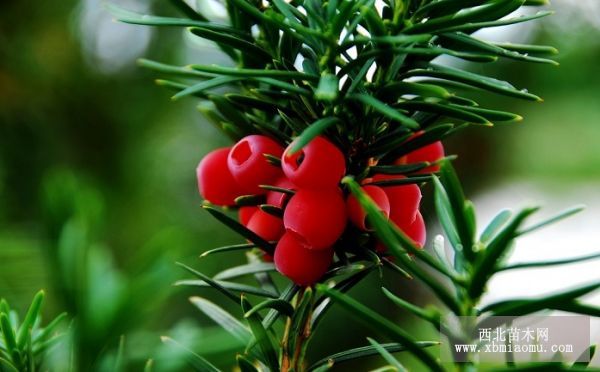
3. “Soil selection” The soil used for planting Taxus should be loose, rich in humus, fertile, and slightly acidic (PH=5~6.5).
4. “Water requirements” When the surface of the potting soil turns slightly yellowish-white and the leaves curl slightly, the potting soil does not need watering; simply mist the leaves. When the soil in the pot turns white, the potting soil should be watered. Note that when watering, water thoroughly in one go so that the potting soil fully absorbs enough water.
5. “Soil fertility” The three essential elements for plant growth are nitrogen, phosphorus and potassium fertilizers. Nitrogen fertilizer can promote the growth of flowers, grass, branches and leaves.
6. “Bonsai pruning” If the lower part of the bonsai shows severe shedding of dry, yellow leaves, it may be that the lower branches are growing too densely, and it is enough to prune away a few of the overly dense lower branches. This reduces the excessive consumption of nutrients by branches and leaves and restores root growth. Apply a wound healing and antiseptic film to the pruning cuts to promote wound healing.
7. “Pest and disease control” In hot and dry seasons, individual young Taxus trees may develop leaf blight and red blight. Various targeted pesticides can be sprayed in rotation for control, and add xingaozhimo to enhance the control effect.
Taxus cultivation and care methods, Taxus propagation methods
Taxus cultivation and care methods, Taxus propagation methods, Taxus bonsai care knowledge. Southern Taxus, also called yew, and in the Jincheng production area also called dongqing, is a national first-class protected endangered and rare plant. Its branches, leaves and trunk bark are all raw materials for extracting the new anti-cancer drug —— taxol. Besides medicinal and timber uses, it also has extremely high ornamental value. In order to preserve this precious tree species and vigorously develop this valuable resource, the propagation and cultivation techniques of recent years are specially introduced here.
1 Selecting a suitable nursery site
Choose a fertile, loose, neutral or slightly acidic soil plot with good drainage, preferably a plot within woodland or a semi-shaded fertile plot. Apply sufficient base fertilizer, rake level, and prepare the beds ready for planting.
2 Seed propagation
2.1 Seed treatment
The seeds mature in October. After timely harvesting, place them in a mixture of water and fine sand (water-to-sand ratio 2:1). Rub the seeds on a washboard to remove the outer seed coat and wear down the hard fleshy seed coat. Choose a shady, dry plot that does not accumulate water, dig a pit, and store them in the pit mixed with wet river sand at a ratio of 1:2. In March of the following year, take out the cleaned seeds and soak them in 50-degree baijiu and 40 degrees Celsius warm water (1:1) for 20 minutes; after removing them, soak the seeds with 0.05% 920 for 20-24h to break dormancy and increase the emergence rate. At the end of March, move them into a greenhouse for germination; the temperature should be 20-25 degrees Celsius, and when the seeds “show white” they can be sown in spots.
2.2 Sowing and transplanting
Make the beds 1m wide and of suitable length. Sow the seeds in the beds, cover with 2.5 cm of soil, water thoroughly and cover with film. Germinated seeds can also be spot-sown in beds covered with plastic film, with row spacing 20 cm and plant spacing 10 cm. Generally, seedlings emerge in 20-30d. When the seedlings have 3-4 leaves, thin and transplant them on a cloudy day, with row spacing 20 cm and plant spacing 10 cm. After planting, water, cultivate and weed to promote growth. Because Taxus grows slowly and fears strong light most, proper shading is beneficial to growth. Generally, first-year seedlings can reach 10-15 cm, up to 20 cm at most; 2-year-old seedlings 50-90 cm; 4-year-old seedlings 1.5-2m tall.
3 Cutting propagation
From May to June each year, cut the current year's semi-lignified branches as cuttings, choosing mother trees under 10 years old. Length 15-20 cm; cut off the lower small branches and trim the needles into a horseshoe shape, then soak in ABT No. 7 rooting powder at a concentration of 30×10-6 to 50×10-6 for 3-12h. Then insert the cuttings into a seedbed whose substrate is river sand. The seedbed should be 1m wide and of suitable length, with a cutting depth of 3-5 cm. Row and plant spacing 10 cm×8 cm, then spray water immediately. Build a frame over the seedbed and cover it with plastic sheeting; spray water 2-3 times daily, and after half a month spray water once daily. Generally, keep the ground temperature at 20-30 degrees Celsius, avoid strong light, and roots will form in 30-40d. During this period, foliar fertilizers such as brassinolide can be sprayed to promote growth.