How to grow globe amaranth? Detailed explanation of cultivation methods and precautions
Cultivation requirements
Globe amaranth does not have strict environmental requirements, but it prefers sunlight and a hot, dry climate. It is robust and tolerant of pruning; after flowering, pruning can stimulate new branches to sprout and continue blooming. It prefers loose, fertile soil, is not cold-tolerant, tolerates high temperatures, and fears waterlogging. The optimal growth temperature is 20°C to 25°C, and it also grows well within the range of 35°C to 40°C. When winter temperatures drop below 10°C, the plant grows poorly or suffers cold damage.
Cultivation precautions
Globe amaranth is relatively sensitive to water and fertilizer. During the growth period, excessive watering and fertilizing should be avoided, otherwise it will cause excessive vegetative growth of stems and leaves and sparse flowering. During the plum rain season, excessive soil moisture can easily cause the plant to suffer from waterlogging and die entirely. During high summer temperatures, air humidity should not be too high, and the potting soil must not become waterlogged, otherwise both are unfavorable to the growth and flowering of globe amaranth. Globe amaranth is a light-loving flower and requires ample sunlight during growth and flowering periods. If the cultivation site has insufficient sunlight, the leaves will be soft, the internodes will be long, the flower buds will decrease, the flowers will become thinner, and the flower color will fade. Conversely, with ample sunlight, the internodes will be compact, the flower color will be vivid, the flowers will be large, and flowering will be continuous. The soil should be fertile, loose, and well-drained sandy soil.
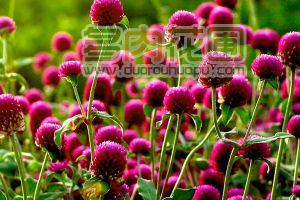
Globe amaranth cultivation methods
Light requirements
Globe amaranth likes a sunny environment. During care, ensure at least 4 hours of direct sunlight per day. The care location should not be too shaded, otherwise the plant will grow slowly and the flower color will be dull. If the seedling stage of globe amaranth happens to fall on an overcast day, fluorescent lamps can be used for supplemental lighting.
Water and fertilizer requirements
Globe amaranth likes a slightly moist to somewhat dry soil environment and is relatively drought-tolerant. When watering, it is better to keep it dry than waterlogged. During the seedling growth stage, especially when growing leaves, watering should be appropriately controlled. After flower bud differentiation, watering can be appropriately increased to ensure normal flower growth.
Globe amaranth likes fertilizer. In addition to adding sufficient base fertilizer to the soil at planting time, applying phosphorus and potassium fertilizer once every half month during the vigorous growth period can not only promote plant growth but also enhance resistance and reduce disease infection.
Shaping and pruning
Globe amaranth grows rapidly. When the seedling reaches 15 cm, pinch it once to promote branching. After that, decide whether to pinch a second time based on the plant's growth to control the plant shape and flowering period. In addition, during growth, promptly cut off yellowing and wilting leaves, and appropriately thin out branches and leaves to keep the plant shape attractive.
Globe amaranth cultivation precautions
Flowering period management
After flowering begins, this is a stage that people easily overlook. Mainly keep the potting soil slightly moist. When watering, do not water from top to bottom, to avoid the flowers getting wet. Stop fertilizing during the flowering period and ensure sufficient light. After flowering, promptly cut off the flowering branches to promote re-sprouting and reblooming.
Pest and disease control
Globe amaranth often develops yellowing, which is Rhizoctonia rot. Prevention should be done well, with timely disinfection before planting. When disease occurs, use fungicide as a root drench.
How to grow globe amaranth, globe amaranth cultivation methods and precautions / Sufficient light
Among the effects and benefits of globe amaranth, its ornamental value is the most widely known. This flower has high ornamental value, so many people want to grow it. However, cultivation requires proper methods. As for how to grow globe amaranth and what the cultivation methods and precautions are, the editor below will explain.
I. How to grow globe amaranth
To know how to grow globe amaranth, we first need to understand its growth habits. Globe amaranth is a light-loving plant, so during cultivation, sufficient light must be maintained. However, besides this, there are many other points to note, which are described in detail in the cultivation methods and precautions for globe amaranth below. You can take a look.
II. Globe amaranth cultivation methods and precautions
1. Soil requirements
Although globe amaranth does not have very high soil requirements, different soils still have a certain effect on its growth. When growing globe amaranth, it is best to choose relatively fertile humus soil. This kind of soil has good drainage and aeration, allowing globe amaranth to absorb nutrients better.
2. Fertilization requirements
In the cultivation methods and precautions for globe amaranth, fertilization is a very important part. Globe amaranth has relatively high fertilizer needs during growth. Generally, it needs fertilizing once every half month. Also remember that before fertilizing, it must first be diluted with water, and then applied, so that globe amaranth can absorb it better. For fertilizer, phosphorus and potassium fertilizer is generally chosen.
3. Watering requirements
During the cultivation of globe amaranth, watering is also a point that requires attention. When watering, it must be thorough, but remember not to cause waterlogging, otherwise it can easily lead to root rot in globe amaranth. When watering, also remember to follow the principle of watering when dry, and do not water too frequently.
4. Light management
Globe amaranth is a light-loving plant, so during cultivation, sufficient light must be maintained so that globe amaranth can grow healthily and quickly. It can be seen that among the cultivation methods and precautions for globe amaranth, light is very important.
5. Proper pruning
During the growth of globe amaranth, if some yellowing or withered leaves or branches appear, they must be pruned in time. This can not only maintain the plant's appearance but also promote branching in globe amaranth.
6. Pest and disease control
In the cultivation methods and precautions for globe amaranth, pests and diseases are also a point to note. This phenomenon is mainly caused by improper care. When it appears, it must be dealt with promptly. If left unchecked, it will cause the plant to wither and die. As for specific treatment methods, you can refer to the article on pest and disease control for globe amaranth.