Can asparagus fern be grown hydroponically? The key to the hydroponic method lies in controlling the water level and light
Asparagus fern (Asparagus setaceus) is a perennial foliage plant, and hydroponics can achieve the dual effect of enjoying both the leaves and the roots, so many people are considering growing asparagus fern hydroponically. So can asparagus fern be grown hydroponically? The editor tells you that it can. Below, let us learn about the hydroponic method for asparagus fern, as well as precautions for hydroponic asparagus fern.
Can asparagus fern be grown hydroponically?
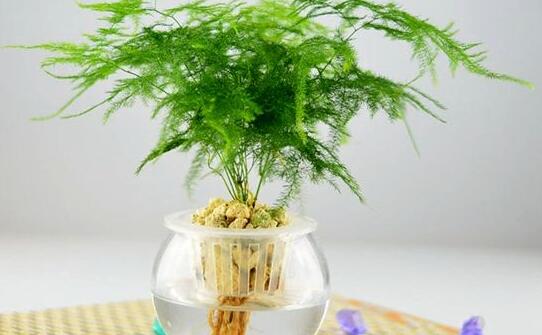
The leaves of asparagus fern are soft and remain emerald green all year round. Its form is elegant and unrestrained, and its stems are smooth, soft and slender, very attractive. So can asparagus fern be grown hydroponically? The answer is yes. Botanists began trying asparagus fern in water basins long ago and have already worked out a very systematic method and steps.
Hydroponic method for asparagus fern
1. Selecting the asparagus fern and container
Asparagus fern: Choose one with a relatively elegant plant shape, relatively robust growth, and no yellowing leaves.
Container: Hydroponics is for viewing the leaves while also being able to see the plant's root growth, so many people choose beautiful transparent glass containers. But in fact, plant roots grow faster in a dark environment. Therefore, in the hydroponic method for asparagus fern, you can choose an opaque container.
2. Placing the plant
Put the plant into the selected container. You can spread some maifan stone at the bottom of the container to secure the plant.
3. Adding water to the container
Usually, for newly hydroponically grown asparagus fern, clean water should be used in the early stage, and after 15 days a nutrient solution can be used.
Precautions for hydroponic asparagus fern
1. Water for hydroponics
When growing asparagus fern hydroponically, it is best to choose well water or river water. Try not to use tap water. Only when the plant has passed the growth period and entered a relatively stable state should tap water be used.
2. Water level control and water change frequency
At the beginning, the water level should not be too high. If the asparagus fern has just been dug out of potting soil, part of the root and stem should be kept above the water surface during hydroponics, which helps it absorb oxygen.
After growth is stable, the water level can be raised, but you should still be careful to keep a small section of root above the water surface. At the beginning, the water change frequency can be once every 2-3 days; after growth is stable, it can be once every 1-2 months.
3. How to use nutrient solution
The nutrient solution can be prepared yourself, but because many chemicals are needed and the proportions are also strictly required, ordinary people are generally not advised to prepare it themselves when growing asparagus fern hydroponically. You can buy a complete nutrient solution at a specialized flower shop. The nutrient solution needs to be added after white water roots have grown, and it should not be used right at the beginning.
4. Light control
When growing asparagus fern hydroponically, it should be maintained under scattered light, so it is generally placed in a place with light, but do not let direct sunlight hit it. Just keep the environment ventilated.
Summary: Asparagus fern can be grown hydroponically, but before that you must understand the ten major precautions for growing asparagus fern. The key lies in controlling the water level well. Even a slightly lower water level is better than too high; it is enough for part of the roots to be in the water. If water droplets appear at the leaf tips, the water level should be lowered, and at the same time direct sunlight should be avoided.
Can asparagus fern be grown hydroponically? What hydroponic methods are there for asparagus fern?
[Common questions] Can asparagus fern be grown hydroponically? What hydroponic methods are there for asparagus fern?
Image: Asparagus fern
[Expert answer]
In addition to traditional soil culture, asparagus fern can also be grown hydroponically, but there are many hydroponic methods. Below, the editor of Diyi Nongjing introduces the hydroponic methods for asparagus fern.
●Method 1: Semi-soil and semi-ceramsite method
Steps: (1) Remove from the pot and clean off the mud, keeping most of the soil around the main root;
(2) Use a large-diameter container, place ceramsite at the bottom as a base, put in the main root, and fill the surrounding area with ceramsite;
(3) Moisten the ceramsite and add a small amount of water. The water must not cover the soil part of the roots;
(4) Spray water on the leaf surface to keep it moist;
(5) Place in a ventilated indoor area, preferably near a window with light.
●Method 2: Semi-soil and semi-water method
Steps: (1) Remove from the pot and clean off the mud, keep part of the soil around the main root, and expose 2/3 of the roots;
(2) Simply prune and disinfect the exposed roots;
(3) Use ceramsite for planting and keep the ceramsite moist;
(4) Put 1/2 of the roots into water and control the water level;
(5) Increase oxygen in the water and cover with a black garbage bag to block light;
(6) Check the root condition daily and promptly remove rotten roots;
(7) Place in a ventilated indoor area, preferably near a window with light.
●Method 3: Evaporated water root-promotion method
Steps: (1) Appropriately raise the roots for cultivation, keeping the upper 1/4 of the main root exposed to air and growing well. This step is key;
(2) Remove from the pot and clean off the mud, keeping part of the soil around the main root;
(3) Use perlite for planting and keep it moist;
(4) Seal the sides of the planting basket with plastic sheets, keeping the bottom hollow;
(5) Use a glass vessel to control the water level so that the roots are not immersed in water, and use the principle of evaporated water to promote rooting;
(6) The outer container produces evaporated water to moisten the leaf surface;
(7) Place in a ventilated indoor area, preferably near a window with light.
Note: This method is suitable for operation in summer.
●Method 4: Water immersion and oxygen enrichment method
Steps: (1) Remove from the pot and clean off the mud, prune the roots, keep the thick and strong main roots, disinfect, and air-dry;
(2) Use perlite or ceramsite for planting and keep it moist;
(3) Control the water level so that 1/2 of the roots are in water;
(4) Continuously increase oxygen in the water until water roots grow;
(5) Cover the container to block light and promote root development;
(6) Check the root condition daily, promptly remove rotten roots, and change the water once every 2 days;
(7) Place in a ventilated indoor area, preferably near a window with light.
●Method 5: Aerial root + sponge planting method
Steps: (1) Choose miniature asparagus fern, appropriately raise the roots for cultivation, and let it grow well and produce something like aerial roots. This step is key;
(2) According to the growth of the aerial roots, divide the plant, keep the aerial roots, cut off all the soil-root parts, disinfect, and air-dry;
(3) After division, directly put it into water to cultivate water roots. Similar to putting spider plant plantlets with aerial roots directly into water, it is very easy to cultivate water roots;
(4) Use sponge for planting, wrap the roots, and keep it moist;
(5) Use a glass vessel to control the water level, exposing 1-2CM of roots;
(6) When necessary, increase oxygen in the water and cover the vessel to block light to promote root growth;
(7) Place in a ventilated indoor area, preferably near a window with light.
[Editor's summary]
Before hydroponic cultivation of asparagus fern, you should choose robust-growing, well-developed mother material. After selecting the mother plant, wash the roots clean and soak them in carbendazim for disinfection. This is a relatively important step. Asparagus fern can be grown hydroponically. In addition, the management and care of hydroponic asparagus fern is easier than soil planting, and for lazy people it is indeed a good method. The editor of Diyi Nongjing has also introduced a variety of hydroponic methods in this article, hoping to be helpful to you.
The hydroponic method for hydroponic asparagus fern, and the care and management methods after hydroponics
Asparagus fern is a great foliage plant. Its small and exquisite figure is lovable. Do not underestimate its small body; it has great energy. It is a little expert at purifying air at home. Keeping a pot of asparagus fern is excellent. Asparagus fern can be grown in soil or hydroponically. Today I will take everyone to learn about the hydroponic method for hydroponic asparagus fern.Hydroponic method
1. Pruning and selection
Select robust-growing, well-developed asparagus fern as the mother material for hydroponics. Take the asparagus fern out of the flowerpot together with the soil, carefully wash away the soil around the roots, remove rotten roots, and cut off some old roots. Then clean the leaves and plant with clean water, avoiding injuring the plant. Asparagus fern roots more slowly, and its fleshy roots are delicate, so be careful when taking out the asparagus fern and do not damage its roots.
2. Disinfection and planting
For hydroponic asparagus fern, it is best to use a planting basket. Secure the cleaned plant with the planting basket, and when securing it, let the roots spread out fully. Then place the plant together with the planting basket into a 1‰ carbendazim solution and soak the roots for 30 minutes. Take it out and place it in a cool place. After the root system becomes soft, you can proceed to the next step.
3. Hydroponics
The previous steps are only preparation. The main event is here. Add nutrient solution specially for asparagus fern to the hydroponic container, and put the treated plant (together with the planting basket) into the hydroponic container. When placing it, put 2/3 in water, and ensure that part of the root system is exposed to air to ensure smooth root respiration.
Care for hydroponic asparagus fern
1. Watering and temperature control
After hydroponics, spray water on the leaf surface twice a day and control the temperature at 15-25°C. New roots can grow in two weeks. During this period, change the water frequently, once every 3-5 days. After three to four weeks, the asparagus fern root system has grown a lot of new roots, so water changes can be reduced, and ceramsite can be added to secure the plant. After rooting, supplement foliar fertilizer once every week.
2. Rooting and supplementary light
Before rooting, place the plant in a semi-shaded place for care. After rooting, new leaves slowly grow, and supplementary light is needed. Generally, place the hydroponic asparagus fern near a window with light, but not in a place with direct sunlight, and keep it ventilated. After rooting, always observe the water level of the hydroponic container and replenish water in time.
3. Replacing the nutrient solution
For hydroponic asparagus fern, it is best to use nutrient solution specially for asparagus fern. The care of hydroponic asparagus fern is much easier than soil planting. Usually you only need to pay attention to changing the water: about every 7-10 days in summer and about every 20 days in winter. Each time you change the water, just replenish the nutrient solution.
The above is the hydroponic method and care method for hydroponic asparagus fern that I have compiled. I hope it can be helpful to the many flower lovers, and please continue to follow Duorou Huapu to learn more about flower care.