How to grow petunias? Detailed guide to planting methods and precautions
Petunias could be called the king of herbaceous flowers, and they are practically a must-grow variety for flower enthusiasts. Indeed, petunias are a plant that is easy to grow and quick to show results, with a full range of flower colors, abundant blooms, continuous flowering, and resistance to both cold and heat. The planting method for petunias is actually very simple, please read on:
Sowing: In this autumn sowing, I sowed Easy Wave mixed colors, with 4 out of 5 germinating, and Opera Ice Lilac 4 out of 5. The soil used was Fafard peat sowing soil, and a little perlite and vermiculite can be added appropriately to increase air permeability; otherwise, peat retains water too well and can easily smother the seedlings yellow. Petunias need light to germinate, so place them on a south-facing windowsill, in a spot without direct harsh midday sun, and remember the water in the seedling tray must be sufficient, maintaining 100% humidity.
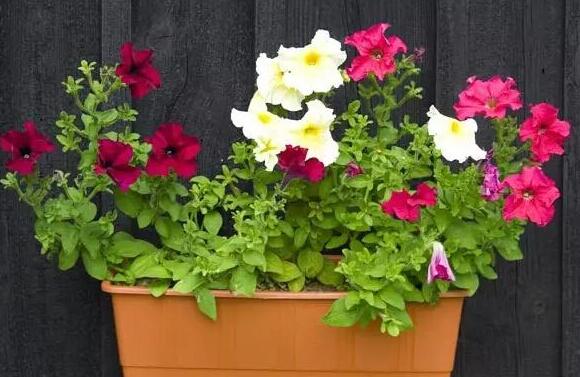
Before planting petunias, flower enthusiasts need to first understand their growth habits. Petunias prefer warmth, ample light, and moist soil. They are not cold-tolerant, not waterlogging-tolerant, and not drought-tolerant, so attention should be paid to reasonable watering while also ensuring the soil is fairly fertile. Below, let us learn about their care techniques together.
Petunia planting methods
1. What soil to use for petunias
1. Garden soil + peat soil: Since petunias like fertile, loose soil, we can mix garden soil and peat soil in a 1:1 ratio, and we can also add some organic fertilizer to increase its nutrient content.
2. Peat soil + leaf mold + vermiculite: Leaf mold is one of the soils many plants like, but to ensure the soil is looser, some vermiculite can be added. The ratio of the three is 40%, 40%, and 20%. If you want to add base fertilizer, you can appropriately add some bone meal.
3. Rice husk ash + peat soil: The ratio of the two is 2:1, and some compound fertilizer or soybean cake powder can also be added. Stir them evenly before use. The rice husk ash can be replaced with garden soil. Before use, the soil is best soaked with carbendazim or potassium permanganate solution, which can prevent and control pests and diseases.
2. Light conditions
Petunias prefer an environment with ample sunlight, but in summer they need shade. So regarding light, how do you grow petunias? The answer is to ensure ample sunlight in spring, autumn, and winter, with at least 12 hours of sufficient light each day, while in summer avoid overly strong light.
3. Suitable temperature
In petunia planting methods, the most suitable temperature is 13-18 degrees. In winter, keep the temperature at 4-10 degrees. If it is below 4 degrees, growth will stop, and prolonged low temperatures may cause the plant to suffer frost damage. As for high temperatures, petunias can withstand temperatures above 35 degrees, but during cultivation, prolonged high temperatures should be avoided as much as possible.
4. Watering method
When petunias are growing vigorously, sufficient water must be ensured. In summer, water once in the morning and once in the evening. During the rainy season, drainage and waterlogging prevention should be done well. If the soil is often too wet, the branches and leaves may grow excessively, and the flowers may also easily wither and fade early. Therefore, ensure the soil is neither too dry nor too wet.
5. Propagation methods
Petunias generally use two common propagation methods, namely cuttings and sowing. For cuttings, healthy branches are used as cuttings, carried out in spring or autumn. For sowing, relatively plump and mature seeds are needed. Germination generally takes about 2 months, and under normal circumstances, from sowing to flowering takes about 100 days.
6. Pest and disease control
Petunias are prone to damage from white mold disease, aphids, and other pests and diseases. If white spots are found on the leaves and the leaves fall off early, promptly spray pesticides such as chlorothalonil. For aphid control, use omethoate emulsion to kill them.
Precautions for petunias overwintering
1. Keep warm and maintain humidity: As mentioned earlier, when the temperature is below 4 degrees, the growth of petunias will be inhibited. But in order to let them successfully enter dormancy, in winter you must both keep them warm and prevent the temperature from being too high. Maintaining 4-10 degrees is relatively suitable. At the same time, ensure moderate humidity, not too dry.
2. Remove dead leaves: After the temperature begins to drop, some old leaves on the petunia plant will turn yellow and wither. They can be removed before they naturally fall off. This can both prevent and control pests and diseases and make the petunia plant shape more attractive, allowing it to still display its ornamental value in winter.
Petunia planting methods
Petunias could be called the king of herbaceous flowers, and they are practically a must-grow variety for flower enthusiasts. Indeed, petunias are a plant that is easy to grow and quick to show results, with a full range of flower colors, abundant blooms, continuous flowering, and resistance to both cold and heat. The planting method for petunias is actually very simple, please read on:Sowing: In this autumn sowing, I sowed Easy Wave mixed colors, with 4 out of 5 germinating, and Opera Ice Lilac 4 out of 5. The soil used was Fafard peat sowing soil, and a little perlite and vermiculite can be added appropriately to increase air permeability; otherwise, peat retains water too well and can easily smother the seedlings yellow. Petunias need light to germinate, so place them on a south-facing windowsill, in a spot without direct harsh midday sun, and remember the water in the seedling tray must be sufficient, maintaining 100% humidity.
Fertilizing: Petunias like fertilizer, and the difference between using and not using fertilizer is huge. My experience is: after 4 true leaves appear and up to the temporary planting stage (when the roots have filled the small cells of the seedling tray), apply Peters Professional 2000 times dilution once a week. From temporary planting to final planting, apply Peters Professional 1500 times dilution once a week, and when temporary planting, a little slow-release fertilizer can be added appropriately. From final planting to the stage when the plant is full, apply Peters Professional 1000 to 1500 times dilution twice a week (the concentration increases with the size of the plant). Add sufficient base fertilizer when final planting. From the bud stage to the full bloom stage, mix Peters Professional and Peters Professional Bloom at 1000 times dilution and fertilize twice a week. Sometimes petunias lack iron, so a little ferrous sulfate can be added.
Pinching and pot selection: To form a flower ball, you must pinch!! As for how to pinch, in Maomao's words: cut evenly along the edge of the pot! Don't be soft-hearted, don't feel sorry, decisively snip!! You can't catch the wolf without risking the child, after all. For the specific implementation of pinching, you still need to refer to Maomao's amazing post. I feel I haven't fully mastered it yet... As for the pot, 20cm-25cm with one plant per pot is always right.
Watering and sunlight: Petunias love to drink water, and once they have drunk their fill, they are not afraid of sun! But you must absolutely remember to give them sun!! If there is not enough sun and you want to form a flower ball, it will test your pinching technique. During autumn sowing, once petunias have four true leaves, they can receive full sun, provided there is still enough water. My approach was to put them directly on the terrace from the moment they germinated, but after all, autumn temperatures are not high, and I always kept enough water in the bottom tray of the seedling box.
Recommended varieties: Easy Wave White and Purple-red, not recommending Easy Wave Blue-purple! Opera Ice Lilac's flower color is indeed beautiful, but Opera likes to grow sideways and easily becomes a frying pan shape. Still, planting two together gives a pretty good effect (34cm diameter semicircular wall-mounted pot, as shown in the picture).
Pesticide use: Petunias will get whiteflies and leafminers; just use a little Huhuashen. Summary: In this autumn sowing, petunia cultivation cannot be considered very successful. Of a total of 7 pots of petunias, only four formed balls. This is related to both variety and technique. No matter what, still remember that growing petunias requires a large pot, plenty of water, + plenty of fertilizer (light fertilizer applied frequently), daring to prune, and daring to sun = ruthless and heavy-handed~!! Most important: read Maomao's amazing post more!!