What to Do When Anthurium Leaves Turn Yellow? 5 Tricks to Keep Leaves Evergreen
Anthurium leaves should normally stay evergreen year-round, but if the cultivation method is improper, yellowing will occur. So what should you do when anthurium leaves turn yellow? This is something everyone who grows anthuriums should know. Today, the editor will give you the answer.
What to Do When Anthurium Leaves Turn Yellow
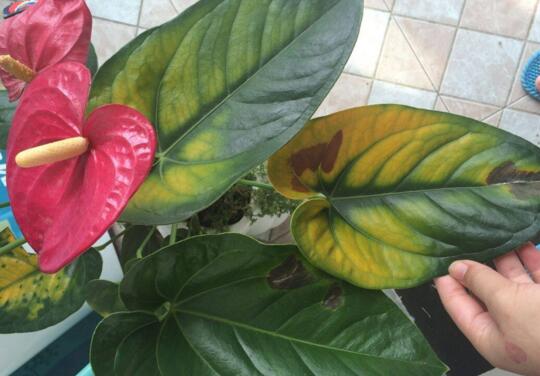
Statistics show that many people have encountered yellowing leaves when growing anthuriums. What should you do when anthurium leaves turn yellow? Finding the cause is crucial, and the main causes are watering, fertilizing, lighting, temperature and so on, so the solutions differ accordingly.
1. Improper Watering
1. Too much watering
Most plants will show poor growth when overwatered, because too much water can cause waterlogging in the potting soil. When roots are soaked in water for a long time, their respiration is affected, nutrients cannot be absorbed properly, and the leaves turn yellow.
What to do: If yellowing anthurium leaves are caused by overwatering, what should you do? Reduce the frequency and amount of watering. We have previously described anthurium watering methods in detail in "How to Water Anthurium." The principle is to keep the potting soil from drying out completely while avoiding waterlogging.
2. Too little watering
If you understand the growth habits of anthurium, you will know that it likes a humid environment. Too little watering obviously cannot create such an environment; instead, the soil becomes compacted and lacks moisture, resulting in yellow leaves.
What to do: Increase watering frequency according to growth needs and climate changes. Keeping the potting soil moist is what allows it to grow well.
2. Fertilization Problems
1. Too little fertilizer
Long-term under-fertilization leads to yellow leaves. This phenomenon is called "yellowing from nutrient deficiency." The leaves look lusterless and weak, and appear very thin.
What to do: Supplement fertilizer to restore normal growth. You can apply additional phosphorus or potassium fertilizer, but be careful not to over-fertilize.
2. Too much fertilizer
When too much fertilizer is applied, it can burn the roots, and then the leaves turn yellow. This phenomenon is not common, but if you do not pay attention to fertilizing methods, you may encounter it.
What to do: Promptly remove excess fertilizer. You can use a large amount of clean water to flush the soil in the pot to dilute the fertilizer solution.
3. Lighting Problems
1. Lack of light
Although anthurium likes a semi-shady environment, long-term lack of light results in yellow leaves, because it lacks the necessary photosynthesis and chlorophyll production is suppressed.
What to do: If yellowing anthurium leaves are caused by lack of light, what should you do? The answer is to increase light. You can care for it in a place with scattered light or relatively sufficient sunlight.
2. Exposure to direct sunlight
Not all plants are highly sun-tolerant. If anthurium is exposed to direct sunlight, its leaves will shrivel and turn yellow. This is a natural phenomenon.
What to do: Move the anthurium to a shady place or provide shade for it. Blocking more than 70% of sunlight will prevent this problem.
4. Soil Problems
The soil should contain the nutrient elements necessary for anthurium growth. If it lacks iron, the leaves will turn yellow. In addition, poor soil aeration can also cause this problem.
What to do: When choosing soil, use fertile soil with good aeration. You can also apply additional fertilizer or loosen the soil regularly to prevent soil compaction.
5. Dry Air
Anthurium likes a relatively humid environment. If the air is too dry, it will not only affect its normal growth but also cause yellow leaves.
What to do: Dry air is a climate issue, so if anthurium leaves turn yellow for this reason, what should you do? We can artificially increase air humidity, for example by misting the anthurium with water.
What to Do When Anthurium Leaves Are Dry and Have Holes in the Middle
1. Cause
Dry, holey patches in the middle of leaves are generally caused by lack of light. For example, if anthurium is in a dark environment, the leaves will dry out and then develop holes in the middle. It must be dealt with promptly.
2. What to do
For minor holes, you can apply medication, such as gentian violet, and then place it in a ventilated place for care. If it is more serious, you need to cut off the leaves and then place it in a place with sufficient light for care.
What Causes Anthurium Leaves to Turn Yellow with Scorched Edges and Dry Up?
If the leaves not only turn yellow but also have dry edges, the cause is generally bacterial or fungal infection, which is what we commonly call pests and diseases. You can use a sprayed 0.3% garlic juice solution, 0.2% vinegar, or specialized agents such as carbendazim or chlorothalonil for treatment.
How to Grow Hydroponic Anthurium - What to Do When Hydroponic Anthurium Leaves Turn Yellow
Anthurium has emerald-green leaves and brilliantly colored flowers, and hydroponic anthurium looks even more ornamental. However, hydroponic anthurium has relatively high requirements and is prone to yellowing leaves during cultivation. So how should we grow hydroponic anthurium? Below, we introduce knowledge related to hydroponic anthurium cultivation.
How to Grow Hydroponic Anthurium
1. Transplanting. Dig the potted anthurium out of the soil, cut off rotten roots, fine roots and old leaves, wash the roots clean with clean water, place them in a potassium permanganate solution for disinfection, and then rinse the anthurium again with clean water. If using a transparent glass container for hydroponic anthurium, it is best to cover the outside of the glass with a black plastic bag to prevent strong light. Cover the top with a transparent convenient bag (to keep warm and moist). Place it in a place with scattered light and keep the temperature above 10°C.
2. Changing water. During acclimation, change the water frequently: every 3 days for the first half month, and once a week for the second half month. Each time you change the water, add nutrient solution once, and choose a nutrient solution specially made for hydroponic flowers. After one month, the anthurium will grow new roots, and the newly grown roots will be relatively adapted to the aquatic environment. The leaves will begin to sprout new buds.
Later, because the roots of anthurium respire very strongly, you must regularly change the water for the anthurium, remove the mucus secreted by the anthurium roots and some algae, and prune old and rotten roots. This also helps increase the dissolved oxygen content in the water. Generally, change the water every 2 to 3 days; in winter, once a week. Add nutrient solution once with each water change.
For acclimated hydroponic anthurium, you can change the water according to actual conditions. When there are many impurities in the water, it should be changed. After a period of time, also clean the hydroponic flowerpot. Do not add nutrient solution too frequently, because it will cause eutrophication of the water, accelerate the reproduction of microorganisms in the water, and cause the oxygen content of the water to drop sharply, which is not conducive to plant growth.
3. Potting hydroponic anthurium. If the hydroponic flowerpot is semi-transparent, it will be a bit easier. Carefully put the anthurium roots into the hydroponic basket; river stones or ceramsite can be placed in the basket to fix the plant's position. Add water to half or 2/3, so that roots not submerged in water can still breathe from the air. When growing hydroponic anthurium, just immerse 1/2 of the anthurium root system in water and leave the other roots exposed to the air so that the anthurium roots can breathe. Insufficient dissolved oxygen in the water will cause anthurium root rot.
4. Light and temperature. Anthurium likes a warm, semi-shady environment and avoids direct sunlight. During hydroponic anthurium cultivation, pay attention to the placement position; it is best to place it in a ventilated place that also avoids strong light. In summer, the ambient temperature around hydroponic anthurium should not be higher than 28°C; in winter, the cultivation temperature for hydroponic anthurium must not be lower than 14°C. Below this temperature, the anthurium will suffer cold damage.
5. If you use a larger flowerpot for hydroponic anthurium, you can also keep small fish in the water. Plants and fish benefit each other and form a corresponding scene. It can be said to serve two purposes at once.
What to Do When Hydroponic Anthurium Leaves Turn Yellow
Causes of Yellowing Leaves in Hydroponic Anthurium
In fact, the most important thing for hydroponic anthurium is water. Most of the plant's nutrients are obtained from the water, and some nutrients are accumulated through photosynthesis. If water is not added in time to the hydroponic container, the nutrients in the water are insufficient, or the light is insufficient, any one of these will cause anthurium leaves to turn yellow.
Solutions for Yellowing Leaves in Hydroponic Anthurium
1. Add water in time
Frequently check the water level in the hydroponic container. When the water level is lower than 1/3 of the roots, replenish water in time. As long as there is enough water in the hydroponic container, there is no need to spray water on the leaves every day. If the leaves are dirty, gently wipe them with a damp cloth.
2. Add nutrient solution at the right time
For hydroponic anthurium, how often to change the water does not matter much; the key is to control the nutrient solution content in the water. As time goes on, the water will be absorbed by the plant, and the daily process of adding water has actually already completed the step of changing the water.
Therefore, to ensure sufficient nutrients in the water, drip a few drops of nutrient solution when adding water to the container. As for exactly how many drops, you can be flexible according to the anthurium's growth. At minimum, drip two drops each time, then observe the plant's growth. If normal, maintain the original amount; if growth is poor, add appropriately.
3. Supplement sunlight
Compared with soil cultivation, hydroponic anthurium needs more sunlight. Ensure 2 to 3 hours of direct sunlight each day (avoid direct sunlight at noon). In winter, more sun exposure can prevent the branches and leaves from becoming weak and yellow.
The above is the related knowledge introduced for everyone about hydroponic anthurium cultivation. We hope it can help everyone. For more home knowledge, please stay tuned.
What to Do When Anthurium Leaves Turn Yellow_How to Handle It?
Some people who grow anthuriums encounter yellowing leaves. The originally green leaves turning yellow not only affects the appearance, but also makes people worry whether the anthurium will die.
So do you understand why your anthurium leaves are turning yellow? Today, the editor will introduce what to do when anthurium leaves turn yellow.
Stylish ornaments make a space different! Classic home art! Click to view>>
.....
Before understanding what to do when anthurium leaves turn yellow, let us first introduce anthurium. Anthurium is a perennial evergreen herbaceous flower. Its plant height is generally 50 to 80 cm, varying by variety. It has fleshy roots and no stem. Leaves emerge from the rhizome, have long petioles, are solitary, heart-shaped, bright green, with sunken veins.
.....
.....
Anthurium flowers are axillary, with a waxy spathe, from perfectly round to ovate, bright red, orange-red flesh-colored, or white, with a spadix, cylindrical, upright, blooming in all seasons. The leaves and stems have a peculiar shape. The leaves are dark green, heart-shaped, thick and tough. The spadix is long and pointed, in bright red, white or green, surrounded by a red, pink or white spathe. All parts are toxic.
.....
.....
Before understanding what to do when anthurium leaves turn yellow, you first need to figure out why your anthurium leaves are turning yellow. Generally, anthurium leaf yellowing is caused by the following reasons:
1. Yellowing anthurium leaves are mainly caused by root rot due to too low temperature.
2. Too much fertilizer and water, because excessive fertilizer application causes metabolic disorders in the anthurium.
3. Excessive watering can also cause anthurium leaves to turn yellow and affect their ornamental value.
4. Excessive light will cause anthurium leaves to turn yellow and lose their luster, and will also lead to slow growth, short petioles, small leaves, and curling that does not spread out.
5. Vigorous growth without flowering is generally caused by placing it in too dark a location or applying too much nitrogen fertilizer.
.....
.....
So what should you do when anthurium leaves turn yellow? Too much watering, lack of sunlight and so on can all cause anthurium leaves to turn yellow. We need to treat the root cause.
1. When yellow leaves appear on anthurium, pay attention to checking for root rot. Once there is root rot, cut it off in time.
2. Excessive watering or excessive light can easily cause yellow leaves and curled edges. Pay attention to adjusting the position of the potted plant.
3. Anthurium has wide leaves and large flowers, so when misting, also wipe the flowers and leaves at the same time. Keeping them fresh and clean is the key to a beautiful plant.
4. Anthurium flowers are slightly toxic; the toxin mainly comes from the sap. Never ingest them by mistake, and wash your hands after each care session.
5. Anthurium is best grown outdoors, or in a well-ventilated corner that is not easily touched.
.....
.....
Now that we understand what to do when anthurium leaves turn yellow, the editor will finally teach everyone how to pair anthurium. Anthurium combines the three bright colors of red, green and yellow, rich but not monotonous, colorful but not cluttered. Use the vibrant anthurium to complement other green plants and echo one another.
.....
.....
In this way, you can create a tranquil space, allowing you to comfortably spend a quiet moment and experience the various flavors you most desire in life. Indoors alone, with only friendly wooden furniture, wallpaper, fabric, tableware and green plants carefully matched, you can complete a pleasant picture comparable to outdoor pastoral life.
.....
Anthurium has a unique appearance, emerald-green leaves and beautiful flowers. It is a spathe flower with bright and gorgeous colors and rich hues, and is a precious flower worldwide. Today, the editor's introduction on what to do when anthurium leaves turn yellow ends here. Thank you all for reading.