When Does Marigold Bloom? Marigold Blooming Season Care / Blooms July-September, a 3-Month Blooming Period
Marigold is a highly ornamental plant that can be seen in many gardens across our country. When it comes to the marigold's most ornamental moment, it is certainly when it blooms. So when does marigold bloom? And how should marigold be cared for during its blooming season? Let me walk you through it below.
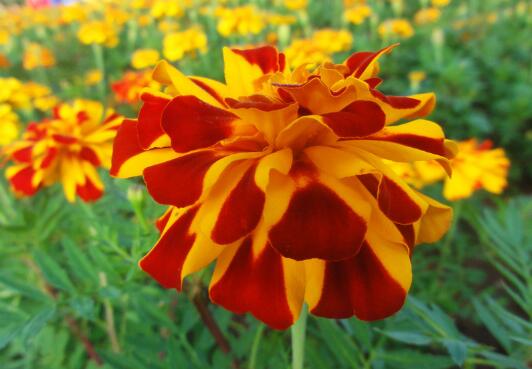
I. When Does Marigold Bloom
As for when marigold blooms, it is generally around July each year, and its blooming season is usually from July to September. Among flowering plants, the marigold's blooming season is relatively long. However, if you want its flowers to bloom more brilliantly, care during the blooming season cannot be careless. A detailed guide to marigold blooming season care is provided below; those who are unfamiliar with it can take a look.
II. Marigold Blooming Season Care
1. Fertilizing During the Blooming Season
Marigold consumes a large amount of nutrients when blooming, so sufficient fertilizer must be applied before flowering so that it can produce more flowers. Fertilizer also cannot be stopped after flowering begins; regular fertilizing is essential. For specific fertilizing methods, you can refer to the article on how to fertilize marigold, and I will not go into too much detail here.
2. Pay Attention to Temperature Control
During marigold blooming season care, temperature control is a very important point. The suitable environment during the marigold's blooming season differs from that during its growing period, and the requirements are relatively stricter. Generally, it is best to keep the temperature at around 18-20°C.
3. Watering Management
The marigold's blooming season is in summer each year. Temperatures are higher in this season and water evaporates relatively quickly, so watering must be done frequently, basically every day. If water is insufficient, it can easily cause the flowers to wither prematurely, so everyone must remember this point.
4. Light Management
During marigold blooming season care, light is also indispensable. Marigold is a light-loving plant, so it is best to maintain sufficient light, which also allows it to carry out photosynthesis better and makes the flowers bloom more brilliantly.
When Does Marigold Bloom? Which Months Are the Marigold Blooming Season
Just hearing the name marigold gives people a feeling of blessing life. A blooming marigold is a very beautiful plant, with large and brightly colored flowers, so it is often used in flower beds, garden landscaping, and more. During the blooming season, looking at those neat rows of blooming flowers, one's mood is surely wonderful. So when is the marigold's blooming season?
When Does Marigold Bloom
Under normal circumstances, the marigold's blooming season is in summer and autumn, normally between July 10 and September 25. The male stamens at its flower center are generally partially open or not open at all.
Because technology is now very mature and they can be sown year-round, their blooming time is no longer fixed. Generally, if sown in spring, the blooming season is in summer; if sown in summer, the blooming season is in autumn.
Which Months Are the Marigold Blooming Season
Marigold sown in open ground in April blooms from June to October. It is currently commonly used as an off-season flower supply, and greenhouse cultivation has extended the blooming season; generally, it blooms 70-90 days after sowing.
The Value of Marigold
1. Landscape Value
The marigold plant is not tall, blooms brilliantly and is very beautiful, possessing certain ornamental value, and is often used as an ornamental flower. Marigold can be grown in pots for viewing, or planted individually to appreciate the flower shape and color. It can also be placed at home, where the distinctive odor it gives off can drive away flies.
Because the marigold plants are relatively uniform, grow well, and are easy to manage, they are often used as lawn accent flowers, and can also be used in flower beds as mosaic flowers to form shapes, very neat and uniform. In addition, marigold can be used as cut flowers for water culture and can last a long time, making it an excellent fresh cut flower material. It can also be planted in strips as a hedge, or used as background material.
2. Medicinal Value
Marigold has certain medicinal value; the flowers, roots, and leaves can all be used as medicine. The root of marigold has the effect of detoxifying and reducing swelling. The leaves are used for carbuncles, sores, boils, and ding sores, and unnamed swellings and toxins. The flowers mainly soothe the liver and relieve heat, dispel wind and resolve phlegm. They can generally treat dizziness, head wind and eye pain, infantile convulsions, cold and cough, whooping cough, breast pain, and mumps.
Marigold petals used to make tea can reduce swelling and remove toxins, treat human respiratory tract infections, and achieve a strong heat-reducing effect. Secondly, marigold used as medicine can lower blood pressure and has effects such as anti-inflammatory disinfection and reducing edema.
3. Other Value
Marigold flowers are fragrant and can be made into aromatic agents. Marigold is called stinking roger because it has a distinctive odor that can drive away swarms of flies. Marigold is rich in lutein. Lutein is a natural pigment with certain medical and health benefits; for this use, marigold is used as a natural raw material for producing lutein.
Marigold Fertilizing Methods
1. Care Methods
Marigold is generally sown in spring, with 3 seedlings placed in each flower pot, and organic fertilizer scattered in the pot as base fertilizer. During the growth period, watering must be sufficient, and after about 7 days it can be placed in a sunny spot. During the growing period, apply liquid organic fertilizer or compound fertilizer once every half month, and fertilizing can be stopped once the blooming season arrives; just keep the soil moist and breathable.
2. Seedling Stage
When fertilizing, attention should be paid to the ratio of organic fertilizer to inorganic compound fertilizer; do not apply only one kind of fertilizer, as uneven application can easily lead to fertilizer deficiency in the middle and late stages. Combine organic fertilizer with inorganic fertilizer, increase the total amount of phosphorus, potassium, and nitrogen fertilizer, but note that nitrogen fertilizer should be applied in split doses.
The base fertilizer at the seedling stage should be applied deeply, choosing soil with good drainage and aeration and a deep, loose soil layer; afterward, no further fertilizing may be needed. When the growing period arrives, fertilize with small amounts but frequent applications to meet growth needs.
3. Full Bloom Stage
During the marigold full bloom stage, additional fertilizing can be carried out, and spraying at around seven in the evening is best. For large-scale marigold planting, turn and harrow the soil layer about 20cm so that the surface soil is not only fine and crumbly but also soft, keeping the field surface level. Apply a set amount of organic fertilizer per mu, and cover and harrow the fertilizer as base fertilizer.
As described above, the marigold's blooming season is generally in summer or autumn, but due to current technological development, its blooming season is often artificially regulated, so you can often see stretches of golden marigold flower seas.
How Long Is the Marigold Blooming Season? How to Control the Marigold Blooming Season
Marigold has strong growth vigor, tolerates transplanting, is easy to cultivate, and grows quickly. It is widely used in flower bed landscaping, and many friends like to grow it for viewing. So how long is the marigold blooming season? How do you control the marigold blooming season?
I. The Marigold's Blooming Season
Marigold usually blooms only in summer and autumn, but current technological development allows artificial control of the blooming season so that they bloom at the needed time. At the Yanqing Four Seasons Flower Sea landscape base, over a thousand mu of marigolds bloomed, with the blooming period two weeks earlier. Learned from the Beijing Municipal Bureau of Agriculture Agricultural Technology Extension Station that marigold is a landscape economic crop with excellent performance in the landscape agriculture construction of the Beijing suburbs over the past two years, with an ornamental period of up to 80 days. It is reported that more than 3,000 mu of marigolds bloomed two weeks earlier, allowing two more harvests of flowers than in previous years, with raw material flower output increasing by more than 500 tons. Moreover, the blooming season can be enjoyed from mid-July all the way to the "National Day" holiday.
II. How to Control the Marigold Blooming Season
Marigold should be sown indoors in late March, and seedlings will emerge quickly at a room temperature of 20°C. When the seedlings grow 3 true leaves, immediately separate the seedlings into pots or plant them in a courtyard flower bed, and they can bloom in early to mid-June. To make them bloom in July and August, cut 10cm-long tender branches from spring-sown plants in late May and insert them into plain sand, keep them shaded for care, roots can be expected after 10 days, and they can bloom after one month. Calendula for National Day display should be sown in late July and can all bloom after 50-60 days.
Marigold itself has a very long blooming season, but in the later growth stage the plants tend to lodge, and the leaves age and turn brown, which detracts from the ornamental effect. If spring-sown seedlings are not propagated in stages to bloom year-round, then spent flowers should be removed promptly, overly dense stems and leaves should be cut off, and fertilizer and water management should be strengthened at the same time, so that new flowering branches can sprout after autumn.
The above isthe marigold blooming seasonrelated introduction. Friends who like marigold should not miss it; only by understanding the marigold blooming season can you better appreciate it.