What to do when anthurium flowers wilt? Six tricks to bring them back from the dead, except for natural wilting
Anthurium flowers are bright red and look like a palm. Although they are very beautiful and highly ornamental, they also wilt very easily. After blooming, if care is improper, they will wilt and fade within a short time. So what should you do when anthurium flowers wilt? The editor will teach you six commonly used methods.
What to do when anthurium flowers wilt
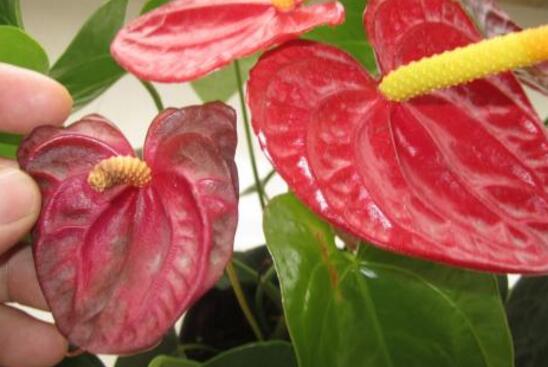
Normally, the flowering period of anthurium can last more than 1 month, and with correct care it can last 4-6 months. However, if the following situations occur, it may wilt prematurely, such as temperature being too low, too little fertilizer, humidity being too low, and so on. If anthurium flowers wilt, what should you do? Six methods can help anthurium return to normal.
1. Increase light
When anthurium flowers wilt prematurely, you can move them to a place with sufficient light. If anthurium is grown in a place that is too dark, it will wilt quickly after blooming because photosynthesis is poor.
2. Raise the temperature
Keeping the temperature between 15-25 degrees can make anthurium flowers last for several months. Even water-cultured anthurium can be enjoyed for more than 1 month after blooming. One of the main reasons anthurium flowers wilt is that the temperature is too low.
3. Prevent pests and diseases
The prevention of pests and diseases should start from every little detail of daily anthurium growing. For example, do not let it be exposed to strong sunlight, and do not leave it for a long time in a place without ventilation and with low humidity. Once disease appears, corresponding measures should be taken promptly.
4. Fertilize frequently and pay attention to the amount
Experts suggest that when growing anthurium flowers, fertilizer should be applied once every 15-20 days, and if time is limited it can be adjusted to once every 1 week. The amount of fertilizer each time does not need to be too much. Ensuring that anthurium flowers have enough fertilizer can avoid the situation of flowers wilting.
5. Increase air humidity
If it is grown indoors, attention should be paid to changes in humidity, because too low humidity will affect the growth and flowering of anthurium and will also cause flowers to wilt. At this time, what should you do when anthurium flowers wilt? Increasing air humidity is the main method. You can use a humidifier or spray water on the leaves.
6. Increase the frequency of watering
Although the frequency of watering after blooming is less than during the growth stage, the soil still needs to be kept moist throughout the flowering period. To avoid premature wilting of the flowers, you can slightly increase the frequency of watering, for example once every 3-4 days, as long as there is no water accumulation.
What to do when anthurium flowers curl up
Sometimes we also encounter the situation where anthurium flowers curl up. In addition to trying the six methods above, you can also try pruning the anthurium, cutting off the branches, leaves, and flowers that have wilted or curled due to metabolism. This can prevent nutrients from being absorbed by dead leaves and can improve the situation of curled leaves.
Fresh flower care | How to let flowers drink their fill of water?
If you like growing and arranging flowers, do you often encounter situations like this:
A bouquet has only been kept for two or three days, and the flower heads begin to droop;
The petals look wilted and fall off at a touch;
Just like the picture below:
The reason this happens is mostly:
The flowers have not drunk their fill of water
So they wilt faster, and the life of the flowers shortens sharply
How can you let flowers drink their fill of water and maintain longer vitality?
Today the editor will teach you a few simple little tricks to bring your flowers back from the dead.
Preparation before flowers absorb water
[Remove petals and leaves]
To protect the flowers, the flowers that are delivered generally have more leaves left on the stems, and the outer petals are also left as a protective layer;
Therefore, before arranging the flowers, be sure to remove excess leaves and damaged outer petals so that water absorption is more efficient.
Reason: Too many green leaves will make fresh flowers demand more water, and water will also be lost faster. To ensure that the flowers have sufficient water, unnecessary leaves must be removed.
Note: Carefully remove leaves from the base with your fingers
[Cut the stems at an angle]
When fresh flowers are first received (or before changing the water), the stems must be cut to give the flower stems a new cut. The water absorption of the entire fresh flower depends entirely on this brand-new cut. If the cut is blocked, water cannot reach the flower stems, and the flowers will naturally wilt faster.
Generally, fresh flowers can be cut at a 45-degree angle;
If the flowers are relatively wilted, or if the weather is hotter, you can cut at a 60-degree angle to give the flower stems a larger water-absorbing surface.
Underwater cutting method
Put water in a bucket, immerse the flower stems in the water, use flower scissors to cut underwater, and then take them out after soaking for 10-20 minutes.
Cutting the flower stems underwater will make them feel pressure, which helps retain water. If it is running water, there is no pressure effect, and water cannot be absorbed more effectively.
Deep water method
When flowers clearly show signs of water shortage, the deep water method can be used.
Wrap the bouquet well with newspaper, let the flower stems extend about 5 cm beyond the newspaper, and then soak them in water. The water level should be fairly close to the flowers. Observe the appearance of the flowers and soak for about 10 minutes to 1 hour.
The deep water method can allow flowers that have been cut underwater to transport water more sufficiently to all parts of the flower. For flowers whose water needs cannot be met by simply using the underwater cutting method, the deep water method can be used.
How can you tell whether a flower material is suitable for the deep water method?
Varieties with glossy leaves and firm stems are more suitable: iris, anthurium, clematis, peony, rose, Chinese peony, and others are all suitable.
However, varieties with narrow leaves and soft stems are not suitable for this method. All chrysanthemum species as well as love-in-a-mist are not suitable.
In addition, the leaves and flowers of multi-headed flowers easily evaporate water, so wrap them well with newspaper, and be careful not to let the water cover the flowers.
▼
Have you got these methods?
Next time you receive fresh flowers, be sure to remember to let them drink their fill of water, so they can bloom longer!