How to grow Anthurium in water? Changing the water and water temperature are key
Anthurium is a plant that loves humid environments, so many people want to grow it in water. So can Anthurium be grown in water? How should Anthurium be grown in water to do well? Today, the editor will teach you the hydroponic method for Anthurium, as well as the daily care after hydroponics.
Can Anthurium be grown in water?
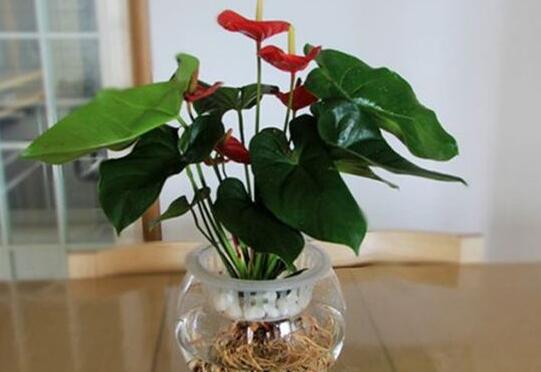
Among the functions and benefits of Anthurium, we have learned that Anthurium is a hydrophilic plant, so it can be grown in water. However, because it has relatively high requirements for water quality and fertilizer, hydroponics is somewhat difficult. If you do not understand the hydroponic method for Anthurium, the survival rate is relatively low.
Hydroponic method for Anthurium
1. Choose a container
For hydroponic Anthurium, it is best to choose an opaque or semi-transparent container, because it likes a semi-shaded environment. If a transparent container must be used, it is best to wrap a layer of black plastic film on the outside to avoid strong light shining directly on its roots and affecting root growth.
2. Choose an Anthurium plant
Take a robustly growing Anthurium out of the pot soil, cut off rotten roots, fibrous roots and old leaves, then wash the roots clean with clean water. You can use potassium permanganate solution to disinfect the roots to prevent pathogens from infecting the Anthurium during hydroponics.
3. Potting
Put the roots of the Anthurium into the hydroponic basket. River stones or ceramsite can be added to fix the position of the plant. Add water to half full; it is enough to let two-thirds of the roots be submerged in water.
How to grow hydroponic Anthurium
After hydroponics, Anthurium will go through several stages, mainly the acclimation period, growth period, and so on. Therefore, after using the hydroponic method for Anthurium, how to care for it later is very important. Improper care will lead to a relatively low survival rate.
1. Changing water
During the acclimation period, the water should be changed frequently. In the first 15 days, change the water once every 3 days; in the latter 15 days, change the water once a week. Each time you change the water, you can add nutrient solution until new roots grow out and new shoots begin to appear.
2. Maintain water temperature
Anthurium has relatively particular temperature requirements for growth. It likes a high-temperature environment, so hydroponic Anthurium should keep the water temperature above 15 degrees as much as possible. The water temperature must not be too low, otherwise it will affect root development.
3. Pruning
When Anthurium is grown in water, because the roots are soaked in water for a long time, root rot is relatively likely to occur, so attention should be paid to pruning it regularly, which can benefit the growth of new roots.
Hydroponic Anthurium Anthurium andraeanum Hydroponic Anthurium guide: How to grow hydroponic Anthurium / How to propagate hydroponic Anthurium
Hydroponic Anthurium profileHydroponic Anthurium Anthurium andraeanum
Aliases: Huazhu, Anzuhua, Huohehua, Hongezhang
Classification: Aquatic flowers
Family and genus: Plantae, Angiosperms, Monocotyledoneae, Araceae, Anthurium
Full bloom period: All seasons
Hydroponic Anthurium is a plant with relatively strong hydrophilic properties. However, hydroponics is slightly difficult. It is a flower plant from South America, and by nature likes warm, humid, semi-shaded environments. Hydroponic Anthurium originated in the tropics of South America, and is now widely cultivated in Europe, Asia, and Africa. Contents.
Cultivation methods and precautions for hydroponic Anthurium Introduction to hydroponic Anthurium
Hydroponic Anthurium is a plant with relatively strong hydrophilic properties. However, hydroponics is slightly difficult. It is a flower plant from South America, and by nature likes warm, humid, semi-shaded environments.
Hydroponic Anthurium originated in the tropics of South America, and is now widely cultivated in Europe, Asia, and Africa. Contents.
Morphological characteristics of hydroponic Anthurium Roots and stems
Hydroponic Anthurium is a perennial evergreen herbaceous flower. Its plant height is generally 50-80 cm, varying by variety. It has fleshy roots and no stems.
Leaves
The leaves of hydroponic Anthurium emerge from the rhizome, have long petioles, are solitary, heart-shaped, bright green, with sunken veins.
Flowers
The flowers of hydroponic Anthurium are axillary. The spathe is waxy, from perfectly round to ovate, bright red, orange-red flesh-colored, or white. The spadix is cylindrical and upright.
Hydroponic Anthurium blooms in all four seasons.
Ecological habits of hydroponic Anthurium
Anthurium likes an environment with relatively high humidity. The humidity mentioned here refers to the relative humidity in the air, not only the water content in the planting medium. Humidity is also a variable, because when humidity rises and dry winds increase (especially in northern China), if water is not supplemented, the humidity will decrease. Generally speaking, the humidity required by Anthurium should preferably be maintained at 70%-80% (temperature 20-28°C). The level of humidity can regulate humidity for Anthurium, that is, regulate the transpiration of Anthurium leaves.
If relative humidity is too low, it will cause drought and water deficiency, and the edges of leaves and spathes will dry up, and the spathes will be uneven. The water temperature for watering Anthurium should be maintained at about 15°C (including the nutrient solution used for watering). This is especially important in severe cold and extreme heat. The medium moisture should not be too wet, because Anthurium roots are semi-fleshy and store a large amount of water themselves. Too much water in the medium causes oxygen deficiency in the medium, obstructs root respiration, and long-term excessively wet conditions will cause root rot. You can use discarded cola bottles or mineral water bottles, fill them with tap water, let them sit for 3-4 days, then pour the water into a spray bottle and spray the leaf surfaces of Anthurium. In summer, spray once at 10:00-11:00 and once after 15:00, but the pH value of the sprayed water should be low.
Cultivation techniques for hydroponic Anthurium Hydroponic planting method
Before hydroponically growing soil-grown Anthurium, it must first be acclimated so that it grows new roots in water, and then it can be placed in water for hydroponics.
1. Dig the potted Anthurium out of the soil, cut off rotten roots, fibrous roots and old leaves, wash it clean with clean water, put it into potassium permanganate solution to disinfect, and then rinse the Anthurium again with clean water. If using transparent glassware for hydroponics, it is best to cover the outside of the glass with a black plastic bag to prevent strong light. Cover the top with a transparent convenience bag (to preserve heat and moisture). Place it in a place with scattered light, and keep the temperature above 10 degrees.
2. During acclimation, change the water frequently. At the beginning, change it once every 3 days for half a month, and once a week for the latter half month. Each time you change the water, add nutrient solution once, and the nutrient solution should be selected specifically for hydroponic flowers. After one month, Anthurium will grow new roots, and the newly grown roots will be relatively adapted to the aquatic environment. The leaves will begin to sprout new shoots.
3. Potting hydroponic Anthurium. If the hydroponic flowerpot is semi-transparent, it will be somewhat better. Carefully put the Anthurium roots into the hydroponic basket. River stones or ceramsite can be added to the basket to fix the position of the plant. Add water to half or two-thirds full; in this way, the roots not submerged in water can still breathe from the air.
4. For acclimated hydroponic Anthurium, the water can be changed according to actual conditions. When there are many impurities in the water, it should be changed. After a period of time, the hydroponic flowerpot should also be cleaned. Nutrient solution should not be added too frequently, because it will cause eutrophication of the water, accelerate the reproduction of microorganisms in the water, and the oxygen content of the water will drop sharply, which is not conducive to plant growth.
5. If a larger flowerpot is used for hydroponic Anthurium, small fish can also be kept in the water. Plants and fish mutually benefit each other and accordingly form a scene. It can be said to kill two birds with one stone.
How to manage
After adding nutrient solution, it should also be left to sit as above before use. On one hand, the chlorine in tap water can volatilize; on the other hand, water that has been left to sit can remain consistent with room temperature. Do not put the water left to sit in the sunlight, to avoid the formation of green algae. If cooled boiled water is used, it is also feasible. When growing Anthurium hydroponically, the speed of inducing new roots takes a relatively long time compared with plants such as Aglaonema. However, its root system has strong vitality. Once a hydroponic root system is formed, it is very easy to care for. Therefore, robust virus-free Anthurium plants should be selected. They can be disinfected with agricultural streptomycin and then acclimated with flower nutrient solution.
Disease control of hydroponic Anthurium
Anthurium sometimes shows premature flower aging, deformities, adhesion, splitting, vitrification and blue spots. These are mostly physiological diseases caused by improper management of fertilization, pot soil and air humidity, or by varietal reasons. The prevention method is to improve cultivation management, fertilize reasonably, and provide appropriate ventilation.
The main pests and diseases of potted Anthurium include bacterial wilt, leaf spot disease, root rot, Cylindrocarpon, Cylindrocladium, nematodes, red spider mites, aphids, lepidopteran pests, whiteflies, scale insects, snails, and so on.
Anthracnose
Anthracnose is one of the common diseases of Anthurium. The pathogen is fungi of the genus Gloeosporium or Colletotrichum. The former has symptoms of round brown lesions forming along leaf veins, after which the lesions connect to form large lesions with brownish-yellow edges, and the diseased part finally dries up. The latter is similar to the former, with black setae growing on the acervuli, and it can also cause flower rot, forming black necrotic spots on the spadix. High humidity is the main cause of this disease. The control methods are chemical control and strengthened cultivation management. It is necessary to ventilate and provide light frequently, avoid splashing water or air-conditioning condensate onto the leaves, and remove diseased leaves in time.
Red spider mite
Symptoms of red spider mite damage: mainly causing fading of leaves and flowers, affecting the commercial quality of leaves and flowers. Chemical control can be sprayed in the early stage of damage. Control agents include dicofol, tetradifon, omethoate, and cyhalothrin, etc.
Bacterial wilt
Bacterial wilt is a bacterial disease caused by Xanthomonas and can infect leaves and spadix. In the early stage of onset, water-soaked, semi-transparent irregular small spots form on the leaves, then turn black, with a bright yellow edge outside, and the area around the lesion loses green color. This pathogen can cause systemic infection, manifested as old leaves turning yellow, petioles breaking, and vascular bundles turning yellow. The control method is to strengthen cultivation management, supplement with chemical control, promptly remove diseased plant residues, and burn them. During cultivation management, reduce artificial wounds as much as possible, and reduce the use of ammonium nitrogen fertilizer as much as possible. Generally, agricultural streptomycin or streptomycin is sprayed in the early stage of onset.
Bacterial leaf spot
One symptom shown is on leaves and flowers: in the early stage, water-soaked spots can be seen on the back of leaves and flowers; later, brown spots appear on the leaf margins, accompanied by yellow halos. Another type is that bacterial infection begins on the stem and rapidly spreads to the entire plant by infecting cells through vascular bundles. In the early stage, it can be found that the color of new leaves is dull, because the vascular bundles are blocked by bacteria, hindering the flow of water and the transport of nutrients within the plant, making leaf color dull and leaves yellow. In a relatively short time, this type of infection will cause flower stalks and leaves to fall from the plant, and the growing point rapidly rots with bacterial ooze flowing out.
There is no specific cure for bacterial diseases, so prevention is mainly relied upon:
Environmental prevention
Strengthen the control of greenhouse temperature (the ideal reproduction condition for bacteria is around 30 degrees), the sanitary environment, and the movement of personnel and tools in the production area.
Fertilizer prevention
During plant growth, try not to use nitrogen fertilizer in high NH4 form. Remove or isolate diseased plants.
Leaf blight nematode disease is caused by infection by nematodes of the genus Aphelenchoides, mainly infecting roots and leaves. The symptoms are necrotic spots or brown spots forming along leaf veins, root swelling, and finally the entire leaf drying up. The control method is mainly to strengthen seedling quarantine, select robust seedlings, and properly disinfect the cultivation substrate.
Distribution area of hydroponic Anthurium
Hydroponic Anthurium originated in the tropics of South America, and is now widely cultivated in Europe, Asia, and Africa. Contents.
Medicinal or dietary therapeutic value of hydroponic Anthurium
The medical information and health dietary therapy information on Huahua Network is for reference only and cannot be used as a basis for diagnosis or medical treatment. For any health problem, consult professional medical personnel, and for the treatment of any disease, please follow medical advice.
Ultimate flower care mission: Love yourself, start from reality, and strictly follow medical advice. For illness, do not be careless, do not delay, do not give up hope; face it bravely, use love to warm the silent world, and use care to protect the flower field within your heart.
Pharmacological toxicity
The flowers of hydroponic Anthurium have slight toxicity. As long as they are not eaten by mistake, there will be no problem. Wash your hands each time after pruning branches and leaves. Its toxicity mainly comes from the sap, and with a little extra care there will be no problem. Anthurium belongs to the Araceae family, and most are toxic, but as long as you do not come into overly close contact with it, there is no problem. Anthurium can be kept at home, has slight toxicity, but it is best placed outdoors.
Landscape use of hydroponic Anthurium Ornamental value
The flowers of hydroponic Anthurium are unique, with a spathe, bright and gorgeous in color, and rich in color. They are precious flowers in the world. The flowering period is long. Cut flowers kept in water can last as long as 1.5 months, and cut leaves can be used as matching leaves for flower arrangements. It can be used as a potted plant, and a single potted flowering period can last as long as 4-6 months, and it can bloom year-round.
Uses and functions of hydroponic Anthurium Home matching
The shape of hydroponic Anthurium is unique, the leaves are so green they seem about to drip, and the fiery red spathe inflorescence sits atop them. The pairing of red and green appears so eye-catching, and the yellow inlaid within that fiery red even plays a finishing touch. We have to praise such a combination as a masterpiece of nature. Precisely because of its outstanding elegance, Anthurium is loved by many flower enthusiasts.
Anthurium and flowers of the same genus are newly emerging cut flowers and potted flowers at home and abroad.
Japanese people who are skilled in flower arrangement crown it with the reputation of "large red round fan."
The influence of hydroponic Anthurium on the home environment
Hydroponic Anthurium combines the three bright colors of red, green, and yellow in one, rich but not monotonous, colorful but not complicated. Use the vitality-filled Anthurium to set off and echo other green plants, and you can arrange a space with a calm atmosphere, allowing you to comfortably spend a quiet moment and feel the various flavors you most desire in life. Indoors alone, with only friendly wooden furniture, wallpaper, fabric, tableware, and green plants carefully matched, you can complete a pleasant picture comparable to outdoor pastoral life.
Hydroponic Anthurium pictures
How to grow hydroponic Anthurium What to do if hydroponic Anthurium leaves turn yellow
Anthurium leaves are emerald green, and the flowers are brilliantly colored, while hydroponic Anthurium looks even more ornamental. However, hydroponic Anthurium has relatively high requirements, and leaves are prone to turning yellow during cultivation. So how should we grow hydroponic Anthurium? Below, we will introduce relevant knowledge about hydroponic Anthurium cultivation.
How to grow hydroponic Anthurium
1. Transplanting. Dig the potted Anthurium out of the soil, cut off rotten roots, fibrous roots and old leaves, wash the roots clean with clean water, put them into potassium permanganate solution to disinfect, and then rinse the Anthurium again with clean water. If using transparent glassware for hydroponic Anthurium, it is best to cover the outside of the glass with a black plastic bag to prevent strong light. Cover the top with a transparent convenience bag (to preserve heat and moisture). Place it in a place with scattered light, and keep the temperature above 10 degrees.
2. Changing water. During acclimation, change the water frequently. At the beginning, change it once every 3 days for half a month, and once a week for the latter half month. Each time you change the water, add nutrient solution once, and the nutrient solution should be selected specifically for hydroponic flowers. After one month, Anthurium will grow new roots, and the newly grown roots will be relatively adapted to the aquatic environment. The leaves will begin to sprout new shoots.
Later, because the roots of Anthurium breathe very strongly, the water must be changed regularly for Anthurium to remove mucus secreted by the Anthurium root system and some algae, and cut off old roots and rotten roots. This also helps increase the dissolved oxygen content in the water. Generally, change the water once every 2 or 3 days; in winter, it can be changed once a week, and add nutrient solution once each time you change the water.
For acclimated hydroponic Anthurium, the water can be changed according to actual conditions. When there are many impurities in the water, it should be changed. After a period of time, the hydroponic flowerpot should also be cleaned. Nutrient solution should not be added too frequently, because it will cause eutrophication of the water, accelerate the reproduction of microorganisms in the water, and the oxygen content of the water will drop sharply, which is not conducive to plant growth.
3. Potting hydroponic Anthurium. If the hydroponic flowerpot is semi-transparent, it will be somewhat better. Carefully put the Anthurium roots into the hydroponic basket. River stones or ceramsite can be added to the basket to fix the position of the plant. Add water to half or two-thirds full; in this way, the roots not submerged in water can still breathe from the air. When growing hydroponic Anthurium, just immerse 1/2 of the Anthurium root system in water, and expose the other roots to the air so that the Anthurium roots can breathe. Insufficient dissolved oxygen in the water will cause Anthurium root rot.
4. Light and temperature. Anthurium likes warm, semi-shaded environments and avoids direct sunlight. During the process of growing hydroponic Anthurium, pay attention to the placement position. It is best to place it in a place that is ventilated and breathable and can avoid strong light. In summer, the ambient temperature around hydroponic Anthurium should not be higher than 28°C. In winter, the cultivation temperature for hydroponic Anthurium should not be lower than 14°C. Below this temperature, Anthurium will suffer cold damage.
5. If a larger flowerpot is used for hydroponic Anthurium, small fish can also be kept in the water. Plants and fish mutually benefit each other and accordingly form a scene. It can be said to kill two birds with one stone.
What to do if hydroponic Anthurium leaves turn yellow
Reasons why hydroponic Anthurium leaves turn yellow
Actually, the most important thing for hydroponic Anthurium is water. Most of the plant's nutrients are obtained from water, and some nutrients are accumulated through photosynthesis. If water is not added to the hydroponic container in time, the nutrients in the water are insufficient, or light is insufficient, any one of these will cause Anthurium leaves to turn yellow.
Solutions for hydroponic Anthurium leaves turning yellow
1. Add water in time
Frequently check the water level in the hydroponic container. When the water level is below 1/3 of the roots, replenish water in time. As long as there is enough water in the hydroponic container, there is no need to sprinkle water on the leaf surface every day. If the leaves are dirty, gently wipe them with a damp cloth.
2. Add nutrient solution at the right time
For hydroponic Anthurium, how often to change the water does not matter much. The key is to grasp the content of nutrient solution in the water. As time goes by, the water will be absorbed by the plant. The daily process of adding water has actually already completed the step of changing the water.
Therefore, to ensure sufficient nutrients in the water, drip a few drops of nutrient solution when adding water to the container. As for exactly how many drops, it can be flexible according to the growth of the Anthurium. At minimum, drip two drops each time, then observe the plant's growth. If normal, maintain the original amount; if growth is poor, add appropriately.
3. Supplement sunlight
Compared with soil cultivation, hydroponic Anthurium needs more sunlight. Ensure 2-3 hours of direct sunlight every day (avoid direct sunlight at noon). In winter, more sun exposure can prevent branches and leaves from becoming weak and turning yellow.
The above is the relevant knowledge introduced to you about hydroponic Anthurium cultivation. We hope it can help you. For more home knowledge, please stay tuned.