What to Do When Dracaena Gets Tip Blight? Detailed Prevention and Control Methods
Dracaena tip blight mainly affects the lower leaves. After the leaf tip is infected, the disease spreads inward; the lesion turns straw-yellow and sunken, with a brown line at the boundary between diseased and healthy tissue, and many small black dots form on the diseased area. The leaves often die from the disease, but on the middle leaves only the leaf tip dies back, which is why it is called tip blight. It therefore directly and greatly affects the ornamental effect.
The pathogen of Dracaena tip blight is a facultative parasite, often surviving on diseased Dracaena leaves or on fallen diseased leaves on the ground. The pathogen spores are released under high humidity and spread by wind and rain to cause primary infection and repeated secondary infections. Rainwater is an important condition for the occurrence of this disease, and it is prone to occur when there is a lot of rainfall.
Prevention and control methods for Dracaena tip blight:
(l) Select and breed disease-resistant varieties, or use disease-resistant varieties as grafting material.
(2) Provide careful maintenance to improve disease resistance.
(3) During transport, do everything possible to reduce wounds.
(4) When necessary, spray 1:1:100 Bordeaux mixture, or 53.8% Kocide 2000 dry flowable 1000-fold solution, or 10% Score water-dispersible granules 3000-fold solution.
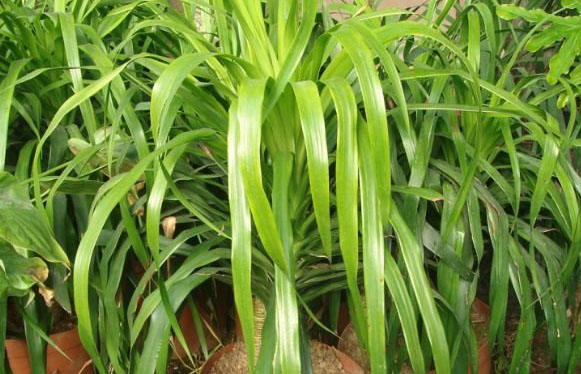
Prevention and control methods for Dracaena tip blight
Dracaena tip blight mainly affects the lower leaves. After the leaf tip is infected, the disease spreads inward; the lesion turns straw-yellow and sunken, with a 1 brown line at the boundary between diseased and healthy tissue, and many small black dots form on the diseased area. The leaves often die from the disease, but on the middle leaves only the leaf tip dies back, which is why it is called tip blight. It therefore directly and greatly affects the ornamental effect.The pathogen of Dracaena tip blight is a facultative parasite, often surviving on diseased Dracaena leaves or on fallen diseased leaves on the ground. The pathogen spores are released under high humidity and spread by wind and rain to cause primary infection and repeated secondary infections. Rainwater is an important condition for the occurrence of this disease, and it is prone to occur when there is a lot of rainfall.
Prevention and control methods for Dracaena tip blight:
(1) Select and breed disease-resistant varieties, or use disease-resistant varieties as grafting material.
(2) Provide careful maintenance to improve disease resistance.
(3) During transport, do everything possible to reduce wounds.
(4) When necessary, spray 1:1:100 Bordeaux mixture, or 53.8% Kocide 2000 dry flowable 1000-fold solution, or 10% Score water-dispersible granules 3000-fold solution.
Through the detailed introduction in this article, we hope everyone can gain something from it! Thank you, flower lovers, for your attention and support of Zuihua Network!
Prevention and control methods for Dracaena tip blight
Dracaena tip blight mainly affects the lower leaves. After the leaf tip is infected, the disease spreads inward; the lesion turns straw-yellow and sunken, with a 1 brown line at the boundary between diseased and healthy tissue, and many small black dots form on the diseased area. The leaves often die from the disease, but on the middle leaves only the leaf tip dies back, which is why it is called tip blight. It therefore directly and greatly affects the ornamental effect.
The pathogen of Dracaena tip blight is a facultative parasite, often surviving on diseased Dracaena leaves or on fallen diseased leaves on the ground. The pathogen spores are released under high humidity and spread by wind and rain to cause primary infection and repeated secondary infections. Rainwater is an important condition for the occurrence of this disease, and it is prone to occur when there is a lot of rainfall.
Prevention and control methods for Dracaena tip blight:
(1) Select and breed disease-resistant varieties, or use disease-resistant varieties as grafting material.
(2) Provide careful maintenance to improve disease resistance.
(3) During transport, do everything possible to reduce wounds.
(4) When necessary, spray 1:1:100 Bordeaux mixture, or 53.8% Kocide 2000 dry flowable 1000-fold solution, or 10% Score water-dispersible granules 3000-fold solution.