A Comprehensive Analysis of Clivia Appreciation and Evaluation Standards
For many years, when people have purchased mid-to-high-end clivias, they have mostly based their choice on the quality of the leaves, essentially disregarding the flowers and other conditions. Therefore, the clivia appreciation and evaluation standards are of course leaf-oriented. To sum up, there are mainly + criteria, namely brightness, fineness, stiffness, thickness, vein pattern, color, length-to-width ratio, head shape, base shape, plant shape, and two auxiliary conditions, flowers (flower scape, fruit) and others.
1. Brightness
Brightness refers to the degree of reflection on the leaf surface. When appreciating, special attention should be paid to distinguishing whether it has been polished or is the leaf's original state. The quality of brightness, from best to worst, is: oily shine, glossy, bright, slightly bright, not bright.
2. Fineness
Fineness refers to the smoothness of the leaf surface. Fineness can be detected both visually and by touch. It is most obvious when observed with a magnifying glass. The quality of fineness, from best to worst, is: fine, relatively fine, generally fine, relatively rough, rough.
3. Stiffness
Stiffness refers to the overall bending resistance of the leaf, or can be understood as the degree to which it would rather break than bend. It is related to hardness but is not the same thing. It can also be regarded as the hardness of the entire leaf, rather than the hardness at a single point on the leaf. It is related to the length and thickness of the leaf. Therefore, when comparing the stiffness of two clivias, one with long leaves and one with short leaves, measurements should be taken at 10 cm from the tip. The stronger the stiffness, the better; the weaker, the worse.
4. Thickness
Thickness is the degree of thickness of the leaf flesh in cross-section. The smaller the difference in thickness between the leaf edge and the middle, the better. The thickness of the leaf head determines the quality of leaf thickness, so the average of the thickness at the edge and the middle at 5 cm from the leaf tip should be taken. The quality of thickness, from best to worst, is: 1.6 mm, 1.4 mm, 1.2 mm, 1 mm, below 1 mm.
5. Vein Pattern
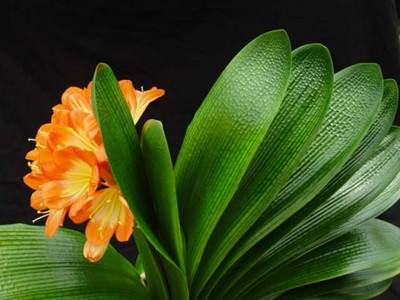
Thick, raised veins evenly spaced across the entire leaf surface, with dense granular veins at the head, are considered best. Vertical veins reaching the top with wide spacing, and horizontal veins that are straight and form a grid pattern, are good. The smaller the differences between leaves, the better; multiple leaves should be taken for comprehensive evaluation.
6. Color
Lighter colors are preferred. If the leaf surface has two colors, the greater the contrast, the better. For the Golden Silk Path variety, the ratio of light to dark colors on the leaf surface is best at 1:1, and the light color should be translucent. Since the Golden Silk Path is a member of the clivia family, its appreciation and evaluation should be carried out with reference to all the standards.
Clivia Appreciation and Evaluation Standards
For many years, when people have purchased mid-to-high-end clivias, they have mostly based their choice on the quality of the leaves, essentially disregarding the flowers and other conditions. Therefore, the clivia appreciation and evaluation standards are of course leaf-oriented. To sum up, there are mainly ten criteria, namely brightness, fineness, stiffness, thickness, vein pattern, color, length-to-width ratio, head shape, base shape, plant shape, and two auxiliary conditions, flowers (flower scape, fruit) and others.1. Brightness
Brightness refers to the degree of reflection on the leaf surface. When appreciating, special attention should be paid to distinguishing whether it has been polished or is the leaf's original state. The quality of brightness, from best to worst, is: oily shine, glossy, bright, slightly bright, not bright.
2. Fineness
Fineness refers to the smoothness of the leaf surface. Fineness can be detected both visually and by touch. It is most obvious when observed with a magnifying glass. The quality of fineness, from best to worst, is: fine, relatively fine, generally fine, relatively rough, rough.
3. Stiffness
Stiffness refers to the overall bending resistance of the leaf, or can be understood as the degree to which it would rather break than bend. It is related to hardness but is not the same thing. It can also be regarded as the hardness of the entire leaf, rather than the hardness at a single point on the leaf. It is related to the length and thickness of the leaf. Therefore, when comparing the stiffness of two clivias, one with long leaves and one with short leaves, measurements should be taken at 10 cm from the tip. The stronger the stiffness, the better; the weaker, the worse.
4. Thickness
Thickness is the degree of thickness of the leaf flesh in cross-section. The smaller the difference in thickness between the leaf edge and the middle, the better. The thickness of the leaf head determines the quality of leaf thickness, so the average of the thickness at the edge and the middle at 5 cm from the leaf tip should be taken. The quality of thickness, from best to worst, is: 1.6 mm, 1.4 mm, 1.2 mm, 1 mm, below 1 mm.
5. Vein Pattern
Thick, raised veins evenly spaced across the entire leaf surface, with dense granular veins at the head, are considered best. Vertical veins reaching the top with wide spacing, and horizontal veins that are straight and form a grid pattern, are good. The smaller the differences between leaves, the better; multiple leaves should be taken for comprehensive evaluation.
6. Color
Lighter colors are preferred. If the leaf surface has two colors, the greater the contrast, the better. For the Golden Silk Path variety, the ratio of light to dark colors on the leaf surface is best at 1:1, and the light color should be translucent. Since the Golden Silk Path is a member of the clivia family, its appreciation and evaluation should be carried out with reference to all the standards.
7. Length-to-Width Ratio
The length-to-width ratio is the ratio of leaf length to width. Only when the ratio is harmonious can it be called beautiful; it is not appropriate to speak of leaf length or width alone. One-sidedly pursuing width and shortness results in a disproportionate ratio that is unscientific and, from a design perspective, not beautiful. The harmonious length-to-width ratio is 3:1. Leaf length refers to the distance from the leaf tip to the junction of the leaf sheath edge and the leaf base; width refers to the measurement at the widest point of the leaf being measured. When appreciating, the average length-to-width ratio of six of the best leaves should be taken.
8. Head Shape
Head shape refers to the shape of the top of the leaf. A smooth, rounded transition at the leaf tip is best; equal radius is optimal; a blunt tip is better than a sharp tip. When appreciating the quality of head shape, the shapes of more than half of the leaves should be considered comprehensively. The quality of head shape, from best to worst, is: semicircular, elliptical (flat head shape), acute, acuminate, sharp.
9. Base Shape
Base shape refers to the shape of the pseudobulb formed by the leaf sheaths woven on the rhizome. There are mainly the ingot shape (trapezoid), pagoda shape (triangle), column shape (square), and wedge shape (inverted trapezoid). These four shapes are further divided into two by height. The quality of the base shape depends on the longitudinal spacing between the leaf sheath edges and the angle between the edges of the sheaths of two opposite leaves. The smaller the spacing and the larger the angle, the better-looking the base shape. The quality of base shape, from best to worst, is: low wedge shape, high wedge shape.
10. Plant Shape
This refers to the overall form of the clivia, formed by the shape, arrangement, and weaving of the leaves. A good plant shape looks like a single line from the side and like an open fan from the front. "A single line from the side" means the leaves do not lean left or right, which is mostly related to cultivation and care and has little to do with variety. "An open fan from the front" means: the leaves differ little in length; the leaves extend flatly toward the upper diagonal; the angle between the bottom leaves and the horizontal line should be greater than zero. The spacing between leaves is basically uniform. The quality of plant shape depends on whether the leaves extend flatly and spread out, and on the length and tilt angle of the leaf base (commonly called the neck, i.e., the narrow and thick transitional section between the leaf sheath and the leaf blade). The worst plant shape is one in which the leaves droop in an arc, and the leaf base is too short with too large a tilt angle, causing the leaves to fall and overlap on both sides, forming no fan shape at all.
The above are the ten main standards for appreciating the grade level of clivias.
Two auxiliary standards:
1. Large flowers with vivid colors, compact petals, thick and appropriately tall flower scape, fruit light in color with luster.
2. No damage from human or other factors, no pests or diseases, etc.
Clivia Grade Classification and Score Values
A. Score values of each standard. Among the ten main criteria for appreciating clivias, the first four are foundational and are essential conditions for high-grade clivias. The other six are icing on the cake on this basis; the more of them present, the better. Therefore, the score values of these ten standards cannot be evenly distributed. The auxiliary standards are mostly used when awarding prizes at various exhibitions and are almost never considered in appreciating clivia grades. Therefore, their score values are extremely small. The specific distribution is as follows, main standards:
1) Brightness: 1——10 points
2) Fineness: 1——10 points
3) Stiffness: 1——10 points
4) Thickness: 1——8 points
5) Vein pattern: 1——10 points
6) Color: 1——10 points
7) Length-to-width ratio: 1——10 points
8) Head shape: 1——10 points
9) Base shape: 1——8 points
10) Plant shape: 1——8 points
Auxiliary standards:
1. Flowers and fruit: 1——3 points (under normal growth conditions, flowers, scape, and fruit can each score 0.1 points——1 point)
2. Others: 1——3 points (no pests or diseases, various damages, and pot soil cleanliness can each score 0.1 points——1 point)
Total: 100 points
B. Score values for each grade
1. Those scoring above 80 points are treasures;
2. 70 points——79 points are premium;
3. 60 points——69 points are fine;
4. 50 points——59 points are good;
5. Below 50 points are ordinary varieties.
Clivias are profound and unfathomable, and few can truly discern their mysteries. Our views may not be entirely correct; this standard is proposed only so that new and old flower enthusiasts may avoid detours, or take fewer detours, and so that clivias may spread throughout the country and go global at an early date. We welcome insightful people to offer valuable opinions or suggestions.
Clivia Appreciation and Grading
Clivia is a rare and wonderful flower among the myriad blooms. It is remarkable in that its leaves, flowers, and fruit are all beautiful, and its leaves are even better to appreciate than its flowers. Other precious flowers may attract attention with gorgeous blooms or make people stop with intoxicating fragrance, but flower color is obvious at a glance and fragrance is known as soon as it is smelled. Clivia leaves have high ornamental value and can be appreciated at all times, giving people aesthetic enjoyment. The pseudobulb formed by the leaf sheaths at the lower part of the leaves resembles a delicate pagoda in some cases and a golden ingot in others; the tops of the leaves have various shapes, some like ellipses and some like semicircles, as if drawn with a compass. The leaf surface in some cases resembles black pearls scattered on a jade plate, and in others green gems inlaid on a golden plate, forming gorgeous and colorful patterns. The firm, upright leaves spread flatly toward the upper diagonal from the base, neither bending nor bowing, symbolizing an upright, unyielding, and indomitable spirit.
Clivia is a perennial plant. After decades of cultivation, a section of its rhizome can be cut off to rejuvenate it, making it "return to youth" and regain its vitality. The first generation 'Technician' has now reached nearly 48 years of flower age and is still growing vigorously. It is precisely because clivia has the remarkable trait of extremely strong vitality and longevity that it is called the "flower of longevity." In recent years, clivia bonsai and flower arrangement art have gained attention from some people and have broad prospects for development. As for the appreciation of a single clivia plant, a leaf length-to-width ratio of 3?1 or below is preferred, while for clivia bonsai in multi-plant clumping states, the larger the length-to-width ratio, the better, because the narrower and longer the leaves, the more they appear relaxed, elegant, and generous. In addition, clivia also contains the trace element selenium and has high medicinal value.
Another wonder of clivia is that it requires no special cultivation, and its flowers bloom in winter with a long flowering period. Especially in the north, when outside is a world of ice and snow covered in silver, indoors green leaves and red flowers are full of spring vitality, giving people a feeling of joy and pleasure and creating a festive and lively atmosphere, making it popular in countless households.
For many years, when people have purchased clivias, they have mostly based their choice on the quality of the leaves, so the clivia appreciation and evaluation standards are leaf-oriented. To sum up, there are mainly 10 criteria, namely brightness, fineness, stiffness, thickness, vein pattern, color, length-to-width ratio, head shape, base shape, and plant shape; and two auxiliary conditions, flowers (flower scape, fruit) and others.
1. Score values of each standard. Among the main 10 criteria for appreciating clivias, 4 are foundational and are essential conditions for high-grade clivias. The other 6 are icing on the cake on this basis; the more present, the better.
Main standards: 1. Brightness: 1 to 11 points; 2. Fineness: 1 to 11 points; 3. Stiffness: 1 to 11 points; 4. Thickness: 1 to 11 points; 5. Vein pattern: 1 to 11 points; 6. Color: 1 to 11 points; 7. Length-to-width ratio: 1 to 8 points; 8. Head shape: 1 to 8 points; 9. Base shape: 1 to 8 points; 10. Plant shape: 1 to 10 points. Total: 100 points.
Auxiliary standards: 1. Large flowers with vivid colors, compact petals, thick flower scape, moderate height, fruit vivid in color with luster: 1 to 6 points (flowers, flower scape, and fruit 2 points each); 2. No pests or diseases, no damage from human or other factors: 4 points. Total: 10 points.
2. Score values for each grade. The grade of a clivia is determined by the score values of the main 10 standards. If the score values are the same, then the auxiliary standard score values are compared: above 90 points is supreme grade; 80 to 89 points is treasure grade; 70 to 79 points is premium grade; 60 to 69 points is fine grade; 50 to 59 points is good grade; 40 to 49 points is ordinary grade; below 40 points is inferior grade.
Niu Junqi, Vice President of the Changchun Clivia Association