Detailed Guide to Autumn Care Methods and Key Points for Paphiopedilum (Slipper Orchids)
Paphiopedilum is a member of the tropical orchid family, but there are also many varieties native to China. The greatest convenience of growing Paphiopedilum at home is that it does not require special temperature conditions; it can grow normally at room temperatures above 5°C.
After the hot summer heat passes, Paphiopedilum awakens from dormancy and enters its normal growth period. To make Paphiopedilum bloom as desired during its normal flowering period, autumn care is very important.
Autumn is the critical period for Paphiopedilum to absorb nutrients and develop flower buds. Based on years of observation, the author has found that some Paphiopedilum species, such as Paphiopedilum wardii, basically have the same bud development time as autumn chrysanthemums; around September 20 each year, you can see Paphiopedilum flower buds peeking out from the leaf clusters. Although bud development and flowering periods differ among Paphiopedilum varieties, applying fertilizer and providing careful care for various Paphiopedilum species in autumn is done at the same time.
The specific steps are as follows:
1. Before the first fertilization, use a thin wooden stick to slightly loosen the potting soil, but do not damage the roots.
2. Apply a liquid fertilizer with equal proportions of nitrogen, phosphorus, and potassium once a week; it should be diluted rather than concentrated. If using granular fertilizer containing nitrogen, phosphorus, and potassium nutrients, this can be reduced to once every two weeks.
3. Apply foliar fertilizer to the leaves once every 10 days, spraying with monopotassium phosphate at a 0.2% ratio; stop once the flower buds emerge from the leaf clusters.
4. Be careful to prevent waterlogging. Paphiopedilum is a shallow-rooted plant; overly wet potting soil can easily cause root rot.
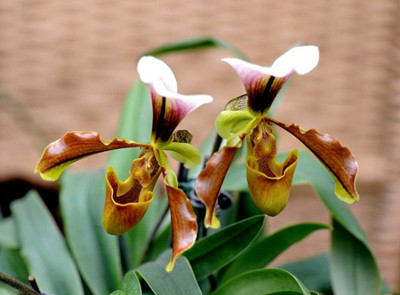
5. Grow potted Paphiopedilum in a hanging manner, which benefits both the aeration of the potting soil and the spreading of the plant's leaves.
6. When the temperature reaches around 25°C, the Paphiopedilum plant should be exposed to as much light as possible. Also, rotate the pot frequently so that the entire plant receives light; this helps all the plants in the pot develop more flower buds.
7. In late autumn, when outdoor temperatures drop below 10°C, potted plants should be moved indoors promptly to prevent harm to Paphiopedilum plants from cold winds and frost.
Autumn Care for Paphiopedilum
Autumn Care for Paphiopedilum
Fertilization
For the first fertilization, use a thin wooden stick to slightly loosen the potting soil, but do not damage the roots. Apply liquid fertilizer once a week; fertilization should not be too concentrated, and at minimum it can be applied once every half month. Apply foliar fertilizer to the leaves about once every 10 days, spraying with monopotassium phosphate at a 0.2% ratio; stop immediately once the flower buds emerge from the leaves.
Waterlogging Prevention and Aeration
Be careful to prevent waterlogging. Paphiopedilum is a shallow-rooted plant, and overly moist potting soil can easily cause root rot. Grow Paphiopedilum in a hanging manner, which benefits both the aeration of the potting soil and the spreading of the plant's leaves.
Supplementary Lighting and Temperature Control
When the temperature reaches around 25°C, the Paphiopedilum plant should be exposed to as much light as possible. At the same time, be sure to rotate the pot so that the entire plant receives light; this also helps all the plants in the pot develop more flower buds.
In late autumn, when outdoor temperatures drop below 10°C, potted flowers need to be moved indoors promptly to avoid the invasion of cold winds; frost can cause significant harm to Paphiopedilum.
Autumn Care Tips for Potted Paphiopedilum Flowers
Autumn Care Tips for Potted Paphiopedilum Flowers
Paphiopedilum (Cypripedium corrugatum Franch.), also known as slipper orchid. Orchidaceae perennial herb. Most are terrestrial species, with many hybrid varieties. It is one of the most widely cultivated tropical orchids. Mainly distributed under tropical and subtropical forests in Asia. Prefers warm, humid, and semi-shaded environments. The stem is very short; leaves are strap-shaped or oblong-lanceolate, green or with reddish-brown markings. The flowers are very unusual, with the lip shaped like a pouch; the dorsal sepal is extremely developed, with various brilliant patterns; the two lateral sepals are fused together; the petals are relatively thick, and the flowers are long-lasting, with some remaining open for more than 6 weeks, and there are species that bloom in all four seasons.
Autumn Care Tips for Paphiopedilum
(1) Cultivation location: Compared with summer, autumn not only has shorter daylight hours but also weaker sunlight. If two layers of shade netting are still used, it will result in insufficient sunlight, so one layer should be removed, maintaining 50-60% shading. Western exposure can easily cause leaf scorch, so western sunlight should still be avoided. Good ventilation should still be maintained; in late autumn, if nighttime temperatures are relatively low, the windows around the greenhouse should be closed.
(2) Watering: Watering is generally done when the surface of the growing medium is dry. Since it has entered the growth cessation period, its water absorption is far less than in summer. Therefore, watering is generally done about once every 2-3 days. Because the air is dry in this season, the surface of the growing medium dries easily. There is often a phenomenon where, when the surface of the growing medium appears dry, the inner layer is still very moist, so watering should not be excessive. In addition, note that water easily accumulates in the crown of the orchid, which can cause flower bud rot. Therefore, for orchid plants with flower buds, watering requires special attention.
(3) Fertilizer: Same as in summer, apply liquid fertilizer 2-3 times per month, but for flowering plants, suspend fertilization.
(4) Removal of old leaves: When this year's growth ends, the leaves that grew in the previous two years turn tea-brown and are about to wither. This is not a disease but simply an aging phenomenon; just carefully remove or cut them off from the base.
(5) Weeding: When cultivating in urban areas, this problem is relatively uncommon. However, when cultivating in suburban or rural areas, weed seeds often fly everywhere and sprout all over, causing great trouble. Therefore, in early to late autumn, weeds should be pulled out by the roots; once they are allowed to grow, removing them becomes quite difficult.