A Detailed Guide to Tree Peony Planting Techniques and Care Methods
Tree peonies can be propagated by sowing, division, or grafting. However, the sowing method takes too long, and the seedlings are difficult to grow successfully after germination, so division is generally the method most often used. Below we provide a complete analysis of tree peony planting techniques and methods, in the hope that flower-loving friends will find it useful.
Tree peony seeds must not be sown too deep; 3 to 4 cm is appropriate. After sowing, cover with soil level with the ground, then gently firm the soil, and water thoroughly. In winter, cover with millet straw, leaves, or horse manure, or cover well with plastic film to keep warm, preserve moisture, and protect against cold. The tree peony is a deep-rooted deciduous shrub flower that likes sunlight, tolerates cold, prefers a cool environment and dislikes high temperatures and muggy heat, and is suited to growing in loose, fertile, well-drained sandy soil.
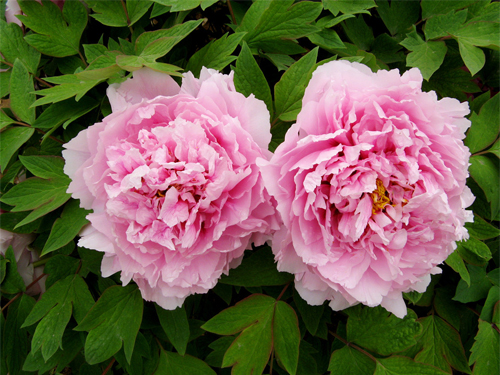
To plant tree peonies, choose a spacious, well-ventilated spot with morning sunlight and fertile, loose soil; do not plant them in waterlogged ground, damp shady ground, or rubble-filled ground. When building a raised bed for planting, the size of the bed should be determined by the number and size of the plants, and the height should be determined by the original terrain of the site and the level of the groundwater table.
When planting, the bottom of the pot can be covered with a 3-5 cm layer of coarse sand or small stones to aid drainage. For the potting soil, it is best to use a mixture of yellow sandy soil and cake fertilizer, or a culture soil thoroughly mixed from fully rotted barnyard manure, garden soil, and coarse sand in a 1:1:1 ratio. When filling in soil, let the root system spread out and not curl; after covering with soil, press it firm with your hands so that the roots make close contact with the soil, which makes survival easier.
When tree peonies are in bloom, you can set up a canopy for cover or temporarily place them indoors to avoid direct sunlight, which can extend the flowering period. For main branches whose terminal buds are leaf buds, these should be removed to prevent excessive vegetative growth that affects flowering. Watering should be done sensibly, watering when dry and letting them dry out between waterings; do not water heavily, and prevent water from accumulating in the pot, which can cause root rot and leaf drop.
How to plant tree peonies? Tree peony planting methods and cultivation techniques
China is the place of origin of the tree peony, and the tree peony is also deeply loved by the general public. In order to better develop tree peonies and bring out their ornamental value, this article starts from the cultivation history of tree peonies, analyzes the morphology and ecological habits of tree peonies, and discusses tree peony cultivation techniques through an account of propagation methods, cultivation management, and flowering-period regulation.
The Cultivation History of Tree Peonies
Since ancient times the tree peony has been called the king of flowers, known as “national beauty and heavenly fragrance” and called the “flower of wealth and honor.” The tree peony has a long cultivation history in China, of more than 1500 years. In the Tang Dynasty it was already a precious flower in the imperial palace, and a dedicated tree peony garden was established at Mount Li. By the Ming and Qing dynasties, the tree peonies of the middle and lower reaches of the Yellow River, the tree peonies of Bozhou, the tree peonies of Caozhou, the tree peonies of Jiangnan, and the tree peonies of Lanzhou all shone brilliantly, truly pushing the tree peony to the status of “king of flowers.” Now, countries such as China, the United States, Japan, and the Netherlands, through crossbreeding, have bred new commercialized potted tree peony varieties.
The Biological Characteristics of Tree Peonies
1. Morphological characteristics. The tree peony belongs to the Paeoniaceae family as a deciduous small shrub. The stems are generally 1 m to 2 m tall, and the tallest can reach 3 m. The branches grow in clusters from the ground, and the nodes and leaf scars are obvious. It has a fleshy taproot system with no horizontal lateral roots. The leaves are bipinnate with three leaflets, dull on the surface, green, hairless, with a white bloom on the underside and nearly hairless. The flowers are solitary at the tips of the branches, large, 10~30 cm in diameter. Currently cultivated varieties are mostly double-flowered, with rich colors including yellow, white, red, pink, purple, and green. The flowering period is April to May. The fruit is a follicle, and the seeds are black. The fruit ripening period is from mid-August to early September.
2. Ecological habits. The tree peony is a cultivated species, and the original species is produced in the area of northwestern China and the Qinling Mountains. It likes cold winters that help dormancy and mild summer climatic conditions that are favorable for flower bud differentiation. It is relatively cold-tolerant but not heat-tolerant. It can usually withstand low temperatures of -20 degrees, but temperatures above 32 degrees have adverse effects on tree peonies. It likes light, but does not like the western sun. Its roots are fleshy, preferring dryness and disliking dampness, and fearing waterlogging. It is suited to fertile, loose, well-drained soil, and a soil pH that is neutral or slightly acidic is appropriate; it can also grow normally in alkaline calcareous soil, but saline-alkaline soil is taboo. The plant grows slowly, and the new shoots wither each year, showing the phenomenon of “branch dieback,” hence the saying “the tree peony grows one chi and recedes eight cun.” Seedlings generally take 5~6 years.
Cultivation Techniques for Tree Peonies
1. Propagation methods
(1) Division propagation. Asexual propagation can keep the superior traits of the mother plant basically unchanged, and the propagation of ornamental tree peonies mainly uses this method. The tree peony has no obvious main trunk and is a clump-forming shrub, which makes it very suitable for division and also relatively simple and easy. The method and steps are as follows:
① Choose a suitable time for division. Tree peony division is generally done from late September to early October, during which the ground temperature is very suitable for the formation of new roots in tree peonies. If division and planting are done too early, because the outside air temperature is still high, it easily causes winter buds to sprout and send out new branches, that is, “autumn flushing,” which not only consumes nutrients but also reduces cold and drought resistance, and is very unfavorable for growth and flowering the following spring. If division and planting are done too late, the new roots are weak or no new roots form, and the next year the plant grows weakly, with few tillers, short and thin branches, and it is very easy for it to die in drought.
② Division method. Tree peonies can be divided for propagation after growing for 3 years, but 4-5 year old plants are preferable. First dig the mother plant out of the ground and let it dry in the sun for 1-2 days so that the roots lose water and soften, but do not dry it in the shade excessively. Split it apart at places that separate easily; the lower part of each new division should have a good root system, and each division should have 3~5 tiller buds. After division, plant in pots, and after 5~6 years it can be divided again. The old branches on the upper part of the division should be cut off before planting at 3-5 cm above the root crown; if the division has no sprouting tiller buds or has too few, thin and weak sprouting tiller buds, then 2-3 latent buds should be left below the cut site. The main purpose of cutting off the old branches is to avoid consumption of nutrients in the roots by the leaves and flowers of the old branches, promote tillering, and strengthen the growth vigor of the division.
③ Planting method for divisions. Quickly dip the divisions in a mixed solution of isofenphos-methyl and lvheng No. 1, and plant them after they dry. At the same time, to stimulate the formation of new roots, rooting agents such as 50-200 mg/L indolebutyric acid or naphthaleneacetic acid can be added to the mixed solution, which can promote rooting and strengthen growth vigor. When planting, use the “three burials, two tramplings, one lift” method as in forest production, that is, first place the seedling vertically into the hole, position its roots well, and with one hand gently lift the seedling while with the other hand fill soil into the hole. When the soil has been filled to half the hole, gently lift the seedling upward with your hand, gently shake it left and right once so that the fine soil makes close contact with the roots, use a wooden stick to tamp the soil firmly around the seedling, then fill the hole with soil and tamp it firm, and finally fill the planting hole completely. After planting, use loose soil to seal the planting hole into a mound, generally 15-20 cm above the ground.
(2) Grafting propagation
The main considerations are several aspects including grafting time, rootstock, scion, and grafting method.
① Grafting time. Tree peonies can be grafted from late September to early October, and the period from White Dew (September 7-8) to the Autumn Equinox (September 23-24) is preferable; in particular, the survival rate is highest when grafting around White Dew. This may be a response of tree peony grafting to specific temperature and humidity. Around White Dew, the air temperature is 20-25°C, and the ground temperature at 30 cm depth is 18-23°C, so the graft union quickly heals and produces callus tissue, resulting in a high survival rate.
② Selection of rootstock. The rootstock is usually tree peony root or herbaceous peony root. Using tree peony root as the rootstock, because it is relatively fine, hard, and not easy to graft, the propagated plants grow relatively slowly at first, but the base of the scion easily sends out roots and also produces relatively many tillers, which is favorable for later division, and the lifespan is also relatively long. Using herbaceous peony root as the rootstock, because its woodiness is relatively weak, it is more convenient to operate, and the survival rate is also relatively high. However, the scion sends out relatively few roots at the base, does not produce many tillers, and has a shorter lifespan. The rootstock should be dried in the sun for 1-2 days and grafted after it loses water and softens, so that the cut is not easy to split and is convenient to work with.
③ Scion. The scion is best taken from branches grown from soil buds, as their tissue is substantial, their vitality is vigorous, and new roots and new branches are easily produced at the base, giving a high survival rate after grafting. If there are very few tiller branches, one-year-old branches from the upper part of the crown can only be used as scions. The scion length is generally 5-10 cm, the thickness is more than 0.5 cm, and it bears 2-3 plump, full buds.
④ Grafting. After split grafting or cut grafting, bind with hemp rather than plastic film strips, coat with mud slurry, and plant into a deep, wide pot. The potting soil should be moist; generally do not water after planting, and cover with soil to preserve moisture.
(2) Seed propagation
This is commonly used for ornamental tree peonies when breeding new varieties, but not for medicinal tree peonies. When the tree peony fruit ripens, it naturally splits open and releases black seeds, so the fruit must be collected before the follicle is about to split. Place the collected fruit in a sieve to dry in the sun, and after collecting the seeds in September, sow them immediately. Be careful to keep the soil moist. After the seeds overwinter in the soil, due to the stimulation of low temperature, the epicotyl elongates the following spring and the seedlings emerge.
Management Methods for Tree Peonies
1. Watering. For pot cultivation, it is best to choose tree peonies grafted onto herbaceous peony roots. Because tree peonies dislike water accumulation, place more tiles at the bottom of the pot to aid drainage. After planting, as long as the soil is moist, generally there is no need to water thoroughly immediately, and certainly do not water heavily. During the growing season, water moderately. In arid northern regions, generally water before flowering, after flowering, and before freezing.
2. Fertilizing. Tree peonies like fertilizer, and fertilizing over the year can be divided into three times: nutritional fertilizer, supplementary fertilizer, and wintering fertilizer. Nutritional fertilizer should be applied 15~20 days before flowering, generally at the end of March. Supplementary fertilizer is generally applied within 15 days after flowering. Wintering fertilizer is applied in late October, and the amount can be moderately increased. Fertilizing is generally based on rotted organic fertilizer. Fertilizing methods can be combined with loosening the soil, broadcasting, or hole application. For pot cultivation, liquid fertilizer can be applied together with watering.
3. Pruning. In the year of planting, it can be allowed to grow freely. In each subsequent year after spring sprouting, completely remove the tiller buds at the base of the plant and the adventitious buds sent out from the base of the trunk, concentrating nutrients so that the flowers are large and brightly colored the following year. After flowering, cut off the spent flowers and do not let them set seed. In autumn and winter, dried branches and leaves as well as thin, weak, and flowerless branches should all be cut away. For pot cultivation, it can also be pruned into different shapes according to your own preferences and needs.
4. Spraying. There are not many insect pests on tree peonies. The main diseases are black spot disease and violet root rot. For black spot disease, spray equal-strength Bordeaux mixture after flowering and in summer. If a small number of diseased leaves appear, they should be removed immediately and burned. For violet root rot, because its harmfulness lies in the roots of the tree peony, when diseased roots are found they should be pulled out and disinfected with 20% lime water. For prevention and control, spray lime sulfur mixture before sprouting in early spring, and in summer use a mixed solution of insecticide and fungicide, once every 2 weeks depending on the condition of the disease. At the same time, combine with fertilizing, and appropriately add chemical fertilizers and growth regulators.
Flowering-Period Regulation of Tree Peonies
The uses of tree peonies are mainly medicinal, garden applications, and cut flowers and bonsai. The ornamental value of the tree peony was
discovered from ancient times to the present. However, a single tree peony has a natural flowering period of about 10-15 days, which shortens as the temperature rises; at 3-8°C, it can be maintained for more than a month. Therefore, how to regulate the flowering period is also a key point in tree peony cultivation.
1. Selection of plants for forcing. To add to festivals or celebratory events, tree peonies are usually forced. First, the plants must be selected. First, choose forcing varieties. For retarding cultivation, it is suitable to choose semi-double late-flowering or mid-to-late-flowering varieties with active dormant flower buds, such as 'Zhi Hong,' 'Zi Chong Lou,' and 'Zi Xiu Qiu.' For forcing cultivation, it is suitable to choose early-flowering varieties that bloom later and have a high flower-setting rate. Second, the quality of the forcing seedlings. Generally speaking, forcing plants should be selected as strong seedlings with vigorous growth, compact plant shape, thick branches, plump buds, well-developed roots, no insect damage, and flower buds that have already differentiated.
2. Measures for flowering-period regulation. When forcing, depending on the variety, tree peonies can be heated about 50 days in advance, with the temperature controlled at normal 10-25°C, and an average daily temperature of about 15°C. In the early stage, pay attention to keeping the plants moist; after buds appear, pay attention to ventilation and light; after the buds form, control the temperature according to the required flowering period. Usually, apply foliar fertilizer and ensure an adequate water supply. In this way, flowers can be seen at any time in winter and spring. To extend the viewing time, field plantings can have temporary shelters set up to block wind and light; potted plants can be moved to a place where sunlight cannot shine directly; the temperature should be maintained at 5-10°C; and there should also be a ventilated and light-transmitting environment. Water should also be given in good time according to how moist the potting soil is, but note that water should not be splashed on the flowers; this way the flowering period is longest.
Pest and Disease Control for Tree Peonies
What harms the normal growth of tree peonies is, first, diseases and, second, insect pests. They weaken the growth of tree peonies, cause flower color to fade, reduce the yield of tree peony bark, and lower its grade. For this reason, doing a good job of timely pest and disease control is very important for ensuring the normal growth of tree peonies.
1. Disease control for tree peonies
① Leaf spot disease. Leaf spot disease is also called "black spot disease." This disease is caused by infection by fungi of the genus Pestalotiopsis, and the fungi mainly infect leaves, stems, and flowers. It generally appears 15 days after flowering, and becomes increasingly serious as humidity rises in mid-July. In the early stage, the disease shows on the underside of leaves as brown spots the size of grains of rice, with slightly darker edges, forming irregular concentric ring-shaped blighted spots. In July the spots enlarge and merge with one another, and the leaves wither and scorch. The affected petioles produce a dark green fuzzy layer, and the stems produce raised diseased spots. Small pink spots appear on the peduncles and corollas. The control method for leaf spot disease should combine cleaning the garden with chemical control. Around "Start of Winter," clean the dry leaves in the tree peony field thoroughly to reduce the source of pathogens. In May, spray Bordeaux mixture at 1:1:160, once every 10-15 days, until the end of July. In the early stage of the disease, spray zineb at 500-800 times dilution, once every 7-10 days.
② Violet root rot. Violet root rot is a fungal disease, caused by transmission through soil and roots. The affected areas have purple or white cottony mycelium, commonly called "black lump head." In mild cases, no new roots grow, branches wither and become thin, and leaves turn yellow; in severe cases, the entire root crown and roots rot and the plant dies. It mostly occurs in hot, rainy seasons. The most effective way to control this disease is to choose a well-drained, high, dry plot for planting; cultivate in time during the rainy season to reduce humidity; crop rotation and breeding disease-resistant varieties can all reduce the harm; before planting, smearing the roots with 500 times diluted pentachloronitrobenzene solution, or soaking the roots in 1000 times diluted 5% amobam solution, both have fairly good results.
Common ones also include sclerotinia disease, anthracnose, and rust. In old tree peony planting areas, there is also damage from nematode disease, and appropriate pesticides should be selected for control.
2. Insect pest control for tree peonies
Underground pests include mole crickets, white grubs, and cutworms, mainly harming root bark and tender buds. To control mole crickets, use poison bait and nighttime light trapping. To control white grubs and cutworms, fermented organic fertilizer mixed with phoxim can be turned into the ground at a depth of 20 cm, with good results.
Aboveground pests include scale insects and longhorn beetles, mainly harming the stems and causing the death of the whole plant. To control scale insects, use 1000-1500 times diluted dichlorvos spray during the larval hatching period; spraying fluoroacetamide is even more effective; during dormancy or before sprouting in early spring, brushing the branches and trunk with 3 degrees Baumé lime sulfur mixture also has a fairly good effect. To control longhorn beetles, use sulfur powder or Stemona to block the holes, or use cotton dipped in 50% dichlorvos at 20 times dilution to block the holes. For seedlings, airtight fumigation with aluminum phosphide is also a good method.
How to plant tree peonies: Tree peony planting methods
The tree peony ranks second among China's ten famous flowers and has the reputation of being the king of flowers. Luoyang is one of the birthplaces of Chinese tree peonies and a city famous for tree peonies. With their gorgeous colors and beautiful flower shapes, tree peonies are deeply loved by people. So how do you plant tree peonies? Next, Xiao Qi will share the planting methods for tree peonies.
Tree peony picture
I. How to plant tree peonies
The tree peony is a deep-rooted deciduous shrub flower that likes sunlight, tolerates cold, prefers a cool environment and dislikes high temperatures and muggy heat, and is suited to growing in loose, fertile, well-drained sandy soil. Therefore, the potting soil for generally cultivating tree peonies should be a mixture of sandy soil and cake fertilizer, or a culture soil thoroughly mixed from fully rotted barnyard manure, garden soil, and coarse sand in a 1:1:1 ratio.
Tree peony picture
II. Planting methods for tree peonies
1. Planting: For the soil in which tree peonies are planted, we should choose loose-textured, fertile loam that is neutral to slightly alkaline, and also cut off broken and diseased roots of the tree peony seedling to be planted, then sterilize it, and place it into a pot or hole prepared in advance; let its root system spread out, fill in soil to more than half, gently shake the seedling, then firm and seal the soil.
2. Watering: After planting, a tree peony should be watered thoroughly the first time, and since tree peonies also dread water accumulation, during their growing season they also need to be watered as appropriate.
3. Fertilizing: One year after planting, tree peonies can be fertilized in autumn, mainly with rotted organic fertilizer. Then combine this with loosening the soil, and so on. In spring and summer, chemical fertilizers are mostly used, applied together with watering as pre-flowering fertilizer and post-flowering fertilizer. If potted, liquid fertilizer can also be applied together with watering.
4. Pruning: In the year a tree peony is planted, after spring sprouting leave about 5 branches, then remove the others, so that nutrients can be concentrated and the flowers the following year can be even more brightly colored. In autumn and winter, we can also combine this with clearing the garden to cut away thin, weak, and flowerless branches and leaves. When potted, it can also be pruned into different shapes according to your own preferences.
5. Repotting: After the tree peony in a pot has grown for three or four years, in autumn we need to add new fertile soil and move it to a larger pot, or divide it and plant it separately.
Tree peony picture
The above is an introduction to how to plant tree peonies and the planting methods for tree peonies. Friends who like tree peonies may as well learn from it and grow some at home themselves.