What are the cultivation methods for yesterday-today-and-tomorrow (Brunfelsia pauciflora)?
Yesterday-today-and-tomorrow, also known as morning-noon-and-night (Brunfelsia pauciflora), five-color jasmine, or Brunfelsia, belongs to the Solanaceae family and the genus Brunfelsia. It is an evergreen shrub with a height of 30-100 cm. It is native to tropical America. When the flowers open from bud to first bloom, the color is deep blue, but after two or three days, under the influence of light, temperature and various other factors, the original deep purple pigment of the corolla gradually fades, and finally becomes pure white. Because the flowers on the same plant do not bloom at the same time, the earlier ones have already turned white while the later ones are still deep purple. The two-colored flowers bloom together on the branches like a pair of mandarin ducks, and at the same time release a rich jasmine-like fragrance, hence the name “mandarin duck jasmine”.
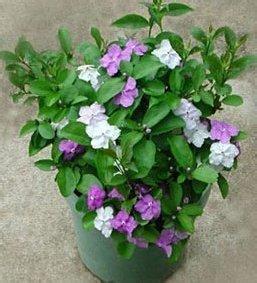
Cultivation methods for yesterday-today-and-tomorrow
Yesterday-today-and-tomorrow likes a sunny, warm and humid climate environment, requires well-drained slightly acidic soil, and the suitable growing temperature is between 20-30°C. At 12°C it enters a dormant state, and the winter room temperature must not be lower than 13°C. In East China and North China it is grown as a potted plant in a greenhouse, requiring well-drained slightly acidic soil, with an optimum growing temperature of 18-30°C. Indoor cultivation requires at least 4 hours of light, and under sufficient sunlight conditions it blooms profusely. At 12°C it enters dormancy.
The key cultivation points for yesterday-today-and-tomorrow are as follows:
① Morning-noon-and-night likes a warm, humid climate and is not cold-tolerant. It requires sunny, well-drained acidic loam. In winter it needs to overwinter indoors, and in spring it is moved outdoors.
② The growing medium can be made from garden soil : leaf mold : rice husk ash (1.5:1:0.5), with an appropriate addition of farmyard manure. When repotting in spring, prune and shape appropriately, removing old roots, dead branches, dense branches and leggy branches. In summer it needs to be moved under large trees for cultivation.
③ After spring, gradually increase the amount of watering; in summer, water thoroughly once every 2 days. Spray water appropriately on the leaves and the surrounding environment, and reduce the frequency of watering in autumn. In winter, generally water once every 10 days; excessive watering and an indoor environment that is too humid will cause leaf drop or root rot.
④ In spring and summer, apply a thin cake fertilizer solution (20%) once every 10-15 days; stop fertilizing at the beginning of autumn to prevent new shoots from growing and suffering cold damage.
⑤ Propagation. a. Cutting propagation can be done between April and August; cut one-year-old branches 8-10 cm long, and they will take root after 1 month. Using the full-light misting method in summer gives a high survival rate. b. Layering can also be used for propagation; notch the branch at the 15 cm point, bury it in soil, and it will take root after 3 weeks, and after 50 days it can be separated as a seedling for transplanting.
How to prune yesterday-today-and-tomorrow, and how to cultivate yesterday-today-and-tomorrow
The plant yesterday-today-and-tomorrow really exists; it is itself a kind of purslane plant and can be considered a relatively special variety. Yesterday-today-and-tomorrow is mostly described as rather delicate, and the yesterday-today-and-tomorrow plant is also very rare, and its leaves can even change color. Today I will introduce the cultivation of yesterday-today-and-tomorrow, and see how yesterday-today-and-tomorrow is best pruned.
How to prune yesterday-today-and-tomorrowI. How to prune yesterday-today-and-tomorrow——flowering
Many people literally think that yesterday-today-and-tomorrow does not bloom and only has branches and leaves. But in fact yesterday-today-and-tomorrow does bloom, and if you can buy one that is already flowering when you purchase it, that is even better. The flowers of yesterday-today-and-tomorrow are small red flowers, especially beautiful among the green leaves. If you have never seen the flowers of yesterday-today-and-tomorrow, it only means you have not grown it successfully.
II. How to prune yesterday-today-and-tomorrow——propagation
The yesterday-today-and-tomorrow plant can be propagated by cuttings; choose robust branches for cutting propagation, cut off all leaves except the ones at the top, and insert them into the soil when dry. Soil prepared with leaf mold and mixed with coarse sand grains has good water permeability, does not accumulate water, and is suitable for yesterday-today-and-tomorrow.
III. How to prune yesterday-today-and-tomorrow——fertilizing
Do not fertilize yesterday-today-and-tomorrow during the first two months after planting; it is also fine to fertilize after the root system of yesterday-today-and-tomorrow has fully grown. At the appropriate fertilizing stage, yesterday-today-and-tomorrow can be fertilized about once every ten days. Yesterday-today-and-tomorrow is highly vigorous and suitable for beginners to grow.
How to prune yesterday-today-and-tomorrow, and the cultivation methods and precautions for yesterday-today-and-tomorrow
Yesterday-today-and-tomorrow is also known as morning-noon-and-night (Brunfelsia pauciflora), five-color jasmine, or Brunfelsia. Do you know much about it? Today I will tell everyone how to prune yesterday-today-and-tomorrow and the cultivation methods and precautions for yesterday-today-and-tomorrow.
Cultivation methods for yesterday-today-and-tomorrow:
Soil: Yesterday-today-and-tomorrow is generally cultivated in East China and North China and likes slightly acidic soil with good drainage and air permeability.
Temperature: The most suitable growing temperature for yesterday-today-and-tomorrow is between 20-30°C. At 12°C it enters a dormant state. It is not cold-tolerant, so pay attention to adjusting the room temperature in winter.
Light: Yesterday-today-and-tomorrow likes a sunny, warm and humid climate environment, and is afraid of scorching sun exposure. Pay attention to shading in summer. It needs at least four hours of light a day to ensure the quantity and quality of flowering.
Watering: Yesterday-today-and-tomorrow likes moisture but is afraid of waterlogging; the watering principle is "water when dry, stop when wet." In summer, not only should it be watered sufficiently, but the air should also be kept humid, spraying the leaves with clean water 2-3 times a day; in winter keep the potting soil on the dry side to prevent cold damage.
Fertilizing: After yesterday-today-and-tomorrow finishes flowering, apply 1 application of thin cake fertilizer solution, and 10 days later apply 1 application of liquid fertilizer mainly composed of phosphorus and potassium, and combined with watering spray 0.2%-0.3% monopotassium phosphate on the leaves to promote flower bud differentiation. In addition, during the growing period, apply thin alum fertilizer solution twice to prevent soil alkalization and leaf yellowing.
Pest and disease control: During the period when red spider mites cause damage, spray 40% omethoate 1000-1500 times dilution for control.
Pruning: After flowering, cut off the spent flowers, and cut 1/3-1/2 off some of the long branches. In late autumn, cut off weak branches, inward-facing branches, and diseased and pest-damaged branches to ensure vigorous growth of yesterday-today-and-tomorrow the following year.
Precautions for cultivating yesterday-today-and-tomorrow:
1. Yesterday-today-and-tomorrow likes a warm, humid climate and is not cold-tolerant. It requires sunny, well-drained acidic loam. In winter it needs to overwinter indoors, and in spring it is moved outdoors.
2. The growing medium can be made from garden soil : leaf mold : rice husk ash (1.5:1:0.5), with an appropriate addition of farmyard manure. When repotting in spring, prune and shape appropriately, removing old roots, dead branches, dense branches and leggy branches. In summer it needs to be moved under large trees for cultivation.
3. After spring, gradually increase the amount of watering; in summer, water thoroughly once every 2 days. Spray water appropriately on the leaves and the surrounding environment, and reduce the frequency of watering in autumn. In winter, generally water once every 10 days; excessive watering and an indoor environment that is too humid will cause leaf drop or root rot.
4. In spring and summer, apply a thin cake fertilizer solution (20%) once every 10-15 days; stop fertilizing at the beginning of autumn to prevent new shoots from growing and suffering cold damage.
How to prune yesterday-today-and-tomorrow
The specific pruning method differs from plant to plant, but generally the pruning principle is to lower the plant height so that it produces more new branches, blooms more, and renews old branches. In plain terms, after flowering, shorten the flowering branches; after each flowering, cut off the spent flowers and cut 1/3-1/2 off some of the long branches to encourage more branching, making the tree shape compact and beautiful, so as to facilitate more flowering the following month. After the last flowering in late autumn, carry out heavy pruning, that is, keep 2-3 buds on each branch and cut off the rest, and cut off thin and weak branches, inward-facing branches, and diseased and pest-damaged branches, so as to facilitate vigorous growth in spring the following year, with branches and crown of yesterday-today-and-tomorrow flowering.