Detailed Explanation of the Key Technical Points for Wisteria Cultivation and Management
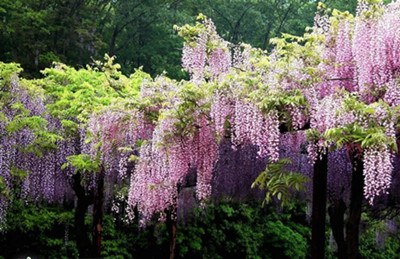
Wisteria, also known as tengluo, zhuteng, and huanghuan, Latin name: wisteria sinensis, belongs to the Fabaceae family, Wisteria genus, a deciduous climbing vine. The stem twines counterclockwise, the branches are relatively thick and sturdy, young branches are covered with white soft hairs, later becoming smooth; winter buds are oval. It is a deciduous climbing and twining large vine with dark gray bark that does not split; it blooms in spring, with blue-purple pea-like corollas, the flowers purple or deep purple, very beautiful. Wisteria is a famous ornamental flowering vine native to China, with a long history of cultivation, with records of cultivation dating back to the Tang Dynasty. Also known as tengluo and zhuteng, it is a deciduous vine of the Fabaceae (Papilionaceae) family, Wisteria genus. The woody stem is thick and sturdy, the bark grayish-white, growing in a counterclockwise spiral direction, thus presenting spiral grooves, with prominent lenticels on the surface. Winter buds are closely pressed against the lateral branches, the buds covered with dark brown scales bearing white hairs. Odd-pinnate compound leaves are alternate, with 7—13 leaflets, oblong to ovate-lanceolate, entire margins, with white soft hairs on both sides when young, shedding as they mature. Racemes are borne at the tips of new branches or in leaf axils, 15—30 cm long, pendulous, each raceme bearing 50—100 small pea-like flowers, purple to pale purple, fragrant. The flowering period is from April to May; the pods are short-knife-shaped, about 15 cm long, grayish-green before maturity, covered with silvery-gray soft hairs, containing 1 to 3 seeds, maturing from October to November. Wild types include Nanjing wisteria, red wisteria, one-year wisteria, musk wisteria, wild white jade wisteria, white-flowered wisteria, three-foot wisteria, native white jade wisteria, Taiwan wisteria, double-flowered wisteria, etc.
Cultivation and Care
Wisteria has a long main root and few lateral roots. During transplanting, root damage should be minimized, and the roots should be trimmed with a sharp blade. The survival rate of spring and autumn transplanting is relatively high, and generally it does not need to be transplanted with soil. To promote luxuriant branches and abundant flowers in wisteria, more base fertilizer should be applied before planting to improve the soil. In the first few years, timely fertilization and watering are needed to promote growth and shaping. Wisteria is mostly planted as a climber. Because its branches are thick and leaves lush, and its flowers are numerous and the trunk heavy, a solid trellis should be made according to garden design requirements before planting or before the wisteria climbs, and the plant should be planted on the south side of the trellis. Wisteria planted in shrub form produces many long branches due to its climbing nature. Although it gives a striking impression during the growing season, it must be pruned when growing in shrub form. Due to the characteristics of flower bud differentiation, wisteria focuses on flowering on the short branches in the upper part of the vine canopy and the lower part of long branches. In the early stage of pot cultivation, the main focus is on cultivating the tree shape, promptly cutting off excess suckers and branches to promote the formation of the tree shape. For potted wisteria that has already been shaped, during the growing period, promptly cut off leggy and twining branches, and after flowering cut off the spent flowers; during the dormant period, cut off dead branches, overly dense branches, etc. Ground-planted wisteria grows quickly and should be pruned every year. The flower buds of wisteria are mainly borne at the base of the branches. If not pruned, the upper leaf buds will produce many leggy branches, consuming a large amount of nutrients and affecting normal flowering. Therefore, every spring the branches should be cut back, and overly dense branches and diseased or weak branches should be removed to promote flower bud formation. New branches of the current year should be properly tied and guided so that they are evenly distributed on the trellis surface. After flowering, if seeds are not wanted, the spent flower racemes can be promptly cut off.
Wisteria Cultivation and Management Techniques
Wisteria, also known as tengluo, zhuteng, and huanghuan, Latin name: Wisteria sinensis, belongs to the Fabaceae family, Wisteria genus, a deciduous climbing vine. The stem twines counterclockwise, the branches are relatively thick and sturdy, young branches are covered with white soft hairs, later becoming smooth; winter buds are oval. It is a deciduous climbing and twining large vine with dark gray bark that does not split; it blooms in spring, with blue-purple pea-like corollas, the flowers purple or deep purple, very beautiful. Wisteria is a famous ornamental flowering vine native to China, with a long history of cultivation, with records of cultivation dating back to the Tang Dynasty. Also known as tengluo and zhuteng, it is a deciduous vine of the Fabaceae (Papilionaceae) family, Wisteria genus. The woody stem is thick and sturdy, the bark grayish-white, growing in a counterclockwise spiral direction, thus presenting spiral grooves, with prominent lenticels on the surface. Winter buds are closely pressed against the lateral branches, the buds covered with dark brown scales bearing white hairs. Odd-pinnate compound leaves are alternate, with 7—13 leaflets, oblong to ovate-lanceolate, entire margins, with white soft hairs on both sides when young, shedding as they mature. Racemes are borne at the tips of new branches or in leaf axils, 15—30 cm long, pendulous, each raceme bearing 50—100 small pea-like flowers, purple to pale purple, fragrant. The flowering period is from April to May; the pods are short-knife-shaped, about 15 cm long, grayish-green before maturity, covered with silvery-gray soft hairs, containing 1 to 3 seeds, maturing from October to November. Wild types include Nanjing wisteria, red wisteria, one-year wisteria, musk wisteria, wild white jade wisteria, white-flowered wisteria, three-foot wisteria, native white jade wisteria, Taiwan wisteria, double-flowered wisteria, etc.
Cultivation and Care
Wisteria has a long main root and few lateral roots. During transplanting, root damage should be minimized, and the roots should be trimmed with a sharp blade. The survival rate of spring and autumn transplanting is relatively high, and generally it does not need to be transplanted with soil. To promote luxuriant branches and abundant flowers in wisteria, more base fertilizer should be applied before planting to improve the soil. In the first few years, timely fertilization and watering are needed to promote growth and shaping. Wisteria is mostly planted as a climber. Because its branches are thick and leaves lush, and its flowers are numerous and the trunk heavy, a solid trellis should be made according to garden design requirements before planting or before the wisteria climbs, and the plant should be planted on the south side of the trellis. Wisteria planted in shrub form produces many long branches due to its climbing nature. Although it gives a striking impression during the growing season, it must be pruned when growing in shrub form. Due to the characteristics of flower bud differentiation, wisteria focuses on flowering on the short branches in the upper part of the vine canopy and the lower part of long branches. In the early stage of pot cultivation, the main focus is on cultivating the tree shape, promptly cutting off excess suckers and branches to promote the formation of the tree shape. For potted wisteria that has already been shaped, during the growing period, promptly cut off leggy and twining branches, and after flowering cut off the spent flowers; during the dormant period, cut off dead branches, overly dense branches, etc. Ground-planted wisteria grows quickly and should be pruned every year. The flower buds of wisteria are mainly borne at the base of the branches. If not pruned, the upper leaf buds will produce many leggy branches, consuming a large amount of nutrients and affecting normal flowering. Therefore, every spring the branches should be cut back, and overly dense branches and diseased or weak branches should be removed to promote flower bud formation. New branches of the current year should be properly tied and guided so that they are evenly distributed on the trellis surface. After flowering, if seeds are not wanted, the spent flower racemes can be promptly cut off.
Pruning and Care
Dormant-season pruning mainly involves adjusting the vine form so that its growth direction is fixed, thinning branches appropriately to make use of nutrient space, and removing some non-flowering branches.
Post-flowering pruning can use heavy pruning of the previous year's branches and removal of excessive shoots to appropriately reduce height, ensuring the shrub form and sufficient vigorous branches for the current year's growth. After autumn and before flower bud differentiation, the branches should be appropriately cut back and thinned to help preserve the lower buds of long branches for differentiation into flower buds.
After leaf drop in winter, carry out a comprehensive pruning of the plant, cutting off dead branches and shortening the current year's branches by 1/3 to 2/3, so that they vary in length and are well arranged. In winter, move it to a cold room or overwinter it outdoors in a wind-sheltered, sunny spot; as long as the potting soil does not freeze, it can overwinter safely. After budding in spring, promptly remove overly dense buds so that nutrients are concentrated on the retained branches, which is beneficial for flowering. Repot once every 1—2 years before spring budding; when repotting, remove part of the old soil and place some decomposed animal hoof pieces, crushed bone residue, and other fertilizers with relatively high phosphorus content at the bottom of the pot as base fertilizer. The potting soil should be loose, fertile, and well-drained slightly acidic soil.
Fertilization and Care
Fertilization and Care: Wisteria fertilization should be divided into 3 steps: (1) In autumn, apply base fertilizer around the base of the wisteria stem, preferably organic fertilizer, and water after application. (2) Before budding in early spring, apply a concentrated nitrogen-phosphorus-potassium compound fertilizer once every half month, preferably 2 times; before flowering, apply an additional fertilizer mainly of phosphorus and potassium. Do not use too much nitrogen fertilizer, otherwise it will only grow branches and leaves, with few or no flowers. (3) After flowering, prune promptly, cut off the flower stalks, and apply 1 time a mixed fertilizer mainly of nitrogen or base fertilizer.
Specific Measures
(1) Watering
Wisteria consumes a lot of water, but it should still be kept dry rather than wet. If the potting soil is only moist and never dries, it is not conducive to flowering. Watering should follow the principle of not watering until dry, and watering thoroughly when watering. Especially during the flower bud differentiation period in August, water should be withheld appropriately. Normal watering can be carried out in September. After leaf drop in late autumn, water less. During the spring and summer growing period, water fully and keep the potting soil moist regularly. After autumn, control watering to prevent the sprouting of autumn shoots, which is beneficial for more flowering the following year.
(2) Fertilization
Applying thin fertilizer frequently is an important measure for making wisteria flowers abundant and leaves lush. During the growing period, in combination with watering, apply dilute cake fertilizer once every half month until fertilization is stopped in July——August. Continue fertilizing in September, but the frequency and concentration should both be appropriately reduced. Before flowering, appropriately increase the application of phosphorus and potassium fertilizers. Wisteria should be given dilute cake fertilizer water once every half month during the growing period, and phosphate fertilizer applied before flowering, which can make the flowers abundant and the leaves lush and increase the ornamental effect.
(3) Pruning
When wisteria sprouts tender buds in spring, appropriately remove dense buds. When new branches grow to more than 20 cm long, the overly long parts can be cut off. At ordinary times, pay attention to cutting off leggy branches, diseased branches, and weak branches at any time. During the dormant period, pruning should also be carried out. In September, the old leaves of wisteria tend to age and droop, affecting the appearance. The old leaves can be removed to encourage the sprouting of new leaves. The newly sprouted leaves are tender green and delicate, which can delay leaf drop and extend the ornamental period.
(4) Pests and Diseases
Wisteria has leaf-eating pests such as lappet moths, aphids, and slug moths. Lappet moths can be controlled by spraying with trichlorfon or phoxim at 300 times dilution. Aphids and slug moths can be controlled by spraying with 80% thiophanate-methyl at 1200 times dilution (preferably for control from May to June).
Summer: The leaves of wisteria then take on a dark green color. It extends powerful sinews and bones, and the leaves become more and more numerous, growing extremely luxuriantly. Walking into the corridor, everything is clear and green, and even clothes are tinted with a faint green. Accompanied by the sounds of birds, wandering through it gives a feeling of relaxed and joyful heart. Only then does one notice a gentle breeze blowing past, carrying waves of refreshing fragrance.
Autumn: It is like a beautiful poem, a wonderful painting. The yellow wisteria leaves slowly drift down with the autumn wind.
Winter: It is more like a clean young girl. On the abrupt vine stems, pure white snow accumulates, clad in silver, extremely charming.
If potted wisteria is not properly maintained and managed, the phenomenon of not flowering often occurs. Potted wisteria: if overwintered indoors, the room temperature should not be too high, otherwise it cannot obtain sufficient dormancy and will consume too much stored nutrients, affecting flowering the following year. Apply fertilizer in appropriate amounts: for potted wisteria, lack of fertilizer or excessive fertilization will affect flowering. Generally, apply diluted cake fertilizer water before flowering and long-acting phosphate fertilizer after flowering to promote flower bud differentiation. Do not fertilize again in winter and summer. The branches and vines of potted wisteria will elongate and twine, consuming nutrients. If this is found, it should be cut off immediately; otherwise, the twining branches and vines will grow rapidly and the plant will not flower.
Wisteria Cultivation and Management Techniques
Wisteria, also known as tengluo, zhuteng, and huanghuan, Latin name: wisteria sinensis, belongs to the Fabaceae family, Wisteria genus, a deciduous climbing vine. The stem twines counterclockwise, the branches are relatively thick and sturdy, young branches are covered with white soft hairs, later becoming smooth. Winter buds are oval. It is a deciduous climbing and twining large vine with dark gray bark that does not split. It blooms in spring, with blue-purple pea-like corollas, the flowers purple or deep purple, very beautiful. Wisteria is a famous ornamental flowering vine native to China, with a long history of cultivation, with records of cultivation dating back to the Tang Dynasty. Also known as tengluo and zhuteng, it is a deciduous vine of the Fabaceae (Papilionaceae) family, Wisteria genus. The woody stem is thick and sturdy, the bark grayish-white, growing in a counterclockwise spiral direction, thus presenting spiral grooves, with prominent lenticels on the surface. Winter buds are closely pressed against the lateral branches, the buds covered with dark brown scales bearing white hairs. Odd-pinnate compound leaves are alternate, with 7—l3 leaflets, oblong to ovate-lanceolate, entire margins, with white soft hairs on both sides when young, shedding as they mature. Racemes are borne at the tips of new branches or in leaf axils, l5—30 cm long, pendulous, each raceme bearing 50—l00 small pea-like flowers, purple to pale purple, fragrant. The flowering period is from April to May; the pods are short-knife-shaped, about l5 cm long, grayish-green before maturity, covered with silvery-gray soft hairs, containing l to 3 seeds, maturing from l0 to ll months. Wild types include Nanjing wisteria, red wisteria, one-year wisteria, musk wisteria, wild white jade wisteria, white-flowered wisteria, three-foot wisteria, native white jade wisteria, Taiwan wisteria, double-flowered wisteria, etc.
Cultivation and Care
Wisteria has a long main root and few lateral roots. During transplanting, root damage should be minimized, and the roots should be trimmed with a sharp blade. The survival rate of spring and autumn transplanting is relatively high, and generally it does not need to be transplanted with soil. To promote luxuriant branches and abundant flowers in wisteria, more base fertilizer should be applied before planting to improve the soil. In the first few years, timely fertilization and watering are needed to promote growth and shaping. Wisteria is mostly planted as a climber. Because its branches are thick and leaves lush, and its flowers are numerous and the trunk heavy, a solid trellis should be made according to garden design requirements before planting or before the wisteria climbs, and the plant should be planted on the south side of the trellis. Wisteria planted in shrub form produces many long branches due to its climbing nature. Although it gives a striking impression during the growing season, it must be pruned when growing in shrub form. Due to the characteristics of flower bud differentiation, wisteria focuses on flowering on the short branches in the upper part of the vine canopy and the lower part of long branches. In the early stage of pot cultivation, the main focus is on cultivating the tree shape, promptly cutting off excess suckers and branches to promote the formation of the tree shape. For potted wisteria that has already been shaped, during the growing period, promptly cut off leggy and twining branches, and after flowering cut off the spent flowers. During the dormant period, cut off dead branches, overly dense branches, etc. Ground-planted wisteria grows quickly and should be pruned every year. The flower buds of wisteria are mainly borne at the base of the branches. If not pruned, the upper leaf buds will produce many leggy branches, consuming a large amount of nutrients and affecting normal flowering. Therefore, every spring the branches should be cut back, and overly dense branches and diseased or weak branches should be removed to promote flower bud formation. New branches of the current year should be properly tied and guided so that they are evenly distributed on the trellis surface. After flowering, if seeds are not wanted, the spent flower racemes can be promptly cut off.