Nandina propagation methods illustrated, easy to understand at a glance
Nandina (Nandina domestica) likes a warm and humid environment, is relatively shade-tolerant and cold-tolerant, easy to care for, prefers fertile sandy loam with good drainage, and is not very strict about water requirements, tolerating both moisture and drought. Several propagation techniques for nandina are introduced below:
1. Division method: In spring and autumn, dig out the clustered plants, shake off the old soil, and cut them apart at the weak points where the bases join. Each division should have 2 to 3 stems and must include part of the root system. At the same time, cut off some of the larger pinnate compound leaves. Plant in the ground or in pots, and after one to two years of growing on, they can bloom and bear fruit.
2. Cutting method: Spring cuttings are mostly used, in February and March. Select one- to two-year-old stems and cut them into sections 20 to 25 cm long. Cut off most of the leaves (it is best to keep the terminal bud). After treatment with rooting powder, insert them into a sandy loam seedbed. The insertion depth should be about 1/2 to 2/3 of the cutting length, with a spacing of about 5 cm and row spacing of 10 to 15 cm. After inserting, water thoroughly. After summer begins, a shade shed needs to be built, and roots generally form after two months. Cuttings can also be taken during the plum rain season or in autumn using the same method as spring cuttings, but the cutting medium should be yellow subsoil, or it can also be made by mixing alkaline-leached rice husk ash and fine sand at a ratio of 1:1. Current-year branches can be used as cuttings, covered with plastic film to retain moisture and promptly shaded with a shed, and roots can form after one month.
3. Sowing method: At the end of December each year or in January or February of the following year, pick fully mature, plump fruits that are about to fall. Mix them with coarse sand and rub them in water to remove the fruit skin and pulp, and float off the empty, shriveled seeds to obtain pure seeds. Mix the pure seeds with moist fine sand at a ratio of 1:3, then store them in a large vat or large flower pot. Be careful to always keep them moist; when the sand grains are found to have turned white and dry, spray water to increase humidity. Turn over and inspect once every half month to prevent the seeds from becoming moldy or being stolen and eaten by mice.
In September the seeds crack and show white, and they are sown onto a prepared seedbed. Generally, drilling is used, with row spacing of 15 to 20 cm, trench width of 10 cm, trench depth of 5 to 8 cm, and seed spacing of 1 to 2 cm. Lightly cover with a thin layer of soil 0.5 to 1 cm thick, just enough that the seeds are no longer visible. Then cover with grass to retain moisture. After half a month, 70% of the seedlings emerge. Remove the covering grass in two or three stages, build a shed for shade, and strengthen water and fertilizer management. In the same year the seedlings can reach five or six cm tall, and in winter they should be protected appropriately against the cold. The harvested fruits can also be sown directly in the seedbed without treatment, with trench width of 10 to 15 cm, depth of 5 to 6 cm, and row spacing of 20 to 25 cm, covered with burned soil 3 to 4 cm deep, then covered with grass to retain moisture. Seedlings will only emerge after September, and during this period the seedbed must be kept moist.
Nandina - Nandina cultivation methods | Nandina pictures
Nandina
Nandina (Latin family name: Berberidaceae), also called nandina, red loquat fruit, heavenly candle fruit, red wolfberry, diamond yellow, heavenly bamboo, orchid bamboo, etc., is an evergreen shrub. Nandina is a common woody flower species in southern China. Because of its graceful plant form, bright fruits and strong adaptability to the environment, it often appears in landscaping applications.Nandina cultivation methods
1. Soil: Nandina requires fertile, well-drained sandy loam for cultivation, and slightly acidic soil is suitable. It can be prepared at a ratio of 5 parts sandy soil, 4 parts leaf mold, and 1 part manure soil.
2. Watering: Nandina should be watered by the principle of drying out then soaking. In dry seasons, water frequently to keep the soil moist; in summer, water once a day and mist the leaf surface 2 to 3 times to keep the leaves moist and prevent the leaf tips from drying and scorching, which would harm the appearance. Especially during flowering, attention should be paid to watering so the potting soil does not dry out, and water should be sprinkled on the ground to raise air humidity so as to help increase the pollination rate. In winter the plant is in a semi-dormant state, so do not let the potting soil become too wet.
3. Sunlight: Nandina is best cared for in a semi-shaded, cool, humid place. Under strong light, the stems become thick and short and turn dark red, young leaves are "burned", and mature leaves turn red; in a very shady place, the stems are thin and the leaves are long, and the plant clump is loose, which detracts from its ornamental value and is also unfavorable for fruiting.
Uses of nandina
Uses of nandina: 1. Ornamental
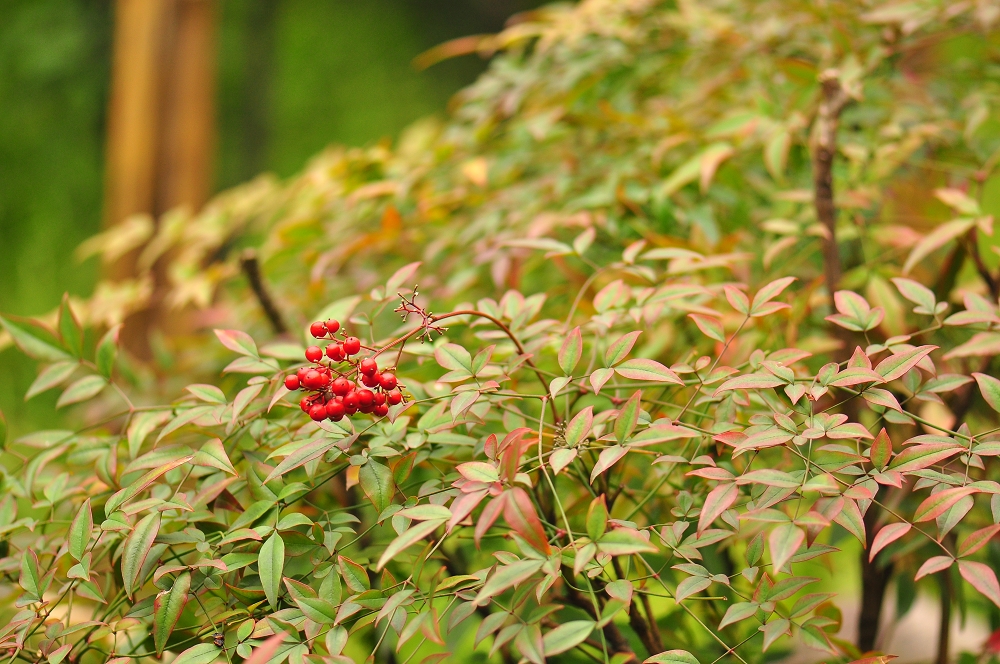
Nandina's branches and trunks are upright like bamboo, and its pinnate leaves spread out beautifully. In autumn and winter they turn red, exceptionally gorgeous. On the spike-like fruit clusters, red fruits hang in abundance, bright and eye-catching. In classical gardens it is often planted beside rockery stones and in courtyard corners. Small plants are suitable for potted display to beautify the home.
Uses of nandina: 2. Medicinal
Nandina has relatively high medicinal value. A decoction of its leaves has inhibitory effects on Staphylococcus aureus, Shigella flexneri, Salmonella typhi, Pseudomonas aeruginosa, and Escherichia coli. It can treat colds, whooping cough, red swollen painful eyes, scrofula, and blood in the urine. The fruit astringes the lungs and stops cough, clears the liver and improves vision. It treats chronic cough, asthma, and malaria. The root dispels wind, clears heat, removes dampness, and resolves phlegm. It treats wind-heat headache, lung-heat cough, damp-heat jaundice, and wind-damp painful obstruction.
How to grow nandina
Evergreen upright shrub, plant height about 1 to 2 m. Clustered, few branches. Three-times pinnate compound leaves, total length about 30 cm, alternate, leaflets elliptical-lanceolate, entire, leaves thin, sessile, some leaves turn red after autumn. Terminal panicle, small flowers white, flowering period May to July; berry spherical, red, ripening September to October, not easy to fall.
Ecological habits: Likes a warm, humid climate, and likes semi-shade and a well-ventilated environment. Suitable growth temperature 15 to 30, relatively strong cold resistance; in winter a low temperature of -5 does not cause freezing damage. In courtyards in Beijing and central Hebei and other areas, open-ground planting should choose a wind-sheltered, sunny spot, and with cold protection it can overwinter. Avoids strong light, and in summer should be shaded appropriately. Under strong light, the stems become thick and short, dark red, young leaves are scorched, and leaf margins often become scorched and rather rough, and the leaves will turn red, affecting fruiting. In autumn and winter under sunlight, the plant's leaves change from green to red, enhancing the ornamental effect. It is not strict about soil requirements, and likes slightly acidic, fertile, humus-rich, well-drained sandy loam. It can tolerate poor soil and slightly alkaline soil. It is not strict about water requirements and is drought-tolerant.
Propagation: Mainly by sowing and division, and also by cuttings. For sowing propagation, sow the fruits as soon as they are harvested, or carry out spring sowing. Because nandina seeds are seeds with an underdeveloped embryo, sand storage treatment can be used. Seedlings are relatively difficult to germinate and need about 3 months to emerge. Before emergence, the medium must be kept moist. After emergence, shading is needed; once the plants grow true leaves, the shading can be removed and the seedlings hardened off. When the low temperature is below 0, protect the seedlings from freezing. After 2 to 3 years they can grow into large plants and bloom and bear fruit. Nandina produces many suckers, so 2 to 3 sucker shoots can be cut off and planted as divisions with roots, and after 2 to 3 years of growing on they can bloom and bear fruit. Division should be done before spring sprouting or in autumn. For potted divided seedlings, shade treatment should be carried out after separate planting for recovery, and normal management can begin after 15 days. For cutting propagation, select robust one- to two-year-old stems and cut them into cuttings, each 15 to 20 cm long, with 3 to 4 nodes per cutting. The lower end of the cutting is cut flat, more than 1 cm from the upper stem node, and the lower end of the cutting is cut at a slant; remove the lower leaves and keep a small number of leaves at the upper end. Before cutting, the base of the cutting can be soaked for 10 seconds in a 0.1 concentration aqueous solution of naphthalene acetic acid, or the base of the cutting can be dipped in rooting powder. During cutting, the medium moisture must be maintained, and roots can form in 35 to 45 days.
Is nandina toxic
Nandina is toxic, and the toxicity is in the whole plant. Symptoms of poisoning are excitement, pulse first fast then slow and irregular, decreased blood pressure, muscle spasms, respiratory paralysis, coma, etc. Plants that can be used as medicinal materials are more or less toxic to some degree. The severity of toxicity is related to the amount, and after all, only a minority of plants contain toxic chemical components.
Nandina market price
What is the market price of nandina? Depending on height, it ranges from 0.8 yuan to 15 yuan
Related encyclopedia
Pocket scale non-woven bag rush pith bamboo shoot crab claw Redmi Note 3 YKK zipper YBS zipper large mountain cherry climbing rose wall plum wild senna winter plum green pine wristwatch Omega Longines famous watch children's building blocks flint nobile orchid curling iron soursop
How to propagate nandina, nandina propagation methods / sowing / division / cuttings
Nandina is a relatively common flowering plant in people's lives, and many people in China grow it. As more people grow it, how to propagate it has also become a matter of concern. So how is nandina propagated? What exactly are the propagation methods for nandina? Below, the editor will introduce them to you.
1. How to propagate nandina, sowing / division / cuttings
When it comes to how to propagate nandina, it is actually mainly divided into three methods. Nandina propagation is mainly by sowing and division, and cuttings can also be used. When the fruits are ripe, they can be sown as soon as they are harvested. Let us look at these three propagation methods together below.
2. Nandina propagation methods
Sowing propagation
1. Seed germination
After harvesting nandina seeds, it is best to first soak the seeds for 1-2 days to germinate them before sowing. Wait until the seeds begin to absorb water and swell, then take them out and sow them. This can increase the seed germination rate, and the practical rate is still very high.
2. Sowing method
Among nandina propagation methods, sowing propagation is a relatively commonly used method. First, evenly scatter the germinated seeds into the potting soil, then cover them with 1-2 cm of soil, and afterward water them. When watering, be careful to water thoroughly at once, and remember not to let water accumulate. About 10 days after watering, the seeds can germinate.
Division propagation
In spring and autumn, we can dig out the clustered plants, then shake off the old soil, and cut them apart at the weak points where the bases join. Each division should have 2 to 3 stems and must include part of the root system. At the same time, cut off some of the larger pinnate compound leaves. Plant in the ground or in pots. After 1-2 years of cultivation in this way, they can bloom and bear fruit.
Cutting propagation
1. Cutting selection
Before carrying out cutting propagation, we must first select cuttings (nandina branches). It is best to choose relatively thick, pest- and disease-free branches, as the survival rate will be relatively high. If you choose branches that look very weak, it will be very difficult for them to survive, so choosing cuttings is a very important point.
2. Cutting method
Among nandina propagation methods, although cutting propagation is not very commonly used, its survival rate is by no means low. As long as you master the correct method, it is still very easy to succeed. Before cutting, we can use chopsticks to poke a hole in the potting soil, then insert the cutting into it and water it. About 15-20 days after watering, it can take root.
Summary: After reading the above content, I believe everyone has gained a certain understanding of how to propagate nandina. The editor will introduce nandina propagation methods here. After everyone successfully propagates it according to the above methods, we then need to care for it. If you do not know how to grow it, you can refer to the article on nandina cultivation methods, which contains detailed care instructions.