Detailed Explanation of the Key Points of Flowering Pomegranate Cultivation and Management Techniques
1) Soil management: Leave a tree disc with a diameter of 1 meter under the tree. In areas where the summer soil temperature is too high, or in courtyards with cement paving, organic matter (straw, rice husks, sawdust, etc.) can be used to cover the tree disc, or grass can be grown on the tree disc (planting a lawn), to achieve cooling and moisture retention and promote normal growth and development. Where no covering or grass is used, carry out 3-4 rounds of intertillage and weeding on the tree disc each year, with an intertillage depth of 5-10 cm.
2) Fertilization: After the seedlings survive in the year of planting, apply a small amount of fertilizer to the tree disc once a month from May to July, pouring 1-2 kg of decomposed manure water plus a small amount of urea per plant. Before leaf fall in autumn, dig a ring-shaped trench and apply 20-30 kg of organic fertilizer per plant. From the second year to the full fruiting period, apply base fertilizer once a year in a ring-shaped trench, and apply compound fertilizer and decomposed manure water 3-4 times a year by hole application or broadcast application on the tree disc; the amount of fertilizer should be adjusted according to the yield. At the same time, pay attention to foliar topdressing during the growing season, mainly nitrogen fertilizer in the early stage and mainly phosphorus and potassium fertilizer in the middle and late stages, with the total concentration of the fertilizer solution not exceeding 0.3%. For topdressing outside the roots, biogas slurry or decomposed manure water can also be sprayed.
3) Irrigation and drainage: The key periods for watering pomegranate are mainly the bud burst stage, the fruit expansion stage and the period before leaf fall, and it is more suitable to keep soil moisture at 60-80%; at other times, it should be managed flexibly mainly according to soil moisture. Pomegranate is drought-resistant but not waterlogging-resistant, so attention should be paid to drainage during the growing season to prevent water from accumulating in the soil and on the tree disc for too long and causing waterlogging damage.
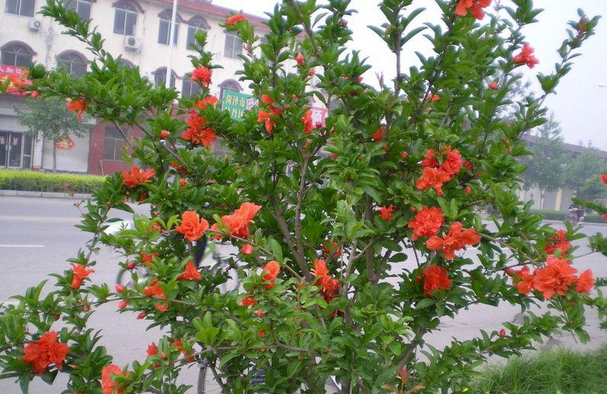
Training and pruning.
1. Pomegranate training
Pomegranate trees like light. For courtyard pomegranate training, both the growth and fruiting characteristics of the pomegranate and a certain ornamental value should be considered. The commonly used tree forms are mostly trunkless clump forms or forms without a central leader, mainly the "V" shape, the natural open-center shape, and so on.
1) "V" shape: It is divided into two types, with a trunk and without a trunk. From the ground (without a trunk) or on the trunk, select and retain two main branches extending symmetrically to both sides, with an angle of 45-55° between the main branches and the ground. On each main branch, arrange 2-3 side branches respectively. The first side branch is about 60-70 cm from the base of the main branch, the second side branch is on the opposite side of the first side branch, and the third side branch is on the same side as the first side branch, with a spacing of 50-60 cm between side branches. Reasonably equip fruiting branch groups on the main and side branches. The key to training is to make the main branches extend smoothly. That is, during winter pruning in the first 2-3 years after planting, heavy heading-back should be carried out on the main branches to promote the buds at the pruning cut to send out strong shoots as extension branches.
Cultivation and Management Techniques for Flowering Pomegranate
I. Soil management: Leave a tree disc with a diameter of 1 meter under the tree. In areas where the summer soil temperature is too high, or in courtyards with cement paving, organic matter (straw, rice husks, sawdust, etc.) can be used to cover the tree disc, or grass can be grown on the tree disc (planting a lawn), to achieve cooling and moisture retention and promote normal growth and development. Where no covering or grass is used, carry out 3-4 rounds of intertillage and weeding on the tree disc each year, with an intertillage depth of 5-10 cm.II. Fertilization: After the seedlings survive in the year of planting, apply a small amount of fertilizer to the tree disc once a month from May to July, pouring 1-2 kg of decomposed manure water plus a small amount of urea per plant. Before leaf fall in autumn, dig a ring-shaped trench and apply 20-30 kg of organic fertilizer per plant. From the second year to the full fruiting period, apply base fertilizer once a year in a ring-shaped trench, and apply compound fertilizer and decomposed manure water 3-4 times a year by hole application or broadcast application on the tree disc; the amount of fertilizer should be adjusted according to the yield. At the same time, pay attention to foliar topdressing during the growing season, mainly nitrogen fertilizer in the early stage and mainly phosphorus and potassium fertilizer in the middle and late stages, with the total concentration of the fertilizer solution not exceeding 0.3%. For topdressing outside the roots, biogas slurry or decomposed manure water can also be sprayed.
III. Irrigation and drainage: The key periods for watering pomegranate are mainly the bud burst stage, the fruit expansion stage and the period before leaf fall, and it is more suitable to keep soil moisture at 60-80%; at other times, it should be managed flexibly mainly according to soil moisture. Pomegranate is drought-resistant but not waterlogging-resistant, so attention should be paid to drainage during the growing season to prevent water from accumulating in the soil and on the tree disc for too long and causing waterlogging damage.
IV. Pomegranate training
Pomegranate trees like light. For courtyard pomegranate training, both the growth and fruiting characteristics of the pomegranate and a certain ornamental value should be considered. The commonly used tree forms are mostly trunkless clump forms or forms without a central leader, mainly the "V" shape, the natural open-center shape, and so on.
1. "V" shape: It is divided into two types, with a trunk and without a trunk. From the ground (without a trunk) or on the trunk, select and retain two main branches extending symmetrically to both sides, with an angle of 45-55° between the main branches and the ground. On each main branch, arrange 2-3 side branches respectively. The first side branch is about 60-70 cm from the base of the main branch, the second side branch is on the opposite side of the first side branch, and the third side branch is on the same side as the first side branch, with a spacing of 50-60 cm between side branches. Reasonably equip fruiting branch groups on the main and side branches. The key to training is to make the main branches extend smoothly. That is, during winter pruning in the first 2-3 years after planting, heavy heading-back should be carried out on the main branches to promote the buds at the pruning cut to send out strong shoots as extension branches.
2. Natural open-center shape: A tree form with a trunk, with a trunk height of 60-100 cm. On the trunk, select and retain 3-4 reasonably oriented branches as main branches, with a horizontal projection angle of 90-120° between main branches and an angle of 45-60° between the main branches and the trunk. On the main branches, select and retain the first side branch at 50-60 cm from the trunk, and at 40-50 cm from the first side branch, select and retain the second side branch on the opposite side of the first main branch. It is suitable to select and retain 6-8 side branches for the whole tree, and equip fruiting branch groups on the main and side branches.
V. Pruning. The principles of pomegranate pruning are: having a form but not rigidly fixed, and not becoming chaotic without a form, achieving sparse upper parts and dense lower parts, sparse outer parts and dense inner parts, sparse large branches and dense small branches, and ensuring sufficient light inside the tree canopy. Winter pruning is mainly thinning and long-term retention, mainly removing crossing and overlapping branches, densely growing branches, diseased and pest-infested branches, vigorous growing branches, and water sprouts, so as to avoid disrupting the tree form. During the growing season, remove excess sprouted suckers to reduce the consumption of nutrients by excess branches and leaves.
In the first 3-4 years after planting, training should be the main focus. From the third year onward, carry out girdling and other treatments on some auxiliary branches to promote flowering and fruiting. For trees beginning to bear fruit, while promoting flowering and fruiting, the cultivation of main framework branches at all levels and the equipping of fruiting branch groups should continue to be improved. The mixed buds (flower buds) of pomegranate are borne at the top or near the top of moderate shoots. Therefore, for these short branches, fruiting mother branches should be retained and left unpruned for a long time, and heading-back pruning is prohibited, so as to use them for fruiting. For strong vigorous branches and water sprouts that have available space, girdling, ring cutting or branch bending should be carried out to moderate the growth vigor and promote flower formation and fruiting; those with no available space or that have already affected the growth of framework branches should be resolutely removed.
During the full fruiting period, fruiting branch groups should be promptly retracted or alternately renewed, drooping branches should be appropriately retracted, strong vigorous branches should be reasonably used, and thin and weak branches and densely growing branches should be removed, so as to maintain a good tree structure and delay senescence.
VI. Disease and pest control:
Courtyard pomegranates generally have relatively mild diseases and pests. Disease and pest control is mainly based on prevention and manual control. After leaf fall, promptly clean up and remove dead branches, diseased branches and fallen leaves, and burn them in a centralized manner. Before bud burst, spray 5°Be lime sulfur mixture to kill overwintering diseases and pests. During the growing season, frequently remove diseased and pest-infested branches, leaves and fruits by hand, and scrape off diseased spots; manually capture pests and egg masses. When necessary, spray insecticides and fungicides for chemical control. When spraying, choose biological and mineral-source pesticides that are non-toxic to humans and livestock, or low-toxicity, low-residue chemical pesticides.
What are the cultivation and management techniques for flowering pomegranate, and the corresponding precautions
What cultivation and management techniques and care methods are there for flowering pomegranate? This has always been a topic of relatively great concern among flower enthusiasts. Today, the editor has compiled for everyone the specific methods related to flowering pomegranate cultivation and management, hoping to provide help to everyone.
Soil
Leave a tree disc with a diameter of 1 meter under the tree. In areas where the summer soil temperature is too high, achieve cooling and moisture retention and promote normal growth and development. Where no covering or grass is used, carry out 3-4 rounds of intertillage and weeding on the tree disc each year, with an intertillage depth of 5-10 cm.
Fertilization
After the seedlings survive in the year of planting, apply a small amount of fertilizer to the tree disc once a month from May to July, pouring 1-2 kg of decomposed manure water plus a small amount of urea per plant. Before leaf fall in autumn, dig a ring-shaped trench and apply 20-30 kg of organic fertilizer per plant. From the second year to the full fruiting period, apply base fertilizer once a year in a ring-shaped trench, and apply compound fertilizer and decomposed manure water 3-4 times a year by hole application or broadcast application on the tree disc; the amount of fertilizer should be adjusted according to the yield.
Irrigation and drainage
The key periods for watering pomegranate are mainly the bud burst stage, the fruit expansion stage and the period before leaf fall, and it is more suitable to keep soil moisture at 60-80%; at other times, it should be managed flexibly mainly according to soil moisture. Pomegranate is drought-resistant but not waterlogging-resistant, so attention should be paid to drainage during the growing season to prevent water from accumulating in the soil and on the tree disc for too long and causing waterlogging damage.
Training and pruning
Pomegranate trees like light. For courtyard pomegranate training, both the growth and fruiting characteristics of the pomegranate and a certain ornamental value should be considered. The commonly used tree forms are mostly trunkless clump forms or forms without a central leader, mainly the "V" shape, the natural open-center shape, and so on.
The above is the knowledge about pomegranate trees that I have introduced for everyone. If you want to learn more information, please continue to follow Duorou Huapu, and we will provide you with more information.