What are the cultivation methods and precautions for Darlingtonia californica (cobra lily)
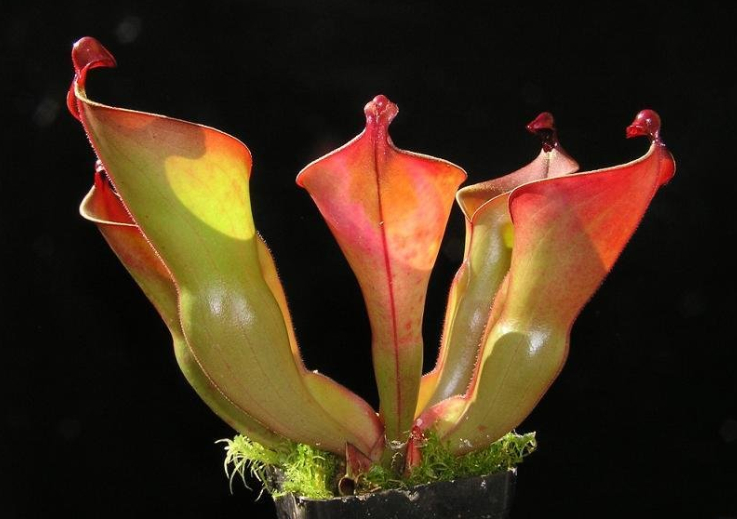
Watering requires water with low mineral content (such as rainwater, purified water, etc.); it tolerates cold but fears heat, especially the roots must stay icy cold, and there must be a large temperature difference between day and night; it likes strong light, and when the temperature is not too high, it can be exposed to sunlight, and the top of the plant will show a red vein pattern, which is very beautiful; if fertilization is needed, spray at more than 1/5 of the indicated concentration.
Cultivation methods
Survival temperature: -10-30
Suitable temperature: 15-27
Growing medium: peat, sphagnum moss, perlite, sand, etc.
Environmental humidity: >50%
Place of origin: Darlingtonia californica is one of the more difficult carnivorous plants to cultivate. It needs a relatively high daytime temperature and a relatively low nighttime temperature. Its native habitat is marshes or riverbanks with cold mountain springs flowing in year-round, so the roots can remain at a relatively low temperature all the time. Therefore, the best simulation method in cultivation is to grow it with cool purified water. When the weather is hot, ice cubes can be placed on the soil surface to lower the temperature. In a high-humidity, warm environment, the plant can be given sufficient sunlight; if the humidity is low or fluctuates greatly, then a little shade is needed.
Growing Darlingtonia californica from seedlings is very difficult and slow, so it is usually propagated in late winter or spring using its stolons. Usually from the spring equinox to late spring, many small buds grow on the nodes of the stolons. Cut the stolons into several segments, each with some roots. Then place these stem segments on cool, moist chopped sphagnum moss, maintaining a bright and highly humid environment. After a few weeks, buds can be seen developing.
Like other carnivorous plants that grow in temperate regions, Darlingtonia californica needs winter dormancy to survive long term. The plant stops growing for 3 to 5 months in winter. Until close to spring, mature plants will produce a single flower, and after a few weeks will grow several large pitcher traps. Throughout summer it will continuously grow pitcher traps, but their size is far smaller than the spring pitcher traps.
Many growers have successfully cultivated Darlingtonia californica and have found three forms: all green, all red, and red-green. Wild Darlingtonia californica is all green under ordinary light intensity, and appears red-green under strong light.
What to pay attention to when cultivating Darlingtonia californica, precautions for cultivating cobra lily
Darlingtonia californica is a very interesting potted ornamental plant, so everyone likes it very much, and many people grow it in their bedrooms or on balconies. Recently a few friends asked me what to pay attention to when cultivating Darlingtonia californica, so today the editor will tell everyone about the precautions for cultivating Darlingtonia californica.
Darlingtonia californica is also a carnivorous plant, native to northern California and Oregon in the United States. Because it closely resembles a cobra, it is favored by many flower growers. Below is an explanation of the precautions for cultivating Darlingtonia californica:
The growing medium for Darlingtonia californica can be peat, sand, sphagnum moss, peat, perlite, coconut husk, etc.
The water used to irrigate Darlingtonia californica must be soft water, namely rainwater, distilled water, reverse osmosis deionized water, etc. Because tap water in most areas contains a large amount of minerals, especially calcium salts, and carnivorous plants such as Darlingtonia californica mostly grow in poor acidic soil and are very sensitive to calcium salts.
Darlingtonia californica tolerates cold but fears heat, especially the roots must stay icy cold, and there must be a large temperature difference between day and night; 15~27 degrees is its most suitable growing temperature, and it can withstand a minimum temperature of minus 10 and a maximum temperature of 30 degrees.
Darlingtonia californica likes strong light. When the temperature is not too high, it can be exposed to sunlight, and at the same time the top of the plant will show a red vein pattern, which is very beautiful.
What to pay attention to when cultivating Darlingtonia californica
Darlingtonia californica is susceptible to damage by aphids or mealybugs. Smaller infestations can be removed by hand, while larger infestations should be treated with insecticides as appropriate; commonly used insecticides include isopropyl alcohol, diazinon, malathion, and acephate. The greatest threat to Darlingtonia californica is gray mold, and the control method is to place it in a cool, well-ventilated environment and promptly remove diseased branches, which can effectively inhibit the development of gray mold. Use fungicides when necessary.
The above article has introduced in detail what to pay attention to when cultivating Darlingtonia californica, and also told everyone the precautions for cultivating Darlingtonia californica. I hope this article can help everyone better grow our beloved Darlingtonia californica and keep them from being harmed. If there is anything you still do not understand, you can pay more attention to our Huobao Agricultural Materials Network to learn more agricultural information.
Carnivorous plants Cultivation methods of Darlingtonia californica
Darlingtonia californica (scientific name: Darlingtonia californica) is one of the genera in the Sarraceniaceae family. It is a carnivorous plant mainly distributed in northern California and Oregon in the United States. Darlingtonia californica is a very well-known species of carnivorous plant, named for its resemblance to a cobra, and is a target for many collectors. The leaves of Darlingtonia californica are of two types. The leaves are arranged in a rosette, and each adult growing point consists of 3 to 14 leaves. The leaves of seedlings remain simple tubular shapes with tapering tips within 2 to 3 years. Young leaves are generally 1 to 3 cm long and range from red-green to red.
Cultivation methods of pitcher plants
Temperature:It likes warm winters and cool summers, with a suitable growing temperature of 10~20°C, and is relatively cold-tolerant. In winter, the plant is in dormancy, and the temperature should not be lower than -5°C, but it is best to maintain a temperature above 8C. In summer it does not tolerate dryness and high temperatures, with a suitable growing temperature of 20~26°C; during high temperatures, measures such as shading, misting the environment, and enhancing ventilation should be used to create a relatively cool environment.
Light:It likes a semi-shaded environment, and strong sunlight will scorch the leaf tubes. From late spring to early autumn, attention should be paid to shading, blocking out 50%~60% of sunlight; or place it in a location with sufficient scattered light, avoiding direct sunlight. At other times, sufficient light is needed. Plants that fully receive sunlight outdoors in winter and spring often have fresher and more attractive pitcher leaves than those cultivated in greenhouses or sheds. When light is insufficient, the plant grows leggy and the leaf color becomes dull.
Watering:It likes a moist soil environment and does not tolerate drought. During the growing season, it should be watered sufficiently to keep the medium moist. In winter, watering should be controlled, and slightly moist is enough. In summer, prevent the water temperature from being too high, otherwise it will cause root rot. Rainwater is preferable for watering, and water containing lime should be avoided.
Environmental humidity:It likes a humid environment and does not tolerate dryness. During the growing season, water should often be sprayed on the plant and around it to keep the environment moist. In summer, spraying more water on the leaves can lower the environmental temperature and also avoid the adverse effects of dry hot winds on the plant.
Fertilization:In spring, apply a nitrogen-based fertilizer once every half month. A 0.2%~0.3% fertilizer solution can be used to water the roots, or the diluted fertilizer solution can be poured directly into the pitcher traps for absorption. For varieties with red leaves and red veins, attention should be paid to the balance of nitrogen, phosphorus, and potassium to make the leaf color vivid and enhance ornamental value. Do not apply nitrogen fertilizer alone or in excess, otherwise the leaf color will become pale and lose green. Fertilization should be light rather than concentrated, as concentrated fertilizer easily causes fertilizer burn. During winter dormancy, fertilization should be stopped.
The above content is the editor's introduction to how to grow Darlingtonia californica. After reading it, do you have a further understanding of pitcher plants? If you like them, you can also try growing them yourself.