How Does Oxalis Reproduce? A Detailed Guide to Common Propagation Methods
For oxalis, corm propagation and division propagation are the main methods, though seed propagation is also used.
The connected stem of oxalis can be separated into three types of corms: mother corms, bud corms, and leaf corms. Among these three, the mother corm has the ability to directly produce new corms, with a diameter of 2 to 2.5 cm, bearing residual leaf scars where dormant buds form and can successively sprout and grow into corms. Bud corms are young corms growing on the mother corm, with a diameter of about 0.5 to 0.8 cm. Leaf corms are leafy corms that grow leaves from bud corms and can flower, measuring about 1.2 to 1.5 cm; after growth and development, they become mother corms.
According to experiments, the propagation coefficient of a single corm is high, with an average of about 15 to 17 corms obtained per single corm. The survival rates of mother corms and leaf corms planted individually in open ground differ little, but leaf corms have the highest propagation coefficient. The survival rate of oxalis planted at different times shows no great difference, only the corm size and type differ markedly.
Generally, oxalis propagation is mainly carried out in spring and autumn. To increase the propagation coefficient, on the basis of corm division propagation, corms can also be cut into 2 to 6 pieces according to size for propagation. Corms cultivated for two years can produce 20 to 30 plants per plant, with high survival rate and fast growth, and can flower in about one month.
Oxalis can also grow in ordinary soil, but grows fastest in fertile, loose, and well-drained sandy soil. In hot seasons it grows slowly and is basically in a dormant state. During the growing period, apply organic fertilizer once a month and water promptly. Oxalis is susceptible to red spider mite damage; if not controlled in time, it can cause leaves to yellow and dry up, with fewer flowers, affecting ornamental value. Therefore, during the growth of this plant, spray 40% omethoate at 1000 to 1500 times dilution, 0.2 to 0.3 degree lime sulfur mixture, and acaricides, etc.
Cultivation Methods and Precautions for Oxalis corymbosa: An Introduction to Oxalis corymbosa
Oxalis corymbosa (the character is pronounced the same as "cu" for vinegar), also known as large sour grass, Nantianqi, etc., belongs to the order Geraniales, family Oxalidaceae, a perennial erect herb. It has no aboveground stem; the underground part has bulbous scales, the outer scales membranous, brown, with 3 ribbed longitudinal veins on the back, covered with long ciliate hairs; the inner scales triangular, hairless. Leaves basal; hairy; leaflets 3, broadly obcordate, 1-4 cm long, apex concave, lateral angles rounded, base broadly cuneate, surface green, hairy or nearly hairless; abaxial surface light green, usually with small glands on both surfaces or sometimes only on the margin that turn brownish-black after drying, especially on the abaxial surface, and sparsely hairy; stipules oblong, apex narrowly pointed, connate with the petiole base.
Morphological Characteristics of Oxalis corymbosa: Stem
Oxalis corymbosa (the character is pronounced the same as "cu" for vinegar) is a perennial erect herb. It has no aboveground stem; the underground part has bulbous scales, the outer scales membranous, brown, with 3 ribbed longitudinal veins on the back, covered with long ciliate hairs; the inner scales triangular, hairless.
Leaves
The leaves of Oxalis corymbosa are basal; petiole 5-30 cm long or longer, hairy; leaflets 3, broadly obcordate, 1-4 cm long, 1.5-6 cm wide, apex concave, lateral angles rounded, base broadly cuneate, surface green, hairy or nearly hairless; abaxial surface light green, usually with small glands on both surfaces or sometimes only on the margin that turn brownish-black after drying, especially on the abaxial surface, and sparsely hairy; stipules oblong, apex narrowly pointed, connate with the petiole base.
Flowers
The inflorescence of Oxalis corymbosa is basal on the peduncle, a dichasial cyme, usually arranged in umbel-like form; peduncle 10-40 cm long or longer, hairy; pedicels, bracts, and sepals all hairy; pedicels 5-25 mm long, each pedicel with 2 lanceolate dry membranous bracts; sepals 5, lanceolate, about 4-7 mm long, apex with 2 dark red oblong small glands, ventral surface of the tip sparsely pubescent; petals 5, obcordate, 1.5-2 cm long, 2-4 times the length of the sepals, pale purple to purplish-red, darker at the base; stamens 10, the 5 longer ones exceeding the style, the other 5 reaching the middle of the ovary, filaments covered with long soft hairs; ovary 5-locular, styles 5, covered with rusty-colored long soft hairs, stigma shallowly 2-lobed.
The flowering and fruiting period of Oxalis corymbosa is March to December.
Ecological Habits of Oxalis corymbosa
Oxalis corymbosa prefers sunny, warm, and humid environments. In hot summer regions, it should be given half shade. It has strong drought resistance but is not cold-tolerant. In North China, it needs to be cultivated in a greenhouse in winter; south of the Yangtze River, it can overwinter outdoors. It prefers shady and humid environments and has strong adaptability to soil; it can grow in general garden soil, but grows most vigorously in sandy loam rich in humus. It has a short dormant period in summer. When the sunlight is excellent, it tends to open its flowers.
Cultivation Techniques for Oxalis corymbosa: Lifting Seedlings
Use a shovel to dig up the entire aged seedling, gently pat off the soil around the root system, and pile them together. When digging seedlings, stay a little farther from the plant to avoid accidentally damaging the bulbs, and note that the shovel should be dug straight down, not at an angle, to avoid injuring the bulbs.
Division
Remove dead and residual leaves from the dug-up Oxalis corymbosa, and remove about 1/2 of the old leaves to reduce transpiration water loss after planting. Use a sharp knife to cut off the lower old bulbs; the cut should preferably be below the first or second new bulb from the top, so that the seedling retaining 1~2 new bulbs can, after planting, both remove the lower old bulbs for renewal and rejuvenation, and ensure the new plant stores sufficient nutrients to sprout and flower quickly. Finally, dip the cut wound of the new bulbs in fresh plant ash to prevent the wound from rotting.
Fertilization
In the flower bed where aged seedlings were dug out, apply additional organic fertilizer, deep till once, and rake out dead and residual leaves and weeds. Generally apply 0.5~0.8 kg/sq m of decomposed cake fertilizer, and appropriately increase phosphorus and potassium fertilizer to ensure the flowering needs of Oxalis corymbosa.
Planting
Oxalis corymbosa grows rapidly, and each plant can produce 3~9 small seedlings in the same year. When planting, generally use triangular hole planting, with a plant-to-row spacing of 25 x 35 cm. Use a small trowel to dig holes 8~10 cm deep; according to bulb size, place 4~6 plants per hole, and cover with 3~4 cm of soil, taking care to leave the leaves exposed above the soil surface. Of course, furrow planting can also be used, with a plant-to-row spacing of generally 15~30 cm. Water 2~3 days after planting to prevent bulb rot.
Key Maintenance Points
Oxalis corymbosa is easy to establish, has strong growth vigor, and a long flowering period, and is deeply loved by many people. However, because daily management is often too extensive, the phenomenon of planting without care appears in many areas. This leads to Oxalis corymbosa grown for many years becoming crowded, with roots moving upward, weakened ability to absorb fertilizer and water, declining vigor year by year, fewer flowers, a shortened flowering period, and in severe cases, whole patches withering, affecting its ornamental value. Based on years of cultivation experience, the author now attempts to analyze the causes of aging and introduce rejuvenation methods.
Causes of Aging
The underground scaly stem of Oxalis corymbosa is spindle-shaped, covered with a brown hard cortex, with a terminal bud at the apex. After the terminal bud is damaged, numerous axillary buds around it sprout, and adventitious roots can form at the base. When temperatures rise in spring, Oxalis corymbosa begins to tiller, and the plant base growing on the bulb gradually swells, forming new bulbs. This tillering occurs about twice a year, the first time after massive green-up in spring, and the second time at the end of summer dormancy. With the increase in tillering times and the growth of new bulbs, the bulbs continuously move upward, bringing the root system gradually close to the ground surface; this phenomenon is called "root jumping." According to the author's observation, the 2nd~3rd year after planting Oxalis corymbosa is the peak tillering period, and flower quantity is also greater. After the 5th~6th year, tillering ability gradually weakens, most bulbs have already jumped more than 5 cm above the ground, growth vigor is obviously weakened, and they are prone to sunscald and freeze damage and susceptible to pests and diseases. A cross-section of a new bulb shows the interior is milky white; whereas a cross-section of an aged bulb at the bottom shows the interior is moderately red, with lignification.
Renewal and Rejuvenation
Oxalis corymbosa is easy to plant and easy to establish. Renewal and rejuvenation can be carried out year-round in combination with division propagation; the best division time in North China is from early March to late April. At this time, division and rejuvenation planting has a high survival rate and does not affect the growth and ornamental effect of Oxalis corymbosa. In addition, after the summer dormancy of Oxalis corymbosa is also a good period for division and rejuvenation.
Strengthen Management
Strengthening routine maintenance and management of Oxalis corymbosa can also effectively delay the occurrence of aging. The flowering period of Oxalis corymbosa lasts more than 5 months, and during the growing period it needs large amounts of fertilizer and water, so fertilizer and water should be applied promptly during the growing season. Before Oxalis corymbosa greens up in spring, apply 15~20 kg of compound fertilizer per mu, either by hole application or by broadcasting with watering depending on soil moisture conditions. After that, except during the dormant period, fertilize once every 20 days, and pay attention to pest and disease control. In summer, July~August, when temperatures rise, Oxalis corymbosa is forced into dormancy and basically stops growing. To prevent sunscald damage to the new stems exposed above the soil, soil should be mounded over them. The thickness of the covering soil should be determined according to the height by which the new stems move upward each year, generally 2~3 cm is appropriate. Oxalis corymbosa is native to Brazil and prefers shady and humid environments, requiring well-drained sandy loam rich in humus. It is not cold-tolerant; in colder regions, it can only be cultivated in a greenhouse.
Propagation Methods of Oxalis corymbosa
In Tengzhou City, no seed-setting has been observed for Oxalis corymbosa; corm propagation and division propagation are the main propagation methods.
Division Propagation
Propagate in spring and autumn; at this time the underground stem is plump and new buds have already formed. Simply separate by hand and plant, and it is extremely easy to establish.
Stem-Cutting Propagation
Best in spring, with a relatively high survival rate. Cut the corms into pieces, each with 2~3 buds; after planting for more than one month, new leaves can emerge, and it can flower in the same year.
Rapid Propagation
The propagation coefficient of a single corm is high, with an average of about 15~17 corms obtained per single corm. The survival rates of mother corms and leaf corms planted individually in open ground differ little, but leaf corms have the highest propagation coefficient. According to experiments, the survival rate of Oxalis corymbosa cultivated at different times shows no great difference, only the corm size and type differ markedly. Generally, Oxalis corymbosa propagation is mainly carried out in spring and autumn. To increase the propagation coefficient, on the basis of corm division propagation, corms can also be cut into 2~6 pieces according to size for propagation. Corms cultivated for 2a can produce 20~30 plants per plant, with high survival rate and fast growth, and can flower in about 1 month.
Seed Propagation
Oxalis corymbosa can also grow in ordinary soil, but grows fastest in fertile, loose, and well-drained sandy soil. When planting, it should not be too deep. During the growing period, apply organic fertilizer once a month and water promptly. During the growing period, attention should be paid to watering, maintaining moisture, and applying fertilizer 2~3 times, which can keep flowers abundant and leaves lush. In hot seasons it grows slowly and is basically in a dormant state; attention should be paid to stopping fertilizer and water, placing it in a shady spot, and protecting it through the summer. In winter and spring, during the vigorous growing period, fertilizer and water management should be strengthened.
Disease and Pest Control of Oxalis corymbosa
Oxalis corymbosa is susceptible to red spider mite damage; if not controlled in time, it can cause leaves to yellow and dry up, with fewer flowers, affecting ornamental value. Therefore, during the growth of this plant, spray 40% omethoate at 1000~1500 times dilution, 0.2~0.3 degree lime sulfur mixture, and acaricides, etc.
Variety Classification of Oxalis corymbosa
Species related to "Oxalis corymbosa DC." include:
Oxalis acetosella L.
Oxalis acetosella L. subsp. acetosella
Oxalis acetosella L. subsp. griffithii (Edgew. & Hook.f.) Hara
Oxalis acetosella L. subsp. japonica (Franch. & Sav.) H. Hara
Oxalis acetosella L. subsp. leucolepis (Diels) C. C. Huang & L. R. Xu
Oxalis bowiei Herb. ex Lindl.
Oxalis corniculata L.
Oxalis corniculata L. var. corniculata
Oxalis corniculata L. var. stricta (L.) C. C. Huang & L. R. Xu
Oxalis pes-caprae L.
Distribution Range of Oxalis corymbosa
Oxalis corymbosa is distributed in Hebei, Shaanxi, East China, Central China, South China, Sichuan, Yunnan, and other places. It is native to the tropical regions of South America. It was introduced as an ornamental plant in areas north of the Yangtze River in China, and in various places in the south it has escaped into the wild, as in Japan. It grows in low-altitude mountainous areas, roadsides, wasteland, or paddy fields.
Medicinal or Dietary Therapeutic Value of Oxalis corymbosa
The medical information and health dietary therapy information on Hugarden Network is for reference only and cannot be used as a basis for diagnosis or medical treatment. For any health problem, consult professional medical personnel; for the treatment of any disease, follow a doctor's advice.
Ultimate flower-protecting mission: love yourself, start from reality, and strictly follow a doctor's advice. For illness, do not be careless, do not delay, do not give up hope; face it bravely, warm the silent world with love, and care for the flower field in your heart with your heart.
Medicinal Value
Nature, flavor, and meridian entry: sour, cold.
Functions and indications: clear heat and detoxify, dissipate blood stasis and reduce swelling, regulate menstruation. Used for pyelonephritis, dysentery, watery diarrhea, pharyngitis, toothache, strangury with turbid urine, irregular menstruation, leukorrhea; externally used for venomous snake bites, traumatic injuries, carbuncles and sores, burns and scalds.
Medicine
[Bai medicine] The whole plant is used for pyelonephritis, dysentery, pharyngitis, toothache, irregular menstruation, leukorrhea; externally used for venomous snake bites,
Oxalis corymbosa
Oxalis corymbosa (4 photos)
traumatic injuries, burns and scalds "Dali Zi Zhi."
[Dong medicine] Madang Ketu: the whole plant is used for impetigo "Gui Yao Bian."
[Yao medicine] Suanmi Cao: used for traumatic swelling and pain "Gui Yao Bian."
[Miao medicine] Tiankui Cao, Liangui Zai: the whole plant is used to clear heat and detoxify, dissipate stasis and reduce swelling "Xiang Lan Kao."
[Lisu medicine] Alaca Bo: the whole plant is used for cold and fever, enteritis, hepatitis, urinary tract infection, stones, neurasthenia; externally used for traumatic injuries, carbuncle swelling and sores; externally use an appropriate amount, pound and apply to the affected area "Nujiang Yao."
Whole plant (Tongchui Cao): sour, cold. Dissipate blood stasis and reduce swelling, clear heat and detoxify. Used for traumatic injuries, sore throat, edema, strangury with turbid urine, leukorrhea, diarrhea, dysentery, carbuncles and sores, scalds.
Landscape Uses of Oxalis corymbosa
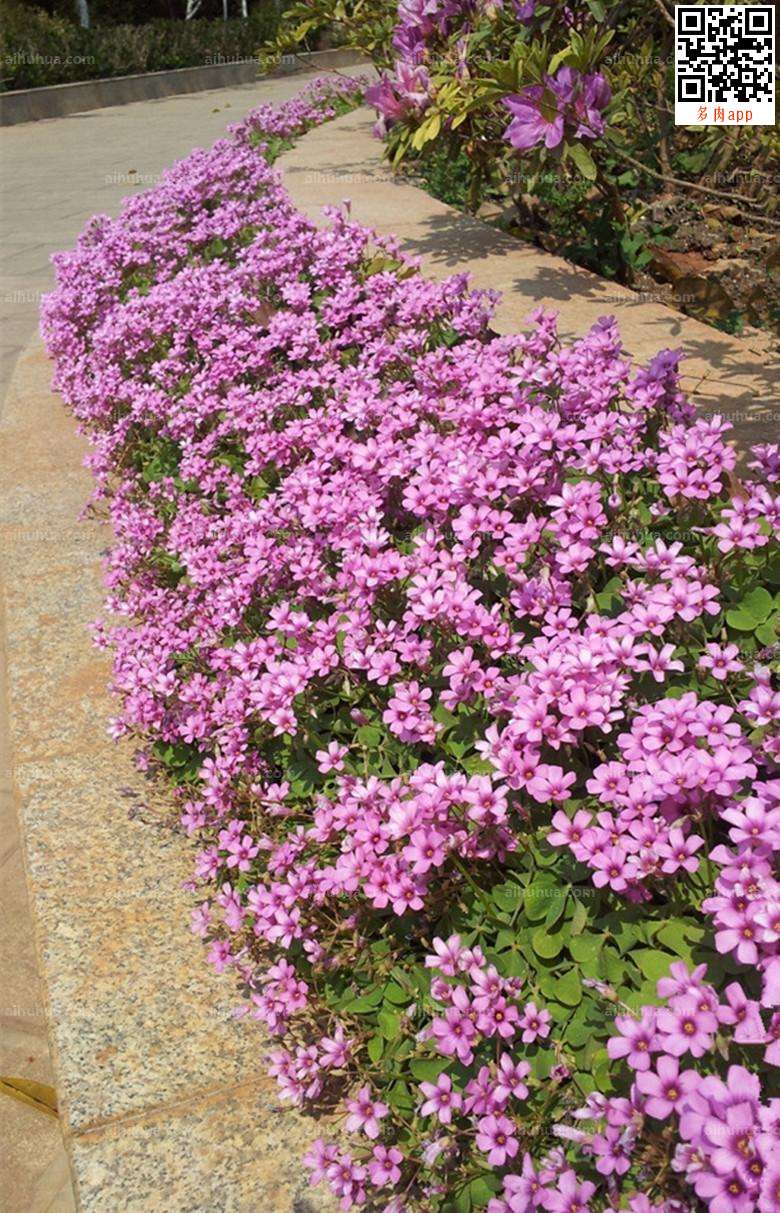
Oxalis corymbosa is widely planted in gardens; it can be arranged in flower beds and flower borders, and is also suitable for large-scale planting as ground cover and for clump planting in gaps, and is also a good material for potted plants.
Uses and Functions of Oxalis corymbosa
Oxalis corymbosa has many advantages, such as low and neat plants, abundant flowers and leaves, a long flowering period, brilliant flower color, rapid ground coverage, and the ability to inhibit weed growth. It is very suitable for large-scale planting in flower beds, flower paths, open woodlands, and forest edges. Using Oxalis corymbosa to form characters or pattern designs gives very good results. Oxalis corymbosa can also be potted to decorate plazas and indoor balconies, and is also a good material for courtyard greening edging.
Oxalis corymbosa Pictures