How to propagate Bleeding Heart Vine? These propagation methods are simple and easy to learn
Bleeding Heart Vine is commonly propagated by cuttings, division and sowing.
Cutting propagation:
Stem cuttings, bud cuttings and root cuttings are all suitable. For stem cuttings, you can choose the tender top shoots of healthy, disease-free branches, or cut the lower old branches into 8-10 cm stem sections as cuttings. Bud grafting is done by taking the lateral buds on the branches, with a part of the woody tissue, as cuttings. For root cuttings, cut the rhizomatous stolons into 8-10 cm lengths as cuttings. The cutting bed can use substrates such as peat, perlite, leaf mold, river sand and vermiculite. Spring and autumn are the best times for cuttings. The suitable temperature for cuttings is 21°C, and the cutting bed temperature is 26°C, which is very beneficial for rooting. Roots can form 3 weeks after cutting. If the base of the cuttings is treated with a 0.5%-0.8% indolebutyric acid solution for 1-2 seconds, rooting will be faster and more numerous.
Division propagation: After flowering, dig out the new shoots sprouting from the underground stolons, pot them directly with roots, and place them in a semi-shaded place for care.
Sowing propagation: Carry out in March to April. The seeds are relatively large. Sow in indoor pots, keep the room temperature at 24°C, and they will germinate successively about 10 days after sowing. When the seedlings are 10 cm tall, move them into small pots for care, and they can bloom in the second year.
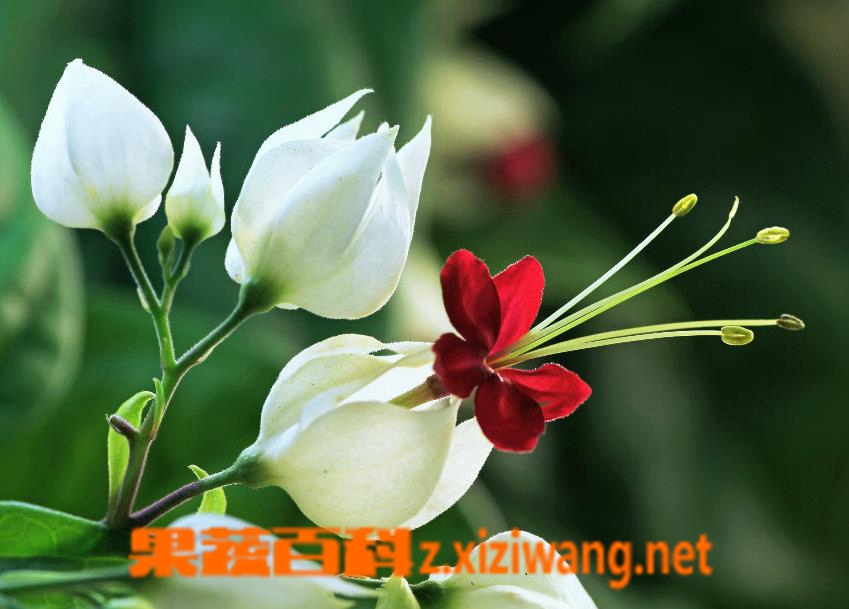
1. How to grow Bleeding Heart Vine——Pot culture
Bleeding Heart Vine in pots generally needs to be repotted once every two years. The best time for repotting is before spring or after the entire bloom has faded. When repotting Bleeding Heart Vine, it is best to first place a tile at the bottom, arrange a suitable drainage hole, then add bone meal as a base fertilizer, and after adding new potting soil, you can plant the Bleeding Heart Vine. After planting the Bleeding Heart Vine, you can water and fertilize to help the seedlings get nutrients for growth.
2. How to grow Bleeding Heart Vine——Watering
The more vivid the color of Bleeding Heart Vine, the more inseparable it is from water. Bleeding Heart Vine is very sensitive to water content. During the growth of stems and leaves, it is very necessary to enhance soil moisture, but the amount must not be too much. If Bleeding Heart Vine is watered too much or too little, it will fail to bloom, or the leaves will turn yellow and wither.
3. How to grow Bleeding Heart Vine——Light
The Bleeding Heart Vine plant itself is very sensitive to light. Sufficient light is suitable even in the cold winter. In summer, pay attention to shading while also taking it out to receive light in the afternoon when the sun is not intense.
How to grow Bleeding Heart Vine
Bleeding Heart Vine is a perennial plant of the Verbenaceae family. Generally, potted plants grow very short due to the restriction of pruning. In fact, it is a semi-vining climber, and its branches can reach more than one zhang in length. Because this flower is relatively vigorous and easy to grow, has a large number of flowers, and has very few pests and diseases, it is most suitable for home cultivation. If it is pruned promptly after the flowers fade in summer, it can be expected to bloom a second time before the end of the year.Bleeding Heart Vine is native to western Africa and is now widely cultivated as a potted climbing flowering plant. It likes a warm, semi-shaded and humid environment. The overwintering temperature should be above 15°C. Being below 10°C for a long time can cause leaf drop and even death. It is propagated by sowing or cuttings. (Propagation methods) The seeds have a short lifespan, so sow immediately after collection.
Bleeding Heart Vine is a flowering plant with a very long flowering period. It is suitable to use fertile, well-drained, slightly acidic sandy loam. For potted Bleeding Heart Vine, generally repot once every 1-2 years. Repotting can be done in early spring or after the flowers fade. When repotting, first use broken tiles to cover the drainage hole, then put in a small amount of bone meal as base fertilizer, then fill in new potting soil (4 parts leaf mold, 4 parts garden soil, 2 parts sand), plant the plant well, and leave 2-3 cm of rim at the top for fertilizing and watering. After repotting, water thoroughly and place in a shaded place to recover. After recovery, move it to a place with sufficient sunlight for care
Bleeding Heart Vine should not be fertilized too much. During the flowering season, apply 1 time of fully decomposed dilute cake fertilizer water every 7-10 days, and applying fertilizer 3-4 times in succession is enough. If yellowing is found during the cultivation of Bleeding Heart Vine, you can combine it with topdressing and apply 0.2% ferrous sulfate water, which will gradually turn the leaves from yellow to green.