Venus flytrap benefits and effects: beautifies the home, purifies the environment, and offers fascinating insect-catching fun
Most people have heard of the Venus flytrap. It is a plant that can repel mosquitoes, and every summer it becomes a houseplant for many people. When it comes to the Venus flytrap, everyone thinks of its ability to catch flies, but besides catching insects, do you know its other benefits and effects? It does not matter if you do not; below, the editor will give you a detailed introduction.
I. Origin of the name Venus flytrap
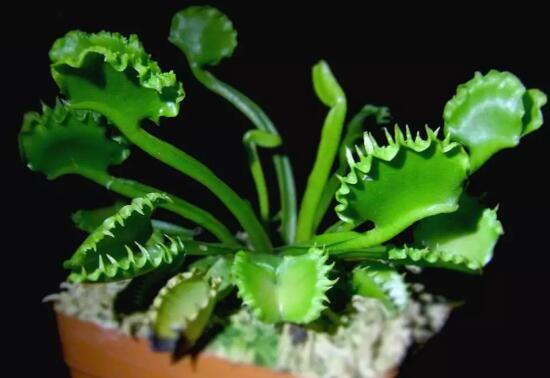
Before learning about the benefits and effects of the Venus flytrap, it is necessary to know the origin of its name. It is said that the edges of the Venus flytrap's leaves have regular trigger hairs, as shown in the picture above; they are like Venus's eyelashes, both beautiful and lethal, so it is called Venus's flytrap. And because the Venus flytrap can eat the insects that land on it, it got the name Venus flytrap.
II. Benefits and effects of the Venus flytrap
1. Ornamental value
When it comes to the benefits and effects of the Venus flytrap, everyone thinks of catching insects, but it also has a certain ornamental value. As shown in the picture above, the Venus flytrap's appearance is covered with many trigger hairs and has red stalkless glands; its look is like a gaping, fanged and clawed mouth, very unique, and quite popular with some people. In addition, the Venus flytrap is often grown as a potted plant on the balcony for care and viewing, appreciated for its leaves.
2. Beautifying the environment
The Venus flytrap has a unique and beautiful shape, elegant and dignified (of course, not everyone thinks so). Usually, we can grow the Venus flytrap as a potted plant indoors, or place it on a windowsill or balcony for people to admire. So beautifying the environment is also one of the Venus flytrap's effects.
3. Purifying the air
In addition, the Venus flytrap also has the common traits of plants: during respiration it absorbs carbon dioxide from the air and converts it into oxygen released into the air, so the Venus flytrap also has a good purifying effect on the air, making the air fresher.
4. Preying on insects
Here comes the key point. When it comes to the benefits and effects of the Venus flytrap, its insect preying is naturally indispensable. The Venus flytrap has a natural shell-like structure, where nectar is usually secreted; when an insect smells the natural fragrance and enters the inside of the shell, it closes naturally, then slowly consumes the plump insect, and when grown indoors it can effectively eliminate flies.
5. Highly entertaining
Finally, growing a Venus flytrap also has a certain entertainment value. When you have nothing to do, you can put some live insects on its traps and watch the plant eat animals; although it is a bit cruel, it is still entertaining.
Is the Venus flytrap toxic? Can the Venus flytrap be kept indoors? Non-toxic, and keeping it indoors has many benefits
As a plant that can repel mosquitoes, the Venus flytrap has many benefits; it can not only repel mosquitoes but also has good ornamental value. Such a plant naturally attracts many people's attention, and they all want to keep the Venus flytrap at home, so can the Venus flytrap be kept indoors? Before growing a plant, we first need to know whether it is toxic, so is the Venus flytrap toxic? For this, the editor will answer your questions.
I. Is the Venus flytrap toxic? Yes
Regarding the question of whether the Venus flytrap is toxic, let us first talk about the Venus flytrap's insect-catching process. According to the editor's research, the Venus flytrap does not rely on releasing fragrance to remove mosquitoes like mosquito-repellent grass or night-blooming jasmine; it secretes nectar on the inner wall of the trap to attract insects. When an insect touches the trigger hairs inside the trap, the trap slowly closes.
The more the insect struggles and touches the trigger hairs, the tighter the trap closes. Finally it secretes digestive fluid, and after about 10 days, it digests the insect. From this analysis, we can know that the Venus flytrap is not toxic. So even if you touch it, do not be afraid; it takes so long just to digest a small insect, let alone a person.
II. Can the Venus flytrap be placed indoors? Yes
From the above content, everyone should know that the Venus flytrap is non-toxic, and it also has the function of repelling mosquitoes and flies, so can the Venus flytrap be placed indoors? The answer is obviously yes, and keeping a Venus flytrap at home has many benefits.
III. Benefits of growing a Venus flytrap at home
1. Ornamental value
When it comes to the benefits of growing a Venus flytrap at home, everyone thinks of catching insects, but it also has a certain ornamental value. As shown in the picture above, the Venus flytrap's traps are like a gaping mouth, very unique, and quite popular with some people. In addition, the Venus flytrap is often grown as a potted plant on the balcony for care and viewing, appreciated for its leaves.
2. Purifying the air
In addition, the Venus flytrap also has the common traits of plants: during respiration it absorbs carbon dioxide from the air and converts it into oxygen released into the air, so the Venus flytrap also has a good purifying effect on the air, making the air fresher.
3. Preying on insects
Here comes the key point. When it comes to the benefits of growing a Venus flytrap at home, its insect preying is naturally indispensable. The Venus flytrap has a natural shell-like structure, where nectar is usually secreted; when an insect smells the natural fragrance and enters the inside of the shell, it closes naturally, then slowly consumes the plump insect, and when grown indoors it can effectively eliminate flies.
4. Highly entertaining
Finally, growing a Venus flytrap also has a certain entertainment value. When you have nothing to do, you can put some live insects on its traps and watch the plant eat animals; although it is a bit cruel, it is still entertaining.
Some plants also eat insects: a complete guide to carnivorous plants
People may think plants that eat animals are terrifying, but this is actually just due to our lack of understanding and fear of the unknown. You may not know that there are many insect-eating plants around you, you just do not notice them; if you take the time to learn about them, they may surprise you. Below, the editor takes everyone to look at some common carnivorous plants.
Some plants also eat insects
What are carnivorous plants
Carnivorous plants are autotrophic plants that capture and digest animals to obtain nutrients (not energy). Most prey of carnivorous plants are insects and arthropods. They grow in nutrient-poor soils, especially areas lacking nitrogen, such as acidic swamps and rocky desertification areas.
Carnivorous plants that can attract and capture prey, produce digestive enzymes and absorb the decomposed nutrients are distributed across 10 families and about 21 genera, with more than 630 species. In addition, plants of more than 300 genera have insect-catching functions, but they do not have the ability to digest prey and can only be called insect-catching plants. Some pitcher plants can occasionally prey on small mammals or reptiles, so carnivorous plants are also called flesh-eating plants.
What carnivorous plants are there?
1. Venus flytrap
Venus flytrap
The genus Dionaea belongs to the sundew family (Droseraceae), and the whole genus has only 1 species, the Venus flytrap Dionaea Muscipula, but there are many cultivated varieties. It is native to Carolina in the United States, and mostly grows in wetlands or swamps. The Venus flytrap's insect-catching traps have the ability to move, and the catching process is very interesting, deeply loved by people, and it has become the most popular carnivorous plant variety among enthusiasts in China. The Venus flytrap's catching process is probably the most peculiar among all carnivorous plants, and its catching mechanism is the most complex. The Venus flytrap's predatory structure is a trap formed by a pair of symmetrical leaves on the left and right; this trap-like structure is specialized from the leaf, while the leaf-like structure connecting the trap is the petiole. The outer edge of the trap is lined with spine-like hairs; at first glance they look very sharp and prickly, but in fact these hairs are very soft. The function of these hairs is to prevent captured insects from escaping.
2. Sundew
Sundew
The genus Drosera is one of the carnivorous plants, belonging to the sundew family, genus Drosera, with about 100 species, distributed in Oceania, North Africa, Europe, the Americas, Southeast Asia and Australia, with a few in cold zones. China has 6 species; except for 1 species produced in the Northeast, the rest are produced in the provinces and regions south of the Yangtze River and coastal areas such as Taiwan, China. The sundew is also a carnivorous plant. The sundew has obvious stems, and the stems bear tiny glandular hairs that can produce a sticky liquid. The sundew uses this sticky liquid to capture insects.
3. Pitcher plant
Pitcher plant
The pitcher plant is a famous tropical carnivorous plant, mainly produced in tropical Asia. The pitcher plant has a unique nutrient-absorbing organ, the pitcher, which is cylindrical with a slightly swollen lower part; because its shape resembles a pig cage, it is called the pitcher plant. In its place of origin in China, Hainan, it is also called Leigong hu, meaning it is like a wine pot. Plants of this kind that do not directly take in and produce the nutrients needed to sustain life from the soil and other inorganic sources, but instead rely on capturing insects and other small animals to make a living, are called carnivorous plants. The pitcher of the pitcher plant contains nectar glands that can secrete nectar to lure insects; after an insect enters the pitcher, the lid does not close as people imagine, but the inner wall of the pitcher's mouth is very smooth, so it can prevent insects from crawling out.
4. Pitcher plant (Sarracenia)
Sarracenia
Sarracenia belongs to the family Sarraceniaceae, genus Sarracenia; plants of this genus are native to Western Europe, North America and Mexico. Because their tubular leaves can secrete digestive fluid, which mixes with the stored rainwater and can cause insects trapped inside the tube to rot. In other words, they use their leaves to capture and digest insects such as ants and wasps. Anatomical structure of the purple pitcher plant. Sarracenia is a perennial herbaceous plant, growing pitcher-like leaves in a rosette from the growth point of the underground stem; the leaves are divided into insect-catching leaves with an insect-catching function and sword-shaped leaves without an insect-catching function.
5. Sundew (woolly sundew)
Woolly sundew
The woolly sundew belongs to the sundew family. It mainly grows in moist, swampy sandy acidic soil. The flowers are small, white or pale pink, with a maximum diameter of 1.25 cm. The leaf margins are flat, and the leaf surface is covered with a layer of glandular hairs; the glands secrete a sticky substance that attracts insects. When an insect is attracted to feed, it is captured by the bendable trigger hairs on the leaf surface, and then the leaf rolls up; after the trigger hairs secrete enzymes to digest it, the leaf opens again and spreads its net once more.
6. Butterwort
Butterwort
The butterwort is a small carnivorous plant with a delicate temperament. Its leaves are as beautiful as a flower that never stops blooming, and the leaf surface is covered with glands that can secrete mucus. When a small insect approaches, it can stick the insect like flypaper and digest and absorb it. The butterwort's bright flowers easily attract insects, and when a flying insect lands on the leaf, it is stuck by the mucus. Of course, the stuck insect is unwilling to be caught without a fight, and it struggles desperately, so the leaf margin curls inward and wraps it inside so it cannot escape. In this way, the insect falls into the clutches of the butterwort.
7. Bladderwort
Bladderwort
The most representative aquatic plant in the genus Utricularia. The plant body is emerald green or yellow-green. It has a slender main stem axis more than 100 cm long, from which branches grow on both sides, and beautiful feather-like needle-shaped lobed leaves grow on the branches. Its bladders are usually green to yellow-green and can prey on and digest microorganisms in water. Because its feather-like needle-shaped lobed leaves are densely grown and slender, and the plant form is graceful, it is a bladderwort variety very suitable for aquatic plant landscaping, but when planting it, care must be taken to fix the bottom stem. It can adapt to the environment of an aquarium and grows quickly, so it may fill the aquarium in a short time, and therefore must be pruned regularly.
8. Drosera burmannii
Drosera burmannii
Drosera burmannii is the whole plant of the sundew family plant Drosera burmannii with the flowering stem removed. It is a carnivorous plant that often grows on grassland or moist rock surfaces and sandy soil. The leaves of Drosera burmannii spread flat on the ground in a rosette; the leaves are broadly spoon-shaped, with glandular hairs all over the edges. When an insect falls in, the glandular hairs surround the insect body, and the sticky glands stick the insect; the secreted liquid can decompose nutrients such as insect proteins, which are then absorbed by the leaf surface. A family in the subclass Dilleniidae of the class Dicotyledoneae.
9. Albany pitcher plant
Albany pitcher plant
Albany pitcher plant: also called the Australian pitcher plant. The only species in the family Cephalotaceae, native to southwestern Australia. It is a perennial herb with a short woody underground stem. The flowers are pale yellow, and its lower leaves are pitcher-shaped, used to capture insects. It catches insects with passive pitfall traps. The lid cannot move. The pitcher and lid turn purplish red under strong sunlight, and the lid has transparent windows to attract insects. There are glands inside the pitcher, and the pitcher mouth is slippery; insects resting on the outer edge of the pitcher mouth easily lose their footing and fall into the pitcher, where they drown in the liquid inside and are digested and decomposed by the digestive fluid.
10. Utricularia bifida
Utricularia bifida
Utricularia bifida, with alternative names rue herb and hairy-leaf herb (Diannan Bencao), wild tobacco leaf and wild thought herb (Caomu Bianfang), wild tobacco (Fenlei Caoyaoxing), daotihu (Zhongyao Xingxing Jingyan Jiandiefa), jinwayer (Sichuan Zhongyao Zhi), wild sunflower, Liushi herb, hairy-leaf rue herb, wild chaoyang stem (Yunnan Zhongcaoyao). It is the whole plant of the Asteraceae plant Carpesium abrotanoides. Lentibulariaceae, annual herb. It has inconspicuous creeping branches, and leaf organs on underground branches; the whole plant has no green leaves and does not carry out photosynthesis; bladders are borne on the leaf organs and creeping branches, spherical, flattened, preying on tiny animals in wet soil. The raceme stands above the ground, the bracts are brown-red, and the flowers are yellow. It often grows in wet grassland. It is distributed in the southeastern and southwestern provinces of China.