How to sow sundew seeds, easy for beginners to master
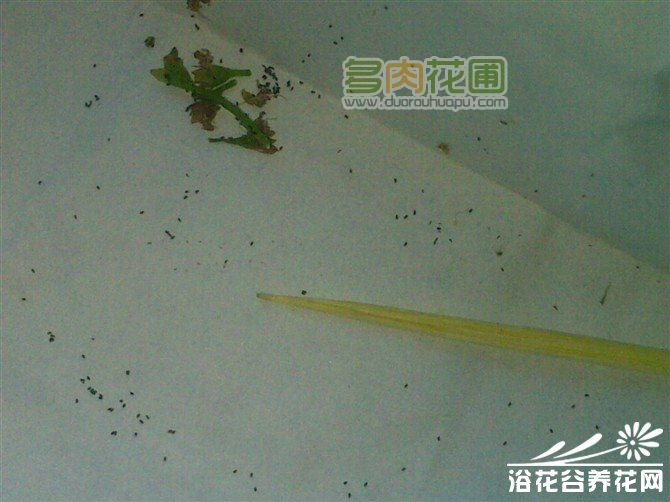
Sundew seeds are black and very small, so be careful when opening the package, otherwise you may waste seeds. Below are the sowing steps:
1. Prepare the substrate: the recommended medium is finely crushed sphagnum moss. According to some carnivorous plant enthusiasts, using live sphagnum moss for sowing has an unexpectedly good effect on improving the germination rate. Put the substrate to be used into a slightly larger container to mix, then add a little water and mix until moist, and set aside for later use.
2. The pot for sowing: after filling the pot with substrate, place it in a glass tank or water basin filled with purified water, so that the substrate fully absorbs water until the surface is moist, then use a spray bottle to spray the surface moist (mist spray).
3. Sowing: carefully open the seed package and evenly scatter the seeds on the surface of the substrate (if they stick to the packaging paper, you can tear off a strip of paper and scrape them off). Do not cover with soil.
4. Spraying water: use a spray bottle to spray the surface moist, adjust the nozzle to mist and spray carefully so that the seeds are not washed away. Place the pot with the sown seeds together with the glass tank or water basin on the inner side of a sunny windowsill. If it is a water basin, a plastic cover with an opening at the top should be added to keep moisture. Pay attention to replenishing water in time.
Sundews generally germinate in about 30 days (20 degrees). Under excellent conditions, seedlings can emerge in about 15 days. After growing up, if growth is too dense, transplanting with soil can be carried out, and roots must never be damaged.
Introduction to the methods of growing sundews
Sundew is also called "maozhantai", a name more people should be familiar with. It belongs to the carnivorous plants, with about 250 native species. The leaf surface is covered with a layer of fuzzy glandular hairs that can secrete mucus, thereby sticking passing insects and digesting and absorbing them. The maximum height is about 6 to 25 cm. It looks like a delicate little herb, but in fact its lethality to insects is very strong. To understand the methods of growing sundews, you must first understand their habits. Sundews like light and moisture, but also tolerate shade.
Ecological environments in nature: 1. Growing on humid slopes, under pine forests, in grass clusters, or by stream ditches at an altitude of 1200-3650 m.
2. Growing on hillsides, in grass clusters by streams, in shrublands and under open forests.
Sundews cannot adapt to natural environments such as cold or exposure to strong sunlight, and do not have a strong ability to resist harsh environments. Cold and hot zones are not suitable for their survival.
These plants themselves have chlorophyll and can carry out photosynthesis, but their root systems are extremely underdeveloped, so by preying on insects they can make up for the deficiency of nitrogen nutrients.
Growing sundews requires attention to the following aspects:
Seeds can generally be stored for about three years. Sow in a cold room or hotbed, by broadcasting, without covering with soil. Not suitable for cultivation in alkaline soil. After sprouting, use peat soil for separate planting. Propagation can also be done by cuttings, using root cuttings; cut into small sections, each section 1 cun long, lay them flat in peat soil, keep warm and moist, and they will take root and sprout. Keep the temperature at about 25 degrees, and they will germinate in about one month.
Water: use a water source with low mineral concentration. During the growing season, the substrate can be kept relatively moist. It is suitable to supply water from the bottom of the pot tray. The plant should not be sprayed with water frequently, so as not to make it difficult for the "dew" on the glandular hairs to form. During the dormant period, it needs to be somewhat drier, but not completely dry, to prevent root rot. Air humidity should be kept above 50%. Higher humidity can make the "dew" on the glandular hairs larger and more ornamental.
Light: most sundews like light. Sufficient sunlight can make the plant brightly colored, but in summer strong light must be shaded to prevent sunburn. Without light, the plant will appear green.
For fertilizing, it is better to apply thin fertilizer frequently. Do not use too high a concentration, so as to avoid the serious consequences of fertilizer burn or even fertilizer death. It is not recommended to provide nutrients by feeding food, so as not to affect the ornamental value.
There are many varieties of sundews, and their growth habits are also very diverse. Most are relatively easy to grow and do not change much throughout the year. They also have good medicinal value. Their secretions contain proteases similar to trypsin. However, they must not be used casually. Careless use can cause poisoning reactions. External application has an analgesic effect and can treat rheumatism and bruises. After applying the medicine, there will be a slight burning pain, and it should not be applied for a long time. Some people will have adverse reactions after oral administration, such as tinnitus and drowsiness. It is most commonly used to treat arthritis, neurodermatitis, stomach qi pain, etc.