Detailed Guide to Nasturtium Cutting Propagation: Easy Propagation Step by Step
Nasturtium can be grown not only from seed but also from cuttings. The nasturtium cutting method actually has nothing special about it; it is almost the same as for other flowers and plants, and the survival rate is even higher than for other flowers and plants. Below, let's look at the basic steps for nasturtium cuttings.
1. Choice of container and medium
For the cutting container, you can choose a smaller one, as this makes it easier to control the humidity of the medium and less likely to cause root rot. It is recommended to use a disposable plastic cup. As for the medium, it is fairly flexible: peat, vermiculite, and perlite are basically the standard mix.
2. Timing for nasturtium cuttings
For successful cuttings, the choice of timing is very important. According to a survey of flower enthusiasts who succeeded with cuttings, it was found that the success rate for cuttings in May, October, November, and December is very high. Other months have not been tried, but based on feedback from flower enthusiasts, as long as the temperature is above 18°C, the success rate is very high.
3. Selection of branches
Cut top bud branches about 5-7 cm long for cuttings. Generally, rooting takes about 1 week. After cuttings are taken, place them in bright, indirect light and keep the soil moist, but do not let it become waterlogged.
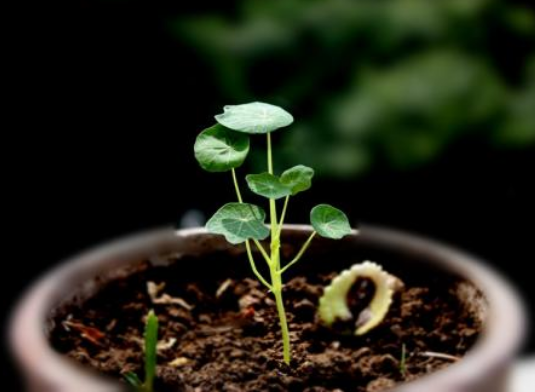
A thousand words are not as good as one picture. Below is a process picture of nasturtium cuttings. Flower enthusiasts can simply imitate the cutting process; it is very easy!
2. Light:
Nasturtium likes full sunlight and cannot tolerate shade. In spring and autumn, it should be placed in a sunny spot for cultivation. In summer, provide appropriate shade, and in midsummer place it in a cool, ventilated area. At the same time, the flowers and leaves of nasturtium are strongly phototropic, so when cultivating or viewing them, the position should be changed frequently to allow even growth.
3. Watering:
Because the branches are succulent inside, nasturtium likes moisture and fears waterlogging. Keep soil moisture at about 50%. During the growing period, watering should be done frequently and in small amounts. In spring and autumn, water once every 2-3 days; in summer, water every day, and in the evening spray water on the leaves to maintain relatively high humidity.
4. Temperature:
When grown in pots in northern regions, it must be moved indoors or into a greenhouse to overwinter in winter, and the minimum temperature must not be lower than 10°C. The suitable growing temperature is 18-24°C. It does not bloom easily during high summer temperatures, and growth is inhibited above 35°C.
5. Fertilizing:
During the growing period, if fertilizer and water management are improper, poor conditions often appear, such as long internodes and yellow leaves, thin stems and small leaves, or lush branches and leaves with few flowers. Generally, apply a small amount of base fertilizer when planting, and apply diluted fertilizer water once a month to encourage abundant flowering. Stop fertilizing during the hot midsummer.
6. Pests and diseases:
Nasturtium is susceptible to damage from aphids and whiteflies, and it needs frequent manual or chemical control. Mature fruits will fall off naturally. They should be harvested promptly when the fruit skin turns white but has not yet dried, then sun-dried and stored; there is no need to thresh them.
How to Grow Nasturtium
Nasturtium is a rare wild plant in the family Tropaeolaceae and genus Tropaeolum. It is an annual or perennial climbing plant. The plant height is 30 cm-70 cm. The basal leaves have long petioles, and the leaf blades are pentagonal, three-parted, with the secondary segments having a few small lobes and sharp teeth. Flowers are solitary or 2-3 in cymes, with 8-19 sepals, yellow, elliptic-obovate or obovate, and petals equal in length to the sepals, narrowly linear. The leaves are lush and the flowers are beautiful, with flower colors including purplish red, orange-red, and creamy yellow. The golden lotus vine stems twine, and the leaf shape resembles bowl lotus. When the creamy yellow flowers are in full bloom, they look like a flock of butterflies dancing. It is an important summer ornamental flower. The flowers of nasturtium can be used as medicine. Its tender shoots, flower buds, and fresh seeds can be used as a pungent seasoning.
For nasturtium cultivation, sandy loam rich in organic matter should be used, with a pH of 5-6. Generally, during the growing period, fertilize once every 3-4 weeks. After each fertilization, loosen the soil promptly to improve aeration and facilitate root development.
Nasturtium likes moisture and fears waterlogging. Keep soil moisture at about 50%. During the growing period, watering should be done frequently and in small amounts. In spring and autumn, water once every 2-3 days; in summer, water every day, and in the evening spray water on the leaves to maintain relatively high humidity.
After flowering, watering should be reduced to prevent excessive branch growth. If watering is excessive or drainage is poor, the roots are prone to rot from moisture. In mild cases, leaves turn yellow and fall off; in severe cases, the whole plant wilts and dies.
Nasturtium likes full sunlight and cannot tolerate shade. In spring and autumn, it should be placed in a sunny spot for cultivation. In summer, provide appropriate shade, and in midsummer place it in a cool, ventilated area. In northern regions, move it indoors in mid-October and keep it in a sunny place for care, maintaining room temperature at 10-15°C and appropriately controlling fertilizer and water. At the same time, the flowers and leaves of nasturtium are strongly phototropic, so when cultivating or viewing them, the position should be changed frequently to allow even growth.
Propagation uses sowing or cutting. Sowing is carried out in a greenhouse from August to October. Before sowing, soak the seeds in warm water at 40-45°C for 24 hours. After sowing, maintain 18-20°C, and seedlings will emerge in 7-10 days. They are planted in pots in May of the following year. Cuttings are carried out from April to June. Select tender stems as cuttings, remove the lower leaves, provide shade after inserting, and maintain humidity; roots can form in 2-3 weeks. As the stems and vines grow, bamboo strips should be used promptly to set up a trellis and tie the branches and vines. Apply topdressing once every 10-15 days, and maintain sufficient water and relatively high air humidity throughout the entire growth period.