How to grow the cobra lily (Darlingtonia californica)? A detailed guide to its cultivation methods
The cobra lily is a very well-known carnivorous plant species, named for its striking resemblance to a cobra, and is a prized target for many collectors. The left and right sides of their pitcher lid are fused together, forming a bulbous top that makes the entire trap almost sealed. Where the bulbous lid meets the pitcher body there is a sunken slit. The lid and the pitcher body bear many white markings that lack chlorophyll, and sunlight can shine through these white patches into the trap. Insects (mostly ants) can enter the trap through the narrow slit. Once inside, they are confused by these white patches, mistaking them for an exit, and lose their way inside the pitcher, finally falling into the digestive fluid and being digested.
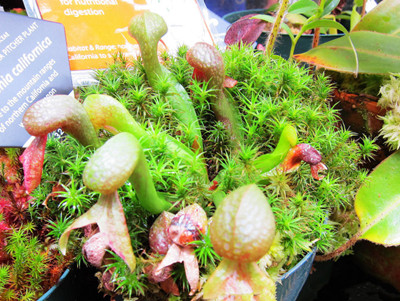
Substrate: peat, sand, sphagnum moss, peat, perlite, coconut husk, etc.
Watering: Soft water is needed for watering, such as rainwater, distilled water, reverse-osmosis deionized water, etc. Tap water in some areas contains large amounts of minerals (especially calcium salts). These calcium salts will accumulate and thereby kill the plant. This is because most carnivorous plants have adapted to poor, acidic soil, so they are extreme calcifuges, and are therefore extremely sensitive to nutrients in the soil.
Temperature: Tolerant of cold but afraid of heat, especially the roots must be kept cool, and there should be a large temperature difference between day and night; it can survive between -10°C and 30°C, and 15°C to 27°C is its most suitable growing temperature. It likes strong light, and when the temperature is not too high it can be exposed to sunlight, and the top of the plant will develop a red network pattern that is very beautiful.
Pests and diseases: It is susceptible to aphids or mealybugs. Smaller infestations are best removed by hand, while larger infestations should be treated with insecticides as appropriate. Isopropyl alcohol is an effective insecticide against scale insects. Diazinon is also a broad-spectrum insecticide that most carnivorous plants can tolerate. Malathion and acephate are likewise suitable for carnivorous plants.
Although insect pests are one problem, the biggest problem is gray mold. It develops in warm, humid environments and becomes a serious problem in winter. Placing it in a cool, well-ventilated environment and promptly removing diseased branches can, to a certain extent, suppress the development of gray mold. If this fails, a fungicide should be used as appropriate.
Cobra lily Darlingtonia californica Cobra lily gallery: how to grow the cobra lily / how to propagate the cobra lily
Cobra lily fact sheetCobra lily Darlingtonia californica
Cobra lily cultivation methods and precautions An introduction to the cobra lily
The cobra lily (scientific name: Darlingtonia californica) is one of the genera in the family Sarraceniaceae, and is a carnivorous plant mainly distributed in northern California and Oregon in the United States. The cobra lily is a very well-known carnivorous plant species, named for its striking resemblance to a cobra, and is a prized target for many collectors.
The leaves of the cobra lily are of two types. The leaves are arranged in a rosette, and each adult growing point consists of 3 to 14 leaves. For the first 2 to 3 years, the leaves of seedlings are simple tubes with tapering tips. Juvenile leaves are generally 1 to 3 cm long and range from red-green to red. After that, the leaves of the cobra lily transform into the mature state. Mature leaves already have the trapping function, are 20 to 80 cm long, hollow, with the lower and middle portions tubular and the upper portion bulbous and swelling forward. At the bottom of the front swelling of the leaf there is a 10 to 20 mm hole, which is the only opening of the leaf. The rim of the pitcher mouth curves inward, forming a shape similar to the mouth of a lobster trap. The pitcher mouth is connected to a forked, fish-tail-shaped appendage. Nectar glands are present on the dorsal side of the appendage and around the pitcher mouth. The surfaces of the bulbous part and the upper end of the tubular part of the leaf bear large numbers of irregular, translucent white markings. The inner surface of the bulbous part of the leaf is hairless, smooth and waxy. The inner surface of the lower third of the tubular part bears downward-pointing hairs, 2 to 8 mm long.
Morphological characteristics of the cobra lily
The cobra lily is a clumping perennial herb. Its stem often grows creeping and branching along the ground surface, with the stolon 20 to 80 cm long. The stolon can also develop into an independent plant. The roots of the cobra lily are brown, 10 to 25 cm long.
The leaves of the cobra lily are of two types. The leaves are arranged in a rosette, and each adult growing point consists of 3 to 14 leaves. For the first 2 to 3 years, the leaves of seedlings are simple tubes with tapering tips. Juvenile leaves are generally 1 to 3 cm long and range from red-green to red. After that, the leaves of the cobra lily transform into the mature state. Mature leaves already have the trapping function, are 20 to 80 cm long, hollow, with the lower and middle portions tubular and the upper portion bulbous and swelling forward. At the bottom of the front swelling of the leaf there is a 10 to 20 mm hole, which is the only opening of the leaf. The rim of the pitcher mouth curves inward, forming a shape similar to the mouth of a lobster trap. The pitcher mouth is connected to a forked, fish-tail-shaped appendage. Nectar glands are present on the dorsal side of the appendage and around the pitcher mouth. The surfaces of the bulbous part and the upper end of the tubular part of the leaf bear large numbers of irregular, translucent white markings. The inner surface of the bulbous part of the leaf is hairless, smooth and waxy. The inner surface of the lower third of the tubular part bears downward-pointing hairs, 2 to 8 mm long.
Each mature cobra lily plant produces only a single flower in spring. The sepals are yellow-green, lanceolate, 3 to 5 cm long. The petals are dark red to purple, lanceolate to oblong, 2 to 3 cm long, hairless, with transverse veins. The ovary is located at the center of the flower, green, 5-chambered, 1 to 2 cm long. The stigma is star-shaped and extends from the end of the ovary. There are 15 to 25 stamens distributed around the base of the ovary. The anthers are 2 to 3 mm long, oblong, yellow. The flower stalk is 25 to 90 cm long, usually 10 to 25 cm taller than the mature leaves. The flowering period is from April to June. One to 2 days after the flower opens, the stigma can receive pollen, and the anthers also begin to release pollen. After 6 to 10 days, the petals and stamens wither and fall off. If pollination is successful, the pistil continues to swell and after 8 to 14 weeks forms a seed pod 3 to 4 cm long. The seed pod splits at the top and contains 40 to 300 light-brown seeds 1 to 3 mm long. The seed surface bears irregular spines.
Ecological habits of the cobra lily
Survival temperature: -10-30
Suitable temperature: 15-27
Cultivation substrate: peat, sphagnum moss, perlite, sand, etc.
Cultivation techniques for the cobra lily
Watering requires water with low mineral content (such as rainwater, purified water, etc.); it is tolerant of cold but afraid of heat, especially the roots must be kept cool, and there should be a large temperature difference between day and night; it likes strong light, and when the temperature is not too high it can be exposed to sunlight, and the top of the plant will develop a red network pattern that is very beautiful; if fertilizing is needed, spray at more than 1/5 of the indicated concentration.
Planting methods
The cobra lily is one of the more difficult carnivorous plants to cultivate. It requires a relatively high daytime temperature and a relatively low nighttime temperature. Its native habitat is marshes or riverbanks into which icy mountain springs flow year-round, so the roots can remain at a relatively low temperature the whole time. Therefore, the best simulated method in cultivation is to grow it with cool, purified water. When the weather is hot, ice cubes can be placed on the soil surface to cool it down. In a high-humidity, warm environment, the plant can be given plenty of sunlight; if the humidity is low or fluctuates greatly, a little shading is needed.
Growing the cobra lily from seedlings is very difficult and slow, so it is usually propagated in late winter or spring from its stolons. Usually from the spring equinox to late spring, many small buds grow on the internodes of the stolons. Cut the stolons into several sections, each with some roots. Then place these stem sections on cool, moist chopped sphagnum moss and keep them in a bright, highly humid environment. Bud development can be seen after a few weeks.
Like other carnivorous plants that grow in temperate regions, the cobra lily needs winter dormancy to survive long-term. The plant stops growing for 3 to 5 months in winter. Until close to spring, the mature plant produces a single flower, and several weeks later grows several large pitchers. Throughout summer it continuously grows pitchers, but their size is far smaller than the spring pitchers.
Many growers have successfully cultivated the cobra lily and have found three forms: all-green, all-red, and red-green. Wild cobra lilies are all-green under ordinary light intensity, and take on a red-green color under strong light.
Distribution range of the cobra lily
Mainly distributed in northern California and Oregon in the United States.
Biological characteristics of the cobra lily Trapping mechanism
The dorsal side of the fish-tail-shaped appendage of the cobra lily secretes large amounts of nectar and gives off a strong odor. Insects such as wasps and flies are attracted by this odor to the pitcher mouth. Insects crawling along the nectar glands may be led into the trap, and the light-transmitting markings inside the trap then confuse the insects, causing them to mistake these markings for an exit and become trapped inside the pitcher. Because of the waxy top of the pitcher and the downward-pointing hairs of the middle and lower portions, the insects gradually fall into the digestive fluid at the base of the pitcher. After that, their bodies are digested, and the plant can absorb the nutrients released by decomposition. Species with a similar trapping mechanism include the parrot pitcher plant (Sarracenia psittacina), the hooded pitcher plant (Sarracenia minor), Nepenthes klossii, and Nepenthes aristolochioides (N. aristolochioides).
The cobra lily is one of the three pitcher plant species of the Americas. Its pitcher does not collect rainwater; instead, it absorbs water through the roots and then secretes it into the pitcher. People once thought that the pitcher of the cobra lily does not secrete digestive enzymes and must rely on symbiotic bacteria and protozoa to break down prey into absorbable nutrients. But later research showed that the cobra lily can secrete at least one proteolytic enzyme to digest its prey. The cells of the inner wall of the pitcher absorbing nutrients from the digestive fluid is similar to the root cells absorbing nutrients from the soil. But the cobra lily still has close mutually beneficial relationships with some animals and microorganisms.
Cultural background of the cobra lily Botanical history
In 1841, botanist J. D. Brackenridge discovered the cobra lily on Mount Shasta in California during an expedition to remote western regions. [1]
In 1853, John Torrey described the genus Darlingtonia and named it after William Darlington.
Cobra lily pictures
Cobra lily gallery: how to grow the cobra lily / how to propagate the cobra lily
Chinese common name: cobra lilyLatin name: Darlingtonia californica
Origin: United States
Growing substrate: peat, sphagnum moss, perlite, sand, etc.
Survival temperature: -10-30°C
Suitable temperature: 15-27°C
Humidity: >50%
Introduction:
The cobra lily (scientific name: Darlingtonia californica) is one of the genera in the family Sarraceniaceae, and is a carnivorous plant mainly distributed in northern California and Oregon in the United States. The cobra lily is a very well-known carnivorous plant species, named for its striking resemblance to a cobra, and is a prized target for many collectors.
The cobra lily (scientific name: Darlingtonia californica) is one of the genera in the family Sarraceniaceae, and is a carnivorous plant mainly distributed in northern California and Oregon in the United States. The cobra lily is a very well-known carnivorous plant species, named for its striking resemblance to a cobra, and is a prized target for many collectors. Chinese common name: cobra lily Latin scientific name: Darlingtonia californica Kingdom: Plantae Phylum: Magnoliophyta Class: Magnoliopsida Order: Ericales Family: Sarraceniaceae Tribe: Darlingtonia Genus: Darlingtonia Species: Darlingtonia
Distribution range: northern California and Oregon in the United States Morphological characteristics: The cobra lily is a clumping perennial herb. Its stem often grows creeping and branching along the ground surface, with the stolon 20 to 80 cm long. The stolon can also develop into an independent plant. The roots of the cobra lily are brown, 10 to 25 cm long. The leaves of the cobra lily are of two types. The leaves are arranged in a rosette, and each adult growing point consists of 3 to 14 leaves. For the first 2 to 3 years, the leaves of seedlings are simple tubes with tapering tips. Juvenile leaves are generally 1 to 3 cm long and range from red-green to red. After that, the leaves of the cobra lily transform into the mature state. Mature leaves already have the trapping function, are 20 to 80 cm long, hollow, with the lower and middle portions tubular and the upper portion bulbous and swelling forward. At the bottom of the front swelling of the leaf there is a 10 to 20 mm hole, which is the only opening of the leaf. The rim of the pitcher mouth curves inward, forming a shape similar to the mouth of a lobster trap. The pitcher mouth is connected to a forked, fish-tail-shaped appendage. Nectar glands are present on the dorsal side of the appendage and around the pitcher mouth. The surfaces of the bulbous part and the upper end of the tubular part of the leaf bear large numbers of irregular, translucent white markings. The inner surface of the bulbous part of the leaf is hairless, smooth and waxy. The inner surface of the lower third of the tubular part bears downward-pointing hairs, 2 to 8 mm long. Each mature cobra lily plant produces only a single flower in spring. The sepals are yellow-green, lanceolate, 3 to 5 cm long. The petals are dark red to purple, lanceolate to oblong, 2 to 3 cm long, hairless, with transverse veins. The ovary is located at the center of the flower, green, 5-chambered, 1 to 2 cm long. The stigma is star-shaped and extends from the end of the ovary. There are 15 to 25 stamens distributed around the base of the ovary. The anthers are 2 to 3 mm long, oblong, yellow. The flower stalk is 25 to 90 cm long, usually 10 to 25 cm taller than the mature leaves. The flowering period is from April to June. One to 2 days after the flower opens, the stigma can receive pollen, and the anthers also begin to release pollen. After 6 to 10 days, the petals and stamens wither and fall off. If pollination is successful, the pistil continues to swell and after 8 to 14 weeks forms a seed pod 3 to 4 cm long. The seed pod splits at the top and contains 40 to 300 light-brown seeds 1 to 3 mm long. The seed surface bears irregular spines. Cultivation techniques: Watering requires water with low mineral content (such as rainwater, purified water, etc.); it is tolerant of cold but afraid of heat, especially the roots must be kept cool, and there should be a large temperature difference between day and night; it likes strong light, and when the temperature is not too high it can be exposed to sunlight, and the top of the plant will develop a red network pattern that is very beautiful; if fertilizing is needed, spray at more than 1/5 of the indicated concentration.
Planting methods: Survival temperature: -10-30 Suitable temperature: 15-27 Cultivation substrate: peat, sphagnum moss, perlite, sand, etc. Environmental humidity: >50% Origin: United States The cobra lily is one of the more difficult carnivorous plants to cultivate. It requires a relatively high daytime temperature and a relatively low nighttime temperature. Its native habitat is marshes or riverbanks into which icy mountain springs flow year-round, so the roots can remain at a relatively low temperature the whole time. Therefore, the best simulated method in cultivation is to grow it with cool, purified water. When the weather is hot, ice cubes can be placed on the soil surface to cool it down. In a high-humidity, warm environment, the plant can be given plenty of sunlight; if the humidity is low or fluctuates greatly, a little shading is needed. Growing the cobra lily from seedlings is very difficult and slow, so it is usually propagated in late winter or spring from its stolons. Usually from the spring equinox to late spring, many small buds grow on the internodes of the stolons. Cut the stolons into several sections, each with some roots. Then place these stem sections on cool, moist chopped sphagnum moss and keep them in a bright, highly humid environment. Bud development can be seen after a few weeks. Like other carnivorous plants that grow in temperate regions, the cobra lily needs winter dormancy to survive long-term. The plant stops growing for 3 to 5 months in winter. Until close to spring, the mature plant produces a single flower, and several weeks later grows several large pitchers. Throughout summer it continuously grows pitchers, but their size is far smaller than the spring pitchers. Many growers have successfully cultivated the cobra lily and have found three forms: all-green, all-red, and red-green. Wild cobra lilies are all-green under ordinary light intensity, and take on a red-green color under strong light.
Botanical history In 1841, botanist J. D. Brackenridge discovered the cobra lily on Mount Shasta in California during an expedition to remote western regions. [1] In 1853, John Torrey described the genus Darlingtonia and named it after William Darlington.
Trapping mechanism The dorsal side of the fish-tail-shaped appendage of the cobra lily secretes large amounts of nectar and gives off a strong odor. Insects such as wasps and flies are attracted by this odor to the pitcher mouth. Insects crawling along the nectar glands may be led into the trap, and the light-transmitting markings inside the trap then confuse the insects, causing them to mistake these markings for an exit and become trapped inside the pitcher. Because of the waxy top of the pitcher and the downward-pointing hairs of the middle and lower portions, the insects gradually fall into the digestive fluid at the base of the pitcher. After that, their bodies are digested, and the plant can absorb the nutrients released by decomposition. Species with a similar trapping mechanism include the parrot pitcher plant (Sarracenia psittacina), the hooded pitcher plant (Sarracenia minor), Nepenthes klossii, and Nepenthes aristolochioides (N. aristolochioides). The cobra lily is one of the three pitcher plant species of the Americas. Its pitcher does not collect rainwater; instead, it absorbs water through the roots and then secretes it into the pitcher. People once thought that the pitcher of the cobra lily does not secrete digestive enzymes and must rely on symbiotic bacteria and protozoa to break down prey into absorbable nutrients. But later research showed that the cobra lily can secrete at least one proteolytic enzyme to digest its prey. The cells of the inner wall of the pitcher absorbing nutrients from the digestive fluid is similar to the root cells absorbing nutrients from the soil. But the cobra lily still has close mutually beneficial relationships with some animals and microorganisms. Pitcher plants are relatively large, elegant carnivorous plants, with leaves shaped like pitchers that are upright or lying on their sides, mostly brightly colored with brilliant spots or network patterns, similar in form to the pitchers of Nepenthes, able to secrete nectar and digestive fluid; insects lured by the nectar lose their footing and fall into the pitcher, and the digestive fluid inside the pitcher digests and absorbs the insects.