How to grow cyclamen in water? Learn the correct hydroponic care method
Growing cyclamen in water not only avoids the problems of susceptibility to pests and diseases and frequent watering that come with soil culture, but also offers higher ornamental value and economic benefit. The flowering period of water-grown cyclamen is generally 1 to 2 weeks longer than that of soil-grown plants, and the colors are more vivid. The specific method is as follows:
1. Choosing cyclamen. Choose 1-year-old to 3-year-old cyclamen plants that are free of pests and diseases, growing vigorously, and in bud. Plants grown in soilless media such as perlite, vermiculite, or wood shavings are best, as they suffer no root damage after a change of environment, need no acclimatization, and adapt quickly.
2. Choosing a container. Water-culture containers are simple and economical, and can serve as a way to reuse items in daily life. Any watertight container will do, such as a fish tank, teacup, drink carton, wine bottle, or vase; a transparent container is best, as the roots, stems, leaves, flowers, and fruit can all be viewed fully. Whatever container is used, its size, height, and color should all harmonize with the cyclamen plant, so as to bring out the exquisite, translucent, crystal-clear elegance of water-grown cyclamen.
3. Water-culture timing and method. The flowering period of cyclamen is generally from October to June of the following year, so the water-culture period is generally from September to April of the following year. Remove the selected cyclamen plant from its pot, wash the medium clinging to the roots with 20°C warm water, and take care not to damage the roots. Then place it directly into a previously prepared container, with the water level even with the root zone; at the deepest it must not exceed 1/3 of the corm, so as to prevent the corm from rotting. Finally, place it in a suitable indoor location and add water and nutrient solution regularly. After two to three months of water culture, once the flowers fade, take the plant out and plant it in growing medium to spend the summer.
4. Water quality and water temperature. The water used for water-grown cyclamen is best mountain spring water or magnetized water, with clean water quality that is neither cloudy nor prone to sediment, and that contains various trace elements essential to plants; no water changes are needed throughout the entire water-culture period. Tap water contains chlorine, which is unfavorable to flower growth, and it easily becomes cloudy and forms sediment, requiring a water change every few days, so it should be avoided as much as possible. The water temperature should be close to the indoor air temperature at the time, generally 10°C to 20°C.
5. Light and temperature. Cyclamen likes a sunny environment. The water-culture container should be placed on a desktop or windowsill with ample indoor sunlight, not directly on a radiator. The most suitable indoor temperature is 15°C to 20°C; it should not exceed 25°C at the highest or fall below 10°C at the lowest.
6. Nutrient solution. Water-grown cyclamen also needs regular nutrient supplementation during the flowering period, generally adding 50 ml of flowering-plant nutrient solution diluted 1:100 per plant every 10 days; mountain spring water should also be used to prepare the nutrient solution. If yellowing leaves, small leaves, or small flowers are observed, and root rot has been ruled out, a little more nutrient solution may be added as appropriate.
How to grow cyclamen in water
For many years, we tried culture soils of various formulas, but could never overcome two major drawbacks: First, cyclamen is prone to root-knot nematode disease, soft rot, and pests such as aphids and red spider mites. Second, it must be watered every day, and even a slight lack of water causes the leaf stalks and flower stems to wilt and droop, the flowers fade quickly, and the ornamental value is reduced. In the past two years, we switched to water culture, which not only overcame the above two drawbacks, but also achieved higher ornamental value and economic benefit. The flowering period of water-grown cyclamen is generally 1 to 2 weeks longer than that of soil-grown plants, and the colors are more vivid. The specific method is as follows:Choosing cyclamen and choosing a container. Choose 1-year-old to 3-year-old cyclamen plants that are free of pests and diseases, growing vigorously, and in bud. Plants grown in soilless media such as perlite, vermiculite, or wood shavings are best, as they suffer no root damage after a change of environment, need no acclimatization, and adapt quickly. Water-culture containers are simple and economical, and can serve as a way to reuse items in daily life. Any watertight container will do, such as a fish tank, teacup, drink carton, wine bottle, or vase; a transparent container is best, as the roots, stems, leaves, flowers, and fruit can all be viewed fully. Whatever container is used, its size, height, and color should all harmonize with the cyclamen plant, so as to bring out the exquisite, translucent, crystal-clear elegance of water-grown cyclamen.
Water-culture timing and method. The flowering period of cyclamen is generally from October to June of the following year, so the water-culture period is generally from September to April of the following year. Remove the selected cyclamen plant from its pot, wash the medium clinging to the roots with 20°C warm water, and take care not to damage the roots. Then place it directly into a previously prepared container, with the water level even with the root zone; at the deepest it must not exceed 1/3 of the corm, so as to prevent the corm from rotting. Finally, place it in a suitable indoor location and add water and nutrient solution regularly. After two to three months of water culture, once the flowers fade, take the plant out and plant it in growing medium to spend the summer.
Water quality and water temperature. The water used for water-grown cyclamen is best mountain spring water or magnetized water, with clean water quality that is neither cloudy nor prone to sediment, and that contains various trace elements essential to plants; no water changes are needed throughout the entire water-culture period. Tap water contains chlorine, which is unfavorable to flower growth, and it easily becomes cloudy and forms sediment, requiring a water change every few days, so it should be avoided as much as possible. The water temperature should be close to the indoor air temperature at the time, generally 10°C to 20°C.
Light and indoor temperature. Cyclamen likes a sunny environment. The water-culture container should be placed on a desktop or windowsill with ample indoor sunlight, not directly on a radiator. The most suitable indoor temperature is 15°C to 20°C; it should not exceed 25°C at the highest or fall below 10°C at the lowest.
Adding nutrient solution. Water-grown cyclamen also needs regular nutrient supplementation during the flowering period, generally adding 50 ml of flowering-plant nutrient solution diluted 1:100 per plant every 10 days; mountain spring water should also be used to prepare the nutrient solution. If yellowing leaves, small leaves, or small flowers are observed, and root rot has been ruled out, a little more nutrient solution may be added as appropriate.
Growing cyclamen in water
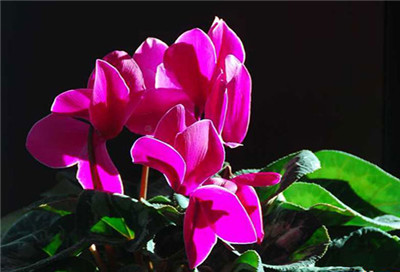
Cyclamen (Cyclamen persicum Mill.), also known as, rabbit-ear flower, rabbit flower, yipin crown, bonfire flower, and fan-petal lotus, is a perennial herbaceous plant in the primrose family, genus Cyclamen. The leaves emerge from the top of the tuber and are heart-shaped, ovate, or kidney-shaped, with fine serrations, green upper surfaces with white or gray mottling, green or dark red undersides, and relatively long reddish-brown leaf stalks. Cyclamen is a commonly grown ornamental flower, suitable for growing in indoor pots, and in winter it requires greenhouse cultivation. Some cultivated varieties of cyclamen have a rich fragrance, while others have a faint fragrance or none at all.
For many years, we tried culture soils of various formulas, but could never overcome two major drawbacks:
First, cyclamen is prone to root-knot nematode disease, soft rot, and pests such as aphids and red spider mites.
Second, it must be watered every day, and even a slight lack of water causes the leaf stalks and flower stems to wilt and droop, the flowers fade quickly, and the ornamental value is reduced. In the past two years, we switched to water culture, which not only overcame the above two drawbacks, but also achieved higher ornamental value and economic benefit. The flowering period of water-grown cyclamen is generally 1 to 2 weeks longer than that of soil-grown plants, and the colors are more vivid. The specific method is as follows: Choosing cyclamen and choosing a container. Choose 1-year-old to 3-year-old cyclamen plants that are free of pests and diseases, growing vigorously, and in bud. Plants grown in soilless media such as perlite, vermiculite, or wood shavings are best, as they suffer no root damage after a change of environment, need no acclimatization, and adapt quickly. Water-culture containers are simple and economical, and can serve as a way to reuse items in daily life. Any watertight container will do, such as a fish tank, teacup, drink carton, wine bottle, or vase; a transparent container is best, as the roots, stems, leaves, flowers, and fruit can all be viewed fully. Whatever container is used, its size, height, and color should all harmonize with the cyclamen plant, so as to bring out the exquisite, translucent, crystal-clear elegance of water-grown cyclamen.
Water-culture timing and method. The flowering period of cyclamen is generally from October to June of the following year, so the water-culture period is generally from September to April of the following year. Remove the selected cyclamen plant from its pot, wash the medium clinging to the roots with 20°C warm water, and take care not to damage the roots. Then place it directly into a previously prepared container, with the water level even with the root zone; at the deepest it must not exceed 1/3 of the corm, so as to prevent the corm from rotting. Finally, place it in a suitable indoor location and add water and nutrient solution regularly. After two to three months of water culture, once the flowers fade, take the plant out and plant it in growing medium to spend the summer.
Water quality and water temperature. The water used for water-grown cyclamen is best mountain spring water or magnetized water, with clean water quality that is neither cloudy nor prone to sediment, and that contains various trace elements essential to plants; no water changes are needed throughout the entire water-culture period. Tap water contains chlorine, which is unfavorable to flower growth, and it easily becomes cloudy and forms sediment, requiring a water change every few days, so it should be avoided as much as possible. The water temperature should be close to the indoor air temperature at the time, generally 10°C to 20°C.
Light and indoor temperature. Cyclamen likes a sunny environment. The water-culture container should be placed on a desktop or windowsill with ample indoor sunlight, not directly on a radiator. The most suitable indoor temperature is 15°C to 20°C; it should not exceed 25°C at the highest or fall below 10°C at the lowest. Adding nutrient solution. Water-grown cyclamen also needs regular nutrient supplementation during the flowering period, generally adding 50 ml of flowering-plant nutrient solution diluted 1:100 per plant every 10 days; mountain spring water should also be used to prepare the nutrient solution. If yellowing leaves, small leaves, or small flowers are observed, and root rot has been ruled out, a little more nutrient solution may be added as appropriate.