How to water cyclamen scientifically? Detailed explanation of the correct method
Cyclamen is a flower that is very sensitive to water. Watering too little can easily cause the plant to wilt, while watering too much can easily cause root rot in cyclamen. Improper watering methods can easily cause damage to cyclamen, so special attention must be paid during cultivation.
Cyclamen likes water but dislikes moisture. The potting soil needs to remain moist, but waterlogging or soggy conditions must be strictly prevented, otherwise once the root system rots, the whole plant will quickly die. Because the entire cyclamen plant is fleshy, it is also not drought-tolerant. If water is not supplied in time, the leaves will quickly turn yellow and wilt. Even after supplementary watering, many leaves will still turn yellow and need pruning, seriously affecting the overall appearance and growth of the plant.
Watering cyclamen should be done regularly: water when dry, do not water when not dry, and when watering, water thoroughly. What cyclamen fears most is being watered whenever there is nothing to do and being given only half-hearted watering. Observe the potting soil: when the surface looks dry and tapping the side of the pot makes a hollow sound, it should be watered. When watering, water thoroughly at one time.
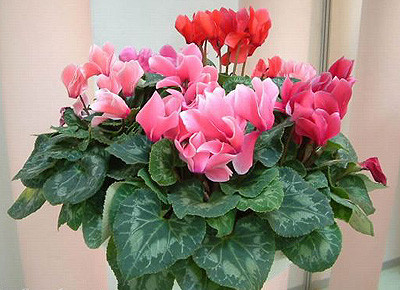
November to March is the flowering period of cyclamen. During the flowering period, cyclamen needs attention when watered. Water once every half month with a 1% potassium dihydrogen phosphate foliar fertilizer, and it can keep blooming continuously. When watering, it is just right to see water overflowing from the bottom of the pot. Never pour or spray water onto the flowers, otherwise the flowers can easily rot. If it loses water and all the flowers and leaves have wilted, quickly place it in a cool place and water thoroughly. If it stands upright normally after 1-2 hours, it has passed the “gate of hell.”
During the dormant period, cyclamen should be watered as little as possible, just keeping the soil moist. When planting, it is best to expose one third of the bulbous root above the soil surface. When watering, pour directly into the flower pot, and try not to let water touch the flowers and leaves. When watering, follow the principle of watering when dry and watering thoroughly at one time, and do not water every day. This is because the bulbous root of cyclamen has the function of storing water, and too much water can easily cause flower buds to drop and leaves to turn yellow. In spring, when the weather is dry, water once every three days; in autumn, watering about once every five days is enough.
Water from above for the first 6 weeks after potting. Once the leaves are dense and the root system is well developed, water from the bottom or use drip irrigation. Water only in the early morning or morning.
Some people worry excessively that cyclamen lacks water. When watering, they not only give an excessive amount at one time, but also keep water in the saucer under the flower pot. This is unfavorable to the growth of cyclamen. Standing water in the saucer will instead cause root rot in cyclamen, so if there is water in the saucer, it must be poured out. At a temperature of 17—18 degrees Celsius, watering cyclamen once every three days is enough, following the principle of watering thoroughly after the soil dries out.
How to grow cyclamen. How to care for cyclamen
Cyclamen, also known as bunny ear flower, belongs to the primrose family and is very suitable for indoor pot cultivation. The flower colors of cyclamen include white, red, purple, orange-red, and red with a white center, and some are also fragrant. Its flowering period can last as long as half a year, so it is quite popular. So, what is the method for growing cyclamen? Today, the editor of Shengduoduo Decoration Network will share with everyone the methods for growing cyclamen, hoping it can help everyone.
In home cultivation, many people like to place it in the study or living room. In feng shui, cyclamen carries the meaning of "an immortal guest drifting in," and is a symbol of good fortune. Cyclamen is also called radish begonia and first-place crown. It is a perennial herbaceous plant, with a flattened spherical tuber, heart-shaped leaves, and peculiar flower shape. The petals curl upward, resembling a rabbit's ears, so it is also called bunny ear flower.
Methods for growing cyclamen
1. Seed selection
Carefully select seeds, choosing plump, glossy brown seeds free of pests and diseases. Soak seeds harvested in the same year for one day and night in a mixed solution of 50ppm GA3 (gibberellin) and 500ppm thiophanate-methyl or chlorothalonil, then drain off the water, rinse clean in clear water, and drain off surface moisture. Then sow. They bloom about 10 days earlier than seeds that were not soaked.
2. Potting soil
Cyclamen requires fertile, well-drained, slightly acidic soil. Long-term neglect of soil management or unscientific management will cause poor growth, fewer flowers, dull colors, and reduced or lost ornamental value. For pot cultivation, loose and fertile nutrient soil is best. Apply decomposed, thin organic fertilizer such as human and animal manure and urine once about every 10 days; after budding, apply 0.1% potassium dihydrogen sulfate twice.
Create suitable temperature conditions. Cyclamen is not tolerant of high temperatures. Too high a temperature will cause it to enter a dormant state. Therefore, temperature has a great effect on cyclamen. Generally, cyclamen is suitable for growing in conditions of around 20°C during the day and around 10°C at night, and the temperature can be slightly lower during the seedling stage. In addition, slightly lower temperatures during flower bud differentiation and flower stalk elongation are beneficial for flowering. In summer, cyclamen enters dormancy because of high temperatures. If low-temperature conditions are created, it can avoid dormancy, which is beneficial for flowering.
4. Light
Extend light conditions. Cyclamen likes sunlight, and extending the light duration can promote earlier flowering. Therefore, cyclamen should be placed in a sunny place for care.
Methods for growing cyclamen
5. Watering
When cyclamen enters dormancy in summer, reduce watering of the dormant corm. After potting in autumn and repotting, water thoroughly and gradually increase fertilizer and water, keeping the soil moist. In winter, reduce the amount of water. When watering, do not let water touch the flower buds and tender leaves, so as to avoid rot and affect flowering. The best watering time is from 10:00 to 12:00 in the morning, and the water temperature and substrate temperature should be as close as possible.
When cyclamen leaves droop and are not very upright at noon, it indicates a lack of water, and you can water it in the morning or afternoon. Generally, for home cultivation of cyclamen, watering once a week according to the situation is enough. A little trick for judging whether a flower lacks water is to tap the side of the flower pot with your finger. If the sound is dull, it is not lacking water; if it is crisp, it means it lacks water and should be watered in time (this method is only suitable for clay tile pots). Usually water once every one or two days to keep the potting soil moist. Never give a large amount of water, and follow the principle of watering only when the potting soil is dry. But be sure to avoid the potting soil becoming too dry. Too dry will damage the root hairs and cause the upper part of the plant to wilt, and even heavy watering afterward will make it difficult to recover.
Cyclamen - methods for growing cyclamen | cyclamen pictures | how to care for cyclamen
Cyclamen
Cyclamen (scientific name: Cyclamen persicum), also known as radish begonia, bunny ear flower, rabbit flower, first-place crown, bonfire flower, and turned-petal lotus, is a perennial herbaceous plant in the genus Cyclamen of the primrose family. Cyclamen is a commonly grown fresh flower, suitable for indoor pot cultivation, and in winter requires greenhouse cultivation. Some cultivated varieties of cyclamen have a rich fragrance, while others are lightly fragrant or unscented.Methods for growing cyclamen
1. Seed selection: Carefully select seeds, choosing plump, glossy brown seeds free of pests and diseases. Soak seeds harvested in the same year for one day and night in a mixed solution of 50ppm GA3 (gibberellin) and 500ppm thiophanate-methyl or chlorothalonil, then drain off the water, rinse clean in clear water, and drain off surface moisture. Then sow. They bloom about 10 days earlier than seeds that were not soaked.
2. Potting soil: Cyclamen requires fertile, well-drained, slightly acidic soil. Long-term neglect of soil management or unscientific management will cause poor growth, fewer flowers, dull colors, and reduced or lost ornamental value. For pot cultivation, loose and fertile nutrient soil is best. Apply decomposed, thin organic fertilizer such as human and animal manure and urine once about every 10 days; after budding, apply 0.1% potassium dihydrogen sulfate twice.
Cyclamen leaves turning yellow
1. Cyclamen leaves curling and turning yellow
Solution: It lacks nutrients. Fertilize promptly. When buying special fertilizer at a flower shop, do not supplement nutrients to the flowers excessively. Usually, a small amount of cooked soybeans, cooked peanuts, bean cake, spoiled steamed buns, etc. can be buried in the pot. In this way, there is no need to worry about a lack of nutrients.
2. Cyclamen cultivation problem: flower stems rotting and flowers and leaves turning yellow
Solution: It has been overwatered. Stop watering, and water again after it heals and the soil dries.
Saving cyclamen seeds
Cyclamen is generally propagated by sowing. If you want to save seeds, during the full flowering period (January to February), select plants with excellent and pure variety, robust growth, and abundant flowering. Keep only 8 to 9 flowers per plant, and remove all other flowers and flower buds, and place the flower pot in a ventilated and sunny place. To increase the seed-setting rate, artificial supplementary pollination can be carried out. On a clear morning 2 to 3 days after cyclamen blooms, rub the pistils and stamens of two flowers against each other, or use a writing brush for pollination.
Cyclamen pest and disease control
Common diseases of cyclamen: bacterial soft rot, gray mold, anthracnose, leaf spot, and root-knot nematode disease. The control methods are as follows: Bacterial soft rot: caused by bacteria of the genus Erwinia. It mostly occurs on leaf stalks and stems. Lesions on the leaf stalk are initially small light brown spots, water-soaked and soft-rotted. After expansion, the diseased tissue becomes soft-rotted, swollen, ruptured, with the epidermis detached and a foul odor. After the corm is infected, the tissue turns yellow-brown, soft-rotted, and mushy. It is prone to occur in the growing season and early spring. After discovery, diseased and remnant tissues should be cleaned up in time to reduce infection sources, ventilation should be strengthened, and watering should be controlled. In the early stage of the disease, spray with 200ppm to 1000ppm streptomycin, oxytetracycline, or penicillin solution, or apply it to diseased plants, then use the same solution to water the pots of diseased plants; spray with equal-strength Bordeaux mixture or 0.40 lime sulfur mixture.
The uses of cyclamen
Uses of cyclamen: 1. Ornamental
Cyclamen has a distinctive flower shape, is delicate and eye-catching, and is gorgeous and varied. Some varieties are fragrant and deeply loved by people. It is a precious potted flower in winter and spring, and is also one of the most important potted flowers on the world flower market. It has been hailed as the queen of potted flowers and has very high ornamental value.
Uses of cyclamen: 2. Decorating the home
Cyclamen has a beautiful and distinctive plant shape, with abundant flowers and brilliant colors. It is suitable for potted ornamental display and can be placed indoors for arrangement. It is especially suitable for decorating sunny shelves and desks in the home, with a very good decorative effect.
The feng shui uses of cyclamen
1. Living room feng shui
The name of cyclamen implies welcoming honored guests and praying for the arrival of good luck, carrying an auspicious meaning. Its refined flowers stand on tall flower stems, with a scene of varying heights, like a flock of birds flying over with spread wings, reminding people of the elegant bearing of an immortal riding the clouds in a clear breeze. Placing such a potted flower in the living room can let visiting guests feel a meaning of being warmly welcomed, and also bring peace and happiness to the family.
2. Dining room feng shui
The dining room is where family members replenish their physical strength. A successfully arranged dining room can create a pleasant atmosphere, make everyone dining feel relaxed, and also help with communication among diners and harmonious coexistence among family members, as well as benefit the health of family members. Therefore, greening and decoration in the dining room are very important. Cyclamen can inject life and vitality into the dining room and add a cheerful atmosphere. It can also be placed on a wooden partition cabinet to divide the dining room from other functional areas. Properly placing a few pots of lush cyclamen in a corner of the dining room or on the windowsill will make the dining room full of vitality and make people's appetites open wide.
Is cyclamen toxic?
Cyclamen has a relatively strong resistance to the toxic gas sulfur dioxide in the air. Its leaves can absorb sulfur dioxide and, through oxidation, convert it into non-toxic or low-toxicity substances such as sulfate.
It is suitable for potted ornamental display and can be placed indoors for arrangement. It is especially suitable for decorating sunny shelves and desks in the home. Because of its beautiful and distinctive plant shape, abundant flowers, and brilliant colors, as well as varieties with fragrance, it is deeply favored by people. Cyclamen can also be potted using soilless cultivation methods, clean and charming, and even more suitable for home decoration. Cyclamen has a distinctive flower shape, is delicate and eye-catching, and is gorgeous and varied. Some varieties are fragrant and have very high ornamental value, and are deeply loved by people. It is a precious potted flower in winter and spring, and is also one of the most important potted flowers on the world flower market. Cyclamen has a long flowering period, up to 5 months. Its flowering period coincides with traditional festivals such as Christmas, New Year's Day, and Spring Festival, so market demand is huge, production value is high, and economic benefits are significant. It is often used for indoor flower arrangement; it is also suitable as a cut flower, and lasts a long time in water.
Plant toxicity: cyclamen plants are somewhat toxic, especially the root and stem parts. Accidental ingestion may cause diarrhea and vomiting; skin contact may cause redness, swelling, and itching of the skin, so attention must be paid when keeping it at home.
Related encyclopedia
Pocket scale non-woven bag lamp grass bamboo shoot crab claw redmi note3 ykk zipper ybs zipper large mountain cherry climbing wall plum wild senna winter plum green pine wristwatch Omega Longines famous watch children's building blocks flint azalea orchid curling iron soursop