How do you grow Phalaenopsis orchids so they bloom abundantly and beautifully?
1. The flower bud differentiation of Phalaenopsis requires a certain annual accumulated temperature, and also a short period of low-temperature treatment. The low-temperature treatment generally starts 110~140 days before the full bloom period. One month before the treatment, the light intensity should be gradually increased to accumulate sufficient nutrients for flower bud differentiation. 7~10 days before the treatment, 100-times-diluted monopotassium phosphate should be sprayed on the leaves 1~2 times.
2. The suitable daytime temperature for low-temperature treatment is 25~27 degrees, and the nighttime temperature is 15~18 degrees, and good ventilation must be ensured. Before the flower buds sprout, a quick-acting liquid fertilizer with nitrogen, phosphorus and potassium (9:45:15) should be applied. After the flower buds emerge and the flower stalk reaches 15~20 cm, apply a quick-acting liquid fertilizer with nitrogen, phosphorus and potassium (10:30:20), focusing the spraying on the leaves and roots, applying once every 10 days, and apply less and dilute fertilizer.
3. During the flowering period, ventilation should be strengthened, air humidity should be reduced, and the water supply to the roots should be increased, which can ensure the flowers are uniform in size.
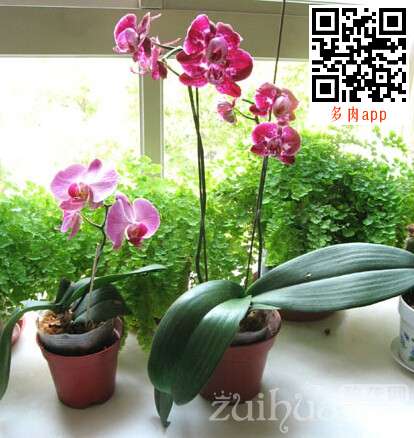
How can you make Phalaenopsis orchids bloom abundantly and beautifully?
1. When Phalaenopsis flower buds are differentiating, the temperature needs to be below 18°C. After differentiation, raising the temperature can promote flowering. The low-temperature treatment generally starts 110~140 days before the full bloom period. One month before the treatment, the light intensity should be gradually increased to accumulate sufficient nutrients for flower bud differentiation. 7~10 days before the treatment, 100-times-diluted monopotassium phosphate should be sprayed on the leaves 1~2 times.
2. The suitable daytime temperature for low-temperature treatment is 25~27 degrees, and the nighttime temperature is 15~18 degrees, and good ventilation must be ensured. Before the flower buds sprout, a quick-acting liquid fertilizer with nitrogen, phosphorus and potassium (9:45:15) should be applied. After the flower buds emerge and the flower stalk reaches 15~20 cm, apply a quick-acting liquid fertilizer with nitrogen, phosphorus and potassium (10:30:20), focusing the spraying on the leaves and roots, applying once every 10 days, and apply less and dilute fertilizer.
3. During the flowering period, ventilation should be strengthened, air humidity should be reduced, and the water supply to the roots should be increased, which can ensure the flowers are uniform in size.
4. Increase light. Phalaenopsis needs diffused light all year round. In winter, a little artificial supplemental lighting can be given to help it bloom; a temperature above 20~24°C is needed all year round. At the same time, when temperatures are high, more water should be sprayed every day, preferably watering in the morning, so that the water can be completely absorbed before night, and no water remains on the leaves or petioles overnight, otherwise diseases are easily caused. In winter, it is also easily damaged by cold and frost, and may even drop its leaves.
5. Phalaenopsis has different water management measures in different seasons; different cultivation media also require different water management methods. Because Phalaenopsis leaves are relatively thick and store more water, they have a relatively strong drought tolerance. In spring, air humidity is high, so watering once every 3~7 days is fine; in summer and autumn, environmental temperatures are high and water evaporates greatly, so watering is usually done once every 1~2 days. In winter, temperatures are low and air humidity is low, so watering once a week is fine. While ensuring a certain level of environmental humidity, it is also necessary to avoid water accumulating on the leaves, because water on the leaves can easily cause frost damage. If conditions allow, forced ventilation after watering is best, so that water on the leaf surface can be dispersed as much as possible to reduce the occurrence of diseases.
6. To promote abundant flowering, some liquid fertilizer can be sprayed on the leaves and roots during the growing season. In spring, fertilize once every 3~4 weeks generally. Stop fertilizing when flowering, and after flowering, fertilize once every 10 days. Fertilization should mainly use liquid fertilizer with relatively high phosphorus and potassium content, and each application should be small and dilute. In summer, Phalaenopsis grows vigorously, so a solid organic fertilizer can be applied once on the pot surface, and then liquid fertilizer applied once a week. After the weather turns cool in autumn, gradually reduce it, and fertilization can be stopped by the end of October.
Phalaenopsis has a relatively long flowering period. If the flower stalk is cut early as a cut flower, it can bloom a second time that same year. Phalaenopsis blooms at different times depending on the variety. Generally, each flower stalk can grow more than a dozen flowers, opening one by one from bottom to top, and one stalk of flowers can bloom for more than 1 month.
Summary: The above is an introduction to knowledge about Phalaenopsis flowering. I hope everyone will exchange more experience in growing Phalaenopsis.
How to make Phalaenopsis orchids bloom abundantly and beautifully
Care tips:
Under normal circumstances, new Phalaenopsis plants need 3 months of cultivation before the flower buds sprout, making flowering possible.
Temperature is the main factor affecting the differentiation and formation of Phalaenopsis flower buds. Not only is a certain annual accumulated temperature needed, but short-term low-temperature treatment is also required.
After late autumn arrives, the nighttime cultivation environment must be kept at 15-18°C for flower buds to differentiate normally. Then, for one and a half consecutive months, the seedlings need low-temperature treatment for about 18 hours every day, which will make the plant sprout many flower buds.
Next, the nighttime temperature should be kept within 18-20°C, and after 3-4 months of growth, bright flowers will bloom.
Because Phalaenopsis has a relatively long flowering period, cutting the flower stalk early to make cut flowers allows a second bloom the same year.
Of course, different varieties of Phalaenopsis bloom at different times. Usually each flower stalk can produce more than a dozen flowers, blooming in sequence from bottom to top, and the flowers on each stalk can bloom for about more than a month.
To make the flowers bloom more abundantly, liquid fertilizer can be sprayed on the leaves and roots during the peak growing period.
In spring, fertilize once every 3-4 weeks generally. Stop fertilizing once the flowering period begins, and after the flowers fall, fertilize once every 10 days. Choose liquid fertilizer with relatively high phosphorus and potassium content, and when fertilizing, use a small amount and a dilute concentration.
Summer is the peak growing season for Phalaenopsis. After applying a solid organic fertilizer once on the pot surface, apply liquid fertilizer once a week;
In autumn, as temperatures drop, fertilization also decreases, until fertilization stops after the end of October.