How to Buy Cyclamen? Methods for Selecting High-Quality Cyclamen
Cyclamen has an attractive and distinctive plant form, abundant and vividly colored flowers, and a rich fragrance. It also helps purify the air, making it very popular in the flower market. When purchasing cyclamen, pay attention to the following:
1. Purchasing time: Cyclamen is a flower that prefers cool conditions. Its flowering period is in winter and spring, which is the best viewing period. Household environmental conditions (daytime temperature below 25 degrees, nighttime temperature above 10 degrees) can usually meet the requirements for cyclamen growth and flowering, making care relatively easy.
2. Plant: Vigorous growth, free of pests and diseases; plant form neat, compact, and well-proportioned, not leaning or scattered; the ratio of flower crown to flower pot is appropriate.
3. Corm: A high-quality cyclamen corm is not rotten and not cracked; 1/3-1/2 of it is exposed above the soil surface.
1. Growing Environment
Cyclamen originates from the low mountain forest zones of the southeastern Mediterranean coast, which determines that the most suitable temperature for cyclamen during the day is about 20°C, and the nighttime temperature should be above 10°C. Cyclamen likes an environment with sufficient light, but avoids direct strong sunlight in summer. Especially during the high-temperature season from June to August, shading is necessary from 12 noon to 4 pm, and it is best placed under a shade shed with 50% shading.
2. Substrate Preparation
Cyclamen likes loose, fertile, well-drained sandy loam rich in humus, with a soil pH of 6.0-6.5. Soilless cultivation is more suitable, as it can effectively control the optimal requirements of cyclamen for temperature, water, light, nutrients, and air during growth and development. The substrate can be prepared with 5 parts peat, 3 parts river sand, 2 parts perlite, or 5 parts peat, 2 parts perlite, 3 parts furnace slag.
3. Sowing and Seedling Emergence
Determining the sowing time for cyclamen seeds is relatively important. Large-flowered cyclamen should generally be sown in September-October, while medium- and small-flowered cyclamen can be sown from December to January of the following year. Care should be taken to select seeds with good maturity, a reddish-brown color, plumpness, and no mold for sowing. To obtain seedlings with uniform growth and facilitate production management, seeds should be sorted by size before sowing and then sown separately. Seed disinfection treatment must be carried out before sowing. The specific method is: soak the seeds in 10% copper sulfate for 30 minutes, or soak them in a 500-fold solution of 50% carbendazim for 30 minutes, then rinse them clean with water, remove them, and spread them on newspaper to dry. Cyclamen seeds require dark conditions during germination, so after sowing they must be covered with black plastic film to block light. At this stage, the key is to maintain a dark, cool, and high-humidity environment. Try not to fertilize during germination. After all seedlings have emerged, spray with dilute fertilizer water, mainly nitrogen fertilizer.
4. Water and Fertilizer Management
Cyclamen has a relatively long growth cycle, and throughout its life it has a relatively large demand for nitrogen, phosphorus, and potassium. Control the nutrient solution concentration at 0.1%-0.2%, and the nutrient solution pH at around 6. To allow cyclamen to grow in a slightly acidic environment, fertilizer should be applied once every 10d during the growing period, and nutrient solution application can be stopped during high-temperature periods. Cyclamen is a bulbous flower with a fairly large demand for calcium, so 3-4 kg of calcium carbonate should be mixed into each m3 of substrate. Cyclamen is a bulbous flower that likes moisture, and water management throughout its life is extremely important. If tap water is used for irrigation, it should first be exposed to the sun for 1d or stored for 1-2d. The potting soil should often remain moderately moist, with relative humidity at 70%-75%. During the plum rain season, rainfall is heavy and air humidity is high, so ventilation must be strengthened to avoid corm rot caused by high temperature and high humidity.
5. Shaping
When cyclamen seedlings are planted into pots, the corm should not be buried too deeply in the soil and must be exposed 1/3-1/2 above the soil surface. In daily management, the pot should be rotated regularly so that the cyclamen plant grows evenly and has a full, attractive plant form.
6. Flowering Period Control
If flowers can be available for the season, the flower price is high. The best time for cyclamen to go on the market is New Year's Day and the Spring Festival. (1) Adjust the sowing period of cyclamen. (2) A reasonable combination of N, P, and K fertilizers can promote flower bud differentiation. For example, using 2% potassium dihydrogen phosphate for foliar topdressing can advance the flowering period and increase the number of flowers. (3) Applying 10-50 mg/L gibberellin by spotting it on the flower buds can advance flowering by 7-10d. (4) Low-temperature treatment: placing cyclamen in a 5-10°C environment can extend the flowering period of cyclamen.
7. Pest and Disease Control
7.1 Gray mold, soft rot, and leaf rot are common diseases of cyclamen. Control should be carried out through both cultivation and chemical measures.
7.1.1 Cultivation control. Strengthen seed quarantine, eliminate seed transmission, strengthen greenhouse ventilation, and appropriately lower humidity; avoid mechanical damage to prevent pathogen invasion; promptly remove diseased leaves to reduce sources of pathogens; fertilize reasonably to avoid excessive nitrogen fertilizer.
7.1.2 Chemical control. For gray mold, use a 1000-fold solution of 70% thiophanate-methyl or a 500-800-fold solution of 50% carbendazim, sprayed once a week to take effect. For soft rot, spray or smear diseased plants with a 1000-fold agricultural streptomycin solution, and also drench the substrate; the control effect is significant. For leaf rot, 1:1:200 Bordeaux mixture can be used for control.
7.2 The common pests of cyclamen are mainly cyclamen mites and aphids. Cyclamen mites parasitize the corm, leaves, flower buds, and shoots, sucking sap, causing leaves to turn yellow, thicken, and curl, spots to appear on the leaf surface, and the flowering period to shorten. They can be killed by spraying with a 1000-1500-fold solution of 40% dicofol or a 2000-3000-fold solution of Bimanda. Spraying must be thorough to prevent mites from escaping and spreading. Aphids mainly damage new shoots and flower buds. When plants are severely affected, growth is poor, and they can also transmit pathogens. They can be killed by spraying with a 1500-fold solution of 10% imidacloprid wettable powder.
8. Market Release
Cyclamen is harvested and marketed as a potted flower. Its market release time is generally when most of the cyclamen flowers are at the bud stage.
Cyclamen
Cyclamen Growing Methods:http://hua.fengqiaoju.com/huahui-jiaoliu/xiankelaiyangzhizaipei/
(Cyclamen flower pictures, potted)
Cyclamen (scientific name: Cyclamenpersicum), also known as radish begonia, rabbit ear flower, rabbit flower, yipin crown, bonfire flower, and fan-petal lotus, is a perennial herbaceous plant in the genus Cyclamen of the family Primulaceae. Cyclamen is a commonly grown fresh flower, suitable for indoor pots, and in winter it needs to be grown in a greenhouse. Some cultivated varieties of cyclamen have a rich fragrance, while others have a light or no fragrance. The Chinese word "xiankelai" comes from the transliteration of the scientific name Cyclamen. Because the transliteration is ingenious, the flower name carries the meaning of "fairy guests arriving gracefully." Cyclamen is the city flower of Qingzhou City, Shandong Province, and was also the mascot of the 43rd World Table Tennis Championships held in Tianjin in 1995.
This flower is also called begonia, but it belongs to the family Primulaceae.
Chinese name: Cyclamen, national flower of San Marino
Latin scientific name: CyclamenpersicumMill.
English names: Florist'sCyclamen, PersianCyclamen, sowbread, persianviolet, primrose
Chinese aliases: rabbit flower, rabbit ear flower, yipin crown, radish begonia. Bu begonia, rabbit flower, bonfire flower, fan-petal lotus.
Toxicity
This plant is somewhat toxic, especially the rhizome. Ingestion by mistake may cause symptoms such as diarrhea and vomiting; skin contact may cause redness, swelling, and itching. If these symptoms appear, please consult a doctor for guidance. Do not let animals or children accidentally eat this plant or its rhizome.
Native to the Mediterranean region, it is now widely cultivated around the world. Cyclamen originated in Mediterranean areas such as Greece in southern Europe, and has been cultivated by flower lovers for more than 300 years. In the 18th century, Germany was once the cultivation center, and later it swept across the whole of Europe. Because horticulturists continuously improved varieties, the cultivation center eventually shifted to the United States. It gradually became a worldwide ornamental flower and was highly praised by flower lovers, and was therefore hailed as the queen of potted flowers. Those currently cultivated are all hybrids, with very many varieties. It is widely cultivated in temperate regions and is a famous winter and spring greenhouse potted flower. Its flowering period lasts for several months, and it is deeply loved by people. San Marino indeed showed considerable insight in choosing this "world-class" flower as its national flower.
Morphological Characteristics
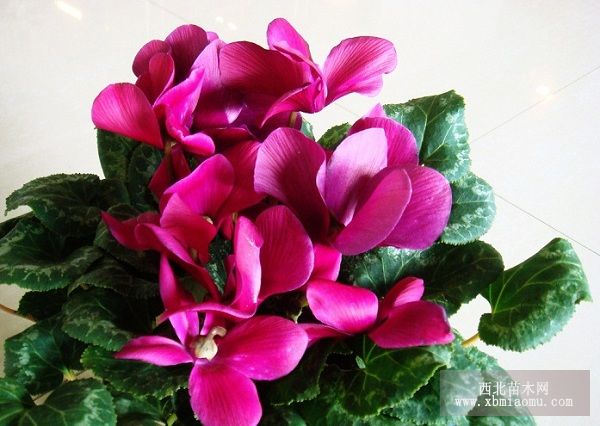
The cyclamen tuber is oblate-spherical or spherical and fleshy. Leaves emerge from the top of the tuber and are heart-shaped, ovate, or kidney-shaped, with fine serrations on the leaf margins. The leaf surface is green with white or gray mottling, and the leaf underside is green or dark red. The petiole is relatively long, reddish-brown, and fleshy. Flowers are solitary at the top of the flower stem, nodding, with petals reflexed upward like rabbit ears; flowers come in white, pink, rose red, bright red, purple red, snow blue, and other colors, often with dark red spots at the base; petal margins are diverse, including entire, notched, wrinkled, and wavy forms.
(Cyclamen pictures)
Cyclamen Growing Methods
Propagation Methods
Mainly seed propagation, but propagation can also be done by dividing the corm.
Seed propagation is usually from early September to mid-October. Sowing too early affects growth, and the corm flowers before it is large} too late, and the temperature is too low, affecting germination. Because its seeds are relatively large, before sowing it is advisable to soak them in 1000-fold carbendazim for 24h for pregermination. Before sowing, the sowing soil and sowing pots should also be disinfected. After sowing, subirrigate the pot and place it in a dark place at 18-20°C for germination, while also providing shading. Generally, rooting occurs in two weeks, and one cotyledon can be produced in 4-6 weeks.
Cyclamen Cultivation Methods
Greenhouse Selection
Choose a solar greenhouse facing south. The greenhouse should have heating and wet curtain cooling facilities. In winter, cover the greenhouse film with straw curtains for insulation, and keep the temperature above 10°C-12°C, with relative humidity at 60%-100%. In summer, install 75%-90% shade netting, keep the temperature at 12°C-18°C, and control light intensity at 25000-35000 lux.
Early Seedling Stage
When the cotyledons have fully grown and 2-3 true leaves have appeared, small seedlings sown in 288-cell trays should be moved into 72-cell or 50-cell trays. The management points at this stage are high humidity (80%-85%), alternating temperature (18°C-20°C during the day, 15°C-16°C at night), medium light (15000-25000 lux), and fertilizer adjustment (after the cotyledons are fully expanded and the first true leaf appears, use 75-100 mg per liter of ammoniacal nitrogen fertilizer or calcium sulfate alternately, each time for 7-10 days). During the hardening-off period, water should be appropriately controlled (humidity 70%-80%), temperature (18°C-20°C during the day, 15°C-16°C at night), light should be strengthened (35000 lux), and fertilization should be reasonable (a compound fertilizer with nitrogen:phosphorus:potassium of 20:20:20 at 100 mg per liter, once a week).
Cyclamen Transplanting Management
After tray seedlings have 4-5 true leaves, they should be transplanted in time. Flower pots generally use 15-18 cm high-quality plastic flower pots with a mesh structure at the bottom. The substrate should be selected as a formula rich in organic matter and humic acid, with strong water retention and relatively large porosity (leaf mold, cow dung, perlite at 2:1:1) as the ideal substrate for cyclamen cultivation in the northwest region. When transplanting seedlings, expose 1/2-1/3 of the corm, place the seedling in the center of the pot, and leave a 1 cm watering space from the pot rim. After potting, promptly spray thiophanate-methyl (800-1000-fold) and agricultural streptomycin to prevent pathogens from invading through wounds. Drenching the roots 1-2 times gives a better effect. The carrying capacity of the solar greenhouse is preferably 8-12 pots per square meter. Within one week after transplanting, shade the plants, then gradually increase light to a maximum of 30000 lux. Due to the phototropism of plants, turn the pots once every 15-20 days after potting. Control humidity at 60%-70% during the day and 80%-85% at night; temperature at 23°C-26°C during the day and 15°C-17°C at night; for fertilization, alternately use compound fertilizers with nitrogen:phosphorus:potassium=1:0.7:2 and nitrogen:phosphorus:potassium=2:1:2, and gradually increase the concentration from 200 mg per liter to 500 mg per liter. Applying more phosphorus and potassium fertilizer at the seedling stage helps corm development, makes leaves thicker, and improves resistance; overwintering management should provide shading (preferably 25000-30000 lux), cooling (install wet curtains in the solar greenhouse, preferably controlled below 28°C), ventilation (install fans), and disease prevention (spray with 4000-5000-fold agricultural streptomycin plus 800-****-fold thiophanate-methyl, alternately drench roots with agricultural streptomycin and copper preparations, but these two pesticides cannot be used at the same time).
Cultivation Management
During cultivation, the soil should be loose. A culture soil mixed with 2 parts leaf mold, 1 part garden soil, and a small amount of superphosphate can be used. Sun-dried and crushed river mud can also be used, or a culture soil mixed with 2 parts peat and 1 part perlite. The culture soil needs fumigation disinfection. When repotting, gradually increase the pot size according to the plant size; it is not suitable to directly use a large pot to cultivate small seedlings. When planting, shallow planting is appropriate. When potting or repotting large seedlings, 2/3-1/2 of the corm should remain above the soil surface to prevent the corm from rotting from moisture in the soil. Avoid applying concentrated fertilizer, as concentrated fertilizer easily damages roots. Topdressing can be done about 3 times per month. Before fertilizing, loosen the soil, choose a sunny day for topdressing, do not apply fertilizer from the top of the plant, apply it to the side instead, and rinse with water after fertilizing.
Cyclamen care and management can be roughly divided into 5 stages:
1. Seedling Stage
When the first leaf has fully grown and true leaves first appear, transplanting should be done. When seedlings have 3-4 leaves, they can be planted in flower pots with a diameter of 10 cm. Later, as the plant grows, switch to larger flower pots. The repotting time should not be later than June. If the seedlings are small, they can be left in small pots to spend the summer. Seedlings need shading. In hot weather, frequently loosen the soil, weed, water, and fertilize.
2. Summer Seedling Maintenance Stage
Summer temperatures are high, which is extremely unfavorable for cyclamen growth. Cooling equipment should be used to lower the environmental temperature so that it can pass the summer safely. To avoid high temperatures, use two layers of shade netting for shading, control watering, and stop fertilizing.
3. First-Year Flowering Stage
After autumn begins, growth resumes, watering can be gradually increased, and thin fertilizer can be applied. In mid-October, place it in a sunny spot. The greenhouse air should be humid. Fertilize 2-3 times per month. From mid-December to early February, fertilization is generally not needed, but in a relatively high-temperature environment, fertilization does not need to be stopped. Flowering generally begins in November.
4. Summer Corm Dormancy Stage
After May, leaves gradually turn yellow, so watering should be gradually stopped to allow dormancy. After the leaves have completely withered, place it in a low-temperature, ventilated environment so the corm can pass the summer safely. Generally, place the pot in a cool, rain-sheltered place.
5. Second-Year Flowering Stage
After the hot summer, water lightly to allow the corm to revive and sprout. After sprouting, repot with new culture soil and remove rotten roots. Care for it in a greenhouse, and it can bloom around December. After flowering, it again enters the summer corm dormancy period. Newly propagated seedlings generally begin flowering in November. If during the bud stage the temperature is kept at 15-20°C, spraying 100 mg/l gibberellin on the flower buds and pedicels can promote pedicel elongation and accelerate flowering.
Cyclamen Care and Management
Watering should be moist rather than waterlogged, fertilizing should be thin rather than concentrated, and light should be warm rather than scorching.
Watering should be moist rather than waterlogged: keep the soil moist regularly, and do not let water accumulate at the roots.
Cyclamen is somewhat contradictory in water absorption. It very much likes a moist environment, but is also afraid of too much water. Therefore, when watering it, water an appropriate amount once a day to maintain the moisture of the potting soil, while also controlling the amount of watering. Water must not accumulate on the potting soil, so as to avoid excessive water corroding its roots. In summer, spray water on it frequently to ensure normal water absorption.
Fertilizing should be thin rather than thick: apply thin fertilizer once every ten days during the growing period, and apply less or no nitrogen fertilizer during the flowering period.
Cyclamen is a plant that relatively likes fertilizer, but what it likes is thin fertilizer. Especially during its growing period, we should apply thin fertilizer once about every ten days. When cyclamen is forming buds, apply liquid fertilizer once more as topdressing. During the flowering period, apply as little fertilizer as possible; even if fertilizing, only occasionally apply thin fertilizer, and do not apply nitrogen fertilizer. When fertilizing, be especially careful not to pour fertilizer water directly on the flowers and leaves, otherwise they are easily damaged.
Light should be warm rather than scorching: sunlight exposure should be warm and mild. In summer, avoid direct sunlight and provide shading.
When the sunlight is relatively warm and not glaring, cyclamen can be given more sunlight exposure. Sufficient sunlight helps promote flowering. In summer, try to place cyclamen in a place with scattered light, and shade it when necessary to avoid being burned by scorching sunlight.
Ventilation Conditions: The growing location for cyclamen should also have good ventilation conditions.When the weather is too hot and stuffy and the surrounding environment is not ventilated, cyclamen can easily enter dormancy. In addition, suitable temperature is also very important for cyclamen growth. Try to maintain 20 degrees during the day. When summer is too hot, be sure to do a good job of cooling and shading. In winter, the indoor temperature should try not to be lower than ten degrees, otherwise it will affect the normal growth of cyclamen.
Precautions
Repot at the right time. Generally in mid-September, dormant corms begin to sprout, so repot immediately, and do not cover the corm with potting soil. When the newly repotted cyclamen corm is growing new roots, watering should not be excessive to prevent corm rot. The potting soil is better kept slightly dry.
Pay attention to ventilation and shading. During the growing period, always pay attention to indoor ventilation and shading. When the leaves are lush, widen the spacing between pots to avoid crowding that causes leaves to turn yellow and rot. Around the Spring Festival, cyclamen enters the full flowering period. On sunny days, ventilation should be adjusted to avoid excessive indoor humidity, which can cause flowers to wither and pedicels to develop water-soaked rot. The fruiting period coincides with rising temperatures, and watering increases accordingly. Strictly prevent excessively high indoor temperature and humidity, and pay attention to ventilation adjustment to avoid flower stem rot and fruit mold. In mid-June, leaves begin to turn yellow and fall, and the corm enters the dormancy period. Place dormant corms in a well-ventilated, cool place and maintain a certain humidity. Too wet and the corm easily rots; too dry and sprouting and flowering are delayed.
Strengthen fertilizer and water management. During the growth and development period of cyclamen, fertilize once every ten days, and gradually increase sunlight exposure so that the petioles do not grow too long and affect appearance. When the pedicels emerge and the buds are about to open, apply one additional application of bone meal or superphosphate. In the middle and lower reaches of the Yangtze River, flowering can occur around New Year's Day. During the flowering period, stop applying nitrogen fertilizer and control watering. Especially on rainy and snowy days, water must not be poured on flower buds and young leaves, otherwise they easily rot and affect normal flowering. After flowering, apply bone meal once more to facilitate fruit development and seed maturation. Around May, the fruit begins to mature. After harvesting, peel open the fruit skin, take out the seeds, dry them in a ventilated place, and store them. In the early growth stage of cyclamen, a 20-20-20 general fertilizer can be used, that is, nitrogen content (N) 20%, phosphorus content (P205) 20%, potassium content (K20) 20%. During the flowering period, a special fertilizer for potted flowers, 15-15-20 water-soluble high-efficiency nutrient solution, can be used.
(Cyclamen pictures)