How to keep hydrangeas in a vase? Choose a good vase, control the water level, and protect them from wind
Hydrangea, a beautiful flower with a long blooming period and large flower clusters that look like embroidered balls after blooming, is welcomed and loved by a wide range of people. Growing hydrangeas in pots at home does look quite nice, but compared to keeping them in a vase, it falls short by quite a bit. So how do you keep hydrangeas in a vase? What do you need to pay attention to after putting them in a vase? On this topic, let the editor explain it to you.
1. How to keep hydrangeas in a vase: prepare a vase
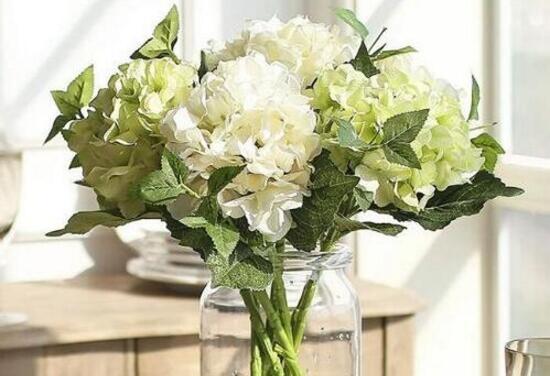
Hydrangeas are very beautiful, and if you keep them in a pretty vase, the effect will be even better. As for how to keep hydrangeas in a vase, first, we need to choose a pretty vase, and then insert the hydrangea into the vase. The specific method will be introduced in detail by the editor below, so don't miss it~
1. Choose a pretty vase, short/long
How to keep hydrangeas in a vase? First, naturally, you need to choose a pretty vase. As for size, there are two kinds: one is a short vase, and the other is a long vase.
(1) Short vase
If you keep hydrangeas in a vase and the stems are relatively long, they need to absorb more water to keep the flowers fresh, and this will shorten the viewing time of the flowers. If possible, it is best to use a short vase, about 15cm or shorter, so the flower stems that need to be kept can be shorter.
(2) Long vase
Of course, to improve the ornamental effect, you can also keep hydrangeas in a long vase (about 46cm). As shown in the picture above, doesn't it look beautiful? However, after keeping them in a long vase, you should often check the water in the vase and replace it in time. Doing this can also appropriately extend the vase viewing period of the flowers.
2. Prepare the hydrangeas
How to keep hydrangeas in a vase? After the vase is chosen, the next step is to prepare the hydrangeas. There are also two situations here: one is receiving fresh hydrangea flowers, and the other is hydrangeas cut from the plant.
(1) Hydrangeas received
If you receive hydrangeas as a gift from someone, you should trim the flower material and cut off an appropriate length from the base according to the height of the vase (cut the stem at a 45-degree angle). Note that the cut should preferably be between two nodes of the stem, avoiding cutting on a node, and the larger the cut surface, the better, or smash the end to increase the water-absorbing area of the flower material.
(2) Hydrangeas cut from the plant
How to keep hydrangeas in a vase? Besides received flowers, the flowers can also be cut directly from blooming hydrangeas. It is best to cut at a 45-degree angle, then soak the hydrangea flowers in clean water for about 2 hours. To improve the water absorption of the stems, you can also use a small hammer to smash the base of the stems. Doing this can keep the flowers fresh and brightly colored, extending their water absorption time and viewing time.
2. Precautions for keeping hydrangeas in water
How to keep hydrangeas in a vase? After completing the above steps, it is basically done, but if you want to keep them well, you also need to pay attention to the following points:
1. Avoid light and wind
They prefer shade and dislike sun, so avoid direct sunlight; at the same time, never expose them to wind. Once hydrangeas are exposed to wind, they easily dehydrate and wilt.
2. Prune carefully
Hydrangea leaves are also very beautiful, but after the hydrangea blooms, they should all be cut off to prevent them from competing for water in the flowers, thereby shortening the life of the cut flowers; in addition, when pruning, do not prune the stems of hydrangeas that are less than 5 years old and have not yet entered the flowering period, because these branches often become the flowering branches of the next year.
3. Change the water in time
When keeping hydrangeas in a vase, water is naturally the most important thing. When caring for them, the water level in the vase must not be low; it needs to be filled with deep water. Change the water and trim the stems every day, otherwise they easily wilt from lack of water. If the hydrangea wilts, you can soak the entire branch in water, and it can easily recover. If the dehydration is not serious, soaking for about 4 hours is generally enough; if the situation is more serious, it is best to soak it overnight.
How to keep hydrangeas in a vase, and how to keep hydrangeas fresh
Hydrangea is a beautiful cut flower material. Its flower shape is elegant and unique, and the meaning of its flower language is also very beautiful. Whether used alone or as a matching flower in arrangements, hydrangeas are very beautiful. So do you know how to keep newly bought hydrangeas in a vase? Below, let's take a look with the editor of Huayu Web at how to care for newly bought hydrangeas in a vase!
Methods for caring for hydrangeas in a vase
Hydrangeas are already very common in flower production. They are not only used as potted flowers and garden plants, but more and more growers are paying attention to cut flower techniques for hydrangeas. However, hydrangea cut flowers wither easily, mainly because their leaves are too large and too numerous. Even if you supplement water, it is still difficult to extend their vase period. So how do you keep hydrangeas in a vase? How can you make the quality of hydrangea cut flowers better and the flowering period longer? The following methods can be adopted:
1. Trim the roots
How to keep hydrangeas in a vase? After receiving fresh hydrangea flowers, you need to promptly remove the water storage tube and perform a second cut on the flower material, cutting the roots according to the height of the vase; the cut should preferably be between two nodes, avoiding cutting on a node, and the larger the cut surface, the better, or smash the end to increase the water-absorbing area of the flower material.
Hydrangea leaves are opposite, and the flowering branches have nodes one after another. When trimming the roots, first cut off the part immersed in the fresh-keeping tube. Note that the cutting position should be chosen between two nodes, avoiding the leaf buds, which can improve water absorption.
Do not leave the flower stems too long. If they are too long, the upward transport of water will be very difficult, and the flower heads will dehydrate. After cutting the hydrangea base at a 45-degree angle, cut a cross into it. Observe the cut surface, and you can see that the stem is not hollow, but has white spongy tissue inside.
At this time, use the tip of scissors or a small knife, like cleaning an ear, to dig out as much of the white spongy tissue as possible, making it hollow. It does not mean cleaning out all the spongy tissue of the entire stem, just digging out a section. In this way, the hydrangea will actively absorb water, and the situation will not occur where the stem is very fresh but the hydrangea does not absorb water.
2. Remove leaves
The green leaves of hydrangeas are large and full, which shows that the hydrangea is very fresh, but the full green leaves will compete with the flower heads for water. So how do you keep hydrangeas in a vase? After all, the water transport process passes through the green leaves first, so the fewer leaves left, the better. Reducing respiration is the best way to prevent the petals from failing to absorb water.
3. Emergency rescue for dehydration
Once dehydration occurs, place the hydrangea in a low-temperature environment of 4°C to 5°C, or soak the entire branch in water, which can also achieve an emergency rescue effect. If the dehydration is not serious, soaking for 4 hours is generally enough; if the dehydration is more serious, it is best to soak it for a whole night. Usually more than 80% can be saved. However, special attention should be paid: if your hydrangea is not dehydrated, then there is no need to soak it; just spray more water on the flower heads.
I believe everyone now has a certain understanding of how to keep hydrangeas in a vase. Hydrangeas prefer a warm, humid, and semi-shaded environment. Avoid direct sunlight, and never place them under air conditioning wind or at a ventilation opening, as this will quickly cause them to wilt. So do you know what the methods are for keeping hydrangeas fresh? Next, let's take a look with the editor!
Methods for keeping hydrangeas fresh
1. The selected hydrangeas should have flowers with fully developed color (the flowering branch has been open for at least one week).
When cutting a branch from a hydrangea plant, note that you must use scissors to cut at an angle, ensuring that there is a very obvious slanted surface on the stem. Here is a little trick: to improve the water absorption rate of the flowers, you can use a small hammer to smash the base of the stem, so that when immersed in water it can increase water absorption.
3. The cut stem should not be too long
When cutting hydrangeas, also be careful not to cut the stems too long. Try to keep the stems shorter than 15cm, because the longer the stem, the more water it needs to absorb, and the water needs to travel a longer path to reach the flowers.
Some people say hydrangeas are like young girls, so you should treat hydrangeas in a relatively gentle and tender way, like treating a girl.
3. Soaking in water to keep fresh
Next, here is a more practical method to extend the flowering period of hydrangeas while also ensuring they stay very fresh and bright. First find a bucket, fill it with clean water, then turn the whole hydrangea flower upside down in the water, immersing it as completely as possible, and leave it in the water for about 5 to 10 minutes. It cannot be left longer, otherwise the hydrangea will be soaked and become wilted. After about that time, take out the hydrangea, drain the water from the flowers while retaining a small amount of water on the flowers, then put it back into the flower container.
4. Cover with paper towels
Based on the previous method, we can also use very common household paper towels to maintain the flowering period. The method is to lay paper towels over the flowers, spreading several sheets evenly, wrapping the flowers as much as possible, but at the same time not covering them too thickly. A thin layer of paper towels is enough. Then, very importantly, remember to spray water evenly on the paper towels. If you do not have a spray bottle, of course you can also hold a mouthful of water and spray it onto the paper towels, which can also spray evenly. During the day when viewing, we remove the paper towels from the hydrangeas. At night, to keep the hydrangeas fresh and bright, we can use the above method of wrapping with paper towels to maintain the ornamental quality of the hydrangeas.
How to adjust the color of hydrangeas: choose the right time, fertilize appropriately / acidic soil makes them blue, alkaline soil makes them red
The beauty of hydrangeas lies in their flower shape, which is like an embroidered ball, and even more in their rich flower colors. Flower lovers who have grown hydrangeas should know that hydrangeas can have their color adjusted. According to the acidity or alkalinity of the soil, they can be adjusted to red, blue, and purple colors. As for how to adjust the color of hydrangeas, I believe the vast majority of flower lovers do not know. On this topic, the editor will introduce a color adjustment method for everyone. Don't miss it~
1. How to adjust the color of hydrangeas: soil is the key
Friends who know something about hydrangeas should know that hydrangea flowering follows "acid blue, alkaline red." Simply put: in acidic soil, hydrangeas bloom blue flowers; in alkaline soil, hydrangeas bloom red flowers. But should the soil's pH remain constant all the time, or should it be adjusted when flowering? How to adjust the color of hydrangeas has become a question that all flower growers want to know. On this topic, the editor will teach you the secret of adjusting hydrangea color!
(1) Hydrangeas blooming red
If you want red flowers, then how do you adjust the color of hydrangeas? Actually it is very simple. You only need to keep the soil slightly alkaline, and the hydrangea will bloom red flowers. Method: do not use acidic soil, and do not apply acidic fertilizer when fertilizing, and it can bloom red flowers. So in daily life, red hydrangeas are very common. In roadside green belts, a patch of brilliantly red hydrangeas looks extremely beautiful!
(2) Methods to adjust hydrangeas to blue and purple
1. Prepare color-adjusting fertilizer
How to adjust the color of hydrangeas? Besides soil, the most important thing is fertilization. If you want to adjust hydrangeas to blue and purple, you need to prepare fertilizers that can adjust soil acidity and alkalinity, such as aluminum sulfate, white vinegar, ferrous sulfate, potassium fertilizer, etc.
2. Color adjustment method and timing
(1) Hydrangeas blooming pure blue flowers
If you want hydrangeas to bloom pure blue flowers, then you need to pay attention to the timing of adjusting soil acidity and alkalinity. When the flower buds form, you should water the roots of the hydrangea with aluminum sulfate fertilizer once every 10 days to increase aluminum ions in the soil. Reason the flowers turn blue: hydrangeas contain an anthocyanin called delphinidin, which turns blue after combining with aluminum ions.
How to adjust the color of hydrangeas? Besides watering the roots with aluminum sulfate once every 10 days, during this period when watering, you should also use acidic water, such as ferrous sulfate and white vinegar water. The purpose is to maintain the hydrangea potting soil in an acidic state for a long time. However, when fertilizing, you must pay attention to the concentration, especially at the beginning; never use too high a concentration. If you find that too much or too concentrated fertilizer has been applied, immediately water the roots with clean water.
(2) Hydrangeas blooming blue-purple-pink flowers
If you want hydrangeas to bloom blue-purple-pink flowers, you also need to apply acidic fertilizer, but the fertilization time needs to be delayed. After the hydrangea blooms pink flowers, begin watering the roots of the hydrangea with aluminum sulfate and vinegar water. In this way, as the hydrangea continues to bloom, the color will gradually become a mixed color of blue, purple, and pink. If you continue to water with acidic fertilizer water, the flowers that bloom afterward may be pure blue.
(3) Hydrangeas blooming blue-purple flowers
How to adjust the color of hydrangeas? If you want hydrangeas to bloom blue-purple flowers, then besides applying acidic fertilizer before the flower buds form, you also need to stop applying it after the flower buds show color. After doing this, the soil acidity will gradually weaken as the acidic fertilizer is stopped, becoming neutral or weakly alkaline, and the hydrangea flower color will also change accordingly, becoming a feeling of purple with blue.