What to Do When Purple Magnolia Leaves Turn Yellow? Poor Root Growth Is the Main Cause
The purple magnolia's flowers are a light purple, elegant and refined, and its branches are emerald green and graceful, so in pictures of purple magnolia trees it always looks lush and full of vitality. But sometimes we find that the purple magnolia we grow ourselves develops yellowing, withered leaves. So what should you do when purple magnolia leaves turn yellow? Let's look at the specific causes and solutions together.
What to Do When Purple Magnolia Leaves Turn Yellow
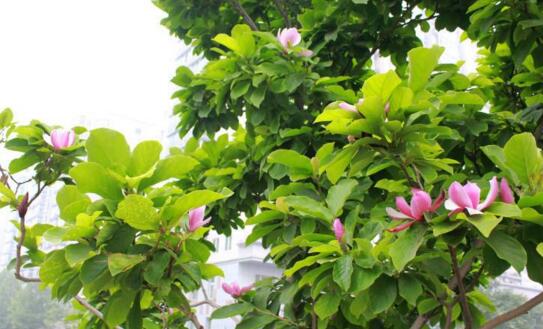
Botanists, after summarizing years of cultivation experience, have found that the main causes of yellowing purple magnolia leaves are poor root growth, insufficient leaf photosynthesis, and pests and diseases. So when faced with the question of what to do when purple magnolia leaves turn yellow, you should start from these three causes.
1. Poor Root Growth
1. Too much water / poor drainage
When watering, if you water too much and the potting soil drains very poorly, the potting soil will alternate between dry and wet, which the purple magnolia's root system cannot withstand, leading to poor growth and thus yellowing leaves.
Solution: Check whether the potting soil drains well. If drainage is poor, you should repot with fresh soil in time, and do not water too much.
2. Too much waterlogging
During the rainy season, pay attention to drainage and waterlogging prevention. If the potting soil is waterlogged for a long time, the root system will turn black and rot, leading to root rot. The result is that the root system loses its vitality, and when the roots cannot absorb nutrients, the leaves will turn yellow.
Solution: During the rainy season, dig trenches for drainage. If it is a potted purple magnolia, you can move it indoors to avoid the roots being soaked in rainwater for too long.
2. Lack of Photosynthesis
Light is the key factor for photosynthesis in plant leaves. With enough light, photosynthesis can proceed normally, but when light is lacking, photosynthesis is limited, which makes the leaves less emerald green.
Solution: What to do when purple magnolia leaves turn yellow due to photosynthesis? The answer is to increase light. The best position is one where it can receive a certain amount of sunlight; it should not be placed in too dark a place.
3. Pests and Diseases
The impact of diseases and pests on the purple magnolia is huge. Many pests feed on leaf tissue or sap. When the sap is sucked out, the leaves will turn yellow, and in severe cases the plant may even die.
Solution: Pests and diseases need to be prevented in advance. Strengthen management according to the purple magnolia's cultivation methods and precautions. When pests or diseases appear, treat them promptly to avoid spreading.
What to Do When Purple Magnolia Gets Bugs: Pest and Disease Control / Fertilizing Is Key
The purple magnolia's cold tolerance is quite good, so pest and disease problems are relatively rare. However, if the purple magnolia is cultivated completely incorrectly, or the environment is too harsh, pests and disease spots will often harm the purple magnolia. So what should you do when the purple magnolia gets bugs? Let's look at pest and disease control for the purple magnolia.
Pest and Disease Control for the Purple Magnolia
1. Purple Magnolia Diseases
1. Purple magnolia chlorosis
Main symptoms: The purple magnolia's leaves gradually change from green to yellow. Chlorophyll gradually decreases due to the disease, and the leaves first turn yellow and then gradually turn white. The plant grows slowly, and in severe cases the plant may die. In pest and disease control for the purple magnolia, this is one of the highly destructive diseases.
Cause: Chlorosis is generally caused by bacteria, viruses, nematodes, and so on, and can also be caused by severe nutrient deficiency, such as nitrogen deficiency, sulfur deficiency, drought, and so on.
Control measures: Strengthen cultivation management, pay attention to rational fertilizing, timely watering, and so on. Before planting, check the soil; if the quality is too poor, improve it through measures such as fertilizing. In addition, a 0.1% ferrous sulfate solution can be sprayed on the leaves for prevention.
2. Purple magnolia anthracnose
Main symptoms: Nearly round or irregular disease spots appear on the purple magnolia's leaves, often on the leaf margins, with a diameter of 10-20 mm. The spots are first grayish white with dark brown edges, and afterward dense small black dots appear.
Cause: Too high a temperature, poor ventilation, and too little fertilizing and watering; the leaves are infected by Gloeosporium fungi, and the small black dots are the fungal masses.
Control measures: 1) Pay attention to rational care, such as scientific fertilizing and watering, maintaining ventilation in the environment, and avoiding excessively high environmental temperatures; 2) When diseased plants are found, promptly spray a 500-600 times dilution of 50% thiophanate wettable powder, or a 500-600 times dilution of 50% carbendazim, or a 1:2:150-200 Bordeaux mixture, or an 800 times dilution of 50% tebuconazole.
2. Purple Magnolia Pests
1. Red spider mite
In pest and disease control for the purple magnolia, the red spider mite is one of the most destructive pests. After the purple magnolia leafs out, it moves onto the leaves and begins harming them along both sides of the main vein on the underside of the leaves, feeding mainly on the leaves.
Control measures: 1) When the leaf color looks wrong, carefully check the underside of the leaves. If only a small number of pests appear, remove the diseased leaves as early as possible; 2) Use a 1000-1500 times dilution of 40% dicofol emulsifiable concentrate or a 2000 times dilution of 20% clofentezine wettable powder for spraying to eliminate the pests.
2. Frost hawk moth
The frost hawk moth usually forages in the early morning and hides in dark places during the day. It feeds on the epidermis of the purple magnolia's leaves, after which the entire leaf may be eaten bare. Not only that, the plant's growth will also be hindered and flowering will decrease.
Control measures: 1) Turn the soil regularly to kill overwintering pupae; 2) When frost hawk moths appear in relatively severe numbers, spray a 1500-2000 times dilution of 20% tebufenozide suspension concentrate, a 2500 times dilution of 50% phoxim, or an 800-1000 times dilution of 80% dichlorvos emulsifiable concentrate for control.
What Is the Purple Magnolia's Flower Language, How Long Is Its Blooming Period / Plus Tips for More Blooms
Because the purple magnolia's flowers are gorgeous and beautifully shaped, it is often used for ornament or given to friends. So what does it mean when you give a purple magnolia to a friend? What is the purple magnolia's flower language? How long is the purple magnolia's blooming period? With these questions, let's look for the answers together.
What Is the Purple Magnolia's Flower Language
In China, the purple magnolia is a very precious flower, mainly grown for its blooms. So what is the purple magnolia's flower language? The answer is: “fragrant sentiments, handsome bearing,” because it is known for its light, elegant fragrance and graceful posture.
What Does the Purple Magnolia Represent
The purple magnolia represents appreciation of the other person, because when its buds are about to open, it looks like an upright writing brush. If you give a purple magnolia to someone, it carries the meaning of praising that person's talent and expresses appreciation.
How Long Is the Purple Magnolia's Blooming Period
Botanists have found through research that the purple magnolia's blooming period is generally in spring, that is, March to April. The flowering time is greatly affected by temperature. For example, a purple magnolia cultivated in a greenhouse may bloom in March, while one cultivated in the open field will bloom in April.
How to Make the Purple Magnolia Bloom More
1. Rational fertilizing
The number of flower buds is directly related to the number of flowering branches on the purple magnolia. The more flowering branches, the more buds there may be, and naturally the more flowers will bloom. This requires rational fertilizing. For example, applying a compound fertilizer once every 10 days before flowering can promote bud growth. For details, you can refer to the detailed introduction in how to fertilize the purple magnolia.
2. Scientific pruning
Many plants need shaping in normal times to keep a beautiful form, but the purple magnolia is not like that. Too much pruning will cut off some flowering branches, so the purple magnolia's pruning method is especially important. Generally, after the flowers fade, you need to cut off overly long and overly dense branches longer than 15 cm, and you do not need to prune as they grow.
3. Control light and temperature
As we introduced earlier, the purple magnolia's blooming is mainly affected by temperature, so keeping the temperature at 15-20 degrees can make it bloom more. In addition, light must also be sufficient. The best planting location is a sunny spot with base fertilizer. In a semi-shaded environment it will bloom very little, and in too dark a place it may not bloom at all.