How to easily get Catharanthus roseus to spill over the pot? Do these five things and prune diligently
Catharanthus roseus (Madagascar periwinkle) is a highly ornamental plant. This plant originated in tropical regions and was later introduced to China. Today, many people in many parts of China grow it. As more people grow it, the question of how to get Catharanthus roseus to spill over the pot has become a matter of concern. Below, the editor will walk you through it.
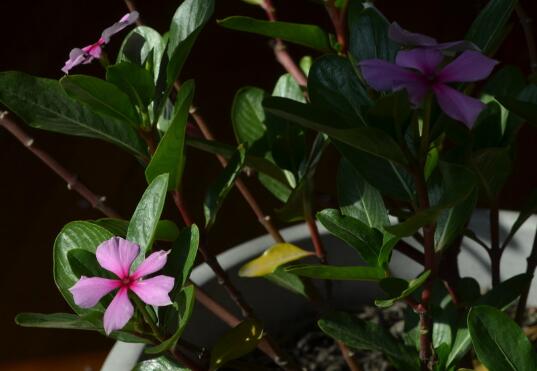
How to get Catharanthus roseus to spill over the pot
1. Soil selection
If you want Catharanthus roseus to spill over the pot, the choice of soil must be correct. It is best to choose relatively loose leaf mold. This kind of soil has good air permeability and drainage, which allows Catharanthus roseus to absorb nutrients better and grow better.
2. Fertilization requirements
When it comes to how to get Catharanthus roseus to spill over the pot, fertilization is the key. Only by maintaining sufficient fertilizer will Catharanthus roseus grow better. Especially before flowering, fertilizer must be replenished sufficiently, so that Catharanthus roseus can produce more flowers and look more like it is spilling over the pot. As for the specific fertilization method, you can refer to the article "Complete Guide to Fertilizing Catharanthus roseus"; the editor will not go into too much detail here.
3. Watering management
When watering Catharanthus roseus, keep to the principle of watering when dry. Never allow waterlogging, otherwise it is very easy to cause root rot. When watering Catharanthus roseus, remember these 12 words: "Do not water if not dry, water thoroughly when watering, no waterlogging."
4. Light management
Catharanthus roseus is a light-loving plant, so during the process of growing Catharanthus roseus, sufficient light must be maintained so that it can carry out photosynthesis better. This will also allow it to grow better and bloom more brilliantly.
5. Proper pruning
When it comes to how to get Catharanthus roseus to spill over the pot, proper pruning can be said to be the most important point. During the growth period, properly pruning the branches of Catharanthus roseus can promote branching. With more branches, it will naturally look like it is spilling over the pot.
Conclusion: After reading the above content, I believe everyone has gained some understanding of how to get Catharanthus roseus to spill over the pot. As long as everyone follows the methods described above when growing it, your Catharanthus roseus will certainly have more lush branches and leaves.
How does Catharanthus roseus overwinter? Pay attention to these four points to let it overwinter easily / reduce watering
For most flowers and plants, winter is a very difficult period, because the vast majority of plants are not cold-resistant, and Catharanthus roseus is no exception. So how does Catharanthus roseus overwinter? Below, the editor will walk you through it.
I. How does Catharanthus roseus overwinter
1. Clean the plant
Regarding how Catharanthus roseus overwinters, first we need to clean the plant before winter begins, because if there is too much dust on the plant, it greatly affects photosynthesis. If it cannot carry out photosynthesis, the plant is very prone to frost damage.
2. Temperature control treatment
During the process of growing Catharanthus roseus in winter, the ambient temperature must not be too low. The most suitable temperature for the growth of Catharanthus roseus is around 20-33°C, but winter is its dormant period, so generally keeping the temperature above 10°C is enough. This allows it to pass through winter safely.
3. Light control
Regarding how Catharanthus roseus overwinters, light is also a very important point. The outdoor temperature in winter is relatively low, so it is generally grown indoors. However, indoors it is difficult to receive light, so at noon each day when the temperature rises, it is best to move it outdoors to receive a few hours of light. This can enhance its cold resistance.
4. Watering control
After entering winter, Catharanthus roseus does not need too much water. Generally, watering once every 15-20 days is enough. Try to keep the potting soil dry. Do not water too frequently, otherwise it is very easy to freeze and damage the plant.
II. Treatment of frost damage in Catharanthus roseus
When caring for Catharanthus roseus in winter, if the plant is frozen, never move it directly to a high-temperature place to thaw, as this will seriously harm the plant. If it is frozen, just move Catharanthus roseus indoors and let it thaw naturally. If the leaves are frozen, they can be pruned off in time. As long as the roots are not damaged, it is fine.
Catharanthus roseus propagation methods: How to prune Catharanthus roseus?
Catharanthus roseus is no stranger to many flower lovers. It is also a very good indoor decorative potted plant, and pots can be placed on balconies and in living rooms. But how much do you know about this flower? Exactly what are the propagation methods of Catharanthus roseus? How do you prune Catharanthus roseus? It does not matter if you do not know. Below, we will explain it for everyone, so you can learn something yourself. It is very helpful for growing and cultivating it.
Catharanthus roseus propagation methods:
1. Seed propagation of Catharanthus roseus
The most commonly used method for Catharanthus roseus is seed propagation, generally carried out in early spring in April. Put sterilized leaf mold, fine sand, and culture soil into a flowerpot, evenly scatter the seeds in it, and control the temperature at 18~24℃. Seedlings emerge in about 14~21 days. After small seedlings grow, place the flowerpot in a place with strong light and high temperature. If the sunlight is too strong, provide appropriate shade. When the small seedlings grow to about 5 cm and have 3 pairs of leaves, they can be potted. Or directly plant the small seedlings in a flower bed, water once every 3~5 days, and appropriately apply additional phosphorus and potassium fertilizer.
2. Cutting propagation of Catharanthus roseus
Cuttings are generally taken in spring or early summer. Cut tender branches from perennial overwintering old plants, with a length of 8~10 cm. Cut off the lower branches and leaves, keeping only 2~3 pairs of leaves at the top. Insert the branches directly into a sand bed, keep the soil moist, control the temperature at 20~24℃, and pay attention to shading in time. After cutting, they root in 15~20 days. When the small seedlings grow to about 10 cm, pinch off the growing tips to promote growth.
3. Tissue culture of Catharanthus roseus
This is a highly difficult propagation method. It uses professional culture dishes and culture liquid, selects stem tips for culture, and after about one month, adventitious buds will grow. Then the nutrient solution is replaced, and after another half month, small white roots will grow, gradually developing into a complete plant. Tissue culture is relatively difficult. It is enough for everyone to understand it; it is not recommended to try it.
How to prune Catharanthus roseus?
Catharanthus roseus is an herbaceous plant and is suitable for pot cultivation. However, it should be noted that its plant should not be allowed to grow too tall, so as not to affect indoor decoration and viewing. Therefore, after potting and surviving, it needs several rounds of pinching to promote Catharanthus roseus to produce more branches and more flowers. After flowering, the spent flowers need to be cut off.
In addition, pest-damaged branches also need to be pruned, and fertilizer and water management should be strengthened. When pruning in winter and summer, pest-damaged branches and dry, withered branches should be heavily pruned. At the same time, fertilizer and water management should also be strengthened to promote Catharanthus roseus to send out new shoots, renew the crown, and restore tree vigor.
In addition to normal fertilizer and water management, the key is pinching and preventing stem and leaf rot during the rainy season. The purpose of pinching is to promote branching in Catharanthus roseus and at the same time control the flowering period. Generally, pinching begins when there are 4~6 true leaves, and the second pinching is carried out when the new shoots grow 4~6 leaves. It is best not to pinch more than 3 times.
The last pinching directly affects the flowering period. Generally speaking, the last pinching in autumn needs to be 25 days before the initial flowering period, and the last pinching in summer should be 3~5 days earlier than in autumn.
Catharanthus roseus can be left un-pinched, but in order to obtain a better plant shape, it is best to pinch once or twice. The first time is when there are 3~4 pairs of true leaves; the second time, leave 1~2 pairs of true leaves on the new branches. During cultivation, regulators can usually be used, but paclobutrazol must not be applied.