How to grow Magnolia liliflora and points to note: be careful when repotting
The flowers of Magnolia liliflora are huge and the flower color is alluring; they are truly very beautiful, so more and more people want to grow them. But if you want them to bloom smoothly, the prerequisite is correct care techniques. So how do you grow Magnolia liliflora best? Let's take a look at how to grow Magnolia liliflora and the points to note.
How to grow Magnolia liliflora
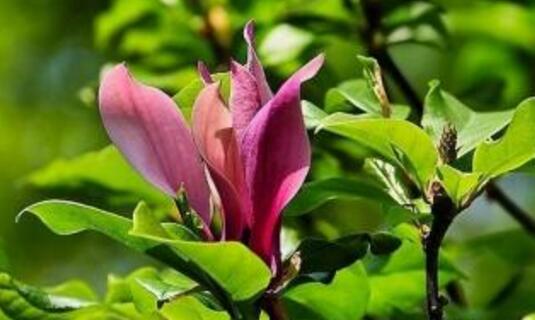
Growing any plant should be based on its growth habits when setting out the corresponding care techniques. So how do you grow Magnolia liliflora? First you need to understand its characteristics. Magnolia liliflora likes a warm and humid environment. In terms of temperature, it is relatively cold-hardy but not tolerant of high temperatures; in terms of soil, it likes fertile acidic soil with good drainage; it likes fertilizer and is not drought-tolerant, and it fears waterlogging.
How to grow Magnolia liliflora and points to note
1. Choosing a pot
The pot should be chosen slightly deep and large, so that the plant's growth will not be obstructed by the pot wall. You can place some foam blocks over the drainage hole at the bottom of the pot to increase drainage at the base.
Points to note: The pot should not be chosen too large either, otherwise using too much soil will cause nutrients to be dispersed, and neither watering nor fertilizing will be fully absorbed; the foam padding should not block the drainage hole.
2. Choosing soil
Magnolia liliflora is not salt-alkali tolerant, so when choosing soil, how do you grow Magnolia liliflora? The answer is that acidic sandy soil is best, such as leaf mold and vegetable garden soil, and you can add 50 grams of bone meal or organic fertilizer to it.
Points to note: Magnolia liliflora mainly obtains nutrients through the soil, so good soil can ensure that Magnolia liliflora gets enough nutrients. Therefore, be sure to pay attention to whether the soil is healthy and non-toxic, so as to ensure that Magnolia liliflora is free from the invasion of pests and diseases.
3. Temperature
Magnolia liliflora is a relatively cold-hardy plant. Even in the north it can overwinter outdoors, but when growing it, be careful not to place it in a higher-temperature environment, such as a kitchen or near a heat source.
Points to note: Although Magnolia liliflora has strong cold hardiness, it is relatively afraid of strong winds, so in winter when the wind is strong, attention should be paid to protecting Magnolia liliflora to avoid damage to the branches, leaves or root system.
4. Light
Magnolia liliflora likes sunlight and has weak shade tolerance. Although it can grow in a semi-shaded environment, it will grow relatively slowly and will also affect flowering, making the flowers thin and weak with dull colors, so it cannot bring into play the ornamental value among the effects and uses of Magnolia liliflora.
Points to note: When growing it indoors, be sure not to let the light be too weak. For example, dark corners or closed environments are not conducive to the growth and development of Magnolia liliflora.
5. Fertilizing
How much Magnolia liliflora blooms and whether the color is vivid are closely related to fertilizing, so the period before the flowering season and within 2 months after the flowers fade is very critical. Before the flowering season, applying phosphorus and potassium fertilizer can make the flower buds swell, and after the flowers fade it can promote Magnolia liliflora to produce more flower buds. This shows the importance of fertilizing in the growing methods and points to note for Magnolia liliflora.
Points to note: Never fertilize excessively. Before winter arrives, you can apply a supplementary phosphorus and potassium fertilizer once, which can increase the cold resistance of Magnolia liliflora; after that, fertilize less.
6. Watering
Magnolia liliflora fears waterlogging and is not drought-tolerant, so when watering, neither water too much nor go without watering for long periods. Keep the soil moist without becoming waterlogged, and water again after the soil dries.
Points to note: When the rainy season arrives, drain and prevent waterlogging in time to avoid rainwater soaking the roots of Magnolia liliflora in water for a long time.
7. Repotting
Repot and change the soil once every 1-2 years, which can prevent root rot. When changing the soil, keep half or one third of the original soil; do not remove all the soil.
Points to note: Repotting is usually chosen in April-May and should be staggered from the flowering season. After repotting, Magnolia liliflora will have a period of adjustment, during which attention should be paid to moderate watering, and fertilizing can be paused.
How to grow and manage Magnolia grandiflora
Magnolia grandiflora has a dense crown, large glossy leaves, and large fragrant flowers. It can be used as a street tree, planted in groups in public green spaces, and is even more suitable for planting in courtyards for viewing. It is a rare and precious landscaping tree species. As urban greening and beautification work is increasingly valued by people, Magnolia grandiflora is also increasingly favored by garden designers. Therefore, how to care for and manage Magnolia grandiflora well is also attracting more and more attention from flower-growing friends.Magnolia grandiflora, also known as lotus magnolia, foreign magnolia, and large-flowered magnolia, is an evergreen tree of the genus Magnolia in the family Magnoliaceae. It is native to southeastern North America and likes a warm and humid climate. It is widely cultivated from the Yangtze River basin to the Pearl River basin in China, but it is also relatively cold-hardy. South of Beijing and Tianjin, it can be planted in the open ground as long as irrigation conditions are met; it is a sun-loving tree species and is relatively shade-tolerant at the seedling stage; it is suitable for growth in moist, well-drained acidic soil and neutral soil, and can also grow in mildly saline-alkali soil; it is a fertilizer-loving tree species, and 1 application of organic fertilizer should be applied before flowering in spring. In autumn, the soil can be deeply turned and decomposed barnyard manure applied; it has very few pests and diseases and strong wind resistance.
Propagation usually uses two methods: sowing and grafting. For the sowing method, seeds are collected in autumn and sown immediately, or the seeds can be stored in sand until the following spring and then sown. When sowing, it is better to sow densely. In the second year, they are transplanted in the nursery to continue raising seedlings, and after about 4 years of seedling cultivation they can leave the nursery. For grafting, Magnolia denudata or Magnolia liliflora can be selected as the rootstock, generally using the branch grafting method in spring. Transplanting should be carried out in spring. To increase the survival rate, the seedlings must be kept with a soil ball.
The natural tree shape of this species is elliptical-ovate and very beautiful. It has low branching ability and poor sprouting ability, and is not tolerant of pruning, so pruning should be done cautiously. Never cut off branches arbitrarily, so as not to affect the tree shape. During the young tree stage, in order to make the central main branch grow well, attention can be paid to removing the side buds around the main branch.
Key points for flower growing and management in December
Key points for flower growing and management in December
1. Sowing
Flower species that can be sown in a greenhouse in December include: gloxinia, asparagus fern, clivia, tuberous begonia, cyclamen, winter coral, African daisy, etc.; flower and tree species that can be sown outdoors as soon as collected or stored in sand to promote germination include: rose (such as 'Elizabeth'), heavenly bamboo, Ardisia crenata, holly species, firethorn, palm, privet, camphor tree, small-leaf privet, soapberry, photinia, Photinia davidsoniae, etc.
2. Cuttage
Woody ornamental flower and tree species that can be cut outdoors in December include: plum blossom (mainly cultivars such as 'Gongfen' and 'Lüe'); rose (mainly easy-to-root cultivars such as 'Elizabeth', floribunda rose, and miniature rose); red-leaf plum, wintersweet (cutting with a heel), spiraea, boxwood species, etc. Among them, plum blossom and red-leaf plum cuttings should preferably use yellow subsoil; rose cuttings should preferably use a mixed substrate of rice hull ash and fine sand at 2:1; other species can use ordinary sandy loam, covered with plastic film to keep warm and moist.
3. Grafting
For excellent plum blossom cultivars, such as 'Guhong' and 'Zhusha', in December you can use the seedlings of apricot, fruit plum, peach, etc. sown that year, dig up the rootstock and then use cleft grafting or cut grafting, then plant them on the seedbed at a certain row spacing, burying soil up to above the graft union, even covering most of the scion. Be careful not to let water seep into the union when watering, and cover with plastic film to keep warm and moist. In the following spring, after the scion sprouts, remove the covering film. Use dug-up wild rose plants to bud-graft excellent rose cultivars; or use healthy branch sections of the 'Elizabeth' rose cultivar (10 to 12 cm long), graft excellent rose scions onto the upper end by cut grafting or cleft grafting, and then insert the grafted 'Elizabeth' scion sections into a loose seedbed. The grafted part can be buried together in sandy soil. Do not let water seep into the graft union when watering, and cover with plastic film to keep moist and warm. In the following spring, after the scion sprouts, remove the covering film, and only after it has completely survived can a blade be used to cut open the binding tape at the union. In addition, red maple can also be side-grafted indoors with a bag to keep moist.
4. Layering
Flower and tree species that can be propagated by layering in December include: Podocarpus, plum blossom, camellia, osmanthus, Michelia figo, Chaenomeles speciosa, Magnolia liliflora, snowball, Weigela florida, gardenia, winter jasmine, Forsythia viridissima, Hydrangea macrophylla, Spiraea cantoniensis, Viburnum macrocephalum, Spiraea thunbergii, pomegranate, etc.
5. Division
Herbaceous flower species that can be propagated by division in December include: autumn zephyr lily, dwarf lilyturf, Reineckea carnea, hosta, purple hosta, red-flowered oxalis, Aspidistra, Cymbidium ensifolium, Cymbidium goeringii, Cymbidium faberi, sword fern, Belamcanda chinensis, iris, large-leaf dwarf lilyturf, Ophiopogon, Rohdea japonica, Kalanchoe daigremontiana, Aglaonema. When cutting off daughter plants from the base of a large colorful bromeliad for division, they must be small plants that have already grown on the mother plant for three or four months; otherwise, the colorful bands of the daughter plants cut off are likely to disappear, which should be given special attention.
6. Collecting seeds
The herbaceous flower seeds that can be collected in December are generally herbaceous flower species moved into greenhouses or cold frames, such as salvia species, Globe amaranth species, marigold, French marigold, cyclamen, clivia, etc. Clivia seeds should preferably be sown as soon as collected.
Herbaceous flower species that can be field-planted in flower beds and flower borders in December include: Dianthus species, ornamental kale, large-flowered pansy, snapdragon, pot marigold, daisy, etc. Some herbaceous flowers can also be potted and then placed in a greenhouse, such as daisy, pot marigold, snapdragon, ornamental kale, Dianthus, pansy, etc. In the following spring they can be used for street displays.In December, most deciduous landscaping trees and flowering shrubs can be transplanted and field-planted, such as rose of Sharon, pomegranate, redbud, crabapple species, wintersweet, plum blossom, Magnolia denudata, Magnolia liliflora, soapberry, goldenrain tree, silk tree, horse chestnut, red-leaf plum, cherry blossom, papaya, Magnolia soulangeana, crape myrtle, wisteria, Chinese trumpet creeper, linden, tulip tree, red maple, ornamental peach, Chinese pagoda tree, weeping pagoda tree, etc. For evergreen trees and flowering shrubs, transplanting should be more cautious. Evergreen tree species that can be transplanted in winter include: privet, osmanthus, palm, Magnolia grandiflora, camphor tree, azalea, holly, etc. When transplanting, first strongly shorten the main tip and large branches, and remove most of the leaves. At the same time, a large soil ball must be kept, the trunk bound with straw rope and wrapped with plastic film, and the cuts on the trunk and large branches sealed with wax or wrapped with film to reduce water transpiration; after transplanting, water must also be sprayed frequently on the leaves and trunk to ensure normal survival.Tree stumps and flowering trees that can be potted in December include: plum blossom, wintersweet stump, camellia, sasanqua, Chaenomeles speciosa, Malus halliana. Place them in a greenhouse for flower-forcing treatment, and they can be expected to bloom during the Spring Festival.In December, for potted hyacinth, tulip, red-cupped narcissus, etc., continue to keep them in the greenhouse for flower forcing, which can cause them to bloom around the Spring Festival.