How to grow a Money Tree (Pachira aquatica)? Detailed care methods and precautions
The Money Tree is a very common foliage plant, easy to care for, and also very suitable for indoor potted cultivation. Many gardening enthusiasts need to understand the care methods and precautions for the Money Tree. This article will discuss some key points on Money Tree care with fellow gardening lovers, hoping to help them.
1. Money Tree care methods
The Money Tree prefers a warm, humid environment with plenty of sunlight. It tolerates partial shade, is not cold-hardy, and fears drought. At home, it can be kept indoors in a bright location for extended periods. If it can receive several hours of sunlight indoors each day, it will grow even more vigorously. In summer, avoid direct exposure to strong outdoor sunlight. During the growing season, keep the potting soil moist but not waterlogged. Regularly spray the plant with water at a temperature close to room temperature to increase air humidity and keep the leaves fresh.
What gardening enthusiasts need to note here is that you must understand the moisture level of the potting soil and not water blindly on a schedule. If the potting soil is not very dry, there is no need to water; just spraying to maintain humidity is sufficient. Many gardening enthusiasts' Money Trees died precisely because they did not check the actual conditions and watered blindly.
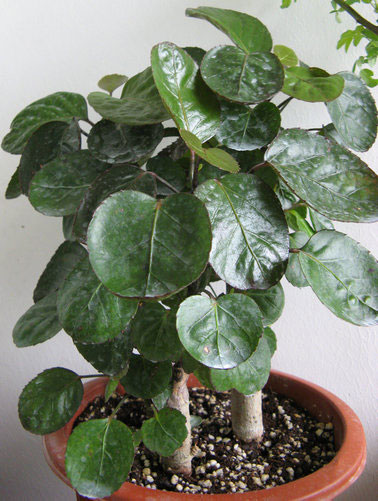
When the Money Tree is in normal condition, apply a light fertilizer about once every two weeks. Stop fertilizing after September to allow new branches to mature and become woody, which helps with overwintering. In winter, place it in a sunny spot indoors, reduce watering appropriately, and maintain the temperature above 12°C. Otherwise, excessively low temperatures will cause massive leaf drop and may even kill the plant.
Repot the Money Tree once every 2 to 3 years. The potting soil should be loose, fertile, rich in humus, and have good drainage and aeration. You can use leaf mold or peat moss mixed with 1/3 river sand, and add a small amount of decomposed chicken or cow manure as a base fertilizer.
Money Tree propagation can be done by taking 1- to 2-year-old branches for cuttings. The cuttings should be about 10 cm long, with most leaves removed to reduce evaporation. Under conditions of 20°C to 25°C and maintained high air humidity, roots will form in 4 to 6 weeks.
2. Precautions for daily Money Tree care
Actually, the precautions mentioned here apply not only to the Money Tree but also to other foliage potted plants. Here is a brief explanation for gardening enthusiasts: one is to pay attention to ventilation. Indoor care is different from outdoor care. If indoor ventilation is poor, it can very easily cause the Money Tree leaves to wilt and slowly die.
Money Tree care methods and precautions
The Money Tree prefers a warm, humid environment with plenty of sunlight. It tolerates partial shade, is not cold-hardy, and fears drought. At home, it can be kept indoors in a bright location for extended periods. It is easy to care for and also very suitable for indoor potted cultivation. Below is an introduction to Money Tree care methods and daily care precautions.
Money Tree care methods. Money Tree cultivation: Growth humidity requirementsDuring the growing season, keep the potting soil moist but not waterlogged. Regularly spray the plant with water at a temperature close to room temperature to increase air humidity and keep the leaves fresh.
Money Tree cultivation: Optimal growing temperatureThe optimal growing temperature for the Money Tree is 15-30°C, with 20-30°C maintained from April to October, and 13-20°C from October to April of the following year. In general, the room temperature in winter should also be maintained at no less than 10°C. When summer temperatures reach above 32°C, you should not just leave it be. For mass production, shade frames should be set up; for home ornamental plants, place them in a cool location and spray water around them to lower the temperature, creating a cool micro-environment close to their native conditions. In late autumn and early winter, when temperatures drop to 15°C, promptly move them indoors to prevent cold damage to the plant. In winter, if room temperature can be maintained above 20°C, the stems and leaves will continue to grow; if the temperature is not high enough, the plant will stop growing and enter a semi-dormant state.
Money Tree cultivation: Optimal growing lightTaking the round-leaf Money Tree as an example, it needs bright light. Insufficient light easily causes leggy stems and leaves, dull leaf color, and fading of variegation. However, it also dislikes intense direct sunlight, especially in early summer after long rainy periods when the sky first clears, to prevent leaves from being scorched. For home potted plants, it can usually be placed in a well-ventilated spot. In summer, it can be placed by a north- or east-facing window; in winter, place it in a brighter indoor location. For production cultivation, from mid-spring to mid-autumn, it should be placed under a shade frame, with 40-60% shading depending on light intensity and duration. In short, it grows most vigorously in a semi-lit environment with bright, indirect light.
Money Tree cultivation: Reasonable fertilizationWhen the Money Tree is in normal condition, apply a light fertilizer about once every two weeks. Stop fertilizing after September to allow new branches to mature and become woody, which helps with overwintering. In winter, place it in a sunny spot indoors, reduce watering appropriately, and maintain the temperature above 12°C. Otherwise, excessively low temperatures will cause massive leaf drop and may even kill the plant.
Money Tree cultivation: RepottingRepot the Money Tree once every 2 to 3 years. The potting soil should be loose, fertile, rich in humus, and have good drainage and aeration. You can use leaf mold or peat moss mixed with 1/3 river sand, and add a small amount of decomposed chicken or cow manure as a base fertilizer.
Money Tree cultivation: Watering key pointsa. Potted Money Trees prefer relatively moist soil and air conditions.
b. During the growing season, provide sufficient water. Water after the soil surface dries out. Slightly dry soil is fine, but do not overwater to avoid waterlogging and root rot.
c. In midsummer when temperatures are high, besides watering adequately, spray the leaves once daily. This keeps the leaves clean and glossy while also increasing the air humidity around the plant.
d. In late autumn and early winter, when temperatures drop below 15°C, control watering.
e. In winter, reduce the amount of water given, or replace watering with spraying. Keep the potting soil slightly moist and on the dry side. When spraying the leaves, make sure the water temperature is basically the same as room temperature.
Precautions for daily Money Tree care1. Actually, the precautions mentioned here apply not only to the Money Tree but also to other foliage potted plants. Here is a brief explanation for gardening enthusiasts: one is to pay attention to ventilation. Indoor care is different from outdoor care. If indoor ventilation is poor, it can very easily cause the Money Tree leaves to wilt and slowly die.
2. Another issue is watering. As we mentioned earlier, watering should be based on actual conditions. Especially when some gardening enthusiasts have a large Money Tree in a big, deep pot, one watering often takes a long time to dry out. In this situation, it is not recommended to water, because overly wet potting soil will cause root problems and ultimately kill the plant. So when watering, try to water only when the potting soil is dry; at other times, just spray.
3. When planting the Money Tree, choose a loose, fertile, well-draining potting mix; for large-scale production planting, shading can be applied, but the light should not be too dim, otherwise the plant will become leggy; regularly loosen the soil; if yellowing and falling leaves occur, it may be due to overwatering, and it will recover after a few days of drying out; too-strong summer light may scorch young leaves, so pay attention to shading.
Money Tree care methods and precautions
The Money Tree is a very common foliage plant, easy to care for, and also very suitable for indoor potted cultivation. Many gardening enthusiasts need to understand the care methods and precautions for the Money Tree. This article will discuss some key points on Money Tree care with fellow gardening lovers, hoping to help them.1. Money Tree care methods
The Money Tree prefers a warm, humid environment with plenty of sunlight. It tolerates partial shade, is not cold-hardy, and fears drought. At home, it can be kept indoors in a bright location for extended periods. If it can receive several hours of sunlight indoors each day, it will grow even more vigorously. In summer, avoid direct exposure to strong outdoor sunlight. During the growing season, keep the potting soil moist but not waterlogged. Regularly spray the plant with water at a temperature close to room temperature to increase air humidity and keep the leaves fresh.
What gardening enthusiasts need to note here is that you must understand the moisture level of the potting soil and not water blindly on a schedule. If the potting soil is not very dry, there is no need to water; just spraying to maintain humidity is sufficient. Many gardening enthusiasts' Money Trees died precisely because they did not check the actual conditions and watered blindly.
When the Money Tree is in normal condition, apply a light fertilizer about once every two weeks. Stop fertilizing after September to allow new branches to mature and become woody, which helps with overwintering. In winter, place it in a sunny spot indoors, reduce watering appropriately, and maintain the temperature above 12°C. Otherwise, excessively low temperatures will cause massive leaf drop and may even kill the plant.
Repot the Money Tree once every 2 to 3 years. The potting soil should be loose, fertile, rich in humus, and have good drainage and aeration. You can use leaf mold or peat moss mixed with 1/3 river sand, and add a small amount of decomposed chicken or cow manure as a base fertilizer.
Money Tree propagation can be done by taking 1- to 2-year-old branches for cuttings. The cuttings should be about 10 cm long, with most leaves removed to reduce evaporation. Under conditions of 20°C to 25°C and maintained high air humidity, roots will form in 4 to 6 weeks.
2. Precautions for daily Money Tree care
Actually, the precautions mentioned here apply not only to the Money Tree but also to other foliage potted plants. Here is a brief explanation for gardening enthusiasts: one is to pay attention to ventilation. Indoor care is different from outdoor care. If indoor ventilation is poor, it can very easily cause the Money Tree leaves to wilt and slowly die.
Another issue is watering. As we mentioned earlier, watering should be based on actual conditions. Especially when some gardening enthusiasts have a large Money Tree in a big, deep pot, one watering often takes a long time to dry out. In this situation, it is not recommended to water, because overly wet potting soil will cause root problems and ultimately kill the plant. So when watering, try to water only when the potting soil is dry; at other times, just spray.