How to grow Hippeastrum (amaryllis)? Cultivation methods and points to note, temperature is key
It is well known that Hippeastrum has many uses and benefits, so more and more people are growing it. However, some flower enthusiasts are not very familiar with Hippeastrum, so they do not know how to grow it. Today, the editor will walk everyone through the cultivation methods and points to note for Hippeastrum.
How to grow Hippeastrum
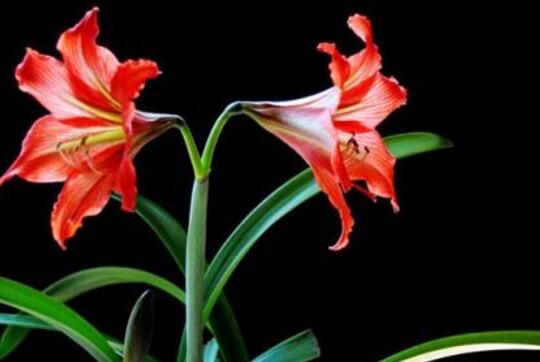
To understand the cultivation methods and points to note for Hippeastrum, you first need to clarify its growth habits. Hippeastrum likes a warm, humid environment. In terms of temperature, it tolerates neither heat nor cold, and the suitable temperature is 18-25°C; in terms of light, it likes light but fears strong light; in terms of soil, Hippeastrum is suited to well-drained sandy soil.
Hippeastrum's environmental requirements
1. Soil
Hippeastrum likes fertile sandy soil, so when planting, the soil should mainly be humus-containing and well-drained soil, such as leaf mold, peat soil, garden soil, and so on. In addition, the soil needs to remain healthy, mainly free of insect eggs and pathogens.
2. Light
Growing Hippeastrum is mainly for admiring its flowers, and flowering requires sufficient light, so in spring, autumn, and winter it should be given plenty of sunlight, but in summer direct sunlight should be avoided, and it can be placed in a bright, well-ventilated spot.
3. Temperature
Hippeastrum's cold tolerance and heat tolerance are both average, and its suitable growing temperature is 18-25°C. In winter, the temperature should be kept above 5°C, and keeping it in a 10°C environment allows it to overwinter safely. In summer, it should be kept out of a high-temperature environment.
Hippeastrum cultivation methods and points to note
1. Watering
Hippeastrum needs sufficient water from growth to flowering, but it is rather afraid of waterlogging, so when watering, the main principle is to keep the soil moist, and do not let water accumulate in the pot. In spring and summer, each watering should soak through. If the air is too dry, you can appropriately mist the leaf surface.
2. Fertilizing
Fertilizing is the key to getting Hippeastrum to flower smoothly, so in terms of fertilizing, how do you grow Hippeastrum? Base fertilizer should be applied at planting time. When the leaves grow to 5 cm, topdressing is needed once every half month, mainly with decomposed cake fertilizer water. Before the flowering period, topdress with phosphorus and potassium fertilizer, and about 20 days after the flowering period, fertilize once to increase the production of fresh bulbs.
3. Changing the potting soil
Hippeastrum is a relatively fast-growing plant, and the potting soil needs to be changed once every 1-2 years. In particular, after 2 years the nutrients in the soil become deficient, and to ensure smooth growth and flowering of Hippeastrum, changing to new soil is especially important.
4. Pruning
During growth, branches and leaves that grow relatively quickly will inevitably appear. If they grow too densely or too tall, they will affect the development of other branches and leaves, so when repotting, you can cut off all the overly dense and overly tall branches and leaves, faded leaves, dead roots, diseased leaves, and so on.
5. Timely propagation
In terms of propagation, Hippeastrum can be propagated by many methods, such as sowing, dividing bulbs, cuttings, and so on. The time is usually chosen in spring and summer. During propagation, attention should be paid to temperature, soil moisture, and so on. Keeping the temperature at 18-20°C can promote sprouting and rooting of Hippeastrum.
6. Pest and disease control
Pests and diseases are extremely harmful to Hippeastrum, so reasonable prevention is needed during normal planting, such as keeping the environment ventilated, moderate light, avoiding water accumulation, scientific fertilizing, and so on, all of which can reduce the chance of pests and diseases appearing. Once they appear, they should be treated promptly.
How to grow Hippeastrum so it grows fast
1. By keeping the day-night temperature difference at around 8°C, you can avoid the situation where the flower scape of Hippeastrum does not extend fully, and at the same time you can make its flowers open more fully and the flower shape more graceful.
2. In spring and autumn, you can move Hippeastrum outdoors in the morning when the sunlight is not strong, letting it fully receive the baptism of sunlight, and when the temperature is higher at noon, move it back indoors to avoid leaf scorching.
3. In winter, be sure to keep it warm. It is best to move it indoors for care, keeping the room temperature above 10-12°C, but the temperature does not need to be too high, to avoid too high a temperature in winter affecting its flowering the next year.
Cultivation methods for imported Hippeastrum, and which aspects need special attention during cultivation
Hippeastrum is a very popular potted plant in home beautification today. It has large flowers, unusual flower shapes, many flower colors, and a wide range of varieties. It is a very rare flower variety, and cultivation is relatively simple. Today we will learn together about how to cultivate it and the points to note during cultivation.
Imported Hippeastrum cultivation methods:
1. After the flowers of Hippeastrum fade, promptly cut off the flower stalk. Because this stage after flowering is mainly for nurturing the bulb, allowing it to fully absorb nutrients, so the bulb enlarges and produces new bulbs. Cutting off the flower stalk concentrates the nutrients on nurturing the bulb. For post-flowering management, in addition to appropriately reducing the amount of watering, also note that the potting soil must not accumulate water, to avoid rotting the bulb. After flowering, cake fertilizer water should still be applied once about every 20 days to promote enlargement of the bulb and sprouting of new bulbs, until after November when it is moved into the greenhouse; only then can fertilizing stop and watering be controlled, keeping the bulb from drying out.
2. Hippeastrum is a perennial bulbous flower that blooms in spring, grows in summer and autumn, and has bulbs that enter dormancy in winter. To promote bulb sprouting and early flowering, attention should be paid during its dormant period to:
① Temperature control. Potted plants should be moved indoors to overwinter, and the leaves cut off. Room temperature should be kept at 5-10°C. If the temperature is below 5°C, the bulbs are prone to frost damage, while above 10°C will affect flowering. For open-ground cultivation, cold protection measures should be taken before frost; the bulbs can also be dug up, dried, and stored indoors in a ventilated place at the same room temperature as above.
② Moisture control. During dormancy, water less, just enough to keep the bulbs from wilting. When moving indoors to overwinter in winter, pay attention to air circulation and keep it dry. In early January, water thoroughly to break dormancy, and after sprouting, repot promptly or replace with new soil.
Points to note during cultivation of imported Hippeastrum: 1. Soil:
The soil for planting Hippeastrum should be loose, fertile sandy loam with a pH of 5.5-6.5, and absolutely must not accumulate water. The potting soil can be made by mixing 2 parts decomposed barnyard manure soil, 6 parts leaf mold, and 2 parts sand evenly.
2. Watering:
Hippeastrum needs to keep the plant moist, and watering should be thorough. But avoid excessive water and poor drainage. Generally, indoor air humidity is sufficient.
3. Sunlight:
Hippeastrum likes sunlight and can take a moderate amount of direct sunlight, but not for too long. It is best placed at a window with bright light, good ventilation, and no strong direct sunlight.
4. Temperature:
Hippeastrum likes warmth and is not cold-tolerant. In summer it prefers coolness, with a suitable temperature of 18-22°C. During the winter dormant period, it requires a cool, dry environment, and the temperature must not be below 5°C.
5. Fertilizing:
Hippeastrum likes fertilizer. When the leaves grow to 5-6 cm long, begin topdressing, generally applying decomposed cake fertilizer water once every half month, and after flowering change to once about every 20 days, to promote bulb enlargement and the production of new bulbs.
6. Pests:
To make Hippeastrum grow vigorously and bloom early, pest and disease control should be carried out, spraying pesticide once a month. Spraying should be done on clear days at around 9 a.m. and 4 p.m.; spraying is not suitable under the strong midday sun, to prevent pesticide damage.
7. Pruning:
Hippeastrum grows fast, and its leaves are long and dense, so when repotting and changing soil, cut off faded leaves, dead roots, and roots and leaves affected by pests and diseases, leaving vigorous leaves.
Summary: The above is an introduction to knowledge on how to care for imported Hippeastrum. We hope it is helpful to fellow flower enthusiasts. To learn more, please continue to follow Duorou Huapu and learn more related knowledge!
Aeonium decorum f. variegata 'Qingshengjin' illustrated guide: how to grow Qingshengjin / how to propagate Qingshengjin
Qingshengjin profileQingshengjin Aeonium decorum f. variegata
Aliases: Yanyehui, Canlan, Yanrihui
Classification: Succulent plant
Family and genus: Plantae, Angiosperms, Dicotyledoneae, Rosales, Crassulaceae, Aeonium
Full bloom period: Summer
Qingshengjin, also known as "Canlan", is a perennial succulent herbaceous plant of the Crassulaceae family and Aeonium genus. Qingshengjin has an elegant and beautiful plant shape, and its leaves are brilliantly colorful. It is often grown in small ornamental pots to decorate windowsills, shelves, desks, and other places, with very good effect. In addition, succulent enthusiasts can also grow it as a variety collection. Qingshengjin is also known as Yanyehui and Canlan, and is a perennial evergreen succulent plant of the Crassulaceae family and Aeonium genus. Its native habitat is located in the Canary Islands in the Atlantic Ocean. The plant is shrub-shaped with many branches, and obovate succulent leaves form relatively small rosette-shaped leaf disks at the tips of the branches. The center of the leaf is mixed pale green and apricot yellow, with red patches at the edges...
Qingshengjin cultivation methods and points to note, introduction to Qingshengjin
Qingshengjin, also known as "Canlan", is a perennial succulent herbaceous plant of the Crassulaceae family and Aeonium genus. Qingshengjin has an elegant and beautiful plant shape, and its leaves are brilliantly colorful. It is often grown in small ornamental pots to decorate windowsills, shelves, desks, and other places, with very good effect. In addition, succulent enthusiasts can also grow it as a variety collection.
Qingshengjin is also known as Yanyehui and Canlan, and is a perennial evergreen succulent plant of the Crassulaceae family and Aeonium genus. Its native habitat is located in the Canary Islands in the Atlantic Ocean. The plant is shrub-shaped with many branches, and obovate succulent leaves form relatively small rosette-shaped leaf disks at the tips of the branches. The center of the leaf is mixed pale green and apricot yellow, with red patches at the edges, and the leaf margins have eyelash-like small teeth. Qingshengjin has an elegant and beautiful plant shape. Spring, autumn, and winter are the main growing seasons, especially spring and autumn. If placed outdoors in an environment with a large temperature difference and more sunlight, the leaf color will change from golden yellow to red, brilliantly colorful. In summer, it is especially sensitive to high temperatures, and its dormant state is very obvious. The leaves will continuously dry up and fall off, and there will not be very brilliant colors either. It is often grown in small ornamental pots to decorate windowsills, shelves, desks, and other places, with very good effect.
Qingshengjin morphological characteristics
The Qingshengjin plant is slightly branched, with succulent leaves arranged in a rosette. The leaves are obovate-round, with pointed tips, slightly concave in the center of the upper surface and with fine downy hairs, with a keel-shaped protrusion on the back, and eyelash-like fine serrations on the leaf margins. The leaves are rich in color, with the central part apricot yellow mixed with pale green, and the outer edges in colors such as red, reddish brown, and pink.
The Qingshengjin plant is shrub-shaped with many branches, and obovate succulent leaves form relatively small rosette-shaped leaf disks at the tips of the branches. The center of the leaf is mixed pale green and apricot yellow, with red patches at the edges, and the leaf margins have eyelash-like small teeth. The flowers are racemes; after flowering the whole plant withers and dies, so in cultivation the plant is generally not allowed to bloom.
Qingshengjin ecological habits
Qingshengjin likes sunlight, and its color changes dramatically. When lacking light it is green, and when the light duration is too long and the temperature difference is large, the whole plant will turn red or orange-red. It relatively likes water. During the spring and autumn growing seasons, it must not be too shaded; water fully to keep the potting soil moist, but it must not remain waterlogged. When the air is dry, mist the plant to keep the leaves fresh.
In summer when temperatures are high, the plant enters a dormant or semi-dormant state and can be placed in a bright spot without direct sunlight for care. Too strong light easily scorches the leaves, while too much shade makes the leaf color dull and the growth weak. In addition, ventilation should be strengthened and watering controlled, avoiding a stuffy, humid environment, otherwise the plant easily rots. In winter, expose it to as much sunlight as possible. If a temperature above 12°C can be maintained, watering can continue to keep the plant growing. If such a high temperature cannot be maintained, keeping the potting soil moderately dry also allows it to tolerate a low temperature of 5°C.
During the spring and autumn growing seasons, it must not be too shaded; water fully to keep the potting soil moist, but it must not remain waterlogged. When the air is dry, mist the plant to keep the leaves fresh. Apply decomposed dilute liquid fertilizer once about every 20 days, and be careful not to splash the fertilizer water onto the leaves. According to growth conditions, repot once every 2-3 years. The best repotting time is in early spring or early autumn when the plant has just begun to grow, and the potting soil should be sandy loam with good drainage and air permeability.
Qingshengjin cultivation techniques, management, and care
Qingshengjin should avoid a stuffy, humid environment, otherwise the plant easily rots. In winter, expose it to as much sunlight as possible. If a temperature above 12°C can be maintained, watering can continue to keep the plant growing. If such a high temperature cannot be maintained, keeping the potting soil moderately dry also allows it to tolerate a low temperature of 5°C. During the spring and autumn growing seasons, it must not be too shaded; water fully to keep the potting soil moist, but it must not remain waterlogged. When the air is dry, mist the plant to keep the leaves fresh. Apply decomposed dilute liquid fertilizer once about every 20 days, and be careful not to splash the fertilizer water onto the leaves. According to growth conditions, repot once every 2-3 years. The best repotting time is in early spring or early autumn when the plant has just begun to grow, and the potting soil should be sandy loam with good drainage and air permeability.
The art of watering
How should you water to be considered appropriate? This should proceed from reality and be grasped flexibly; it must not be applied rigidly. The contents of this "reality" include the following aspects:
First, look at the season and temperature
In spring and autumn, when the sun is not too strong and the temperature is not too high, some flowers can be watered once a day, and some can be watered once every one or two days (water in the evening or morning; small pomegranate can be watered at noon). It mainly depends on the dryness and moisture of the potting soil. When the potting soil is dry and pale, it should be watered appropriately. The general principle is not to water if not dry, and to soak through when watering (exceptions include Japanese crabapple, wax begonia, cacti, and so on).
During the high-temperature period of midsummer, water consumption is greatest, so water thoroughly every evening or morning until water flows out from the bottom of the pot. Chrysanthemums are best watered once in the morning and once in the evening. For orchids, Monstera deliciosa, Clivia, fuchsia, rhododendrons, camellias, camellia sasanqua, and so on, it is best to mist twice daily on clear days.
In winter, especially in severe winter, most flowers and trees enter dormancy. During this period, watering should be strictly controlled. For example, for Japanese crabapple, wax begonia, Milan, money tree, croton, white magnolia, and so on, as long as the soil has some moisture it is enough. Never water frequently or heavily, otherwise it will accelerate their death. As long as watering can be controlled and warmth appropriately maintained, they can get through the severe winter.
Second, look at the type of flowerpot
For pots of different types and sizes, the frequency and amount of watering should also differ. Generally speaking, clay pots have the best permeability and evaporate water fastest, so watering must not only be frequent but also relatively plentiful to keep the soil moist. On the contrary, porcelain pots, glazed pots, and plastic pots, because of poor permeability, evaporate water relatively slowly; if watering is both frequent and plentiful, it is extremely easy to cause root rot and death of the plant. For flowers and trees in this kind of pot, under what circumstances can you water? You can use a small stick to poke open the soil and observe. If the soil below does not have much moisture, you can slowly water a little around the rim of the pot. If you find the potting soil is too wet, watering should be postponed.
Third, look at the type of flower
Each kind of flower has its own characteristics and requires a suitable living environment. Some flowers like sun, some suit shade, some love moisture, some suit being a bit drier, some fear cold, and some avoid heat; they must be treated differently. For plants such as cacti, Japanese crabapple, Clivia, wax begonia, orchids, asparagus fern, Epiphyllum, pot pomegranate, plum, osmanthus, and so on, usually it is suitable to be slightly on the dry side, and watering too frequently or too much must be avoided. If Japanese crabapple is watered even a little too much, it easily rots at the roots and dies. When the potting soil is dry, you can only slowly water a little along the pot rim, letting the water gradually seep in from all around to the roots. If you water directly at its roots or it is exposed to rain for a long time, it easily rots at the roots. Chrysanthemum, freesia, Hippeastrum, spider plant, frog begonia, bamboo-joint begonia, ganyuezi, August chrysanthemum, lantana, Jasminum multiflorum, boxwood, and so on can be watered a bit more during the growing season.
Fourth, look at the growth period
Different growth periods of flowers and plants also differ in how much water they need. Most flowers grow in spring, summer, and autumn, especially spring and autumn, but some flowers grow in autumn and winter. Whenever flowers are in a growth period, they consume more water, and at this time more water should be given (along with fertilizing, of course) to meet their growth needs. From late autumn into winter, many flowers and plants enter dormancy or are in a dormant state, and watering for these flowers should be strictly controlled. Yet some other flowers and plants are precisely in their growing period, such as fuchsia, cineraria, freesia, cyclamen, tulip, hyacinth, and so on. Although it is winter, these flowers are still growing and need appropriate watering or misting at noon, because their dormant period is in summer.
Different flowers also differ in watering methods and timing. Some are suited to watering with a ladle, some are better watered with a watering can, and some require misting. For example, orchids, fuchsia, rhododendrons, wax begonia, Clivia, and so on, especially newly planted flower seedlings, should be misted two or three times a day to reduce water evaporation from the plant and promote survival. And for things like bonsai pomegranate, lantana, small-leaf privet, and so on, they can also be watered at noon in midsummer.
In short, there are many watering methods, and you must grasp them flexibly, proceeding from reality, so as to water at the right time and in the right amount.
Qingshengjin cultivation methods: making your own potting soil
Conditions that flower-growing potting soil should have
Potting soil is one of the important materials in scientific flower-growing techniques; it can provide a relatively ideal growing place for the healthy growth of many kinds of flowers.
The conditions that potting soil should have are as follows:
1. Loose and fertile, with low soil bulk density (should be below 1), and strong drainage and air permeability.
2. Strong water retention and fertilizer retention.
3. Contains the large amounts of nutrient elements and trace nutrient elements necessary for flower growth, and has long-lasting fertilizer effect.
4. Free of pest and disease sources, especially soil used for propagation of precious flowers and for transplanting seedlings, which should be disinfected before use.
How do you make your own soil for potted flowers?
To grow flowers well, soil plays a quite important role. Generally, the soil requirements for potted flowers are: rich in organic matter, fertile, loose, draining and air-permeable, water- and fertilizer-retentive, free of pests and diseases, and with an appropriate pH value. Common soils for potted flowers include garden soil, leaf mold, compost soil, peat, pond mud, moss, and so on. Things like leaf mold and peat can be used directly to grow potted flowers. However, when a single kind of soil is used alone, it will certainly have shortcomings of one kind or another. For example, pond mud is too heavy, and peat lacks nutrients, so generally when growing potted flowers, several soils or other substrates are often mixed together to grow flowers. This artificially prepared potting soil combines the advantages of the various soils or substrates, and the effect is quite good.
For many reasons, whether abroad or domestically, the formulas for artificially prepared potting soil differ from place to place, and different flower types also have different formulas. Here we introduce one formula: for general herbaceous flowers, you can mix 5 parts garden soil, 3 parts leaf mold, and 2 parts river sand as potting soil; for general woody flowers, you can mix 5 parts garden soil, 4 parts leaf mold, and 1 part river sand as potting soil. In this formula, garden soil and river sand are relatively easy to obtain, and if leaf mold cannot be obtained, you can make it yourself.
The method for making leaf mold is: collect fallen leaves, pile on a layer of garden soil about 10 cm thick, one layer of leaves and one layer of garden soil, piling layer by layer, and water frequently. If possible, add a layer of manure between the leaves and the garden soil, and when watering, use dilute human manure or swill instead. After nearly a year of composting, the leaves rot into powder, and after turning, mixing, and sieving, it becomes good potting soil. Leaf mold made by this method contains much humus and nutrients, is loose, draining, and air-permeable, retains water and fertilizer, and can also be used directly to grow potted flowers.
How can you keep potted flowers from lacking water when no one is home?
When growing flowers at home, you will occasionally encounter the problem of the owner being away on a business trip and no one watering the potted flowers. For flowers with strong drought tolerance, sometimes not watering for a week is not a problem, while for flowers that like moisture, sometimes watering once a day is needed. What should you do in this situation? Here are a few feasible methods:
First, use the drip irrigation method: use a drip tube device like the one used for IV saline, dripping water onto the base of the stem so that the water continuously seeps and spreads into the soil to be absorbed by the root system. The dripping speed is adjusted according to the type and size of the flower or tree. This method is relatively advanced and the effect is also relatively good, but a drip tube device is necessary for it to be feasible.
Second, use the capillary action method: use a lamp wick or cloth strip, with one end placed on the potting soil and the other end placed in a container full of water, with the water level in the container higher than the position of the potting soil. In this way, through capillary action, water can be continuously supplied to the potting soil.
Third, use the plastic bag covering method: first water the plant thoroughly, then cover the entire plant with a plastic bag and tie it onto the pot. Because it is covered by the plastic bag, water vapor can be retained inside. If water droplets form on the plastic, the droplets can drip back into the potting soil. The plastic bag can retain moisture for as long as two to three weeks. If you are away from home for less than 10 days, you only need to loosely cover the plant with the plastic bag. It is worth noting that the leaves should not come into contact with the plastic, and the pot covered with the plastic bag should not be placed in direct sunlight. For convenience and greater effectiveness, when putting on the plastic bag, first insert 3-4 thin sticks into the soil at the edge of the pot, and the inserted sticks should be taller than the plant. The above methods can relieve your worries and keep potted flowers from lacking water in the short term. You might give them a try.
Qingshengjin propagation methods
Qingshengjin can be propagated by cuttings during the spring and autumn growing seasons. For the cuttings, you can cut off rosette-shaped leaf clusters or use single leaves for cuttings. Let them dry slightly for a while before inserting them into plain sand or vermiculite, place them in a semi-shaded spot, and keep them slightly moist; they root very easily, but plants grown from leaf cuttings take shape relatively slowly, so you must wait patiently.
The suitable growth temperature is 15-25°C, and in winter not below 5°C; for soil mixing, generally use one part each of peat + vermiculite + perlite; for watering, during the growing season water thoroughly after the soil dries, and in summer high temperatures and winter control watering; during the growing season generally apply thin fertilizer once every 15 days; the main propagation method is cuttings, which can be done during the spring and autumn growing seasons. For the cuttings, cut off rosette-shaped leaf clusters or use single leaves for cuttings, let them dry slightly for a while, then insert them into plain sand or vermiculite, place them in a semi-shaded spot, and keep them slightly moist; they root very easily, but plants grown from leaf cuttings take shape relatively slowly, so you must wait patiently.
Qingshengjin disease control
Qingshengjin is thick and succulent with a high water content, and is very easily infected by bacteria, causing the plant to rot. Therefore, attention should be paid to good ventilation, avoiding water accumulation in the potting soil, and frequently spraying sterilizing drugs such as carbendazim and thiophanate-methyl. Normally spray once a month, and during summer and the peeling period the number of sprayings and the dosage can be increased. It is best to alternate several chemicals to avoid developing resistance. If rot disease occurs, promptly remove the affected plants to prevent the pathogen from spreading and infecting other healthy plants.
The main pest of Qingshengjin is root mealybug, which attaches to the roots and absorbs the plant's nutrients, causing the plant's epidermis to wrinkle, growth to stagnate, no flowering, and no branching, and in severe cases causing the plant to shrivel and die. You can sterilize the potting soil at high temperature, and bury carbofuran in the potting soil or drench with pesticides such as omethoate for prevention. If root mealybug occurs, you can cut off the infested roots, let them dry for 3 to 5 days, and then plant them in sterilized new potting soil.
In addition, birds, mice, and so on will also peck at or gnaw the thick succulent leaves of Lithops, leaving ugly scars on the plant. If watering is done before the wound has dried, it will also cause the plant to rot, so protective covers can be added for prevention.
Qingshengjin distribution area
Qingshengjin is mostly distributed in Mexico and Madagascar Island in Africa.
Qingshengjin garden uses
Qingshengjin has an elegant and beautiful plant shape, and its leaves are brilliantly colorful. It is often grown in small ornamental pots to decorate windowsills, shelves, desks, and other places, with very good effect. In addition, succulent enthusiasts can also grow it as a variety collection.
Qingshengjin is a horticultural variety with the habit of dormancy at high summer temperatures and growth in cool seasons. During the growing season, give sufficient light, keep the potting soil moist but not waterlogged, and apply decomposed dilute liquid fertilizer or compound fertilizer once a month. During the dormant periods in summer and winter, control watering and stop fertilizing. It can be grown in sandy soil with good drainage and air permeability and moderate fertility. For propagation, cut healthy rosette-shaped leaf disks during the growing season for cuttings. This species has bright leaf color, bright and brilliant, and when grown in a small pot and placed on a balcony, windowsill, desk, and so on, it is like a blooming flower, very beautiful.
Qingshengjin, a succulent plant
Succulent plants are also called succulent plants or fleshy plants, referring to plants that have a plump, chubby appearance and internal tissues rich in sap. According to their form, they can be divided into two major categories: the first is leaf succulents, in which the leaves are highly succulent and the stem is secondary. The second is stem succulents, in which the stem is more prominent and green, and can replace the leaves in photosynthesis. Many kinds have leaves that are reduced or entirely absent; some have only very small succulent leaves near the growth point of new stems, but these fall off very early. Some varieties have leaves reduced to spines. Among stem succulents, there is also a category of caudiciform succulents, whose succulent part is concentrated at the base of the stem, making this part especially swollen. Depending on the variety, the shape also differs, but it is mainly spherical or nearly spherical, and the surface also has a layer of corky material, such as the common Testudinaria elephantipes, Beaucarnea recurvata, and so on.
Making home ornamental bonsai with succulents has the characteristics of taking shape quickly, being simple to process, and being easy to care for. When choosing plant materials for making succulent bonsai, it is advisable to choose varieties with small plants, natural forms, and strong constitutions. They can be planted alone or several plants together in one pot, but there should be a clear distinction between primary and secondary. The layout mostly adopts a natural style, and according to the strange stones or other accessories to be embellished, the focus is on highlighting natural wild charm.
Jingye, a plant of the Crassulaceae family and Echeveria genus, has pale gray-green leaves arranged in a rosette, closely resembling holy lotuses one after another, giving a charming and moving feeling, and the strange stones dotted beside it add even more wild charm.
Baijiao Qilin, a plant of the Euphorbiaceae family and Euphorbia genus, has dark green four-ridged succulent stems that give a sense of strength and uprightness, and the irregular stones beside it make the whole bonsai rough and powerful, with a tropical desert flavor.
Zihuangxing, a plant of the Aizoaceae family and Gibbaeum genus, has thick succulent roots that are gnarled and vigorous, and emerald green rod-shaped succulent leaves that closely resemble pine needles; with a little pruning, the style is unique.
The flower language of Aeonium decorum f. variegata
The flower language of Aeonium decorum f. variegata: brilliance.
Aeonium decorum f. variegata pictures