Is mosquito-repellent plant harmful to humans? Introduction to proper cultivation methods
Mosquito-repellent scented geranium is a perennial herbaceous plant. After receiving sunlight and water, it has strong vitality. Normal cultivation has certain requirements for the ambient temperature. Its survival temperature is above zero degrees. The higher the temperature, the more fragrance molecules it releases. In summer, when mosquitoes breed in large numbers, the temperature is also at its highest, and the concentration of fragrance molecules released by the mosquito-repellent scented geranium at this time is likewise at its peak. It develops very quickly during the seedling stage and can grow to maturity in half a year. After growing for two to three years, the main branches gradually become woody. During the growth period, the shape of the branches and leaves can be changed at will by human intervention, giving it high ornamental value.
Biological characteristics and key cultivation techniques of mosquito-repellent plant: It likes light. Apart from slight shading in summer, it should receive direct sunlight in autumn, winter and spring. It likes warmth and water. 10-25 degrees Celsius is the suitable growth temperature. Temperatures below 7 degrees Celsius and above 32 degrees Celsius are unfavorable for growth. Water thoroughly once every 3-6 days, but do not let water accumulate. It likes neutral to slightly acidic soil. Generally, fertilize once every 15-20 days. The mosquito-repellent effect is best when the plant height is 30 cm and it has 40 leaves. Yellow leaves should be removed at any time.
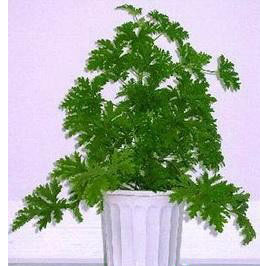
Key points for cultivating mosquito-repellent plant
1. The mosquito-repellent plant has relatively strong vitality, is easier to care for than ordinary flowers and plants, is relatively tolerant of organic fertilizer, and can live for more than 8 years. The mosquito-repellent plant likes a sunny, well-ventilated environment and is afraid of excessive moisture, especially water accumulation in the soil. It likes loose sandy loam soil. The potting soil is best if it is neutral to acidic, and care should be taken to prevent alkalinization caused by improper watering. For fertilization, apply a compound fertilizer once every 15-20 days, mainly by soil application, and do not spray it on the leaves.
2. The mosquito-repellent plant should receive sunlight during the day, but proper shading is needed under strong sunlight. If the light is too intense or the air is dry, the leaf tips or edges will scorch. Usually, pay attention to more ventilation and more light, and keep the soil loose and moist. During the day, it can be placed on a bright, ventilated windowsill or balcony, and it is best to receive one to two hours of direct sunlight every day.
3. When mosquitoes are about to appear at night, place the mosquito-repellent plant in the middle of the room. Before use, use a dedicated small sprayer to spray water evenly on the front and back of the leaves (the effect is poor without spraying water), and spray once more after half an hour.
Is mosquito-repellent plant toxic? Is mosquito-repellent plant harmful to the human body?
Mosquito-repellent plant is cultivated as an aromatic plant. Is it full of fragrance? It can remove odors and make the air fresher. However, its pungent aroma is both the biggest characteristic of the mosquito-repellent plant and its inescapable weakness. So, is mosquito-repellent plant toxic? Is mosquito-repellent plant harmful to the human body? Let us take a closer look below!
Is mosquito-repellent plant toxic:
In fact, the mosquito-repellent plant is non-toxic. The label of “toxic” really does it an injustice. The mosquito-repellent plant originated in South Africa. Today's mosquito-repellent plant variety is a new plant developed by combining cells of an African geranium plant with a chemical substance containing citronellal from China. Therefore, today's mosquito-repellent plant has both fragrance and volatility. Even so, this fragrance is only an ordinary grassy scent and is not toxic.
It should be noted that mosquito-repellent plants sold on the market may have chemical fragrances added, and such fragrances are actually harmful to the human body, so you need to be extra careful in identifying them.
Is mosquito-repellent plant harmful to the human body:
The mosquito-repellent plant has wonderful uses such as repelling mosquitoes and purifying the air, but it is not absolutely safe either. Although there is currently no definitive evidence showing what side effects the mosquito-repellent plant has on the human body, it is still good to be a bit more cautious.
First are those with an allergic constitution. This constitution is extremely sensitive to pungent odors. Once an allergy occurs, symptoms such as redness, swelling and itching of the skin may appear. At this time, move the mosquito-repellent plant outdoors promptly and rest well. If the allergic symptoms do not disappear on their own for a long time, you will need to see a doctor.
Therefore, those who can tolerate the pungent odor of the mosquito-repellent plant and will not be allergic can place it indoors for ornamental purposes. Those who cannot tolerate it had better switch to other potted plants or place the mosquito-repellent plant outdoors.
Is mosquito-repellent plant harmful to humans
The mosquito-repellent plant is a mosquito-repellent plant cultivated by introducing citronellal from lemongrass into the geranium originally from Africa through gene fusion technology to make it effectively repel mosquitoes. Lemongrass is a traditional natural mosquito-repellent herb, so the mosquito-repellent plant is a plant with no toxic effects. Therefore, scented geranium can not only repel mosquitoes through its aroma, but also purify the air.