When transplanting flowering almond (Prunus triloba), keeping a soil ball and watering and pruning in time can improve the survival rate.
Flowering almond grows fairly quickly, and sometimes a flower pot or the environment limits it, so it has to be transplanted. During transplanting, be careful to avoid damaging the roots, and the care and management after transplanting are also very important. Good care can improve the transplant survival rate and will not have an adverse effect on growth. So how do you transplant flowering almond? Follow the editor to learn about it.
How to transplant flowering almond
1. Transplanting time for flowering almond
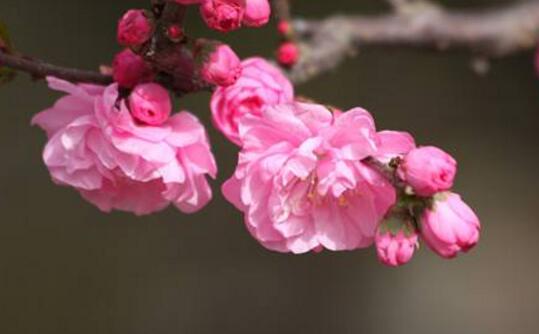
The best time to transplant is spring or autumn, for example March or November. It should be before the flowering period and after the soil thaws. In autumn, you need to wait until the yellowed leaves fall off naturally.
2. Transplanting methods for flowering almond
1. Choosing a flower pot
Choose a suitable flower pot according to the size of the flowering almond plant. It should neither be too small nor too large, otherwise it will make watering and fertilizing unfavorable. Choose a pot that is mainly sturdy and solid. You can place a tile over the drainage hole at the bottom to prevent the potting soil from being washed out when watering. You can also put 2-3 cm of coarse granules at the bottom as a drainage layer, then sprinkle on decomposed base fertilizer.
2. Choosing soil
In the cultivation methods for flowering almond, we mentioned its choice of soil. When transplanting, the selected soil is preferably paddy soil, pond mud, or leaf mold, and it can also be made by mixing garden soil with river sand and sawdust.
3. Transplanting
After choosing the pot and soil, how do you transplant flowering almond? The method is to take the flowering almond out of the previous flower pot with soil, then cut off excess fibrous roots and rotted roots, then plant it into the prepared pot soil, fill in soil, and the soil only needs to reach 2-3 cm below the pot rim.
4. Care after transplanting
After transplanting, water immediately, and make sure to water thoroughly, then place it in a bright and ventilated place for management. Be careful to keep the soil moist and the light moderate, neither too strong nor too dark. After 7-10 days, once the flowering almond has resumed normal growth, carry out routine management.
Precautions for transplanting flowering almond
1. Transplanting requires a soil ball
In the process of taking the flowering almond out of the soil and transplanting it into another flower pot, the roots of the flowering almond need to have a soil ball, as this can improve the survival rate after transplanting. The height of the soil ball is generally 60% of the soil ball diameter. During loading and unloading, handle it gently and place it down gently to avoid injuring the roots.
2. Water in time
After transplanting, water once immediately, then water a second time after 5 days. After that, choose to water once every 3-5 days according to growth rate and climate changes. Never let water accumulate in the pot. If you do not water in time after transplanting, it will affect the survival of the flowering almond.
3. Prune at the right time
Flowering almond has a relatively strong ability to send up suckers, so it is also very tolerant of pruning. When transplanting, pruning can be carried out at the same time. Generally, thinning and heading back are used, cutting off branches that are relatively dense or make the plant too tall, ensuring the plant's light penetration and appearance.
Cultivation and management of flowering almond
Flowering almond (scientific name: Amygdalus triloba), also called xiaotaohong, is named because its leaves resemble elm leaves and its flowers closely resemble plum blossoms. It is a shrub or rarely a small tree, 2-3 m tall; branches spreading, with many short small branchlets; branchlets gray, one-year-old branches grayish brown, hairless or slightly pubescent when young; winter buds short and small, 2-3 mm long.
Branches purplish brown, leaves broadly elliptic to obovate, apex 3-lobed, margin with unequal coarse heavy serrations; flowers single to double, purplish red, 1-2 borne in leaf axils, flowering period April; drupe red, nearly spherical, hairy.
Cultivation methodsFlowering almond is commonly propagated by sowing, division, and grafting, and the survival rates are all very high.
1. Propagation by sowing
After the fruit matures in July, harvest it and remove the flesh, wash it, stratify it with wet sand, and sow in spots after autumn or in early spring.
2. Propagation by division
Generally carried out after leaf fall in autumn, and can also be carried out before bud break in spring. Separate rooted branches from the base of the clump, or dig up the entire mother plant and divide it into several clumps, ensuring each small clump has 3-5 branches and trunks, then plant them separately. Before planting, cut off some branches to reduce water evaporation, so that the newly sprouted branches are thick and healthy, thereby improving the survival rate of planting.
3. Propagation by grafting
Flowering almond is generally grafted by branch grafting and bud grafting. The rootstocks used for grafting are generally seedlings of flowering almond, mountain peach, or wild peach, and apricot, plum, cherry, etc. can also be used. If you want to train it into a small tree form, you can perform high grafting on the trunk of rootstocks such as mountain apricot to raise the position of the crown. The grafting time is generally bud grafting in autumn and branch grafting in spring. After bud grafting in August in autumn, do not let it sprout that year. In the following spring, cut off the rootstock 2-3 cm above the grafted bud to make the grafted bud sprout into a branch. If training a small tree form, high grafting can be done on the rootstock trunk to raise the crown position. Branch grafting generally uses cut grafting or cleft grafting, carried out in mid-to-late March in early spring when winter buds begin to swell. After grafting, mound soil or use a plastic bag to cover the scion together with the graft union, and it can survive in about 20 days. After survival, promptly remove the suckering buds on the rootstock. Later, as the temperature rises, gradually remove the plastic bag or open the mounded soil.
The planting time can be carried out from after leaf fall in autumn to before bud break in early spring. If you want to transplant an mature plant, you can do it in July-August of the previous year, with the aim of keeping the root system intact, and cut the roots on two or three sides, which can make more fibrous roots grow and is beneficial to survival after planting.
Cultivation management
Planting flowering almond is best done in a place with loose, fertile, well-drained soil and sufficient light. The planting time is generally after leaf fall in autumn. Apply decomposed organic fertilizer as base fertilizer in the planting hole. When planting, thin out some branches to improve the survival rate. After planting and survival, cultivate and weed in time, water in time according to drought conditions, pay attention to drainage in the rainy season, irrigate once with antifreeze water before frost, and apply fertilizer once after flowering. In the young stage, after each flowering, the flowering branches should be appropriately headed back to promote the axillary buds to sprout and form more side branches. When the plant enters middle age, the clump has already grown quite dense. At this time, heading back should be stopped, dense branches, weak branches, and diseased and pest-damaged branches should be thinned out, and heavy pruning should be carried out on vigorous branches and sparsely branched areas, so that in the coming year the flowers will be abundant and the leaves lush, and the growth will be robust. After flowering, remove young fruits in time to avoid consuming nutrients and affecting flowering the next year. It can also be pruned into a small tree form after planting. Because with this small tree form, the side branches on the trunk are moderately dense and nutrient distribution is more reasonable, there is no need to remove young fruits, letting strings of fruit hang all over the branches, bright red and beautiful, still having certain ornamental value. After flowering, topdressing is needed to facilitate flower bud differentiation, so that next year the flowers will be large and abundant. If potted or planted as a solitary specimen, attention should be paid to its posture and charm.
Key points for rapid propagation of flowering almond:
The specific operation is as follows. Rapid propagation material is taken from 2-5 year old robust mother trees. Select current-year sprouts that are thick and strong, with plump buds, good lignification, and no disease or pest damage for rapid propagation. Make leafy branch segments 18-20 cm long as detached material, 1.6-2.0 cm thick, cut from the middle and lower part of the shoot as material. The branch collection time is mid-to-late June to July, carried out on cloudy days or early morning. When making the material, the upper cut is flat, and the lower end can be cut flat or obliquely. Note that the cut should be smooth and not split, and the upper bud must not be damaged. The upper cut should be about 1.5 cm from the base of the adjacent leaf, and the lower cut should be 0.5 cm from the base of the bud. Keep the upper two leaves and remove the rest. The prepared leafy branch segments are then treated by ring cutting or longitudinal cutting. The method is: ring cutting is carried out from 3 cm below the lower cut, and the cuts are required to meet; longitudinal cutting is cut downward from 3 cm below the upper cut to the lower cut. The prepared material is then treated with chemicals, and then immediately rapidly propagated in an intelligent seedbed. Generally, callus tissue forms in 12-15 days, roots form in 25 days, and large numbers of roots form in 40 days. This technology has a high propagation coefficient and low cost, and can cycle through 4 generations from June to October, providing high-quality seedlings for the large-scale development of flowering almond.
Flower cultivation in July | Repotting, transplanting | Fertilization management
Flower cultivation in July | Repotting, transplanting | Fertilization management
1. Flower cultivation
Flower seedlings that can be sown in July include: cineraria, Chinese primrose, ornamental kale, campanula, etc. When sowing, attention should be paid to moisture retention, shading, and increasing ventilation and light. You can also pick mature fruits of plum, wild peach, mountain peach, flowering almond, etc., wash off the flesh, and then sow in furrows immediately, or store the washed stone fruits in wet sand until they crack and then sow; wintersweet seeds can be sown as soon as collected, or the seeds removed from the fruit capsule can be dried and stored until the following spring for sowing, which will not affect their germination rate.2. Cuttage
Herbaceous flowers suitable for cuttage propagation in July include: Scutellaria indica, begonia types, coleus, Pilea cadierei, salvia, marigold, French marigold, globe amaranth, geranium, Aster novi-belgii, Lythrum salicaria, Cyperus alternifolius, Parthenocissus tricuspidata, coral flower, Peperomia, Epipremnum pinnatum, Polygonum chinense, Kalanchoe pinnata, pothos, etc. Woody flowers suitable for cuttage propagation include: Excoecaria cochinchinensis, Nandina domestica, poinsettia, Euphorbia milii, Hypericum, Hypericum kouytchense, Weigela florida, Hydrangea macrophylla, Weigela, Spiraea cantoniensis, Spiraea thunbergii, Daphne odora, Gardenia jasminoides, Edgeworthia chrysantha, Magnolia sieboldii, Bougainvillea, Aglaia odorata, Jasminum sambac, Chloranthus spicatus, Schefflera octophylla, Mahonia, pomegranate, Lagerstroemia indica, Hibiscus syriacus, Pyracantha, Cordyline fruticosa, Hibiscus rosa-sinensis, Serissa japonica, Michelia figo, Viburnum odoratissimum, Ficus elastica, Viburnum macrocephalum, Viburnum plicatum var. tomentosum, Buxus species, Ficus carica, Magnolia liliiflora, Osmanthus fragrans, Rhododendron species, Camellia japonica, Camellia sasanqua, Salix matsudana f. tortuosa, Salix babylonica var. chrysocoma, etc. Hippeastrum can also be propagated by scale cuttage. In addition, in July, water cuttage can also be used to propagate some flowers and trees. They are: gardenia, Nerium oleander, Rosa chinensis, jasmine, Chloranthus spicatus, fig, pomegranate, Fuchsia hybrida, Lagerstroemia indica, Hibiscus syriacus, etc. Using water cuttage to propagate flowers and trees, first, prepare a thick foam plastic board 1 cm to 2 cm thick, punch holes in it and use it as fixing material for cuttings; second, keep the water used for cuttage clean, and you can put in a few pieces of charcoal for antisepsis.3. Grafting
One-year-old seedlings of mountain peach or wild peach can be used as rootstocks, and bud grafting can be used to propagate ornamental peach, Shouxing peach, red-leaf peach, plum blossom, flowering almond, red-leaf plum, Meiren plum, etc.; using cuttings of wild rose, Rosa multiflora, and "Shisimei" as rootstocks, bud grafting can be used to propagate variety roses, cut-flower roses, and rugosa roses, etc.; using potted Magnolia liliiflora and Magnolia denudata seedlings as rootstocks, approach grafting can be used to propagate Michelia alba, Michelia figo, etc.; using 2-year-old potted seedling wintersweet as rootstocks, approach grafting can be used to propagate fine varieties of wintersweet; 2-year-old wintersweet seedlings can also be used as rootstocks, and by using the method of softwood side grafting with bagging for moisture retention, grafting is carried out 3 cm to 4 cm above the ground, and whether it has survived can be judged after 7 to 10 days; using "Purple Butterfly" and "Jade Butterfly" among Rhododendron mucronatum as rootstocks, cleft grafting or side grafting can be used to propagate Belgian azalea or Western azalea; using cherry seedlings as rootstocks, bud grafting can be used to propagate fine varieties of flowering cherry; using current-year seedling of Malus baccata, Malus hupehensis, Malus halliana, or Malus spectabilis as rootstocks, "T" shaped bud grafting can be carried out to propagate fine varieties of crabapple types; using Acer palmatum seedlings as rootstocks, bagged grafting can be used to propagate red maple, feather maple, and other seedlings.4. Layering
Flowers and trees suitable for layering propagation in July include: Aglaia odorata (air layering), wintersweet, honeysuckle, hydrangea, Campsis grandiflora, Viburnum macrocephalum, oleander, Weigela, Caragana sinica, Osmanthus fragrans, gardenia, Magnolia liliiflora, jasmine, Chloranthus spicatus, climbing rose, winter jasmine, etc.5. Division
Ornamental plants suitable for division in July include: hosta, purple hosta, Acorus species, Cyperus alternifolius, Aspidistra elatior, Tradescantia spathacea, bromeliads, Haworthia, spider plant, Liriope species, Reineckea carnea, Zephyranthes candida, Nephrolepis cordifolia, iris, Tradescantia zebrina, etc.2. Collecting seeds and transplanting for establishment and potting1. Collecting seeds. Herbaceous flower seeds that can be collected in July include: hollyhock, Malva, morning glory, baby's breath, petunia, Phlox drummondii, foxglove, Coreopsis tinctoria, sweet pea, daisy, delphinium, pansy, Lampranthus spectabilis, etc. Flower and tree seeds that can be collected include: wintersweet, plum, wild peach, mountain peach, flowering almond, etc.2. In July, trees are generally not transplanted, but under some special circumstances, it is also feasible to transplant some flowering shrubs with soil balls, such as Mahonia, Hypericum, Ligustrum sinense var. variegatum, Berberis thunbergii var. atropurpurea, Aucuba japonica, Sabina chinensis 'Kaizuca' balls, etc. However, targeted pruning must be done, shade sheds must be built in time, and the number of water sprays must be increased. After they have basically survived, switch to normal management. Do not be careless.3. July is the main period for potting flower seedlings to be displayed during National Day. At this time, the flower seedlings transplanted and potted can be seedlings from sowing or cuttings. After 3 months of careful maintenance, they will happen to bloom during National Day for holiday decoration. They are mainly: salvia, early chrysanthemum, globe amaranth, dahlia, Impatiens hawkeri, dragon's mouth flower, marigold, French marigold, Kochia scoparia, China aster, Cosmos sulphureus, cockscomb, etc.3. Flower management1. Watering
For flower species that enter semi-dormancy under high temperatures, such as Oxalis corymbosa, geranium types, Fuchsia hybrida, Clivia miniata, Zantedeschia aethiopica, begonia types, Sedum, Kalanchoe blossfeldiana, cactus types, Haworthia cooperi, Stapelia grandiflora, Senecio rowleyanus, Senecio radians, Daphne odora, Schlumbergera truncata, Portulacaria afra, Aloe, etc., because the temperature is too high, their growth activity basically stops and their metabolic level is very low. Watering should be reduced, the potting soil should be kept moist, and attention should be paid to shading and ventilation to create a relatively cool environment for them. If watered too much, it is easy to cause root rot and will also seriously affect their recovery growth after autumn. For flower species that enter deep dormancy under high temperatures, such as Cyclamen persicum, Lycoris types, Ranunculus asiaticus, Dicentra spectabilis, etc., in July the aboveground stems and leaves wither and the underground nutrient fibrous roots die, surviving the summer in a dormant state in the soil as underground stems or tuberous roots. For deeply dormant flowers, stop watering, move them to a cool place, and just keep the potting soil not too dry.For flower species with vigorous growth, especially foliage plants, such as Cycas revoluta, Aspidistra elatior, Monstera deliciosa, Ficus elastica, Michelia alba, jasmine, Aglaia odorata, Chloranthus spicatus, Araucaria heterophylla, Maranta types, Syngonium types, red (green) gem, green giant, green emperor, green queen, pink lady, Brazil iron, money tree, Camellia japonica, Camellia sasanqua, Aucuba japonica, Pyracantha, bitter orange, lemon, Podocarpus macrophyllus, pomegranate, Cercis chinensis, Wisteria sinensis, Rosa chinensis, etc., not only should the amount and frequency of watering be increased, but also appropriate leaf spraying should be given, combining spraying and watering. Especially during continuous cloudy days, because the temperature is relatively high and the air is dry, watering and spraying should likewise be given, and do not be careless. Once the potting soil is found to be too dry and the leaves wilted, first spray the leaves, and after the leaves recover and stand up, then water the roots. Do not pour water heavily at the roots at once, otherwise it is very easy to cause woody flowers to "drop green leaves," or cause the rot of the plant's nutrient fibrous roots, and even cause plant death.For potted plum bonsai, because July to August is its flower bud differentiation period, appropriate "water withholding" should be given to promote normal flower bud differentiation. The method is: keep the leaves on both sides of the potted plant slightly curled inward to control vegetative growth; if the vegetative growth of the branches cannot be controlled, when the second new shoot produces 2 to 3 leaves, keep only one leaf at the base and pinch off the rest. Flower buds can still differentiate in the axils of this leaf.In July, when watering potted flowers, avoid the few hours around noon. It is best to water before 10 a.m. and after 4 p.m., so as to avoid too great a difference between water temperature and soil temperature, which would affect the growth of potted ornamental plants. If continuous rainy weather occurs this month, check the flower pots promptly after the rain. If water is found in the flower pots, pour it out in time, and after the potting soil is slightly dry, loosen the soil once more, so as to avoid root rot of potted plants.2. Fertilization
There are four major categories of ornamental plants that should have fertilization management strengthened in July. First, types with a particularly long flowering period, blooming from spring and summer into autumn, such as Magnolia denudata, Rosa chinensis, Aglaia odorata, jasmine, etc.; second, types that bloom profusely in autumn, such as chrysanthemum, Osmanthus fragrans, Hibiscus mutabilis, etc.; third, types for viewing flowers and fruits in winter, such as bitter orange, Nandina domestica, wintersweet, rhododendron, etc.; fourth, foliage plants, such as Rhapis excelsa, Monstera deliciosa, Philodendron bipinnatifidum, Ficus elastica, etc. For the types of fertilizer, for the first three categories, in addition to applying necessary nitrogen fertilizer, appropriate phosphorus and potassium fertilizer should also be applied to meet the plant's comprehensive needs for nitrogen, phosphorus, and potassium, and provide sufficient nutritional guarantee for bud formation, flowering, and fruiting; for foliage plants, thin cake fertilizer liquid or urea liquid should be the main type. The fertilization method is preferably applying thin liquid fertilizer.Herbaceous flowers that should have fertilization strengthened in July include: salvia (white, purple, pink), cockscomb, China aster, zinnia, globe amaranth, chrysanthemum, Rudbeckia hirta, petunia, Pachystachys lutea, Justicia brandegeeana, Cymbidium ensifolium, marigold, Mirabilis jalapa, dragon's mouth flower, etc. Woody flowers include: Lagerstroemia indica, pomegranate, poinsettia, Michelia figo, Osmanthus fragrans, Camellia japonica, Camellia sasanqua, Hibiscus rosa-sinensis, jasmine, Michelia alba, Aglaia odorata, Cestrum nocturnum, Rosa chinensis, crabapple types, Brunfelsia, Bougainvillea, rhododendron, Chloranthus spicatus, wintersweet, Hibiscus syriacus, Hibiscus mutabilis, etc. There are many kinds of foliage plants, such as bromeliads, Brazil iron, Rhapis excelsa, Araucaria heterophylla, Syngonium, Maranta, green giant, red gem, Cycas revoluta, Ficus elastica, Monstera deliciosa, Cordyline fruticosa, etc. In July, for ornamental plants in dormant or semi-dormant states, fertilization must be stopped. Especially for succulent ornamental plants, such as Sedum types, Senecio, Lampranthus spectabilis, Stapelia, etc., fertilization must be stopped to prevent plant rot.3. Pruning, bud pinching
Ornamental plants that can be tip-pruned and bud-pinched in summer must be species with vigorous growth, strong sprouting ability, and tolerance of pruning. Pinching means directly removing the young tender terminal buds with the fingers. Bonsai plants suitable for pinching mainly include: Ulmus parvifolia, Sageretia thea, Syzygium buxifolium, Euonymus bungeanus, Buxus sinica, wintersweet, Pyracantha, Podocarpus macrophyllus, Tamarix chinensis, Elaeagnus pungens, Adina rubella, Vitex negundo, Forsythia, Celtis sinensis, Carmona retusa, Ficus microcarpa, Fraxinus chinensis, Acer triflorum, Lagerstroemia indica, Serissa japonica, Murraya paniculata, etc. Pruning means using scissors to cut off part of a new shoot to promote the sprouting of lower side buds and form beautiful crown pads or tree shapes. Bonsai plant types suitable for pruning are mostly woody ornamental plants that are inconvenient for finger pinching, such as Juniperus rigida, Platycladus orientalis, Sabina chinensis, Juniperus procumbens, Xylosma racemosum, Ilex cornuta, Sabina chinensis 'Pyramidalis', etc. For potted flower types that continue flowering for a long time, such as Aglaia odorata, Rosa chinensis, jasmine, Chloranthus spicatus, etc., their faded flowers and withered stalks should be removed in time, and necessary shortening pruning should be given to branches that have already flowered, which can promote the sprouting of lower side buds and reflowering. For rhododendron, Camellia japonica, Camellia sasanqua, crabapple, wintersweet, plum blossom, etc., overly long branches protruding from the crown should also be shortened to form a better crown shape.4. Shading
July is the month with the strongest sunlight and the highest temperature of the year. For potted ornamental plants, special attention should be paid to shading management. For ornamental plants that like shade or semi-shade, they must be moved under a shade shed to avoid damage to the plants from direct sunlight. Such as ferns, hosta, purple hosta, Monstera deliciosa, Camellia japonica, Camellia sasanqua, rhododendron, Chloranthus spicatus, Strelitzia reginae, orchid types, Rhapis excelsa, Ficus elastica, red (green) gem, Philodendron bipinnatifidum, pink lady, pothos, Peperomia types, Aspidistra elatior, Tradescantia zebrina, Brazil iron, Epipremnum pinnatum, bromeliads, Maranta types, Reineckea carnea, etc. For light-loving types, sufficient light can be given, such as pomegranate, Wisteria sinensis, Lagerstroemia indica, Pyracantha, jasmine, Serissa japonica, Cycas revoluta, Sabina chinensis, Platycladus orientalis, peach blossom, plum blossom, wintersweet, Ulmus parvifolia, Sageretia thea, Acer triflorum, Pinus thunbergii, Adina rubella, Xylosma racemosum, Pinus parviflora, Michelia alba, Aglaia odorata, Rosa chinensis, etc. For Podocarpus macrophyllus, Podocarpus nagi, Michelia figo, Damnacanthus indicus, Asparagus setaceus, Bambusa multiplex, Pinus parviflora, etc., it is necessary to give appropriate shading. For small, miniature, and shallow-pot bonsai, because the temperature this month is too high and the air is relatively dry, in addition to necessary shading, the flower pots must also be buried in wet sand. This can reduce evaporation from the potting soil surface and is also beneficial for protecting the plant's nutrient fibrous roots.5. Flowers in air-conditioned rooms
In air-conditioned rooms, choose flower types with a relatively high degree of leathery leaves, or with a relatively thick cuticle on the leaf surface, somewhat tolerant of dry environments, and with strong resistance, such as Ficus elastica, Fatsia japonica, Mahonia, Cycas revoluta, Araucaria heterophylla, Abelmoschus moschatus, Livistona chinensis, Rhapis excelsa, Phoenix canariensis, bromeliads, Philodendron bipinnatifidum, Monstera deliciosa, Schefflera octophylla, Aspidistra elatior, Aucuba japonica, etc., while it is not suitable to choose Nephrolepis cordifolia, coleus, green giant, Syngonium, etc. In addition, during management, attention should be paid to combining watering and spraying, and keeping them away from air-conditioner outlets to prevent the wind from directly blowing on the plants and causing their leaf tips to wither and leaf edges to scorch.6. Disease and pest control
(1) When orchid new buds unfold leaves in July, the leaf tips are relatively prone to infection by anthracnose, gradually spreading to the whole plant, and in severe cases causing the plant to wither and die. This disease can occur throughout the year. Poor ventilation, high temperature and high humidity, and continuous rainy weather are more conducive to the cultivation and spread of the pathogen. Ventilation should be strengthened, and during the onset period, spray 75% chlorothalonil wettable powder 800-fold solution or folpet 500-fold solution for control. (2) When reddish-brown sawdust-like insect frass accumulates on the stumps or main trunks of plum blossom, peach blossom, crabapple types, red-leaf plum, flowering cherry, flowering almond, etc., it is mostly caused by the larvae of the peach red-necked longhorn beetle boring and feeding. Methods such as manual digging and killing, injection of systemic pesticides, insertion of poison sticks, and soil burial of carbofuran can be used for control, and can effectively kill the larvae inside the trunk. Note that when injecting pesticides, do not use dimethoate, omethoate, etc., to prevent phytotoxicity. (3) In July, promptly control the boxwood leafroller moth that harms Buxus sinica, Buxus bodinieri, Buxus harlandii, and Buxus sempervirens. When this pest occurs severely, it can gnaw all the leaves bare. Once discovered, promptly spray pesticides such as trichlorfon, dimethoate, or fenvalerate. If a certain pesticide has been used for a long time and resistance has developed, switch to a new type of pesticide. (4) In July, in some areas, larvae of the citrus swallowtail butterfly will continue to harm the leaves of new shoots of bitter orange, kumquat, Glycine max, finger citron, lemon, Citrus wilsonii, and Ruta graveolens. Stomach-poison pesticides should be sprayed promptly to kill them. (5) For the wax insect that harms Ligustrum lucidum, Ligustrum quihoui, Fraxinus chinensis, and Fraxinus chinensis, late July to late August is its eclosion period. Choose the right time to spray pesticides such as Supracide for control, which can prevent the wax insect from causing damage again the following year. (6) The Japanese wax scale is a major pest harming Euonymus japonicus, Platanus orientalis, Pittosporum tobira, Camellia japonica, red-leaf plum, Cedrus deodara, etc. In severe cases, the insect bodies often cover the branches and leaves. Early July is the peak hatching period of its nymphs, and pesticides such as dimethoate and Supracide can be sprayed promptly for control.4. Bonsai styling
In July, because the temperature is high, the air humidity is low, and plants are in a period of vigorous growth, branches are prone to infection by pathogens after injury and are not easy to heal and recover, so most tree stump types are no longer suitable for wire training and styling. The plant types that can still be styled are some with strong adaptability and tolerance of wire training, and the plants are required to be those potted and hardened in spring or planted in the ground. They are: winter jasmine, ginkgo, Podocarpus macrophyllus, Thujopsis dolabrata, Calocedrus macrolepis, Serissa japonica, Pinus thunbergii, Buxus sinica, Adina rubella, etc.In July, plant styling should be careful and meticulous, with gentle wire training and slow tying, using force gradually. Do not operate hastily or use too much force, otherwise it is very easy to cause the plant's branches and trunk to break, endangering its survival.Solar terms in July: July 7 is Minor Heat; July 23 is Major Heat.