How to grow larkspur? Cultivation methods and points to note, light must be sufficient
Larkspur is a highly ornamental flowering plant, and many people in China grow it, but there are many points to note when growing it. How do you grow larkspur? What are the cultivation methods and points to note for larkspur? Below, the editor will walk you through it.
I. How to grow larkspur
II. Cultivation methods and points to note for larkspur
1. Soil requirements
Among the cultivation methods and points to note for larkspur, choosing the soil is the foundational step. Generally, it is best to choose relatively fertile humus soil; this kind of soil has good drainage and aeration, allowing larkspur to absorb nutrients better and grow more vigorously.
2. Fertilization requirements
Fertilizer is one of the main nutrients in the growth process of larkspur, and its demand for fertilizer during growth is relatively high. Basically, it needs fertilizing 1-2 times every month. However, when fertilizing, remember that the fertilizer must first be diluted so it can be absorbed better. If concentrated fertilizer is applied directly without dilution, it can easily burn the plant and cause the leaves to turn yellow.
3. Watering management
In the process of growing larkspur, watering is also a very particular matter: not too much and not too little. It is best to maintain the principle of watering when dry and letting it dry between waterings. When watering, water thoroughly at one time, but remember never to cause waterlogging, otherwise it can easily cause root rot. Therefore, among the cultivation methods and points to note for larkspur, there are still many points to note about watering.
4. Light management
Larkspur is a light-loving plant, so its demand for light during growth is still quite high. It is best to keep it in sufficient light so it can carry out photosynthesis better, thus laying a good foundation for flowering.
5. Pest and disease control
During the cultivation of larkspur, if operations are improper, problems such as pests and diseases can easily occur. Such problems are extremely harmful to larkspur, not only greatly affecting its appearance, but if not dealt with promptly, they can also easily cause the plant to wither and die. As for specific treatment methods, you can refer to the article on pest and disease control for larkspur, which has detailed introductions.
Planting methods and points to note for larkspur
Larkspur is named because its flower shape resembles a swallow. Larkspur is also planted relatively widely, commonly seen in grasslands and hillsides. Some friends also grow larkspur in pots. Next, Xiao Qi will share the planting methods and points to note for larkspur.
I. Planting methods for larkspur
1. Soil: fertile, slightly acidic sandy soil with humus, with pH best controlled at 5.5-6.0, keeping the soil moist and not prone to waterlogging. After sprouting, at 6 to 9 weeks, each seedling can be transplanted into a flowerpot with a diameter of 9 to 10 cm, or every 3 seedlings can be transplanted into a large flowerpot with a diameter of 13 to 15 cm. When transplanting, do not plant the plant too deep.
2. Light: Larkspur needs to receive sufficient sunlight to promote plant growth, especially in winter. It tolerates some shade, and in summer strong light should be avoided, placing it in a semi-shaded place. It likes cool weather, with the best daytime growth temperature between 20-25°C and nighttime controlled at 3-15°C.
3. Watering: Larkspur likes moisture and is also drought-tolerant. When watering, water enough at one time; water when dry. During the flowering period, slightly increase the amount of watering, and it must not be too dry. When repotting, dry manure needs to be added as base fertilizer. At other times, fertilize as appropriate according to the plant's growth. During the growing period, generally apply decomposed cake fertilizer water 1-3 times a month.
II. Points to note when planting larkspur
Larkspur needs a growth environment with sufficient sunlight and coolness. It is both cold-tolerant and drought-tolerant, but not tolerant of high temperatures or waterlogging, and its requirements for soil are not very high. It can be sown in spring or autumn. If sown in autumn, it must be done in mid-September. After sowing, the soil must be kept moist. The simplest method is to cover it with some grass, and gradually remove the cover after seedlings emerge. When larkspur grows 2 true leaves, transplant it with soil into a small pot, and repot once more after the seedling grows larger.
Watering larkspur should follow the principle of watering when dry and letting it dry between waterings. During the flowering period, water slightly more to avoid the soil becoming too dry. When repotting, apply dry manure as base fertilizer, and afterward, according to growth conditions, apply decomposed cake fertilizer water 1-3 times a month. After repotting, use paclobutrazol to control plant height. The specific method is to apply 0.5% paclobutrazol once every 2 weeks. Collect seeds in time to prevent the seed pods from splitting after maturity.
The above isthe planting methods and points to note for larkspurshared, hoping it is helpful to friends growing larkspur.
Recommended reading:
①What is the flower language of larkspur? Complete guide to larkspur flower language and legends
②Planting methods and points to note for mimosa
③Seed planting methods and points to note for wintersweet
④How to plant datura? Planting methods for datura
⑤How to grow pocketbook plant? Cultivation methods for pocketbook plant
Larkspur Delphinium grandiflorum larkspur gallery: how to grow larkspur / how to propagate larkspur
Larkspur profileLarkspur Delphinium grandiflorum
Cultivation methods and points to note for larkspur, introduction to larkspur
Larkspur is an annual or biennial herbaceous flower of the genus Delphinium in the Ranunculaceae family. The plant form of larkspur is upright, with a plant height of 30 cm-100 cm, and some varieties can reach 120 cm. Its stems and leaves have sparse fine hairs, and the leaves are alternate, palmately deeply lobed to fully lobed, with linear lobes; the basal leaves have long petioles, and the upper leaves are sessile.
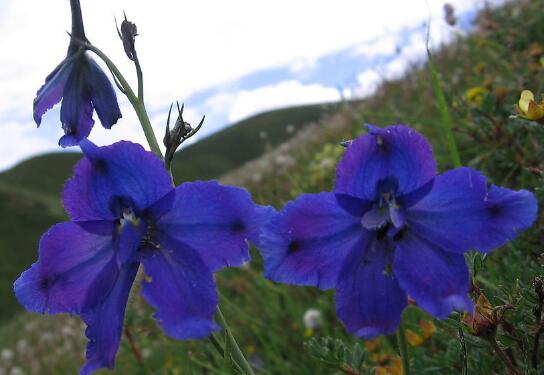
The inflorescence of larkspur is a terminal raceme or spike, with small flowers about 2.5 cm-4.0 cm in diameter, 5 sepals, violet-blue or pink, with a long spur on the upper sepal, 2 petals, connate, the same color as the sepals, and the outer sepals are also petal-like, the same color as the petals, with the outermost one elongated into a narrow ellipse.
The flowering period of larkspur is from May to August. Its flowers are rich in color, including blue, light blue, white, pink, flesh pink, etc., and most varieties also have eye spots on the petals. At present, landscape technicians have bred many hybrid varieties, such as Delphinium belladonna and Delphinium elatum, which not only have richer flower colors but also many variations in flower shape, gradually expanding the larkspur family.
The larkspur plant is upright, with slender emerald-green leaves and dense, brilliant flowers. Seen from a distance, it looks like little birds playing on the branches, offering a special charm.
Morphological characteristics of larkspur
Larkspur is an annual herb, less than 1 m tall, slightly hairy. Branches few and ascending. Basal leaves have long petioles, 3-parted almost to the base, the lobes further divided into many linear small lobes; upper leaves sessile, also with many linear lobes. Raceme very long, thinly covered with fine pubescence; pedicels ascending, 1.5-4 cm long, with a pair of bracteoles at or below the middle; flowers blue, blue-purple to pale red or white, often double, 2-4 cm in diameter when open; sepals 5, broad and slightly obtuse, the posterior one extended into a spur, the spur curved upward, about as long as the other parts of the flower, and the spur of the upper pair of petals is inserted into it; carpel 1, sometimes many in double flowers.
The follicle of larkspur is about 1-2 cm long, hairy, with a pointed beak at the tip. Flowering period May-August. Perennial herb, 35-65 cm tall. The whole plant is covered with soft hairs. Stems sparsely branched. Leaves alternate, palmately deeply lobed, basal leaves and lower stem leaves with long petioles; leaf blade round-reniform, trisected, 2.2-6 cm long, 4-8 cm wide, lobes finely divided, small lobes linear, 0.6-2.5 mm wide.
Raceme with 3-15 flowers, axis and pedicels with recurved fine pubescence; flowers zygomorphic; bracteoles linear or subulate; sepals 5, petal-like, blue or purple-blue, 1.5-1.8 cm long, the upper one spurred, apex often slightly concave; petals 2, smaller, spurred, the spur projecting into the sepal spur; staminodes 2, limb broadly obovate, slightly concave, with yellow bearded hairs; stamens numerous; carpels 3, free. At full bloom, it is even more moving, like a flock of blue little birds descending from the sky, and the follicles are 3 clustered together.
The flowering period of larkspur is August-September, and the fruiting period is September-October.
Ecological habits of larkspur
The wild original species of larkspur is mainly produced in the temperate zones of the Northern Hemisphere. It likes a growth environment with sufficient sunlight, good ventilation, and smooth drainage, and is suitable for growing in fertile sandy soil rich in organic matter. Its cold tolerance and drought tolerance are both relatively strong, but it is not tolerant of high temperatures, so in high-temperature summer areas, it should be moved to a cool place for cultivation.
Larkspur likes a cool climate, with the most suitable daytime temperature of 20°C-25°C and nighttime temperature of 13°C-15°C. Before flowering, an appropriate amount of nitrogen fertilizer should be applied as a top dressing, and after flowering begins, phosphorus and potassium fertilizer should be applied. Larkspur cultivated for cut flowers has tall inflorescences, so care should be taken to prevent the plants from lodging. Nets can be stretched between plants to fix them and prevent lodging. Larkspur fears waterlogging most, so drainage should be noted on rainy days.
Because the fruit ripening period of larkspur is inconsistent and the fruits naturally split after ripening, the seeds are easily lost, so they should be harvested in time.
Distribution area of larkspur
Larkspur is native to China and Siberia, at an altitude of 700 m. Its horticultural domestication began in the 17th century. With its upright plant form, elegant leaves, full inflorescences, and dense flowers, it has become a "beauty" in European gardens and is widely used in gardens.
At present, larkspur is cultivated in all provinces of China, and there are even wild species of larkspur in places such as Hebei. Under the trend of strongly advocating the use of native flowers in landscaping and beautification, it is believed that this beautiful flower will be used more widely.
Cultivation techniques for larkspur: transplanting
Seedbed preparation: choose a plot with good light and drainage and soil pH 6.0-6.5. Applying organic matter to the soil will help improve soil structure and increase yield.
Spacing: 20 cm. Cultivation net support is needed.
Fertilizer and watering: the suitable soluble salt content is 1.0 to 1.4. Using balanced calcium nitrate fertilizer helps promote sturdy plants. Maintain suitable humidity to avoid plant wilt causing root damage and ultimately reducing cut flower quality.
Long-day: long daylight helps promote flowering, resulting in relatively shorter plants.
Larkspur can be propagated by division, cuttings, or sowing.
The suitable temperature for its seed germination is around 15°C, and the soil temperature needs to be kept below 20°C. Generally, germination occurs about two weeks after sowing. For autumn sowing, choose late August to early September. First sow the seeds into an open-field seedbed, and before winter move the seedlings into a cold frame or cold room to overwinter, then move them outdoors for final planting after the weather warms in spring. In southern regions, direct sowing in the open field can also be done in early spring, followed by thinning after emergence, keeping the seedling spacing at 25 cm-50 cm. Generally, final planting can be carried out when the seedlings grow 4-7 true leaves. Cutting propagation is generally chosen in spring. When new shoots grow more than 15 cm, cut cuttings and insert them into sand. Division propagation can be carried out in both spring and autumn.
Cultivation temperature: 15-20 degrees; growth temperature: 15-24 degrees.
Advance cold treatment:
After sowing the seeds into plug trays, cover with a small amount of vermiculite. The substrate is required to have suitable dryness and moisture and no pathogens, with pH 5.5-6.3. Water thoroughly with chlorpyrifos diluted in water to prevent pests and diseases. Place the seedling trays in dark, low-temperature conditions of about 10 degrees for 15-20 days. Be careful to keep the seedling tray substrate moist, and it can be covered with plastic film.
Stage one:
Move the seedling trays to a bright greenhouse, maintaining 20 degrees during the day and 15 degrees at night for 12 hours each. To maximize the germination rate, try to keep the daytime temperature no higher than 25 degrees and the nighttime temperature no higher than 20 degrees.
Stage two:
When the seeds begin to germinate, use a balanced nitrogen fertilizer containing Ca diluted to 75-100 ppm for application. Place the seedling trays in a cool, light-transmitting greenhouse, maintaining the temperature at 15-18°C, and pay attention to air circulation. High temperatures during the seedling stage (above 25°C) will cause early flowering and result in low cut flower quality. Low temperatures (below 10 degrees) will cause the plants to form rosettes, which can be broken by increasing daylength from winter to spring.
Stage three:
When the soluble salt content in the soil is 0.8-1 and the pH is 5.5-6.3, true leaves begin to form. Maintain the temperature at 15-18°C, and at the same time provide a good air environment to prevent diseases. The leaves and root system of larkspur are both susceptible to disease infection, so good environmental conditions and water quality in the early stage are very important.
Stage four: (29-35 days) At this stage the seedlings will reach transplant size and have 3 true leaves. Larkspur has a taproot system, and delaying transplanting will reduce plant and flower quality.
Medicinal or dietary value of larkspur
The medical information and health dietary information on Huhuawang are for reference only and cannot be used as a basis for diagnosis or medical treatment. For any health problem, consult professional medical personnel, and for the treatment of any disease, please follow doctor's advice.
Ultimate flower-protecting task: love yourself, start from reality, and strictly follow doctor's advice. For illness, do not be careless, do not delay, do not give up hope, face it bravely, warm the silent world with love, and care for the flower field in your heart with your heart.
Traditional Chinese medicine
Note: The Chinese herbal medicine larkspur and the aforementioned plant belong to the same genus but different species.
Aliases: cat's-eye flower, dove flower, large-flowered larkspur, chicken-claw lotus, soil coptis [Jilin]
Source: Delphinium grandiflorum, a plant of the genus Delphinium in the Ranunculaceae family
L., with roots, whole plant, and seeds used as medicine. In summer, collect the whole plant, remove soil, cut into sections, and dry in the sun; in autumn, collect roots and seeds and dry in the sun.
Nature, flavor, and meridian entry: bitter, warm. Highly toxic.
Functions and indications: purge fire and relieve pain, kill insects. Root: toothache. Whole plant: kill lice.
Usage and dosage: external use in appropriate amount, decoct in water for washing, or prepare into tincture for use.
(Note) The whole plant is toxic, with the seeds being the most toxic. It mainly contains alkaloids. Accidental ingestion can cause nervous system poisoning. After poisoning, there may be difficulty breathing, blood circulation disorders, muscle and nerve paralysis, or spasms. Take note when using.
The above is excerpted from: "Compilation of National Chinese Herbal Medicines"
The whole plant and seeds can be used as medicine to treat toothache. The juice soaked from stems and leaves can kill insects.
Roots and seeds: Larkspur, an annual herb, less than 1 m tall, slightly hairy. Branches few and ascending. Basal leaves have long petioles, 3-parted almost to the base, the lobes further divided into many linear small lobes; upper leaves sessile, also with many linear lobes. Raceme very long, thinly covered with fine pubescence; pedicels ascending, 1.5-4 cm long, with a pair of bracteoles at or below the middle; flowers blue, blue-purple to pale red or white, often double, 2-4 cm in diameter when open; sepals 5, broad and slightly obtuse, the posterior one extended into a spur, the spur curved upward, about as long as the other parts of the flower, and the spur of the upper pair of petals is inserted into it; carpel 1, sometimes many in double flowers. Follicle about 1-2 cm long, hairy, with a pointed beak at the tip. Flowering period April. Mostly cultivated in gardens. Native to southern Europe; cultivated in China. Generally collected in July-August.
[Functions and indications] Seeds: taken internally, with effects similar to aconite, can treat asthma and edema. Root: mainly treats abdominal pain.
Medicinal selected prescriptions
① To treat wind-heat toothache: larkspur 5 fen to 1 qian. Decoct in water for gargling, do not swallow. ("Manual of Commonly Used Chinese Herbal Medicines in Northeast China")
② To treat scabies and tinea: larkspur combined with Sophora flavescens, grind into powder and apply. ("Manual of Plateau Chinese Herbal Medicine Treatment")
③ To treat head lice: fresh whole plant of chicken-claw lotus, mash, soak in water and wash the head. ("Jilin Chinese Herbal Medicine").
Components
Using normal-pressure column chromatography and thin-layer chromatography, 7 compounds were isolated from Delphinium grandiflorum L., and the structures of 6 of them were identified using physicochemical properties and spectral analysis, namely: (1) 7-dimethoxy-5-hydroxyflavone
(2) 1-O-demethyltalatisamine
(3) methyllycaconitine
(4) delphamine
(5) delphocurine
(6) delphin
Literature retrieval confirmed that compounds 1 and 2 were both isolated from this plant for the first time.
Collection
There are many kinds of Chinese medicinal materials, and the medicinal parts differ, so their optimal harvest times are also different. The so-called optimal harvest period is based on the quality of Chinese medicinal materials. The quality of Chinese medicinal materials depends on the content of active ingredients and is closely related to the place of origin, variety, cultivation techniques, and harvest years, season, time, method, etc. To ensure the quality and yield of Chinese medicinal materials, most should be harvested in time after maturity. Maturity of Chinese medicinal materials means that the medicinal part has reached the medicinal standard and meets the requirements of the national pharmacopoeia. Medicinal material quality includes internal quality and external traits, so the optimal harvest period for Chinese medicinal materials should be when the active ingredient content is highest and the external traits such as shape, color, texture, and size are best, so as to obtain high-quality medicinal materials and achieve better benefits.
Based on previous experience, combined with factors affecting medicinal material traits and quality and the rules of nutrient storage and loss during the growth and development of medicinal plants, the optimal harvest periods of Chinese medicinal materials are briefly described below according to the different medicinal parts.
I. Varieties of Chinese medicinal materials used as medicine from roots and rhizomes
For this type of Chinese medicinal material, those with firm roots and rhizomes, straight root strips, few branches, and sufficient powderiness are generally better in quality. The harvest season is mostly in autumn, winter, or early spring, during the dormant period after growth stops and flowers and leaves wither, and before germination in early spring. For most varieties, harvesting before germination in spring is the most suitable period, because in early spring the medicinal plant is preparing to sprout, and the large amount of nutrients stored in the root and rhizome parts has not yet decomposed or has just begun to decompose, so the active ingredient content is highest, the nutrients are richest, and the quality is best. But there are exceptions, such as Astragalus, Aconitum kusnezoffii, Coptis chinensis, and Codonopsis, which are harvested in autumn, while Pseudostellaria heterophylla, Pinellia ternata, and Aconite are dug in summer for high active ingredient content and good quality.
II. Varieties of Chinese medicinal materials used as medicine from flowers
Flower-type Chinese medicinal materials are mostly harvested when the flower buds are still unopened, when quality is better. If the flowers have already fully bloomed, the petals easily scatter, break, lose color, and the fragrance dissipates, seriously affecting quality. For example, honeysuckle should be harvested in summer and autumn when the buds at the top are enlarged and turning from green to yellow; clove in autumn when the buds turn from green to red; Magnolia biondii in late winter and early spring when the flowers have not opened; rose in late spring and early summer when the flowers are about to open; and Sophora japonica buds in summer when the buds form. These are the most suitable harvest times, with high active ingredient content and good quality. However, some flower-type Chinese medicinal materials need to be harvested when the flowers are open, such as Chinese rose in spring and summer when the flowers are slightly open, Rhododendron molle in April-May when the flowers bloom, Datura metel in spring and summer when the flowers first open, chrysanthemum in autumn and winter when the flowers are fully open, and safflower in summer when the flowers turn from yellow to red. These are the most suitable harvest periods.
III. Varieties of Chinese medicinal materials used as medicine from fruits and seeds
Fruit-type Chinese medicinal materials are better harvested when naturally mature or nearly mature; seed-type Chinese medicinal materials should be harvested when the seeds are fully developed and mature, the grains are plump, and the active ingredient content is high. Such as hemp seed, Aristolochia, Kochia scoparia fruit, Celosia argentea seed, Schisandra chinensis, Vaccaria seed, nutmeg, radish seed, raspberry, papaya, hawthorn, Trichosanthes fruit, bitter almond, bush cherry seed, mume fruit, Cherokee rose fruit, Astragalus complanatus seed, cassia seed, Psoralea corylifolia fruit, fenugreek, bitter orange, Evodia rutaecarpa, croton, wild jujube seed, boat sterculia seed, Hydnocarpus anthelminticus seed, Rangoon creeper fruit, chebulic myrobalan, fennel, Cnidium monnieri fruit, Cornus officinalis, Forsythia suspensa, Ligustrum lucidum fruit, nux vomica, dodder seed, Pharbitis seed, henbane seed, goji berry, burdock seed, coix seed, Amomum villosum, Amomum tsao-ko, Alpinia oxyphylla fruit, etc. For varieties with inconsistent maturity, harvest as they mature and do them in batches, such as garden balsam seed and Euphorbia lathyris seed.
IV. Varieties of Chinese medicinal materials used as medicine from leaves
Leaf-type Chinese medicinal material varieties should be harvested when the plant is growing most vigorously and the flowers have not opened or are fully blooming. At this time, the plant has fully grown, photosynthesis is vigorous, and the active ingredient content is highest. Such as Isatis indigotica leaf, Perilla leaf, senna leaf, Clerodendrum trichotomum leaf, mugwort leaf, etc.
The fruit ripening period is inconsistent, and after ripening they naturally split, so they should be harvested in time. Generally in June, harvest the already ripe seeds first 1-2 times, and in July select the best and harvest all, dry in the sun, and thresh. Rinse the whole plant, cut into sections, and dry in the sun.
Biological identification
Root long cylindrical, 2-7 cm long, 1-3 mm in diameter; surface dark brown, with obvious transverse stripes; broken surface yellow. Stem surface brownish-yellow, with ridges, fracture surface hollow
hollow. Leaves shrunken, yellow-green, after moistening and flattening kidney-shaped pentagonal, 0.8-1.4 cm long, 0.7-2.3 cm wide, trisected, central lobe broadly rhombic, lateral lobes nearly fan-shaped, once or twice finely divided, small lobes narrowly ovate; petiole. Flowers solitary at branch
tips, bracteoles leaf-like or elliptical; pedicels pubescent; sepals 5, blue-purple, broadly elliptical, spur cylindrical-subulate, about as long as sepals; staminodes 2, petal-like, black-brown, 2-lobed, with yellow bearded hairs; ovary hairy. Follicle about 1.8 cm long. Seeds obconical tetrahedral. Slight odor, bitter taste.
Functions and uses of larkspur: landscape value
Larkspur has a distinctive flower shape and elegant colors. It can be planted in groups, planted in flower beds and flower borders, and can be used as cut flowers. Tall-stemmed flower varieties are also good materials for cut flowers.
Industrial uses
The whole plant of larkspur is toxic, and the seed oil can be used industrially.
Garden uses of larkspur
Larkspur flowers resemble flying birds, and the inflorescences are large and form strings. The flower colors are bright, including blue, purple, white, pink, etc. Dwarf varieties are suitable for pot cultivation or flower bed arrangement. In gardens, larkspur is suitable for flower borders or group planting in green spaces.
Delphinium: Cultural Background and Folklore
Legend One
Ajax, a hero of England, was so enraged at receiving too small a share of the spoils that he slashed and hacked wildly at the plants in his courtyard with his sword. When he came back to his senses, he felt ashamed of what he had done and took his own life. The drops of blood that fell to the ground sprouted into beautiful delphiniums, and on the flowers, it is said, appeared the initials of Ajax's English name: A.I.A.
Legend Two
A legend steeped in blood and tears has been passed down in southern Europe. In ancient times, a clan suffered persecution and fled in all directions, yet all of them tragically met their end. Their souls turned into swallows (some say delphinium birds) and flew back to their homeland, hiding among the slender blades of grass. Later, these swallows transformed into beautiful flowers that bloom year after year on their native soil, yearning for "justice" and "freedom" to be restored to them.
★ Strict warning: This plant is highly toxic. Accidental ingestion may cause death or serious illness!
The Language of Delphinium Flowers
The flower language of delphinium is "purity, justice, freedom," along with "lightness, beauty, fragility, brevity." Different flower colors also carry different meanings.
Blue flowers represent "melancholy"
Purple flowers represent "admiration, gentleness"
Pink flowers represent "poetic charm"
White flowers represent "elegant simplicity."
Delphinium pictures