How to Grow Daylilies: Daylily Cultivation Methods and Precautions / Suitable Environment Can Fill a Pot
Because daylilies have so many effects and benefits, quite a few people grow them. They are cultivated in many places in China and can even grow wild. However, if you want to grow them well, you still need certain skills and methods. So how do you grow daylilies? Let's look at the cultivation methods and precautions for daylilies.
The Growing Environment of Daylilies
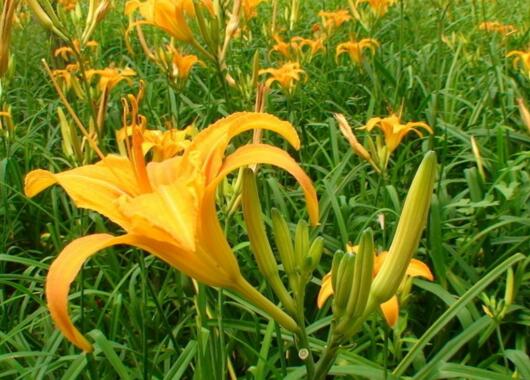
Before learning how to grow daylilies, we need to first know what kind of environment they like. Daylilies like soil rich in humus with good drainage, and they like moist, warm environments, but they are extremely adaptable, tolerant of drought, cold, and semi-shade, so they are planted in both the north and the south.
How to Grow Daylilies
1. Soil
Although daylilies do not have high soil requirements, if you want them to grow more robustly, the soil should preferably be sandy soil with more humus, loose, and with good drainage and aeration. If conditions permit, you can use a mix of leaf mold, garden soil, and river sand.
2. Temperature
Daylilies are relatively cold-tolerant and heat-tolerant. They can be grown in the open field in North China and overwinter successfully, which shows their adaptability to temperature. However, they grow fastest at 15-25 degrees, so if you want them to grow well, keeping the temperature around 20 degrees is best.
3. Light
Daylilies like sunlight and can also grow normally in semi-shade, so if conditions permit, you can place them in full sun, or manage them in a ventilated semi-shady spot.
4. Fertilizing
Topdressing begins in the 2nd year after planting. The first time is when new shoots grow to about 10 cm, the second time is when trimming the flower scapes, and the third time is before the flowering period. Liquid fertilizer is mainly used, which can promote their growth and flowering, so in the cultivation methods and precautions for daylilies, fertilizing is very important.
5. Watering
Daylilies are relatively drought-tolerant, but they prefer moist environments, so during the growing season you can water according to climate changes. In the rainy season, reduce watering or do not water. In summer, water once every 3-5 days, just avoid the soil becoming too dry.
6. Pest and Disease Prevention
Common diseases of daylilies include leaf spot, leaf blight, rust, and so on. Common pests include red spiders, aphids, and so on. Keeping the environment clean, tidy, and ventilated, and fertilizing in a timely manner, improves their resistance to pests and diseases and can achieve good preventive effects.
Precautions for Growing Daylilies
1. When watering, never let waterlogging appear in the soil. If it does, check whether the soil drainage is good and drain the waterlogging promptly. In the rainy season, pay attention to soil moisture and avoid the roots being soaked in water for a long time.
2. Before reusing soil, pay attention to disinfection. You can water it with potassium permanganate, or leave it in the sun for a few days to ensure it contains no pathogens or insect eggs.
3. Before the flowering period, focus on supplementing phosphorus and potassium fertilizer. At the same time, you can also spray 0.2% potassium dihydrogen phosphate. It can make the flowers more brilliantly colored when blooming, make the flowers larger, and also extend the flowering period.
How to Grow Daylilies to Fill a Pot
In addition to doing the above points well, if you want daylilies to fill a pot, you should also prune them in a timely manner, because the root system of daylilies tends to move upward toward the soil surface year by year, so pruning should be combined with earthing up. At the same time, after the flowers fade, cut off the flower stems to avoid nutrient loss.
How to Grow Hemerocallis middendorffii: Propagation Precautions for Hemerocallis middendorffii
Hemerocallis middendorffii, also known as the Amur daylily, is a perennial herbaceous plant of the genus Hemerocallis in the Liliaceae family. It has special tolerance to alkaline soil and can serve as a rare greening material for oilfields and tidal flat areas. It can also be used to arrange various flower beds, road isolation strips, open forest grass slopes, and so on. Its dwarf growth habit can also be used as ground cover. Let's take a look at how to grow Hemerocallis middendorffii!
Morphological Characteristics of Hemerocallis middendorffii
Hemerocallis middendorffii has relatively short fleshy rhizomes, divided into fleshy roots and fibrous roots. The fleshy roots are spindle-shaped, and many fibrous roots grow on the fleshy roots. It has short rhizomes, basal leaves in two rows, and linear leaf blades about 30-45 cm long and 2-2.5 cm wide. The flower stems rise above the leaves and have branches above, with 2-4 small flowers, fragrant, large, with short pedicels and large triangular bracts. The corolla is funnel-shaped or bell-shaped to campanulate, with lobes curved outward, flowering from July to August. The capsule is oval, slightly with three blunt angles, about 2 cm long.
Growth Habits of Hemerocallis middendorffii
Hemerocallis middendorffii grows under forests at lower altitudes, in wetlands, meadows, or grasslands. It is highly cold-tolerant, tolerant of sufficient light, and also tolerant of semi-shade. It is not strict about soil, but soil with high humus content and good drainage and permeability is best, and it should be fertilized regularly during the growing season. In the north, the underground tubers need to be dug up before frost and stored in an environment at about 5°C. The optimum temperature for open-field cultivation is 13-17°C. It resists infection by pests and diseases and has strong tolerance to noise and dust.
Propagation Methods of Hemerocallis middendorffii
1. Division: When dividing, dig up part of the clump's tillers as seedlings. The dug portion must have roots. Cut it apart from the shortened stem, remove old roots, decayed roots, and diseased roots, retain the fleshy roots as much as possible, shorten them appropriately, and then plant. Planting should be done on a sunny day, digging, dividing, and planting seedlings all at once, injuring the roots as little as possible, so that they recover quickly. Generally divide once every 2 to 3 years to ensure vigorous growth of the plants.
2. Sowing: Hemerocallis middendorffii enters the seed collection period around September each year and is sown the following spring. The seedbed should first be given sufficient base fertilizer. The bed width is 1.3 to 1.7 m and the length is about 30 m, with drainage ditches dug on both sides. When sowing, open shallow furrows about 3 cm deep every 20 cm, sow the seeds evenly into the furrows, cover with a layer of fine soil, and then spread a thin layer of fine sand. Before emergence, water and weed, maintain good soil moisture, and in autumn the seedlings can be lifted and planted.
3. Division of buds: Flower buds refer to the small plants on the flower stems of Hemerocallis middendorffii. They can be cut from the flower stems. If they are relatively large, they can be further divided before planting. After transplanting, the flower buds can take root after one week. Rooted flower buds can be used to propagate plants, increasing the number planted and ultimately improving economic benefits.
4. Tissue culture: Use tender leaves, filaments, flower scapes, and other organs to cultivate plants. The method is to first induce the tender organs to produce callus tissue, then use an appropriate medium under suitable conditions of temperature, humidity, light, and air to cultivate young plantlets. Then false-plant the young seedlings in nutrient pots, cultivate them for a period into plant seedlings, and then plant them in place.
Cultivation Methods of Hemerocallis middendorffii
1. Planting: Hemerocallis middendorffii is not strict about soil and can grow normally even in saline-alkali land, gravel land, and so on, but soil with high humus content, deep soil layers, superior irrigation conditions, and good drainage and permeability is best. When preparing the land, apply a certain amount of organic fertilizer, then level, harrow finely, and make beds. The bed width is 2-3 m for easy management. Open furrows or dig holes for planting. Planting should not be too deep or too shallow, and the plant and row spacing should be kept at 30-40 cm. After planting, cover with soil, compact it, and water thoroughly.
2. Watering: During the entire growth and development period of Hemerocallis middendorffii, if the weather is not very dry, watering is generally unnecessary, but after spring sprouting, if soil moisture is insufficient, it will affect the number of flowers, so in spring-drought areas, water timely in spring. During the growing season, provide sufficient water and keep the soil loose and moist; otherwise, normal flowering and flower quality will be affected.
3. Fertilizing: Hemerocallis middendorffii should be topdressed timely starting from the 2nd year after planting, which has a relatively large effect on flowering that year. It is best to apply liquid fertilizer 3 times a year: the 1st time when new shoots grow to about 10 cm, the 2nd time when flower scapes are seen, and the 3rd time 10 days after flowering. Hemerocallis middendorffii has a long flowering period and a relatively large demand for nitrogen, phosphorus, and potassium. In addition to applying sufficient base fertilizer at planting (well-rotted cow manure or pig manure is suitable), it should also be fertilized according to the needs of different developmental stages.
4. Weeding: After Hemerocallis middendorffii is planted, to ensure normal growth of the seedlings, timely cultivation and weeding should be carried out. Weeding is generally divided into two methods: one is to use herbicides to remove weeds in the field, and the other is to loosen the soil mechanically or manually to remove weeds in the field.
5. Pests: Common diseases of Hemerocallis middendorffii include leaf spot, leaf blight, rust, anthracnose, and stem blight, among others. Pests mainly include red spiders, aphids, thrips, leaf miners, and so on. Use pesticides timely for control. For diseases, 75% chlorothalonil 800-fold solution can be sprayed for control, and for pests, 3000-fold Imidacloprid can be sprayed for control.
Cultivation Methods of Hemerocallis middendorffii
Hemerocallis middendorffii, also known as the Amur daylily, is a perennial herbaceous plant of the genus Hemerocallis in the Liliaceae family. It has special tolerance to alkaline soil and can serve as a rare greening material for oilfields and tidal flat areas. It can also be used to arrange various flower beds, road isolation strips, open forest grass slopes, and so on. Its dwarf growth habit can also be used as ground cover. Let's take a look at how to grow Hemerocallis middendorffii!
Morphological Characteristics of Hemerocallis middendorffii
Hemerocallis middendorffii has relatively short fleshy rhizomes, divided into fleshy roots and fibrous roots. The fleshy roots are spindle-shaped, and many fibrous roots grow on the fleshy roots. It has short rhizomes, basal leaves in two rows, and linear leaf blades about 30-45 cm long and 2-2.5 cm wide. The flower stems rise above the leaves and have branches above, with 2-4 small flowers, fragrant, large, with short pedicels and large triangular bracts. The corolla is funnel-shaped or bell-shaped to campanulate, with lobes curved outward, flowering from July to August. The capsule is oval, slightly with three blunt angles, about 2 cm long.
Growth Habits of Hemerocallis middendorffii
Hemerocallis middendorffii grows under forests at lower altitudes, in wetlands, meadows, or grasslands. It is highly cold-tolerant, tolerant of sufficient light, and also tolerant of semi-shade. It is not strict about soil, but soil with high humus content and good drainage and permeability is best, and it should be fertilized regularly during the growing season. In the north, the underground tubers need to be dug up before frost and stored in an environment at about 5°C. The optimum temperature for open-field cultivation is 13-17°C. It resists infection by pests and diseases and has strong tolerance to noise and dust.
Propagation Methods of Hemerocallis middendorffii
1. Division: When dividing, dig up part of the clump's tillers as seedlings. The dug portion must have roots. Cut it apart from the shortened stem, remove old roots, decayed roots, and diseased roots, retain the fleshy roots as much as possible, shorten them appropriately, and then plant. Planting should be done on a sunny day, digging, dividing, and planting seedlings all at once, injuring the roots as little as possible, so that they recover quickly. Generally divide once every 2 to 3 years to ensure vigorous growth of the plants.
2. Sowing: Hemerocallis middendorffii enters the seed collection period around September each year and is sown the following spring. The seedbed should first be given sufficient base fertilizer. The bed width is 1.3 to 1.7 m and the length is about 30 m, with drainage ditches dug on both sides. When sowing, open shallow furrows about 3 cm deep every 20 cm, sow the seeds evenly into the furrows, cover with a layer of fine soil, and then spread a thin layer of fine sand. Before emergence, water and weed, maintain good soil moisture, and in autumn the seedlings can be lifted and planted.
3. Division of buds: Flower buds refer to the small plants on the flower stems of Hemerocallis middendorffii. They can be cut from the flower stems. If they are relatively large, they can be further divided before planting. After transplanting, the flower buds can take root after one week. Rooted flower buds can be used to propagate plants, increasing the number planted and ultimately improving economic benefits.
4. Tissue culture: Use tender leaves, filaments, flower scapes, and other organs to cultivate plants. The method is to first induce the tender organs to produce callus tissue, then use an appropriate medium under suitable conditions of temperature, humidity, light, and air to cultivate young plantlets. Then false-plant the young seedlings in nutrient pots, cultivate them for a period into plant seedlings, and then plant them in place.
Cultivation Methods of Hemerocallis middendorffii
1. Planting: Hemerocallis middendorffii is not strict about soil and can grow normally even in saline-alkali land, gravel land, and so on, but soil with high humus content, deep soil layers, superior irrigation conditions, and good drainage and permeability is best. When preparing the land, apply a certain amount of organic fertilizer, then level, harrow finely, and make beds. The bed width is 2-3 m for easy management. Open furrows or dig holes for planting. Planting should not be too deep or too shallow, and the plant and row spacing should be kept at 30-40 cm. After planting, cover with soil, compact it, and water thoroughly.
2. Watering: During the entire growth and development period of Hemerocallis middendorffii, if the weather is not very dry, watering is generally unnecessary, but after spring sprouting, if soil moisture is insufficient, it will affect the number of flowers, so in spring-drought areas, water timely in spring. During the growing season, provide sufficient water and keep the soil loose and moist; otherwise, normal flowering and flower quality will be affected.
3. Fertilizing: Hemerocallis middendorffii should be topdressed timely starting from the 2nd year after planting, which has a relatively large effect on flowering that year. It is best to apply liquid fertilizer 3 times a year: the 1st time when new shoots grow to about 10 cm, the 2nd time when flower scapes are seen, and the 3rd time 10 days after flowering. Hemerocallis middendorffii has a long flowering period and a relatively large demand for nitrogen, phosphorus, and potassium. In addition to applying sufficient base fertilizer at planting (well-rotted cow manure or pig manure is suitable), it should also be fertilized according to the needs of different developmental stages.
4. Weeding: After Hemerocallis middendorffii is planted, to ensure normal growth of the seedlings, timely cultivation and weeding should be carried out. Weeding is generally divided into two methods: one is to use herbicides to remove weeds in the field, and the other is to loosen the soil mechanically or manually to remove weeds in the field.
5. Pests: Common diseases of Hemerocallis middendorffii include leaf spot, leaf blight, rust, anthracnose, and stem blight, among others. Pests mainly include red spiders, aphids, thrips, leaf miners, and so on. Use pesticides timely for control. For diseases, 75% chlorothalonil 800-fold solution can be sprayed for control, and for pests, 3000-fold Imidacloprid can be sprayed for control.