What to Do When Pennywort Leaves Turn Yellow? Master Four Key Details to Make the Leaves Green Again
Under normal conditions, pennywort is an evergreen plant year-round, but some growers find that their pennywort leaves turn yellow, which not only makes the overall plant shape look unattractive but may also affect the plant's growth. What should you do if pennywort leaves turn yellow? Let's look at the specific causes and solutions together.
What to Do When Pennywort Leaves Turn Yellow
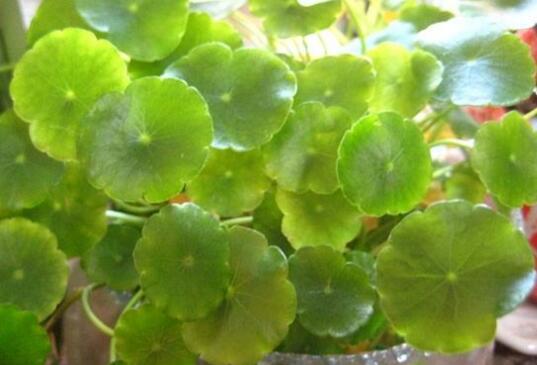
The causes of yellowing leaves fall mainly into two categories: environmental factors and cultivation methods. Yellowing caused by environmental factors mainly shows as yellow-brown leaves near the soil and lusterless leaves at the top; improper cultivation methods show as overall yellowing of the leaves. Both situations require prompt handling.
1. Incomplete watering
[Cause of yellowing]: Each time you water, you only give a half-measure of water, stopping as soon as no water flows from the drainage holes at the bottom of the pot. The surface of the soil is moist while the lower layer is dry, so the roots do not absorb enough water, and the pennywort leaves then turn yellow.
[Solution]: Watering should be thorough. The way to judge is to check whether water seeps out of the drainage holes at the bottom; if it does, the soil is fully moistened.
2. Poor lighting
[Cause of yellowing]: Pennywort likes a semi-shaded environment, but sometimes the branches and leaves grow too densely, so the leaves near the soil do not get enough light and turn yellow, while the lusterless leaves at the top are caused by the plant as a whole lacking light.
[Solution]: What should you do when pennywort leaves turn yellow due to poor lighting? The answer is to increase light, but do not move the pennywort directly into the sun. Instead, expose it to diffused light for 3-4 hours each day.
3. Poor ventilation
[Cause of yellowing]: Pennywort likes a moist and warm environment and has certain requirements for air humidity. If ventilation is poor, the air becomes too dry and the environment stuffy and hot, so yellowing and dropping leaves become a natural occurrence.
[Solution]: Ensure good ventilation in the environment and increase air circulation, which helps control temperature and raise humidity. If the humidity is too low, spray water on the leaf surface.
4. Temperature too low
[Cause of yellowing]: In our guide to growing pennywort, we mentioned that its cold tolerance is relatively weak, so people often move it indoors in winter. But some growers move it outdoors into the sun before the temperature has risen again, and the leaves turn yellow because the temperature is too low.
[Solution]: Pay attention to changes in ambient temperature. In winter, try not to keep pennywort outdoors; you can place it by a window to receive sunlight, but be sure to keep it well insulated.
The ultimate solution
If many pennywort leaves have turned yellow, you can adopt a simple and effective solution: divide and replant. Take the plant out of the pot, separate it with a tool, and plant the daughter plants in new potting soil respectively, so the pennywort regains its vitality.
What to Do When Pennywort Leaves Turn Yellow; Pennywort's Benefits and Functions
Pennywort has a peculiar form and ornamental value, and it also has many benefits and functions, so many people grow it at home. However, pennywort can also develop yellow leaves during cultivation. What should we do? Today, let's talk about solutions for yellowing pennywort leaves, as well as pennywort's benefits and functions.
What to Do When Pennywort Leaves Turn Yellow
1. Giving "half-measure water," that is, watering not thoroughly, without watering until seepage appears at the bottom of the pot.
2. Exposure to cold in winter, with the root system already frostbitten.
3. After overwintering, being in a hurry to move it outdoors and placing it in a warm spot to sunbathe, so it temporarily cannot adapt to the sudden climate change.
4. The potting soil being wet or dry for a long time, failing to water as soon as it dries.
5. Being placed long-term in an environment with poor ventilation.
6. The leaf surface not being sprayed and cleaned for a long time, with dust accumulating and hindering photosynthesis.
7. Lack of potassium; just add an appropriate amount of plant nutrient solution.
Pennywort's Benefits and Functions
1. Ornamental value
Pennywort is a perennial emergent or hygrophytic herbaceous plant, with a plant height of 5-15 cm, small and exquisite. Its submerged leaves have long petioles, are round-shield-shaped, with wavy margins, and grass-green. Pennywort's flowers are umbels, small and pinkish-white. Its stem nodes are distinct, one segment after another, with one leaf growing at each node, and it can extend continuously. Pennywort's underground creeping stems grow astonishingly fast, spreading wherever they reach, and it is not strict about water quality; it can be cultivated in freshwater with lower hardness. It is one of the beautiful and easy-to-grow aquatic plants, with extremely high ornamental value.
2. Home decoration
Pennywort is an evergreen, distinctive small aquatic plant that is easy to cultivate and manage, and it also pairs well with many home decor styles. For example, if used to match a Chinese-style decor that advocates harmony and elegance and emphasizes symmetrical beauty, you can cultivate pennywort in an oval pot carved with blue patterns, making the home appear more elegant. Chinese ornamental plants emphasize "observing its leaves, appreciating its form." Pennywort has a peculiar form, with leaves resembling copper coins, so round and lovely, symbolizing wealth and reunion. Integrating a meaning loved by Chinese people, it also gives the home a touch of prosperity.
If it is a concise and bright modern minimalist style, cultivating pennywort in a round transparent glass container is both fresh and bright and shows off personality, adding much artistic flavor to your home. If it is a natural, rustic home style, there is even less need to say more: pennywort, distinctive and emerald green, appears even more natural, fresh, and refined. Pennywort is a great partner for home style pairing. Hurry and add a pot of pennywort to your home, making your home show its style even more.
3. Air purification
Pennywort is not strict about water quality and can be cultivated in freshwater with lower hardness. In warm regions it can be potted outdoors and is suitable for water trays, aquariums, ponds, and wetlands, and for indoor water greening. It can purify water quality, and pennywort's green leaves can purify indoor air, which is beneficial to the indoor environment.
4. Feng shui effect
In Chinese culture, attention is paid to meanings and homophones. Pennywort has round leaves, like mini lotus leaves, quite lovely, and like ancient copper coins, symbolizing reunion and continuous good fortune. Moreover, its name carries the two characters "copper" and "coin," symbolizing wealth and implying that the home has copper coins and rolling wealth. Therefore, pennywort is regarded as a symbol of wealth, so from the perspective of meaning, it also implies good feng shui along with money. Thus, growing pennywort at home has symbolic meaning and avoids the vulgarity of using golden copper coin decorations, while pennywort's special shape also shows a sense of nobility.
5. Medicinal value
The rhizomes and leaves of pennywort can be used as a vegetable dish, and can also be used as Chinese medicinal material to dispel wind, firm the intestines, and clear the eyes and relieve summer heat. Pennywort is slightly cold in nature and bitter and pungent in taste; the whole plant can be used as medicine and has effects such as clearing heat, removing dampness, detoxifying, promoting urination, and reducing swelling. Pennywort can also be used for damp-heat jaundice, heatstroke diarrhea, strangury with sand and blood, carbuncle swelling and sore toxin, and injuries from falls.
The above is the relevant knowledge introduced for everyone about pennywort cultivation, benefits, and functions. We hope it can help everyone. For more home knowledge, please stay tuned.
What to Do When Cuban Oregano Leaves Turn Yellow: Four Methods to Prevent Leaves from Wilting and Turning Yellow
The most attractive part of Cuban oregano (Plectranthus amboinicus) is its leaves. The fleshy leaves have fine glandular hairs, and touching them with your fingers releases an even stronger fragrance. But all of this requires the leaves to be healthy and emerald green. If the leaves turn yellow, the ornamental value is much worse. So what should you do when Cuban oregano leaves turn yellow? Let's look at the causes and solutions.
What to Do When Cuban Oregano Leaves Turn Yellow
1. Improper watering
Some plants are relatively tolerant of water and moisture; for example, pennywort can grow soaking in water. But Cuban oregano prefers a relatively dry environment. If you water too much, it will cause the roots of Cuban oregano to rot, and then cause the leaves to turn yellow. And not watering for a long time will likewise cause yellowing due to lack of water.
Solution: Adopt a watering strategy of "water when dry, stop when wet." Each time you water, water when you see the soil has dried, and when you see the soil is moist, reduce or stop watering. For the method, you can refer to the detailed introduction in "How to Water Cuban Oregano."
2. Lack of light
Cuban oregano especially likes places with ample sunlight; this is because it has the characteristics of a succulent plant. Only when there is ample light will the leaves be thicker and emerald green; otherwise they will be thin and weak and turn yellow.
Solution: What should you do when Cuban oregano leaves turn yellow due to lack of light? The answer is to increase light. You can place Cuban oregano in the sun for care, but in midsummer pay attention to the temperature; if the temperature is too high, provide appropriate shade.
3. Enclosed environment
Many growers keep Cuban oregano indoors and like to keep doors and windows closed for a long time, resulting in a relatively enclosed environment with insufficient air circulation. Especially in summer, this leads to excessively high temperatures, so yellowing leaves are only reasonable.
Solution: Usually pay attention to opening windows to keep air circulating and increase the ventilation of the environment. This not only lets Cuban oregano breathe fresh air but also reduces the harm of pests and diseases, and is also more beneficial to people's health.
4. Insufficient nutrients
Generally speaking, growing Cuban oregano does not require frequent fertilizing, but some growers do not fertilize even once in 1-2 years, resulting in a real lack of nutrients in the soil. In particular, nitrogen and phosphorus, which are components of chlorophyll, will be severely deficient, leading to yellowing and dropping leaves.
Solution: What should you do when Cuban oregano leaves turn yellow due to insufficient nutrients? Replace the soil promptly, and afterward fertilize 1-2 times each month, mainly with liquid fertilizer. Commonly used compound fertilizer can provide multiple elements such as nitrogen, phosphorus, and potassium. Just do not let the phenomenon of long-term lack of fertilizing occur again.