How to grow four o'clock flowers and key points to note: temperature is crucial
As everyone knows, four o'clock flowers (Mirabilis jalapa) have many uses and benefits: their seeds can clear acne and beautify the skin, their roots can clear heat and detoxify, and so on. But to bring these benefits into play, the plant must grow healthily. So how do you grow four o'clock flowers? Let's look at how to grow them and the key points to note.
Growth habits of four o'clock flowers
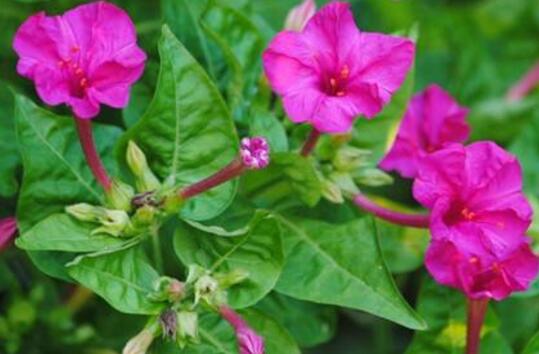
Before figuring out how to grow four o'clock flowers, you need to know their growth habits. Four o'clock flowers are plants that like a warm, humid environment. They have weak cold tolerance; if winter temperatures are low, the above-ground parts may die back. They like semi-shaded conditions and cannot tolerate high heat, prefer fertile soil, and have average demands for fertilizer and water.
How to grow four o'clock flowers
1. Light
Four o'clock flowers need enough light to grow, but the best lighting condition is a spot with a little shade. They fear direct strong light; too much light causes the leaves to drop, and the flowers close up under strong light, which really hurts their looks.
2. Temperature
Four o'clock flowers have weak cold tolerance. In winter, if the temperature is not controlled, their above-ground parts are easily frostbitten. In southern regions, their underground parts can overwinter safely and become a perennial herbaceous flower, sprouting new plants in the following spring.
3. Soil
Four o'clock flowers require fertile, loose soil with good drainage, and good drainage is especially critical. It lets the roots absorb nutrients more efficiently when watering and fertilizing. In addition, you need to pay attention to the health and safety of the soil.
4. Watering
Among the ways to grow four o'clock flowers and the points to note, four o'clock flowers do not have high water demands. They are fairly drought-tolerant plants; you only need to supply water when temperatures are high, and at other times just keep the soil slightly moist rather than too dry.
5. Fertilizing
Four o'clock flowers need some fertilizer to grow. Usually, when planting them out, you should apply some base fertilizer at the bottom of the pot, and during the growing season apply an organic liquid fertilizer once or twice a month to promote the growth of stems and leaves and produce more flower buds.
Key points to note when growing four o'clock flowers
1. Do not overwater
Never overwater. The principle is to avoid standing water inside the soil, otherwise it very easily causes the roots of four o'clock flowers to rot, which not only affects their growth but also affects the medicinal value of their roots, and may also lead to diseases such as root rot.
2. Keep them warm in winter
In the south, four o'clock flowers can be grown as a perennial plant, but only if the temperature is kept above 5°C so they can overwinter successfully. In the north, you can dig up the old roots in late autumn, then keep them at 5°C to overwinter, and plant them outdoors again the following year.
3. Scientific propagation
Propagating four o'clock flowers is very simple. They can self-sow: once the seeds fall to the ground, you will see large patches of new four o'clock flower plants come up the following year. But if you want to propagate them by hand, the usual method is cuttings.
Pest and disease control for four o'clock flowers: four simple control methods, with prevention being key
Generally speaking, four o'clock flowers do not often suffer from pests and diseases, but if you see yellowing leaves, wilting, irregular spots and so on, it may signal that four o'clock flowers have been infected by pests or diseases. At this point, growers need to act promptly, otherwise the whole four o'clock flower plant may die. Today we introduce several common pest and disease control methods for four o'clock flowers.
Pest and disease control for four o'clock flowers
1. Leaf roller
It feeds on the leaves of four o'clock flowers. When the leaf roller appears, the leaves wilt and fall early, causing insufficient photosynthesis in the four o'clock flower. Although the plant may still bloom, there will be fewer flowers and the colors will be less vivid, so it must be eliminated promptly.
To get rid of leaf rollers, a 50% fenitrothion emulsifiable concentrate spray is generally used. After eliminating the leaf rollers, you also need to follow the growing methods for four o'clock flowers and care for them well, keeping the environment ventilated and paying attention to fertilizing and watering, to prevent pests such as leaf rollers from appearing again.
2. White grubs
Among the pest and disease problems of four o'clock flowers, white grubs mainly harm the roots, causing the roots of four o'clock flowers to rot, which creates problems with nutrient uptake by the roots, so the plant grows rather slowly.
If there are few white grubs, you can take advantage of their phototaxis and use a black light trap to lure and kill them. But when large numbers of white grubs appear, you need to use chemicals for control; generally carbaryl powder or phorate granules are used to eliminate white grubs.
3. Peach fruit borer
The seeds of four o'clock flowers are very valuable, but the peach fruit borer causes fatal damage to them. It feeds on the fruit, harming the health of the seeds, so their medicinal and cosmetic value is reduced, and it must be controlled promptly.
The peach fruit borer generally appears when humidity and temperature are high, so you should lower the humidity and temperature, and at the same time spray with a 3000-fold dilution of 3% high-penetration fenoxycarb emulsifiable concentrate. After that, you need to pay attention to managing the environment.
4. Leaf spot
Leaf spot is one of the most common diseases of four o'clock flowers. It is mainly caused by fungi, and its occurrence is related to the environment, watering and fertilizing, such as temperatures that are too high, too much watering causing standing water, too little fertilizing and so on. It harms the leaves of four o'clock flowers, causing partial localized death of some leaves.
When leaf spot appears, spray with an 800-fold dilution of 75% chlorothalonil wettable granules, generally once a week, and it takes effect after 2-3 applications. In everyday care, you need to apply additional phosphorus and potassium fertilizer to improve its resistance to leaf spot.
What are the benefits of Gerbera daisies? Growing methods for Gerbera daisies
Gerbera daisy: (scientific name: Gerbera jamesonii Bolus) is a perennial herbaceous plant in the Asteraceae family, also known as African daisy, Barberton daisy, Transvaal daisy and so on. It is propagated by seed or division. The plant is 30-45 cm tall, with a short rhizome surrounded by the remnants of leaf stalks, and most leaves are basal and pinnately lobed. It has relatively thick fibrous roots and terminal flower heads. The flowers are large, with colors including red, white, yellow, orange, purple and so on. The colors are rich, and management is labor-saving. In warm regions it can be supplied year-round. It is an important material in modern cut flowers, used for flower arrangements and making flower baskets, and can also be grown as a potted ornamental.
The main types can be divided into modern cut-flower types and dwarf cultivated types. It originated in South Africa and was later introduced to the United Kingdom; it is now widely cultivated around the world. It is said that Gerbera daisies can also change the home environment. Let's take a look below at how Gerbera daisies change the home environment and how to grow them.
Introduction to the Gerbera daisy
1. The appearance of the Gerbera daisy. Many small, pointed petals surround a sun-shaped center, and the soft center is full of yellow, red or pink and so on -- a very lovely look. It is a perennial herb in the Asteraceae family, with fine hairs all over the plant, and most leaves are basal and pinnately lobed. The flower heads are solitary, the plant is 30-45 cm tall, the leaves are basal, the leaf stalks are long, and the leaf blades are oblong-spatulate, pinnately lobed or deeply lobed. The flower heads are solitary and rise 20-40 cm above the leaves, with a flower diameter of 10-12 cm, an involucre that is disc-shaped and bell-shaped, and ligulate petals in 1-2 or multiple whorls in a double form. The flower colors include bright red, orange-red, light red, yellow and so on. It usually blooms in all four seasons, with the strongest bloom in spring and autumn.
2. It needs appropriate temperature, humidity and pH. The Gerbera daisy is a perennial evergreen herbaceous plant, and there are about 45 species in the same genus. It likes warm winters and cool summers, circulating air and a sunny environment; it is not cold-tolerant and dislikes intense heat. It likes fertile, loose, well-drained sandy loam rich in humus, dislikes heavy clay soil, and prefers slightly acidic soil, with the optimal growing pH being 6.0-7.0. The optimal growing temperature is 20-25°C, the optimal winter temperature is 12-15°C, and growth stops below 10°C. It is a semi-cold-tolerant flower and can endure short periods of 0°C.
2. It is a flower full of poetry. The Gerbera daisy is also known as the fringed gentian flower (Fulang flower), symbolizing mutual respect and love, perseverance, and fearlessness of hardship. In some regions, people like to use Fulang flowers to make bouquets to decorate the bridal room at wedding celebrations. Taking its homophonic meaning, it expresses the mutual respect and love of newlyweds. The Gerbera daisy has a radiating flower shape and is often used as the main subject in flower arrangements, often paired with sword ferns and asparagus ferns. At the same time, it also represents mystery, excitement, perseverance, elegance, reclusion and nobility. Its flower language is passion and eternal happiness.
3. It has many varieties, each with its own characteristics. Gerbera daisy varieties can be divided into three categories: narrow-petal type, wide-petal type and double-petal type. Common ones include Marleen: yellow double-petal; Delphi: white wide-petal; Helios: vermilion wide-petal; Carmen: deep rose-red wide-petal; Kitty: rose-red petals with a black center. Currently, varieties with black centers are especially popular.
4. Its name comes from a legend. In the early 20th century, Madagascar, located in southern Africa, was a small country rich in tropical flowers and plants. There was a local girl named Slangyini who, from childhood, loved this kind of wildflower with slightly curved stems and drooping flowers. When she married, she asked for more of them to be arranged in the hall to add to the wedding atmosphere. Relatives and friends from all sides sang and danced, toasting each other again and again. Unexpectedly, the bridegroom, who could not hold his liquor, became drunk after only three rounds of drinks. He hung his head and bent over, leaning this way and that, and the bride had to help him into the bedroom to rest. Seeing this supporting posture, everyone thought how similar it was to the growth habit of that wildflower, and many girls said in unison: "Oh, the flower really looks like one supporting a man!" From then on, the name Fulang flower spread far and wide.
The benefits of Gerbera daisies for the home environment
1. It can regulate indoor temperature: when the temperature is high, it can lower it, and when the temperature is low, it can raise it. In the hot summer, the Gerbera daisy carries out respiration, taking in carbon dioxide carrying heat from the air and then releasing oxygen. In this process, it absorbs part of the heat, lowering the overall indoor temperature. In winter, whether indoors or outdoors, it is very cold. The Gerbera daisy carries out respiration, and during respiration it produces heat, driving up the temperature of the whole home and providing insulation.
2. Its role in beautifying the home cannot be ignored. The Gerbera daisy, also known as African daisy, Barberton daisy, Transvaal daisy and so on, is a perennial herbaceous plant with terminal flower heads, and the flower colors include red, white, yellow, orange, purple and so on. With so many bright, eye-catching colors, if planted together in one home, the home becomes colorful and extremely beautiful. Potted Gerbera daisies are often used to decorate doorways and halls, and their cut flowers are used in vases and flower arrangements to adorn desks, display windows and living rooms. With pink Gerbera daisies as the main flower, paired with dendrobium, gypsophila and orchid leaves, the tone is elegant and the mood is rich. If red Gerbera daisies are used as the main flower, paired with sword ferns, palm bamboo leaves, dried branches and dyed walnuts for wall decoration, it can produce a strong decorative effect.
3. Gerbera daisies can indicate light and ventilation conditions. Human living environments and plant growth needs have a certain degree of similarity. The Gerbera daisy is a light-loving plant, so choose a spot with ample light for cultivation. Seedlings should not be planted too deep; the root buds need to be exposed above the soil surface. If light is insufficient, the flower stalks become soft and droop, and cut flower quality is not high. Gerbera daisy colors become dark and dull during the peak summer period, especially under drought and water shortage conditions, while flowers that bloom during the suitable-temperature period of September-October or March-June of the following year are brightly colored. This shows that the Gerbera daisy is relatively sensitive to temperature and light intensity. In summer, keep the soil moist and not drought-stressed, cover with a shade net with 50% light transmission, and spray the leaves to increase air humidity and lower the temperature. In winter, do good insulation work and protect from freezing, with nighttime temperatures not below 10°C and daytime temperatures not below 15°C. These are all very beneficial for improving the vividness of Gerbera daisies. In addition, mites are a major enemy in Gerbera daisy cultivation. Once harmed, they not only lose their vividness but the petal shapes also become incomplete. Observing the growth of Gerbera daisies can always bring us some help in life.
The feng shui benefits of Gerbera daisies
1. Gerbera daisies can promote romance for women. The bedroom is probably the most important space for changing a woman, especially when in love, when most overthinking happens in the bedroom. Love feng shui requires confirming the bedroom arrangement. For example, placing a fresh, long-lasting Gerbera daisy at the head of the bed, with a fragrance that is pleasant and does not easily fade, can encourage oneself.
2. Gerbera daisies can promote family harmony. Like sunflowers, Gerbera daisies are flowers that represent the sun in everyone's mind, except that the latter is tall and mighty while the former is elegant and upright. If the sunflower is the blazing sun of summer, then the Gerbera daisy is like the warm sun of winter, making people feel cozy. Someone once advocated using the Gerbera daisy as the flower representing Father's Day, because the Gerbera daisy is also called the sun flower, and the sun can also symbolize fatherly love. The feng shui effect of the Gerbera daisy, the saying that it can let a family live in harmony and love each other, comes from this.
3. For people whose Five Elements belong to fire, the Gerbera daisy is their lucky flower. Chinese feng shui holds that the types, attributes and placement positions of some plants can affect a person's fate. Plants also have yin-yang and Five Elements distinctions. Using them appropriately in different directions and environments can produce unexpected regulating effects. In geomancy, plants are considered to have spirituality and can help people in various aspects, so plants are often used to regulate the environmental energy field. There are many types of plants and their natures differ greatly, so there are many particular points when using them. Such plants are called feng shui plants. People whose Five Elements belong to fire should choose red as the main color, because red is the original color of fire, or choose the original color of wood, green, as the main color, because green wood generates and strengthens red fire. From a feng shui perspective, this can bring prosperity and good luck to the homeowner and their family. Of course, besides red, Gerbera daisies have many other colors, so the Gerbera daisy is a lucky star for many people. As the color of the Gerbera daisy changes, the group of people it blesses is different.
The benefits of Gerbera daisies
1. The Gerbera daisy is a beautiful plant, and its effect when used for home decoration is quite good. Potted Gerbera daisies are often used to decorate doorways and halls, and their cut flowers are used in vases and flower arrangements to adorn desks, display windows and living rooms. With pink Gerbera daisies as the main flower, paired with dendrobium, gypsophila and orchid leaves, the tone is elegant and the mood is rich. If red Gerbera daisies are used as the main flower, paired with sword ferns, palm bamboo leaves, dried branches and dyed walnuts for wall decoration, it can produce a strong decorative effect. At the same time, the Gerbera daisy is also known as the Fulang flower and originated in southern Africa. Its flowers are large and beautiful, with a charming appearance, and it is an important cut flower decorative material. Large red Gerbera daisies are used in bridal bouquets. Along with roses, gladiolus and carnations, it is listed among the world's best-selling "four major cut flowers."
2. Gerbera daisies can measure whether the indoor environment is good or bad. The Gerbera daisy is a light-loving plant, so choose a spot with ample light for cultivation. Seedlings should not be planted too deep; the root buds need to be exposed above the soil surface. If light is insufficient, the flower stalks become soft and droop, and cut flower quality is not high. From the growth of the Gerbera daisy, you can judge whether the light is sufficient.
Gerbera daisy colors become dark and dull during the peak summer period, especially under drought and water shortage conditions, while flowers that bloom during the suitable-temperature period of September-October or March-June of the following year are brightly colored. This shows that the Gerbera daisy is relatively sensitive to temperature and light intensity. In summer, keep the soil moist and not drought-stressed, cover with a shade net with 50% light transmission, and spray the leaves to increase air humidity and lower the temperature. In winter, do good insulation work and protect from freezing, with nighttime temperatures not below 10°C and daytime temperatures not below 15°C. These are all very beneficial for improving the vividness of Gerbera daisies. In addition, mites are a major enemy in Gerbera daisy cultivation. Once harmed, they not only lose their vividness but the petal shapes also become incomplete. The cause of root rot in Gerbera daisies is mostly root rot disease occurring in the roots, which is difficult to cure once it occurs. The external conditions that produce root rot are excessive moisture in the root soil, long-term standing water around the roots, or long-term rainfall in open fields, which can cause the death of Gerbera daisy plants. From the growth of the Gerbera daisy, you can see whether its roots are growing healthily, and from judging the roots you can infer the home environment.
3. Gerbera daisies also have quite a few benefits for greening the home. The Gerbera daisy is a perennial herb. Its leaves are pinnately deeply lobed. The flowers are solitary, with head inflorescences, and the flower stalks rise above the leaf cluster. Common varieties include the red "Passion," the yellow "Sun Dance," the white "Bianca" and so on. Miniature small-flowered types include "Ballroom" (white), "Ballet" (orange), "Sultan" (yellow), "Canga" (red) and so on. Growing one or two pots at home lets you feel the breath of nature and enjoy the fresh air released by the Gerbera daisy every day.
The role of Gerbera daisies in matching home styles
1. The flower language of the Gerbera daisy has an encouraging and blessing effect on the owner's life. The Gerbera daisy is also known as the Fulang flower, symbolizing mutual respect and love, perseverance, and fearlessness of hardship. In some regions, people like to use Fulang flowers to make bouquets to decorate the bridal room at wedding celebrations. Taking its homophonic meaning, it expresses the mutual respect and love of newlyweds. The Gerbera daisy has a radiating flower shape and is often used as the main subject in flower arrangements, often paired with sword ferns and asparagus ferns. At the same time, it also represents mystery, excitement, perseverance, elegance, reclusion and nobility. Its flower language is passion and eternal happiness. Its flower language all shows that the Gerbera daisy is a plant that loves life; while living firmly on its own, it also encourages everyone to love life.
2. Placed beside the TV or computer, it reflects a home style that yearns for health and loves nature. In a home, apart from the microwave, the places with the most radiation are in front of the TV and computer screens. When we look at computers and TVs for a long time, our eyes feel very tired. At this time, looking at the Gerbera daisy placed nearby is a kind of adjustment; the bright and natural colors make us feel comfortable and relaxed. Moreover, before the radiation reaches our eyes and skin and affects our brain's thinking, the Gerbera daisy has already absorbed part of the radiation, removing part of the harm. A healthy home life is created at this moment.
3. Placed in the living room, Gerbera daisies can match a noble home style. Flowers blooming in wealth and honor fully display luxury -- this is the European style. The European style pursues an elegant sense of luxury, and this kind of gorgeous space is very suitable for setting off with the many-flowered Gerbera daisy. Compared with plants of Chinese style that emphasize foliage, the European style emphasizes flower pots; indoor flowers are also mainly water-grown cut flowers. Close your eyes -- can you breathe in the rose scent beneath an English castle?
The Gerbera daisy comes from Africa, but it can do more than set off an African home style; it can also be paired with many different homes, and the more it is paired, the more wonderful it becomes.
Growing methods for Gerbera daisies
The diseases of Gerbera daisies are a bit different from those of ordinary flowers. Let's learn about them together!
1. When caring for Gerbera daisies, pay special attention to the diseases that may occur on them.
1. Phytophthora blight: The key control technique is that continuous cropping soil must be disinfected with Vapam and formaldehyde and so on; see the instructions for usage and dosage. Plant shallowly, with the root crown exposed 1 cm above the surface. Prevent the soil from being too wet; if soil taken from 10 cm below the surface does not form a ball when squeezed hard in the palm, then it can be watered. In the early stage of disease, when part of the leaves turn red and begin to wilt, drench the roots with a 400-fold dilution of 58% phosethyl-Al and mancozeb, then 7 days later drench the roots with a 500-fold dilution of 64% oxadixyl powder. Apply the pesticide in the early morning or evening when temperatures are low, and stop applying when the temperature is above 28°C. Apply once every 7 days, for 3 consecutive times.
2. Powdery mildew: The key control technique is to keep the greenhouse ventilated and low in humidity; promptly remove diseased leaves; when the disease occurs, spray with a 1500-fold dilution of 70% thiophanate-methyl, or use 20% fungicide smoke for fumigation control, applying once every 7 days for 2-3 consecutive times. In addition, use the sulfur fumigation method for control: put 20-30 g of sulfur powder into each fumigator, and after the curtains are lowered at 17:00 each day, keep the greenhouse sealed, turn on the electricity and heat for 2 hours, replace the sulfur powder every 6 days, and continue fumigating for 15 days. During the powdery mildew outbreak period, fumigate 8-10 h each day, and the powdery mildew can be eliminated in about 10 days.
3. Leaf spot disease: The key control technique is to promptly remove diseased leaves when found and destroy them in a concentrated way; in the early stage of disease, spray with a 300-fold dilution of 2.5% myclobutanil emulsifiable concentrate or an 800-**** fold dilution of 70% thiophanate-methyl wettable powder, spraying once every 7 days for 2-3 consecutive times.
4. Gray mold: The key control technique is that controlling humidity is the key to controlling gray mold. Thin out densely planted and overly crowded leaves; increase ventilation and air permeability, keeping air humidity at 75-85%; water from below the plant canopy; to prevent water vapor from condensing on the flowers, gradually open the side greenhouse covers after 10 a.m. on clear days, avoiding a sharp rise in temperature inside the greenhouse; in the early stage of disease, spray the leaves with a 1500-fold dilution of 70% thiophanate-methyl, and combine with smoke agents for control.
5. Whitefly: The key control technique is to thoroughly clear weeds; insert yellow sticky boards for monitoring at any time, and once pests are found, take measures promptly; choose good pesticides and use them correctly: whiteflies easily develop resistance to pesticides, so pesticides must be rotated. Effective pesticides include beta-cypermethrin, abamectin, imidacloprid and so on. Choose dawn for spraying, keep the greenhouse sealed for 4-5 hours after spraying, and spray once more continuously the next morning.
2. Temperature requirements. Use cultivation facilities to meet as much as possible the temperature requirements of Gerbera daisies during the seedling stage, growing stage and flowering stage, to facilitate normal growth and flowering. In China, outside the South China region, they cannot overwinter in the open field and need greenhouse cultivation; outside the Yangtze River basin, they can be cultivated in unheated greenhouses. In summer, a shade net needs to be covered over the greenhouse roof, and the plastic films on both sides of the greenhouse should be opened to lower the temperature. In winter, when the outdoor nighttime temperature approaches 0°C, seal the plastic film tightly, and plastic film must be added inside the greenhouse. On clear, warm days, open the film at the south end of the greenhouse around noon for ventilation for about one hour.
3. Light requirements. The Gerbera daisy is a light-loving flower and needs full light in winter, but in summer attention should be paid to appropriate shading and strengthening ventilation to lower the temperature and prevent high temperatures from causing dormancy.
4. Watering requirements. After planting out, the seedling stage should maintain appropriate moisture and control the seedlings to promote root development and rapid establishment. During vigorous growth, keep sufficient water supply, watering once every 3-4 days in summer and about once every half month in winter. When watering during the flowering period, be careful not to get water in the center of the leaf cluster, to prevent flower bud rot. When cultivating in the open field, pay attention to preventing waterlogging. In addition, watering can be combined with fertilizing.
5. Topdressing requirements. The Gerbera daisy is a fertilizer-loving perennial flower with high fertilizer demand; the ratio of nitrogen, phosphorus and potassium in fertilization is 15:18:25. When topdressing, pay special attention to supplementing potassium fertilizer. Generally, apply 2.5 kg of potassium nitrate per mu, and 1.2 kg of ammonium nitrate or ammonium phosphate, once every 5-6 days in spring and autumn, and once every 10 days in winter and summer. If high temperatures or relatively low temperatures cause the plant to enter a semi-dormant state, then stop fertilizing.