Four-season care methods for fuchsia: four techniques to keep it blooming continuously
We have emphasized the importance of care methods in our article on fuchsia pest and disease control. Good care techniques can protect fuchsia from many diseases and pests, and usually the methods need to be adjusted constantly with the changing seasons. Below, let us learn about the four-season care methods for fuchsia.
Four-season care methods for fuchsia
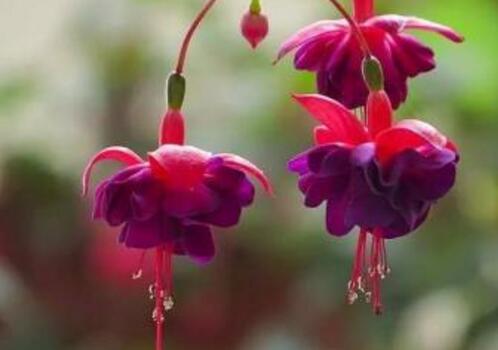
1. How to care for fuchsia in spring
1. Repotting and cuttings. Spring temperatures usually range between 15-25 degrees, which is not only the best growing period for fuchsia but also the most suitable time for many tasks, such as taking cuttings, repotting, pruning, and so on. If the plant is 2-3 years old, cuttings can be taken for propagation in spring, and while repotting, weak branches and rotten roots should be cut off.
2. Care and management. In early spring, fuchsia can be given plenty of sunlight, but it needs shade at noon. Water once every 5-10 days, following the principle of watering when dry and stopping when wet, and apply liquid fertilizer once every 15-20 days; if it is in the seedling stage, pinch out the tips in time, then keep the environment well ventilated.
2. How to care for fuchsia in summer
1. Shade and cooling. In summer, avoid direct sunlight on fuchsia and provide shade and cooling. It can be moved to a north-facing balcony to keep the environment cool.
2. Care and management. In the four-season care methods for fuchsia, summer is a very critical period. In this season, fertilization should be stopped, watering reduced, and rain exposure prevented to ensure that fuchsia gets through the hot summer smoothly.
3. How to care for fuchsia in autumn
1. Pruning. After the beginning of autumn, some old leaves of fuchsia will gradually turn yellow and wither, and flowers will hang on the branches after fading. At this time, dead branches and spent flowers need to be pruned off to reduce nutrient loss and prepare for successful overwintering.
2. Care and management. In the morning and evening, mainly provide scattered light. After late autumn, it can be cared for in a semi-light environment. In mid-October, move fuchsia indoors, and at this time you can also repot it.
4. How to care for fuchsia in winter
1. Keep warm. In winter, the first thing to do is keep fuchsia warm, so that the ambient temperature is at least above 5 degrees, avoiding frost damage to stems, leaves, and roots. If grown indoors, the temperature needs to be kept at 15-20 degrees.
2. Care. In winter, there is no need to fertilize fuchsia. Watering can be done once every half month, as long as the soil does not become compacted. The soil does not need to be too moist, and at the same time make sure there is sufficient light.
Four-season care methods for fuchsia
Spring care methods for fuchsia
In spring, place fuchsia on a south-, east-, or west-facing balcony.
In spring, sowing can be done when the temperature is 20°C. After sowing, when the seedlings grow 4 leaves, they can be transplanted into flower pots with a diameter of 9 cm. The potting soil is best chosen as soil rich in humus. After potting, water thoroughly, place in a shady spot, and let the seedlings recover for 1 week, then gradually expose them to light.
In early spring, give it sufficient light, and provide shade around noon in late spring. Watering should also follow the principle of watering when dry and stopping when wet. 5~10 days after potting, apply diluted liquid fertilizer twice. When the seedlings grow to 10 cm, pinch out the tips, and when the branches grow 3~4 nodes, pinch out the tips again. Keep 5~7 branches per plant so that the plant shape is full and it will bloom abundantly.
Summer care methods for fuchsia
In summer, place fuchsia on an east- or north-facing balcony.
In early summer, the flowers have just faded. At this time, pruning should be done in time to encourage new branch growth. From June to late September, move the flower pot to a cool, ventilated place, control watering, stop fertilizing, and frequently sprinkle water on the ground and spray water on the leaves to lower the temperature and increase humidity, so as to help it pass the summer safely. In fact, when the temperature is too high, fuchsia enters a semi-dormant state and grows slowly. As long as it is not exposed to scorching sun, it will continue to grow after summer.
Autumn care methods for fuchsia
In autumn, place fuchsia on a south-, east-, or west-facing balcony.
After the beginning of autumn, provide more scattered light in the morning and evening. After mid-autumn, gradually increase light. In late autumn, grow it under semi-light conditions to encourage lush branches and leaves and abundant, brightly colored flowers. In late August, prune again, cutting dead branches, dense or sparse branches, and overly long branches shorter, keeping only 3~5 cm on each side branch. After new buds sprout, choose 5~7 strong buds and cut off the rest. It will bloom again between October and November.
In northern regions, it can be moved indoors in mid-October, and repotted after being brought indoors. For repotting, take the plant out of the original pot, remove part of the old soil, cut off dead and weak branches and diseased branches, then plant it in a pot one size larger filled with new potting soil.
Winter care methods for fuchsia
In winter, place fuchsia on a south- or east-facing balcony.
Place it in a spot indoors with sufficient light and pay attention to ventilation. Keeping the room temperature above 5°C will allow it to overwinter safely. In rooms with heating equipment, keep the room temperature at 15~20°C, apply diluted fertilizer water once every half month, and keep the potting soil moist regularly; it can still continue to grow and bloom.
How to grow fuchsia? Techniques for fuchsia to bloom in all four seasons
Fuchsia is also called lady's eardrops and lantern flower. Its flower language is believing in love and having a passionate heart. The flower shape is very special, unique and beautiful, and it is a lush and abundantly blooming potted plant. The more you look at it, the more beautiful it becomes. It can bloom for more than half a year, and with suitable temperatures, it can even bloom all year round. How do you grow fuchsia?
1. To grow fuchsia, one branch is enough. Around April in spring, choose a healthy branch with about three nodes and two leaves, soak it in water for two days, then insert it into sandy soil. In just over a week, it can grow roots and sprout.
2. The planting time for fuchsia can be either spring or autumn. The soil for growing fuchsia is best made of sandy soil plus leaf mold and farmyard manure or animal manure. After planting, place it in a ventilated spot with scattered light, and it must not be exposed to rain.
3. Its growth speed and reproduction speed are both especially fast. Usually it cannot be placed in a spot prone to scorching sun and strong light. Although it needs frequent watering and spraying, the potting soil must not have standing water.
4. In summer, when the temperature is high, it needs to be placed in a relatively ventilated and shady spot not exceeding 30 degrees, and it must not be exposed to high temperatures and strong light. In winter, place it in a warm spot indoors, as long as it is not below 5 degrees.
5. The temperature suitable for its growth is around 20 degrees. During the growing period, apply thin fertilizer once every half month. Cake fertilizer, urea, or monopotassium phosphate. Then it will bloom especially abundantly, hanging all over the branches like little lanterns.
6. It generally blooms in April and continues blooming until December. After blooming, pinch out the tips in time, cut off spent flowers, and prune the branches; it will continue to produce new buds and leaves, especially beautiful.
7. When the winter temperature is below five degrees, move it indoors in time. If the temperature is suitable in a relatively warm place, it can also bloom in winter.
The above are a few suggestions shared by the editor. I hope they can be helpful to you. After all, an article is limited, and many detailed issues in the planting process still require you to continuously accumulate experience during planting and gradually master the techniques for growing fuchsia.