What to Do When Fuchsia Leaves Wilt? Four Tricks to Bring Them Back to Life
Under ideal conditions, the leaves of fuchsia should be green all year round, but due to changes in the environment and differences in growing methods, some flower lovers encounter wilting leaves, which not only prevents it from blooming but also signals poor growth. So what should you do when fuchsia leaves wilt? Let me tell you the solution.
What to Do When Fuchsia Leaves Wilt
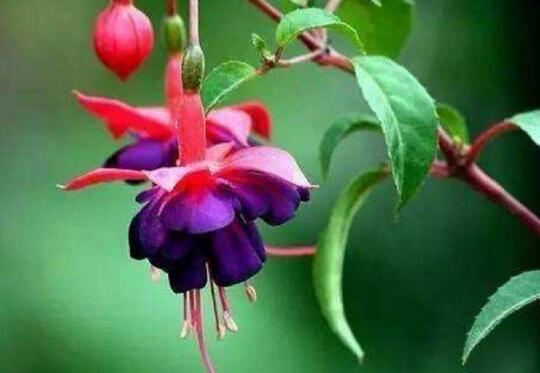
Research has found that the main causes of wilting leaves are: too high a temperature, lack of light, wind and rain, and too little fertilizer and water. So to solve the problem of fuchsia leaves wilting, you need to tackle these four aspects.
1. Too High a Temperature
We know that fuchsia fears stuffy, hot environments and is very sensitive to temperature changes. When the temperature rises slightly above 30°C, its leaves will wilt, and in severe cases the leaves will wither and drop, so measures must be taken promptly.
[Solution]: Help the fuchsia cool down and get ventilation. If it is grown outdoors, provide shade for it; if it is in a pot, move it to a cool, ventilated spot, such as a north-facing windowsill at home, and at the same time spray a small amount of water on the leaves and soil.
2. Lack of Light
Although fuchsia likes semi-shaded environments, its growth still requires enough light. If the environment is too shady, the leaves' photosynthesis will be hindered, leading to a lack of nutrients and wilting leaves, and the whole plant will look listless.
[Solution]: The most suitable place to grow fuchsia is somewhere with diffused light, such as a balcony that doesn't get direct sunlight. This not only avoids direct sunlight but also provides enough light. If conditions are limited, you can use fluorescent lamps to supplement the light.
3. Wind and Rain
Growing fuchsia requires keeping the environment ventilated, but you should not let it be constantly battered by strong winds, nor let it be washed by rain during the rainy season. Excessive humidity not only causes leaves to wilt but also triggers pests and diseases, making it a major taboo.
[Solution]: What should you do when fuchsia leaves wilt due to wind and rain? The answer is to reduce its exposure to wind and rain. You can shield it from wind and rain, but the most suitable method is to move it to another cool, ventilated environment to avoid being battered by rain during the rainy season.
4. Too Little Fertilizer and Water
Whether it is a lack of water or a lack of fertilizer, both will cause malnutrition in fuchsia, making wilting leaves and slow growth unavoidable. So when caring for fuchsia, you must fertilize scientifically and reasonably, and not let it go without fertilizer and water for long periods.
[Solution]: Replenish fertilizer and water in a timely manner. For methods, you can refer to the detailed introduction in "How to Water and Fertilize Fuchsia." The principle is to ensure smooth growth while avoiding root rot caused by too much fertilizer and water.
Balcony Gardening Diary - Early Spring
Spring has finally arrived with warm blossoms, and I mustered up the courage to tidy up the mess on the balcony that had accumulated all winter.
Because I only return to my home in Changzhou on weekends, most of the succulents, geraniums, hellebores, and bougainvillea have been moved to the company in Shanghai. The plants on the balcony have been pared down to just over twenty pots of easy-care varieties.
Only one bougainvillea was left, with green leaves and red flowers, the most ordinary variety, so it wouldn't be a pity if it died. Yet it has been surviving stubbornly all along. Seeing the weather warm up, I wanted to move it to the outer side of the balcony, but just as I lifted it out, the plastic pot broke. In the instant it fell, my heart leaped into my throat. Luckily, before I could even be frightened, the broken pot landed steadily on the ledge outside the railing. I should have repotted it long ago but kept putting it off out of laziness, so now I had no choice but to replant it.
It just so happened that a large red clay pot had become free. It had originally held an agave, bought 2 years ago from the Sansheng Township flower market in Chengdu when it was still a tiny seedling, carefully wrapped and brought home on a plane. It grew rapidly and soon became a large plant. Before the unusually cold winter arrived this year, I specially moved it back to the balcony with the windows tightly closed. Yet the cold-fearing bougainvillea made it through, and the nasturtium stayed lush and green, but this fellow somehow froze. When I came home from Shanghai before the Chinese New Year, I saw that its leaves had frozen into mush, though the core was still a bit green. Holding to the principle of never giving up hope, I kept it, hoping for the moment it would revive. However, it didn't appreciate the gesture and continued to rot hopelessly. I suppose its time had come. Today I finally tipped it out, and the whole pot was full of what had been robust roots. It really broke my heart.
The Agave That Once Was
The firestorm (Crassula capitella 'Campfire') was fine. It bloomed profusely in early winter and is still a big pot now.
What's left on the balcony are a few bulbs: grape hyacinths and hyacinths. The grape hyacinths rebloom every year, especially the blue variety. In autumn, before I even had a chance to plant them, they couldn't wait to sprout. The balcony has good sunlight, and despite all my efforts to shade them and build up the roots, the leaves shot straight up into a big pot of chive-like foliage, all disheveled. Today I moved them outside the window and already spotted several flower buds emerging. The bicolor and pink varieties are a bit more delicate, but fortunately they are sprouting smoothly too.
Last spring's grape hyacinths; the pink four-season primroses will be bought again in spring.
One hyacinth bulb has already bloomed. That one was a DIY project from the parent-child gardening activity with Ryan's classmates and their parents in November last year. Planted in a tiny pot almost the same size as the bulb. Is it the "green thumb" connection? I have to show off a bit: I barely took care of it, watered it no more than 5 times in total, and didn't even give it special sun, yet it produced a large cluster of flower spikes, blue-purple, in an especially neat form. When I posted it in the class group, another parent shared a photo too, with only a few flowers open. Actually, when growing hyacinths in such a small pot, it's best to plant them shallowly so the roots have room to grow in the small pot. Otherwise, like that parent who buried the whole bulb in the pot with no room for roots, the bulb can't absorb nutrients and naturally can't bloom properly.
The hyacinth photo sent by the parent.
The most flourishing plants on the balcony are those few pots of nasturtium, the two pots I originally brought from the yard in Shanghai. Every year I collect the seeds, sow them in autumn, and from early spring each year they bloom with an abundance of orange and yellow flowers. Nasturtium is quite suitable for balcony growing, very drought-tolerant, and I only water it once a week when I come home on weekends. Actually, moderate drought is better for its flowering. With moisture and plenty of fertilizer, it prefers to grow lush green leaves, which can be used in salads, with a very fresh and distinctive flavor, somewhat spicy, not everyone's cup of tea.
Let's not even mention the oxalis; it's a must-have plant for balcony gardening. Most of the varieties were taken to Shanghai. On the balcony there are still 'Tall Stem,' yellow jute, and Brazilian pink-white. In June I harvested a big pile of bulbs, and in September I specially brought home a lot of peat, but there still weren't enough pots, so many had to be crammed together, and some small bulbs were scattered into the pots of the bougainvillea and ivy, and they all sprouted too. Oxalis takes up relatively little space and can bloom abundantly. In the hottest summer you harvest the bulbs and just place them in a shady spot, and normally they need no extra care; it's fine even without fertilizing. I remember doing an activity with the elderly at the Xingbao Senior Apartment in Shanghai in October. I wonder how the oxalis they planted is growing.
Oxalis 'Tall Stem,' with the bulbs left in the asparagus fern's pot, grew into a big clump, trailing down, which actually looks quite nice.
Taking advantage of the rare enthusiasm brought by the warm spring breeze, I fertilized the violas and moved them outside the window. They'll soon be covered in flowers. The treasured variegated serissa with pink flowers and golden-edged leaves has been kept on the flower rack outside the Shanghai office. Work was too busy, and I neglected it, so it looked quite pitiful. Last week I brought it back to the balcony and fertilized it as well. I look forward to it recovering soon.
The serissa then and its current state
On the balcony there are still a handful of other plants: hoya, variegated ivy, and rainbow fern, with basically little change. Of course there are also a few pots of fuchsia, Christmas cactus, and cyclamen. In this weather they're fine, but I'm afraid summer will be dangerous for them. There's even a pot of aloe that didn't get frozen. Once again, my heart aches for that agave. There are also two pots of asparagus fern that nearly dried to death in summer, but their fleshy roots are tenacious; with just a little water, new shoots immediately emerged. I still love plants with such strong vitality. They make you feel that life goes on, and even in the harshest environment, they are always waiting for a chance to be reborn.
I moved the violas, grape hyacinths, and others outside the window. They say tomorrow the temperature will drop to zero again. Let them tough it out~~~
Gardening on a balcony is really much more troublesome than gardening in a yard. Daily watering, fertilizing, care, and pruning are secondary; the main issue is the light and ventilation on the balcony. Plants often die, leaving pots full of empty soil, which is quite discouraging. When the seasons change, you need to tidy up and repot, but the space is too small to rotate things around, and before you've done much, peat and fallen leaves are all over the floor. Cleaning up takes more time than planting. I can well understand the difficulties of promoting balcony gardening. Even as a veteran gardener like me, I still find balcony gardening quite troublesome, so for most balcony gardeners who are just starting out, it takes even more enthusiasm to keep going.