How to grow moss rose? Growing methods and precautions, it needs plenty of light
Moss rose is a flower native to Brazil. Because it blooms in sunlight and closes on cloudy days and in the evening, it is called moss rose. Moss rose is a common potted plant, but there are many things to pay attention to when growing it. About how to grow moss rose? What are the growing methods and precautions for moss rose? Below, the editor will take everyone through it.
I. How to grow moss rose
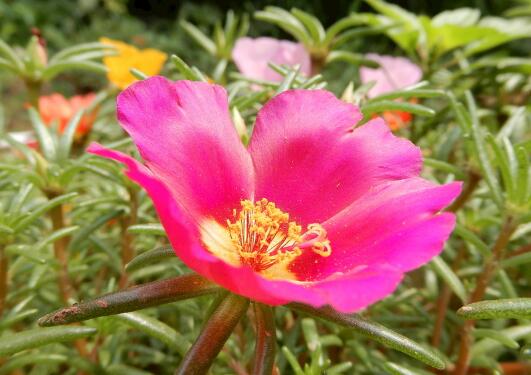
If you want to know how to grow moss rose, first we need to understand its growth habits. Moss rose, as the name suggests, is a light-loving plant, so when growing it you must maintain sufficient light. In addition, fertilization, watering and other aspects also need attention. The specific growing methods and precautions for moss rose are described in detail below, let's continue reading.
II. Growing methods and precautions for moss rose
1. Soil selection
When growing moss rose, first we need to choose soil. Moss rose is a plant that is very easy to keep alive and has no high requirements for soil. Generally, ordinary flowerpot soil is enough. Before planting, we should apply a little base fertilizer to the soil, which will be of great help to its growth.
2. Fertilization requirements
During the growth of moss rose, fertilizer is one of its main nutrients. Generally, we need to fertilize once about every two weeks so that moss rose can grow robustly. When fertilizing, everyone should remember to dilute with water first, and only fertilize when the concentration is below 5 parts per thousand, otherwise too high a concentration can easily burn the plant.
3. Watering requirements
In the process of growing moss rose, watering is also an indispensable part, especially in summer. Moss rose has very high water requirements, but the watering frequency should be determined by the breathability of the flowerpot. If breathability is good, it needs watering every day; if breathability is average, then watering once every other day is enough.
4. Light requirements
Among the growing methods and precautions for moss rose, light is a relatively important point. During growth it needs sufficient light, and it is best to grow it in a place with direct sunlight, so that it will grow with lush branches and leaves.
5. Pest and disease control
During the growth of moss rose, if care is improper, problems such as pests and diseases are very likely to appear. Such problems are extremely harmful to the plant, not only affecting its ornamental value, but in severe cases also causing the plant to die. So when they appear, they must be dealt with promptly. The specific treatment methods have been introduced in detail by the editor in the article on pest and disease control for moss rose, and everyone can take a look.
Summary: After reading the above content, I believe everyone has a certain understanding of how to grow moss rose. As long as everyone follows the above methods for care, your moss rose will certainly grow very robustly. Enough chatter, the editor will introduce the growing methods and precautions for moss rose here, hoping to bring everyone some help.
How to grow moss rose, growing methods and precautions for moss rose
How to grow moss rose? Moss rose likes warmth and sunshine in its growth habits, is very drought-tolerant, and is not strict about soil requirements, but loose, well-drained soil is better. Let's analyze the growing methods and precautions for moss rose together.
Growing methods for moss rose:
Moss rose only opens in sunlight, and a few varieties can open around the clock. Except for large-flowered purslane, which has an extremely low seed-setting rate, most varieties, whether single-petaled or double-petaled, have a very high seed-setting rate and have the ability to self-propagate.
Propagation methods: most varieties are propagated by sowing. The suitable temperature for seed germination is around 251. Generally, sowing and care are carried out from late April to early May according to the small-seed sowing method. Portulaca grandiflora cuttings root and survive extremely easily, so whether planted in the ground or in pots, after pinching off the tips, 3〜4 cuttings can be bundled into a group and inserted directly into flowerpots or planting beds filled with culture soil, then watered once thoroughly.
Cultivation and care: Portulaca grandiflora is easy to cultivate and requires extensive care. Both large and small seedlings transplant and grow easily. Cuttings can also be inserted directly into the planting site or flowerpot, and after proper watering they will root and survive after 4〜5 days. After planting, watering should not be too frequent or too much, otherwise they are very prone to leggy growth and lodging. Apply topdressing once every 7〜10 days, which can make the plant grow robustly and produce more and larger flowers. For overwintering mother plants of large-flowered Portulaca grandiflora cultivated as perennials, it is advisable in September to select robust growing branches as cuttings and insert them into flowerpots containing humus-rich sandy loam soil with strengthened care and management. After autumn, gradually reduce the amount of watering; after winter begins, stop watering, and place the flowerpot indoors in a place with sufficient light. During severe cold, cover the whole pot with a plastic bag. After warmth returns the following spring, gradually open it and sprinkle an appropriate amount of water to replenish moisture, and it can revive and grow.
Precautions for growing moss rose:
① Sufficient light. Large-flowered purslane is a strongly sun-loving plant. Both the growth and flowering periods require sufficient sunlight. Whether cultivated in the open ground or in pots, a sunny place with good sunlight should be chosen. If the weather is clear and the climate dry during the flowering period, then it will certainly bloom abundantly with bright colors. At the same time, the flowering condition changes with sunlight changes: it blooms when it sees sunlight, closes when light is insufficient in the morning and evening, and does not bloom on cloudy and rainy days.
② Good drainage. Large-flowered purslane is extremely tolerant of poor soil and is not strict about soil requirements, but drainage must be good. When cultivating in the open ground, avoid planting in low-lying areas. For potted soil, it is best to use loose culture soil, otherwise water accumulation and prolonged wetness will cause the plant to rot.
③ Proper fertilizer and water management. Because large-flowered purslane has fleshy stems and leaves and is drought-tolerant, it is better for the soil to be slightly dry. Generally, watering when the surface soil turns white is appropriate. During the growth period, liquid fertilizer needs to be applied 2~3 times.
Moss rose grows robustly. In the home, whether planted in the ground in a courtyard or in pots on a balcony, there are generally no serious pests or diseases. Horticultural uses: Portulaca grandiflora is easy to cultivate and requires extensive care, and its flower colors are rich and bright. It is a good flower for flowerbeds, a good material for balcony pots, and can also be used for rooftop greening.
How to grow anthurium: how to care for flamingo flower? Growing methods and precautions for flamingo flower
How to grow flamingo flower? What are the growing methods and precautions for flamingo flower? Friends who like growing flamingo flower will first have such questions. Everyone needs to note that among all flowers, flamingo flower is very sensitive to salt, so some precautions need attention when growing flamingo flower.
Flamingo flower belongs to the genus Anthurium in the Araceae family. It is a perennial evergreen herbaceous plant. It is a typical semi-succulent fibrous-root system and has aerial roots. The stem is extremely short, nearly stemless. It can bloom year-round. Generally, after the plant grows to a certain stage, flower buds can emerge from each leaf axil and bloom.
Growing methods and precautions for flamingo flower. When growing flamingo flower at home, pay attention to the following aspects:
1. Humidity
Normal growth of flamingo flower requires about 70% air humidity, which is generally difficult to achieve in ordinary home cultivation. You can use a clean wet towel to wipe the leaves wet several times a day, or regularly spray water around the plant to increase air humidity. (But be sure not to sprinkle water on the flowers, so as not to affect the ornamental quality.)
2. Watering and fertilizing
Under normal growth conditions, water the culture soil about once a week, allowing it to dry and become wet alternately. Generally follow the principle of not watering when the soil surface is not dry, and watering thoroughly when watering. In spring, autumn and winter, the number of waterings and the amount of water can be appropriately reduced. Every half month, apply a special nutrient solution of 7-8% or fertilizer water diluted 500 times along with watering.
3. Pruning
Under normal circumstances, during the growth of flamingo flower, the basal petioles gradually degenerate. When the stipules become dry, they can be cut off promptly. After flowering, when the peduncle turns yellow, it must also be cut off as soon as possible from the base, leaving a 2 cm protective stub.
4. Temperature
When growing flamingo flower at home, the temperature should be ensured as much as possible. The optimum growth temperature for flamingo flower is 16-24°C, and the minimum temperature should be kept above 12°C. If an ordinary home has heating facilities, this condition is easy to meet. But at the same time, it must be noted that the flowerpot must not be placed on a radiator or too close to a radiator. When the summer temperature exceeds 30°C, the plant must be moved to a relatively north-facing room in a ventilated position, and water can be sprayed around the plant to cool it down.
5. Light
Normal growth of flamingo flower requires sufficient scattered light. For home cultivation, generally you shouldnote: In summer, avoid strong direct light on leaves and flowers; in autumn and winter, when conditions permit, move it near a window to increase light. The plant also needs to be rotated regularly to ensure it receives uniform light and to promote a full, rounded crown shape.
Finally, Aiyouwo Decoration Network also needs to remind everyone that when learning the growing methods and precautions for flamingo flower, you must master the growth and cultivation substrate for flamingo flower. The cultivation substrate must have strong water- and fertilizer-retention capacity, good permeability, no water accumulation, no toxic substances, and the ability to hold the plant in place. You also need to pay attention to air humidity, moisture, and temperature, otherwise the phenomenon of rotten leaves in flamingo flower will occur.
Editor's recommendations:What are radiation-proof plants, orchid growing methods, plants have good or bad luck, lily symbolism, what is the flower language of moss rose, principles for placing plants in the living room feng shui, how to place home plant feng shui, interpretation of bedroom plant feng shui, feng shui of indoor plants, living room background wall, foot-operated glass door handle, electric sofa