How to water Cymbidium orchids? Water once a day in summer
As a hybrid among orchids, Cymbidium orchids have long, emerald-green leaves and bold, magnificent, unrestrained and splendid flowers, making them highly favored by people. In daily life, many people grow Cymbidium orchids, but during the cultivation process, everyone more or less encounters some tricky problems, such as watering. So how do you water Cymbidium orchids? How often should Cymbidium orchids be watered? Here, the editor will answer these questions for you.
1. How to water Cymbidium orchids: the method matters
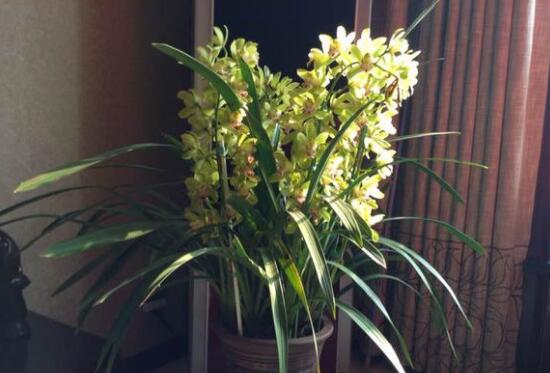
Cymbidium orchids like a humid environment and have high water requirements, so we need to water them frequently. However, Cymbidium orchids have fleshy roots that can store water, so you cannot water too much. Once you water too much and cause waterlogging in the potting soil, symptoms of yellowing leaves may appear. Therefore, for how to water Cymbidium orchids, you must master the method.
2. Watering methods for Cymbidium orchids
(1) How to tell when Cymbidium orchids need watering
Regarding how to water Cymbidium orchids, for beginners, you first need to know when Cymbidium orchids need water! Because in different environments, the frequency and amount of watering are different. This requires us to judge for ourselves. Below are 3 methods for judging whether Cymbidium orchids should be watered, with specific steps as follows:
1. Tap the pot: Whether Cymbidium orchids should be watered, the simplest way is to tap the pot. Specific method: lightly tap the pot at the 1/3 point with your finger. A relatively crisp sound indicates sufficient moisture in the potting soil; a dull sound indicates the pot is dry, and at this time it needs watering.
2. Weigh by hand: If you are very sensitive to weight, before watering Cymbidium orchids, you can lift the pot and feel its weight. If it feels light, then it should be watered. Of course, this weighing by hand also requires a process, otherwise it is easy to make mistakes.
3. Probe the soil: To judge whether Cymbidium orchids should be watered, besides the above two methods, the simplest and most direct is to probe the soil. Specific method: growers can insert a finger into the potting soil at the 1/3 point to feel it. If moist, do not water; if dry, or even if you cannot insert your finger, it should be watered!
(2) Watering time for Cymbidium orchids
When watering Cymbidium orchids, after knowing they need watering, you should also pay attention to the specific watering time: it is best to choose morning watering, because Cymbidium orchids most fear poor root drainage, and at night evaporation is low and water easily accumulates, causing damage.
(3) Water quality and water temperature
Cymbidium orchids have fleshy roots, and watering also has requirements for water quality. Of course, you do not need to specially buy pH test paper to test acidity and alkalinity; just do not frequently use tap water. If you use it, let it sit for 1-2 days first. The best water quality is rainwater. If conditions permit, you can store rainwater. The water temperature should be as close to room temperature as possible. In summer, do not use cold water on the flowers, as it easily damages the roots.
(4) How often to water Cymbidium orchids
Throughout the four seasons, because temperatures differ, watering frequency also differs. As for how often to water Cymbidium orchids, the specifics are as follows:
Summer: At this time Cymbidium orchids are in their peak growing season and need sufficient water, so you should water once a day;
Autumn: As temperatures drop, the plant enters the reproductive growth stage, so watering should be reduced to once every 2-3 days;
Winter: Cymbidium orchids are in dormancy, so water once every 5 days, maintaining basic water use to ensure a smooth winter;
Spring: As temperatures warm up, the amount of watering should gradually increase, similar to autumn, watering once every 2-3 days.
Flowering period: At this time it is not suitable to water too much; keep watering once every 3-7 days to maintain moisture in the potting soil. Because during the flowering period of Cymbidium orchids, once watered too much, it easily causes brown spots on buds or flowers, which not only affects the appearance of the flowers but also causes the flowers to drop early.
(5) Watering amount
In the cultivation methods for Cymbidium orchids, it was said that you cannot water too much, so controlling the watering amount is also very important. According to the soil structure, watering Cymbidium orchids should be thorough but not waterlogged. You can observe the drainage holes of the pot; if a little water overflows, it indicates the watering amount is already sufficient.
Overall, watering is a technical task. Although Cymbidium orchids are not difficult to grow, we should still grow them methodically, so that they will bloom beautiful flowers. Growing Cymbidium orchids requires everyone to explore with care, so that progress can be made. The editor has introduced the watering methods for Cymbidium orchids here, hoping to be helpful to everyone.
Faber's Cymbidium Cymbidium faberi Rolfe Faber's Cymbidium guide: how to grow Faber's Cymbidium / how to propagate Faber's Cymbidium
Faber's Cymbidium profileFaber's Cymbidium Cymbidium faberi Rolfe
Cultivation methods and precautions for Faber's Cymbidium Introduction to Faber's Cymbidium
Faber's Cymbidium (scientific name: Cymbidium faberi) is a terrestrial herb in the orchid family, genus Cymbidium. The roots are relatively thick and short, with the base slightly thicker than the front end of the root, and no branching. The pseudobulbs are inconspicuous, clustered together, and oval-shaped. The flowers are often pale yellow-green, with dark purplish-red veins and spots; the flowers usually have a rich fragrance. One stem bears many flowers, often 6-12 flowers, fragrant. Faber's Cymbidium is native to China and is one of the orchids cultivated for the longest time and most widely popularized in our country. In ancient times it was often called "hui"; "hui" refers to the center of Chinese orchids, the "hui heart," and is often combined with the umbellifer Angelica dahurica under the name "huizhi." Faber's Cymbidium is a rare species in our country and a national second-class key protected wild species. Faber's Cymbidium was originally distributed south of the Qinling Mountains, north of the Nanling Mountains, and across the vast southwestern region, and is one of the more cold-tolerant orchid varieties.
Morphological characteristics of Faber's Cymbidium
Cymbidium faberi Rolfe in Kew Bull. 198. 1896; Iconographia Cormophytorum Sinicorum 5: 745. fig. 8320. 1976; Flora of Qinling Mountains 1: 432. fig. 421. 1976; Orchids of Taiwan 2: 109-110 (fig.). 1977: Flora of Taiwan 5: 942. 1978; Y. S. Wu et S. C. Chen in Acta Phytotax Sin. 18 (3): 299. fig. 2 (9). 1980; Du Puy et Cribb, Genus Cymbidium 177. Phot. 130. fig. 30 (2). 1988; Flora of Anhui 5: 544. fig. 308. 1992; Flora of Zhejiang 7: 524. fig. 7-700-1993; Chinese Orchids (Second Edition) 42. 1993; Vascular Plants of the Hengduan Mountains 2: 2600. 1994; Flora of Fujian 6: 616. fig. 538. 1995; Complete Book of Chinese Orchids 93. fig. 5-20. 1998. -- Cymbidium scabroserrulatum Makino in Bot. Mag. Tokyo 16: 154. 1902. -- Cymbidium oiwakensis Hayata, Icon. Pl. Formos. 6: 80. fig. 14. 1916. -- Cymbidium crinum Schltr. in Fedde Repert. Sp. Nov. Beih. 12: 350. 1922. -- Cymbidium fukienense T. K. Yen, Icon. Cymbid. Amoyens. A. 1. figs. 1964. -- Cymbidium faberi Rolfe f. viridiflorum S. S. Ying in Mem. Coll. Agric. Nat. Taiwan Univ. 30 (1): 41. 1990. Terrestrial herb; pseudobulbs inconspicuous. Leaves 5-8, strap-shaped, strongly erect, 25-80 cm long, (4-)7-12 mm wide, base often folded into a V shape, leaf veins translucent, margins often with coarse serrations. Covered by several long sheaths; raceme with 5-11 or more flowers; floral bracts linear-lanceolate, the lowest one longer than the ovary, capsule nearly narrowly elliptic, 5-5.5 cm long, about 2 cm wide. Flowering period March-May. Produced in southern Shaanxi, southern Gansu, Anhui, Zhejiang, Jiangxi, Fujian, Taiwan, southern Henan, Hubei, Hunan, Guangdong, Guangxi, Sichuan, Guizhou, Yunnan and eastern Xizang. Grows in moist but well-drained bright places, at elevations of 700-3000 m. Also distributed in Nepal and northern India. The type specimen was collected from Zhejiang, China.StemTerrestrial herb; pseudobulbs inconspicuous.LeavesLeaves 5-8, strap-shaped, strongly erect, 25-80 cm long, (4-)7-12 mm wide, base often folded into a V shape, leaf veins translucent, margins often with coarse serrations.[1]FlowersCovered by many Chinese orchid centers Faber's Cymbidium
long sheaths; raceme with 5-11 or more flowers; floral bracts linear-lanceolate, the lowest one[2] longer than the ovary, the middle and upper ones 1-2 cm long, about 1/2 the length of the pedicel and ovary, at least more than 1/3; pedicel and ovary 2-2.6 cm long; flowers often pale yellow-green, the lip with purplish-red spots, fragrant; sepals nearly lanceolate-oblong or narrowly obovate, 2.5-3.5 cm long, 6-8 mm wide; petals similar to sepals, often slightly shorter and wider; lip oblong-ovate, 2-2.5 cm long, 3-lobed; lateral lobes erect, with small papillae or fine hairs; mid-lobe longer, strongly recurved, with obvious, shiny papillae, margins often wrinkled; on the lip disc, 2 longitudinal lamellae extend from above the base to the base of the mid-lobe, with the upper ends inclined inward and converging, more or less forming a short tube; column 1.2-1.6 cm long, slightly curved forward, with narrow wings on both sides; pollinia 4, in 2 pairs, broadly ovate.[1]FruitCapsule nearly narrowly elliptic, 5-5.5 cm long, about 2 cm wide.[1]Flowering periodFlowering period March-May.[3-4]
Cultivation technical characteristics of Faber's CymbidiumCymbidium orchids are native to southwestern China and like warm winters and cool summers. They like high humidity and strong light, with an optimum growth temperature of 10°C to 25°C. The nighttime temperature is preferably around 10°C; especially during the flowering period, maintaining the temperature above 5°C and below 15°C can extend the flowering period to 4 to 5 months. Depending on the variety, the flowering period can last from October to April of the following year. Factory cultivation from tissue-cultured plantlets to flowering takes 3 years. Cymbidium orchids are divided into mother bulbs, daughter bulbs and granddaughter bulbs, among which granddaughter bulbs grow fastest.[6] Cymbidium orchids like strong light and can tolerate strong light of 50,000 to 70,000 lux. Cymbidium orchids are native to the tropical and subtropical plateaus of Asia, and prefer a cool, high-humidity environment, with an optimum growth temperature of 10-25°C. In winter they should be kept in a low-temperature greenhouse. When the nighttime temperature is around 10°C, they grow well and the flower stems elongate normally, mostly flowering in February-March. When the winter temperature is below 5°C, the leaves turn slightly yellow and the flowering period is delayed, with short flower stems. However, when the overwintering temperature is around 15°C, although the plant leaves are green and glossy, the flower stems will suddenly elongate, flowering is advanced to January-February, and the flower stems are soft and cannot stand upright, requiring stakes for support.Cultivation cycleFaber's Cymbidium usually takes 3 to 4 years from tissue-cultured plantlets being removed from the bottle to flowering. Its growth cycle standards are as follows: after removal from the bottle, tissue-cultured plantlets are placed in 50-cell or 66-cell plug trays, with sphagnum moss as the substrate, and cultivated for 2 months. 8×8 black nutrient pots, with bark as the substrate, cultivated for 5 months. 12×12 black nutrient pots, with bark as the substrate and stones at the bottom, cultivated for 7 months. 15×18 black nutrient pots, with bark as the substrate and stones at the bottom, cultivated for 5 to 7 months. 18×22 hard plastic pots, with bark as the substrate and stones at the bottom, cultivated for 12 to 15 months. Wild-collected Faber's Cymbidium
Distribution area of Faber's Cymbidium
Produced in southern Shaanxi, southern Gansu, Anhui, Zhejiang, Jiangxi, Fujian, Taiwan, southern Henan, Hubei, Hunan, Guangdong, Guangxi, Sichuan, Guizhou, Yunnan and eastern Xizang. Grows in moist but well-drained bright places, at elevations of 700-3000 m. Also distributed in Nepal and northern India. The type specimen was collected from Zhejiang, China.[1]
Propagation methods of Faber's Cymbidium
Cultivation conditions for Faber's Cymbidium
3. Air humidity: Very moisture-loving, but pay attention to ventilation, otherwise it is prone to anthracnose. Humidity for small plantlets should be 80% to 90%, and humidity for medium and large plants should be 60% to 85%.
Cultivation techniques for Faber's Cymbidium
1. Medium: In 50-cell plug trays, use sphagnum moss, which must be soaked for 2 to 4 hours in 800 to 1000 times diluted thiophanate-methyl, thiophanate-methyl plus sulfur, or carbendazim. Old sphagnum moss that has been sun-dried for 1 to 2 noons and then soaked in chemicals can also be used. Tissue-cultured rooted plantlets: exercise the bottles in the greenhouse for 1 to 3 days; in summer they must be placed in a shady place for hardening. Before wrapping the plantlets, remove the plantlets from the tissue culture bottles, remove the culture medium, wash clean with clear water, then rinse in 800 times diluted carbendazim solution, and divide the plantlets into three grades--large, medium and small--for wrapping. Use 50-cell plug trays. Half a month after being placed in the plug trays, foliar fertilizer can be sprayed, with an EC value of 0.8 to 0.9. Within 15 days after being placed in the plug trays, frequent spraying is needed, and water should be replenished frequently. Foliar fertilizer with NPK 20:20:20 is sufficient. Tissue-cultured plantlets grow for one year to reach the medium plantlet standard, and during this year they must be maintained as a single shoot (also called the mother bulb). After 2 to 3 months of plug tray cultivation, they can be placed in 8×8 nutrient pots, at which point fine bark can be used as the substrate. Standards for bark use: use 2 to 5 mm bark for seedlings, 5 to 10 mm bark for medium plantlets, and 8 to 18 mm bark for large plantlets. Be sure to buy bark with low salt content. If the bark contains a lot of salt, it will cause many symptoms in Cymbidium orchids: yellowing gradually upward from the leaf tips, mainly a manifestation of sodium chloride, though overly concentrated fertilizer causes the same symptoms.
2. Shoot thinning: In 8×8 and 12×12 nutrient pots, keep only spring shoots and not autumn shoots (September to December is the best time for shoot thinning). Use thinning shears for shoot thinning. Thin to 2 daughter bulbs per pot, and symmetrical retention gives the best effect. Shoot thinning is most suitable when shoots grow to 5 cm. Lateral shoots have no roots before they are 15 cm long, and begin to root after 15 cm. Different varieties use different shoot retention methods.
3. Mature plants: For 15 cm × 18 cm and 18 cm × 22 cm nutrient pots, plants at this stage are given 15 g of organic fertilizer per pot per month. As the plants grow larger, apply 18 to 20 g per pot per month. After 12 months from repotting, apply only bone meal, and continuously thin shoots before October. From November to January, the number of flowering bulbs must be determined. For large-flowered types: cultivate 1 middle stem and 2 flowering stems; for medium-flowered types: cultivate 2 middle stems and 3 flowering stems.
4. Flowering plant cultivation: (third year) From January to June, nighttime temperature is 15°C to 20°C and daytime temperature is 23°C to 25°C, mainly nitrogen with potassium as a supplement. From June to October, nighttime temperature is 10°C to 15°C and daytime temperature is 20°C to 25°C; after November, nighttime temperature is 10°C to 15°C and daytime temperature is 20°C. From February to April, apply 10 g of organic fertilizer per pot per month (bean cake:bone meal 2:1). After April, apply 14 g of organic fertilizer per pot each time. From June to October, increase the temperature difference, mainly applying bone meal, about 15 g per pot. After flower buds appear, immediately stop organic fertilizer. After November, flower spikes form. After the flower stems are determined, remove all newly occurring shoots. For most varieties, flower buds can be seen from September to the end of October. If there is excessive nitrogen nutrition, leaf buds will grow and should be broken off. Use plastic-coated wire with a diameter of 5 mm as stakes for the flower stems, and set them upright when the flower buds grow to 15 cm. The lowest binding point for the flower stems is 10 cm, with intervals of 6 to 8 cm. Generally choose plastic-coated wire 80 cm and 100 cm long and 0.45 cm thick.
5. Flowering period regulation techniques:
(1) Temperature: From June to October, daytime 20°C to 25°C, nighttime 10°C to 15°C. High temperatures are not conducive to flower bud differentiation, but short periods of high temperature are possible; there must be a large day-night temperature difference.
(3) Water control: Appropriate water control during flower bud development can promote flower bud differentiation and inflorescence formation.
(4) C/N ratio: Remove shoots year-round and increase the proportion of P and K.
(5) Selective fertilization: From January to June, balanced N, P and K fertilizer; from June to October, increase the proportion of P and K
(6) Flowers of Faber's Cymbidium: During the flowering period, insufficient nutrients, high temperatures, or a temperature difference greater than 10°C easily causes flower and bud drop. Dark-colored flowers like strong light, and under weak light they easily show drooping leaves.
Open-air cultivation is sufficient, requiring only one layer of shade netting. Under high temperatures, Faber's Cymbidium has high water demand, so there must be a sufficient water source.[1]Propagation methodsUsually propagated by division. Division is mostly carried out after the plant flowers and before the new shoots have grown large, during this short dormant period. Before division, the plant should be properly dried, and the operation is done when the roots are slightly whitish and soft. Vigorous plants are usually divided once every 2-3 years. Each divided clump of orchid plants should carry 2-3 pseudobulbs, one of which must be newly formed in the previous year. To avoid wound infection, sulfur powder or charcoal powder can be applied. Place in a dry place for 1-2 days, then pot separately to form new plants. After division and planting, place in semi-shade and do not water immediately. If it is found to be too dry, spray a small amount of water on the leaves and pot surface to prevent leaf drying, shedding and severe shrinkage of the pseudobulbs. Water only after new roots grow from the base of the new shoots.[7] Cymbidium orchids can use 2 parts fern roots, 1 part charcoal moss, or bark chunks 1.5-2 cm in diameter as potting substrate, and some granular materials such as crushed brick and charcoal can also be added. Pots should be tall pots with a diameter of 15-20 cm, with 2-4 plantlets per pot. Cymbidium orchids like relatively high air humidity. In spring, summer and autumn, while giving sufficient water to the roots, the leaves should be sprayed frequently. However, after flowering in early spring, during the short dormant period of Cymbidium orchids, watering must be reduced, and more watering can only be done when new shoots grow larger new roots. Cymbidium orchids are large plants with luxuriant growth and need significantly more fertilizer than ordinary Chinese orchids, so fertilization should be strengthened during the growing season. Generally, fermented cake fertilizer can be mixed with 1/3 clay, then water added to make balls about 2 cm in diameter, dried in the sun for later use. Place them on the pot surface in spring, at a certain distance from the new shoots, and the fertilizer can slowly release nutrients for orchid growth. They can be applied twice a year, several pellets per pot. Fermented liquid farmyard manure can also be applied once every 1-2 weeks. A sprayer can also be used to spray 1:1:1 nitrogen-phosphorus-potassium compound fertilizer on the leaves and pot surface, with a concentration of 3-5%, 1-2 times a week. Stop fertilizing in late autumn. Cymbidium orchids have stronger resistance to pests and diseases than ordinary Chinese orchids, but during growth they are still attacked to varying degrees by various diseases. Therefore, strengthening prevention is an important measure for growing exotic orchids well. Generally, every 10 days alternately spray both sides of the orchid leaves with 1000 times diluted "chlorothalonil" or "carbendazim" solution.Fertilizer and water management(1) Fertilization: During the growing period, the nitrogen, phosphorus and potassium ratio is 1:1:1; during the flower-forcing period, the ratio is 1:2:2 to 3, and the pH value of the fertilizer solution is 5.8 to 6.2. Generally speaking, the fertilization concentration for small plantlets is 3500 to 4000 times dilution, and for medium and large plantlets 2000 to 3500 times dilution. In summer, 1 to 2 times per day (alternating water and fertilizer application); in other seasons, fertilizer is usually applied once every 3 days. Organic fertilizer: From tissue-cultured plantlets being removed from the bottle until before flowering, organic fertilizer must be applied once a month. During the growing period, the ratio of bean cake to bone meal is 2:1; during the flower-forcing period, pure bone meal is applied. Organic fertilizer must not be applied on the roots, and must not be higher than the rim of the nutrient pot. If bone meal has too high a salt content, it can be rinsed with water before application. In winter, it is best to stop applying organic fertilizer. Application amounts at different stages are as follows: 50-cell/66-cell: 0.5 g per cell; 8 cm × 8 cm nutrient pot: 1 to 2 g per pot; 12 cm × 12 cm nutrient pot: 7 to 9 g per pot; 15 cm × 18 cm nutrient pot: 12 to 15 g per pot; 18 cm × 22 cm pot: 15 to 20 g per pot. Slow-release fertilizer: Slow-release fertilizer is also very widely used on Cymbidium orchids, usually using the N:P:K=13:11:13 formula, with a duration of 3 months or 6 months. Slow-release fertilizer only begins to release nutrients 1 month after application, so during this 1 month a fertilizer supply must be guaranteed. The dosage of slow-release fertilizer is generally 2 to 3 g for small plantlets, 6 g for medium plantlets, and 18 g for large plantlets, varying accordingly. (2) Watering: In May and September, water once a day; in July and August, water 2 times a day; from October to April of the following year, water once every 2 to 3 days. Watering should be done at noon, and the frequency of watering should be adjusted at any time according to the size of the plantlets and weather conditions.Transport and maintenance1. Transport temperature for Cymbidium orchids: ensure it remains above 5°C. If bracts and leaves turn yellow, freezing damage may have occurred. 2. Imported Cymbidium orchid standards: For Cymbidium orchids imported from Japan and South Korea, generally the plant height is required to be 60 to 80 cm, with 15 to 20 flowers per stem, 3 to 5 flower stems per pot, 50% to 80% flowering per stem, and the height difference among flower stems within each pot not exceeding 5 cm. 3. Flowering period maintenance for Cymbidium orchids: The optimum temperature during the flowering period is 8°C to 15°C. They cannot be placed next to high-temperature dry heating. During the flowering period, water once every 3 days. Prolonged low temperatures of 2°C to 3°C will cause freezing damage to the flowers, turning the buds yellow and preventing them from opening. The ornamental period is 50 to 80 days. Special usesCymbidium orchids have a full plant shape, emerald-green leaves and beautiful waxy flowers, and are high-grade daily flowers for winter and spring.
Variety classification of Faber's Cymbidium Historical varietiesTraditional Faber's Cymbidium originates from forests as terrestrial plants and in mountain belts. Mountain villagers call them high orchid, large orchid, cattle orchid, upper orchid, etc. The ancients called one stem with nine flowers "hui"; "hui heart" refers to the united, beautiful and kind Chinese heart. Faber's Cymbidium plants are generally relatively tall, with 5-13 leaves, leaf length about 35-80 cm, leaf width 0.5-1.5 cm, leaf veins thick, numerous and obvious, leaf margin serrations obvious and relatively coarse, and pseudobulbs inconspicuous. The flower stalk is upright; the thick stalk is 1 cm in diameter, while the thin one is like incense sticks, standing tall level with the leaf canopy or above it, generally about 35-80 cm high. It bears 5-30 flowers. The open flower diameter is about 3.5-8 cm. The flower color is mostly yellow-green or emerald green, and the lip has green velvety moss, adorned with many purplish-red dots and blocks. The flowering period in its place of origin is April to early May, with occasional reblooming in autumn. Faber's Cymbidium flowers are relatively widely distributed, and there is also distribution north of the Qinling Mountains. Its native habitat is at a higher elevation than that of Chinese Cymbidium, and it is relatively cold-tolerant, drought-tolerant and sun-loving.Production area varietiesFaber's Cymbidium flowers differ slightly in leaf shape and flower quality. According to production area, they are divided into: Beijing Faber's Cymbidium flowers, Jiangsu-Zhejiang Faber's Cymbidium flowers, western Anhui, Hubei Faber's Cymbidium flowers, Yunnan Faber's Cymbidium flowers, Guizhou-Sichuan inland Faber's Cymbidium flowers, southern Shanghai, Guangzhou Faber's Cymbidium flowers, etc. Faber's Cymbidium is a terrestrial plant originating from forests, with pseudobulbs very small or inconspicuous; leaves 25-80 cm long, 7-12 mm wide. The flower scape is nearly upright or slightly curved, 35-50 cm long, with 5-11 flowers; flower diameter 6 cm, fragrant. Flowering period March-May. Distributed in southern Shaanxi, southern Gansu, Anhui, Zhejiang, Jiangxi, Fujian, Taiwan, Henan, Hubei, Hunan, Guangdong, Guangxi, Sichuan, Guizhou, Yunnan and Xizang; also in Nepal and India. Grows in moist, open and well-drained places; at elevations of 700-3000 m. Faber's Cymbidium is one of the oldest cultivated types among Chinese orchids, and many excellent varieties have been selected from wild plants. Faber's Cymbidium is also the species in this genus with the northernmost distribution in China, and has relatively strong cold tolerance. Main varieties include: Jipin, Jin'ao Su, Wenzhou Su, Jiepei Mei, Old Shanghai Mei, Cui'e, Dayipin, Jiangnan Xinjipin, etc.New technological varietiesCymbidium orchids
Cymbidium orchids are evergreen perennial epiphytic herbs. They are the general term for large-flowered epiphytic species in the orchid family, genus Cymbidium. Pseudobulbs are thick and strong, long oval, slightly flattened; they bear 6 to 8 strap-shaped leaves, 70 cm to 110 cm long and 2 cm to 3 cm wide. The flower stem is nearly upright or slightly curved, 60 cm to 90 cm long, with 6 to 12 or more flowers. Flower scapes range from 40 to 150 cm. Leaf color ranges from light green to dark green. Standard flower stems are 3 to 5 per pot, each bearing 6 to 20 flowers. Among them, green varieties are mostly fragrant. Flowers are large, 6 cm to 10 cm in diameter. Flower colors include white, yellow, green, purplish-red, or with purplish-brown markings. They are one of the most widely cultivated Chinese orchids and are deeply loved by people around the world. Propagated by division. They like warm, humid and semi-shady environments. Pot them with fern roots, moss, bark chunks, etc. They require particularly good aeration and drainage at the root zone. After flower buds form in autumn, they need a cool period before they can bloom in spring. In winter, the nighttime temperature should be around 10°C.Popular varietiesCommonly cultivated ones include: Duzhan, Huangchan Lan, Biyu Lan, Xizang Hutou Lan, and excellent varieties of numerous hybrids. The main commercial cultivated varieties of Cymbidium orchids originally came from Japan and South Korea, and many companies in China have also begun research on variety breeding, tissue culture technology, cultivation technology, etc. The main popular varieties include the following categories: Pink series: 'Guifei', 'Fen Menglu', 'Nanxi', 'Menghuan' Green series: 'Biyu', 'Huanying' (strong fragrance), 'Waltz' (light fragrance), 'Yuchan' Yellow series: 'Xiyang' (light fragrance), 'Mingyue', 'UFO' White series: 'Bingchuan' (hanging), 'Liming'Flower color varietiesFaber's Cymbidium is traditionally usually divided by the color of the flower stem and sheath into red shell, green shell, red-green shell, white-green shell, etc.; in flower shape, as with Chinese Cymbidium, it is divided into lotus petal, plum petal and narcissus petal, etc.; flowers with no other color and uniform color are also called "plain heart." After the petal-type theory appeared, appreciation of Faber's Cymbidium particularly emphasized the petal type of the flowers, valuing plum petals and narcissus petals most highly. The column and lip are best when round, tight and thick in texture, and the outer three petals (sepals) are best when broad, round and glutinous in texture. Most famous varieties are of these petal types. Lotus petals are very rare in Faber's Cymbidium; those resembling lotus petals are also very welcome. Ordinary bamboo-leaf-petal Faber's Cymbidium are as numerous as wormwood, and apart from a few bright colored flowers, are rarely appreciated. There are also Faber's Cymbidium butterfly petals and exotic flower types, brilliantly colorful and dazzling, especially those with many petals and lip segments and gorgeous colors, which are even more sought after and command very high prices. Plain-heart types are also much loved. Things are precious when rare. Because Faber's Cymbidium mostly has yellow-green flowers, if red, purple, black or milky-white Faber's Cymbidium appear, they are also highly valued, and the more brilliantly colored the better. Those with thick, glutinous, jade-like petal and sepal texture are also often considered fine products. Faber's Cymbidium flower branches are thick and large with many flowers, so when appreciating them, attention should also be paid to whether the arrangement of flowers on the entire branch is well-spaced and graceful, and whether the fragrance is mellow and beautiful. Those with beautiful leaf variegation are also fine products. Occasionally, those with leaf variegation, flower variegation and petal type all present are especially favored.Traditional famous varietiesThe traditional famous varieties of Faber's Cymbidium include the Old Eight: Dayipin, Cheng Mei, Shanghai Mei, Guanding, Yuanzi, Ranzi, Pan Lu, Dangzi; the traditional New Eight include: Lou Mei, Cui'e, Jipin, Qinghua Mei, Jiangnan Xinjipin, Duan Mei, Cui Mei, Rong Mei. New famous varieties include: Tianjiao Mudan, Sixi Mudan, Lvyun Mudan, Yuandong Qidie, Luyi Qidie, Loutai Die, Ying Die, Bubugao, Qunying Huicui, Xianhe Jipin, Jianhu Zhimei, Quanzhou Mei, Cuitao Xianshou, Shi Die, Lingnan Baihe, Jinling, Faber's Cymbidium crystal flower, Zijuan, Yuewang Mei, Juhua Su, Duoyun, Zheding, Duanhui Mei, Duanxiu Mei, Diecui, Chunhui QianShou Guanyin and so on.Famous variety introductions1. Dayipin: Petal type: green-shell large lotus-form narcissus petal. History: According to "Lanyan Shulue," it was selected by Hu Shaomei of Jiashan, Zhejiang during the Qianlong period of the Qing Dynasty; according to "Lanhui Tongxin Lu," it was selected by Hu Shaomei in the early Jiaqing years. Characteristics: five petals in separate sockets, emerald green color, upright and glutinous petals, large soft silkworm-moth column, large ruyi lip. It is praised as the crown of lotus-form narcissus petals among Faber's Cymbidium, and is listed first among the traditional Old Eight of Faber's Cymbidium. 2. Jiepei Mei: Petal type: red-shell green-flower plum petal. History: selected in the early Republic of China by a person surnamed Zhang in Shanghai. Characteristics: three petals emerald green, tightly edged, short-footed and round-headed, white jade column heart, large ruyi lip, slender flower scape. When the flower bud first opens the petals, the flower shape is slightly small, then gradually opens larger and larger. The flower posture is upright and vigorous, the leaves are narrow and bow-shaped, and it reproduces quickly and flowers vigorously. 3. Duanhui Mei: Petal type: red-shell green-flower plum petal. History: selected by Zhu Changsheng of Shaoxing, Zhejiang. Characteristics: outer three petals round-headed, tightly edged, long-footed with contracted root, flat shoulders, semi-hard column, large ruyi lip, regular flower shape, slender flower scape. Leaves semi-drooping. 4. Xianlü: Petal type: green-shell plum petal. History: selected in the early Republic of China by orchid growers in Yixing. Also called Yixing Mei; because the flower shape closely resembles Old Shanghai Mei, it is also called Post-Shanghai Mei. Characteristics: three petals round-headed and narrow and long, separate sockets, ram-horn pocket column heart, lip long and not curled. Some people often pass this off as Old Shanghai Mei for sale. Bracts green. It often produces plum-form narcissus petals. 5. Old Jipin: Petal type: green-shell green-flower plum petal. History: selected in the Xin Chou year of the Guangxu period of the Qing Dynasty by Feng Changjin of Gongcheng Garden in Hangzhou. Characteristics: three petals round-headed, long-footed with contracted root, separate sockets, hard pocket column heart (sometimes occasionally split-head combined-back form), dragon-swallowing large lip, flat shoulders. Bracts green. Listed among the New Eight of Faber's Cymbidium. 6. Guanding: Petal type: red-shell plum petal. History: selected during the Qianlong period of the Qing Dynasty by the owner of the Wanhe hotel in Huguan, Jiangsu, hence also called Wanhe. Characteristics: five petals short and round, bean-shell column, separate sockets, large round lip, flat shoulders. Leaves broad. One of the Old Eight red Faber's Cymbidium. 7. Yuanzi: Petal type: red-shell green-flower plum petal. History: selected during the Daoguang period of the Qing Dynasty by orchid growers in Huguan. Characteristics: three petals round-headed with long feet, tightly edged, green in color, separate sockets with semi-hard column heart, flat shoulders, zhugui lip, thick and tall flower scape. One of the Old Eight red Faber's Cymbidium. 8. Old Ranzi: Petal type: red-shell plum petal. History: selected during the Daoguang period of the Qing Dynasty by a person surnamed Ruan in Jiashan, Zhejiang. Also called Ruanzi. Characteristics: three petals short, narrow and deep, flat shoulders, separate sockets with large Guanyin pocket column heart, large round lip; sometimes the flowers open poorly; the tip of the lip is pinched narrow and not stretched, upturned or skewed, so it is commonly called steelyard-hook-head Old Ranzi. Flower scape slender. One of the Old Eight among Faber's Cymbidium. 9. Cui Mei: Petal type: red-turning-green-shell plum petal. History: selected before the War of Resistance by Cui Yiting of Hangzhou. Characteristics: outer three petals round-headed and large, finely contracted root, thick and glutinous petal flesh, semi-hard column heart, separate sockets or split-head combined-back, dragon-swallowing lip. Green in color, flat shoulders. Listed among the New Eight, and also a famous variety among Faber's Cymbidium. 10. Cheng Mei: Petal type: red-shell plum petal. History: selected during the Qianlong period of the Qing Dynasty by a person surnamed Cheng in Changshu, Jiangsu. Characteristics: three petals tightly edged, short and round, split-head combined-back or separate-socket column, dragon tongue, thick and tall flower scape, broad bow-shaped leaves. The first among the Old Eight red Faber's Cymbidium. 11. Zheng Xiaohe: Petal type: green-shell lotus petal. History: selected in Zhejiang before the War of Resistance. Characteristics: outer three petals long-footed, with released corners and contracted root, mussel-shell column, Liuhai lip, green in color. 12. Qinghua Mei: Petal type: green-shell plum petal. History: In 1911 selected by Che Qing, an orchid farmer in Shaoxing, Zhejiang, and sold to Wu Enyuan of Hangzhou. After six years of cultivation it reflowered, at the time of the overthrow of the Qing imperial court. For celebration, and considering that Che Qing discovered this flower at the Huaxing Hotel, the person and place were linked, so it was named Qinghua. Characteristics: three petals short-footed and round-headed, tightly edged, thick petals, separate sockets with silkworm-moth column heart, large ruyi lip, single-character shoulders. Listed among the New Eight of Faber's Cymbidium. 13. Old Shanghai Mei: Petal type: green-shell plum petal. History: selected in the early Jiaqing period of the Qing Dynasty by Li Liangbin. One name is Old Shanghai Mei. Also called Former Shanghai Mei. Characteristics: three petals long-footed and round-headed, semi-closed hard column, pierced-cheek small ruyi lip, emerald-green flower color, single-character shoulders. After full bloom, the secondary petals occasionally turn backward. Leaves semi-drooping. Flower scape slender. Bracts green. Listed among the Old Eight. 14. Jiangnan Xinjipin: Petal type: red-shell plum petal. History: In 1915 brought by Qian Alu of Shaoxing to the home of Yang Ganqing in Wuxi. At that time Yang asked Mr. Rong Wenqing to examine the flower buds and determined that a fine flower variety would certainly emerge in the future; afterward Yang Ganqing bought it. Characteristics: flower shape similar to Old Jipin. Three petals round-headed with contracted root, separate sockets with semi-hard pocket slightly closed, dragon-swallowing large lip, flat shoulders, slender flower scape, excellent charm and complexion. Listed among the New Eight of Faber's Cymbidium. 15. Su Shiba: Produced in the Wudang Mountains, purchased by Dai Xianqin, Shen Xinbao and others of Shanghai in 1996, and named upon request by Wu Yingxiang. 16. Mingzhou Mei: Also named "Tianwang Hui." Discovered and selected by Ningbo orchid friend Shen Qingfa in the spring festival of 2000 when visiting friends in the Xianxiang mountain area, in a mountain farmer's home among unselected plants. This flower plant is about 45 cm tall, about 1.2-1.5 cm wide, with blunt leaf tips in a dew-bearing shape, and a majestic form. The flower stalk is pink at the base with green, round and upright, about 4-5 mm thick, about 50 cm tall and well above the leaves. The small flower stalk and inner bract are purplish-red without green color. The centipede-clamp head shape, flowers are large, diameter up to 6 cm. The outer three petals are short and broad, with contracted root, tightly edged, and the petal tips are perfectly round, forming an embracing shape. The true single-character shoulders also carry a slight flying feel; the soft-hard column does not fall apart after long opening, and the lower side of the column petals can hold the lip (root). The lip is shaped like Liuhai, protruding but not turning back, its length not exceeding the column petals, and there is no red block on the back of the lip. The column is small like a matchstick; whether viewed from above or straight on, the column core is still not visible until the flowers fade. This variety generally bears not many flowers; several reflowerings have all been 7-9 flowers, but the overall arrangement is highly methodical, with the spacing between flowers open and evenly divided. The flower orientations are viewable from all four sides and worthy of painting. The overall momentum is majestic yet dignified.Grading standardsDifferent varieties have different traits, so grading standards also differ, but overall they all follow the following grading standards: Grade A: plant height 80 to 120 cm, 4 to 5 flower stems, 15 to 20 flowers per stem. Grade B: plant height 60 to 80 cm, 3 to 4 flower stems, 10 to 14 flowers per stem. Grade C: plant height 40 to 50 cm, 1 to 2 flower stems, 6 to 9 flowers per stem. They can also be divided according to flower diameter into large-flowered series (flower diameter 8 to 10 cm), medium-flowered series (6 to 8 cm), and small-flowered series (4 to 5 cm).
Cultural background of Faber's Cymbidium: hui quality and orchid heartWhat is now called Chinese orchid was called "hui" in ancient times. As Huang Tingjian of the Northern Song Dynasty (1045-1105) described orchids in "Youfang Pavilion": "One stem with one flower and surplus fragrance is orchid; one stem with five or seven flowers and insufficient fragrance is hui." "Hui quality and orchid heart" means that the essence of Faber's Cymbidium is the center of Chinese orchids. "Hui" is the center of Chinese orchids, namely "hui heart," and hui heart is the "Chinese heart." Those who love orchids must love "hui"; "hui" refers to China, and "hui" means: China's fragrant herb, while "zhi" means the people's fragrant herb. "Huizhi" striving for glory and pressing down all fragrance is called "national fragrance." Chinese orchid Faber's Cymbidium is the representative of orchid and hui sharing one heart. Chinese orchids: Chinese Cymbidium, Jian Lan, Han Lan, Mo Lan, Phalaenopsis, Clivia and others are all called lanhui. The great poet Lu You wrote: "Fragrant orchids are moved and taken throughout the central woods; what harm is there in the remaining space to plant jade hairpins? I further beg for two clumps of fragrant lilies; though an old man of seventy, I still have a child's heart." Fragrant orchids, namely huizhi, being moved and taken symbolizes national image and emblem. In modern times, there has been no lack of people who love huizhi. Song Qingling also gave Huang Qixiang orchids sent from abroad. When Song Qingling learned that Huang Qixiang was about to leave the country to take up a post, she said with concern that defeated Germany lacked everything, so she gave Huang Qixiang many things, packed into a large wooden box, for Huang Qixiang to take to Germany. After the founding of New China, Huang Qixiang was elected a member of the Standing Committee of the First, Second and Third National Committee of the Chinese People's Political Consultative Conference and Vice Chairman and Secretary-General of the Chinese Peasants' and Workers' Democratic Party, and had more opportunities to meet Song Qingling. The Faber's Cymbidium plant's vigorous, graceful and upright orchid leaves, its slender and elegant posture, and its clear, distant and refreshing fragrance attract countless orchid lovers.One stem, nine flowersSince ancient times, among the producing areas throughout our country that are full of one-flowered plants and the warm mountain areas of this province that produce Simbiji orchids, the multi-flowered ones have been called one stem nine flowers, abbreviated as nine flowers, and some people habitually write it as "nine blossoms." In our country, one-flowered ones are called
Cymbidium orchids (19 photos) lan, and multi-flowered ones are called hui to show the difference. The ancients called one stem nine flowers hui, also calling them hui flowers rather than Faber's Cymbidium. For example, "hui" includes: the traditional Chinese Faber's Cymbidium is hui; Jian Lan, which blooms in autumn, is also called "autumn hui"; the large-flowered Hutou Lan native to southwestern China is also called "Cymbidium orchid" and other hui flowers. Ideal petals such as plum blossom, lotus and narcissus can apply to nine flowers. But since ancient times orchid lovers have all chosen orchids produced in our country as selection targets, because our country's orchids not only have beautiful flower colors, excellent fragrance and good luster, but are also extremely diverse in type. The flowering period of nine flowers (including plain-heart and exotic types) is later than that of one flower, so they are also called summer orchids, though not many people know this name. From the customary viewpoint of appreciation, nine flowers are divided into green stems and red stems. Green stems, as the name suggests, are green stems; red stems have red flower axes, that is, the branch flower stem has no red, but if the ovary has slight red dots it belongs to red stem. When appreciating nine flowers, if you look at them in the way you appreciate one flower, then you cannot see the value of nine flowers. Among red-stem nine flowers, Cheng Mei's magnificence is the most outstanding, unafraid of wind attacks; if thin stems are used as the criterion for judgment, then one cannot observe its truly moving qualities.Faber's Cymbidium flower languageThere are many varieties of Faber's Cymbidium flowers. According to incomplete statistics, there are more than 20,000 orchid varieties worldwide, among which the more famous ones include Phalaenopsis, the orchid center Faber's Cymbidium, etc. Hui flowers
Golden love flower language: May every meteor in the sky shine across the sky for you... Colorful Cloud Capital flower language: Happy every year, joyful all your life, safe all your life, full of energy every day. Purple Flower Emotion flower language: Days pass in different spaces, longing arrives at different times; no matter how worldly affairs change, you will always be my favorite. Snow Orchid flower language: Like snow, like flowers, like a dream, like truth. Butterfly Loves Flower flower language: Happiness! It exists only when you and I are together... Colorful Butterfly Flying flower language: If a delicate flower can bloom only once, then it should choose to open at its most beautiful; if a person can be happy only once in a lifetime, then we should seek today's happiness!Cultural readingThe History and Culture of Chinese Huilan (Cymbidium faberi) The character "hui" in Huilan appeared as early as in the "Chu Ci" (Songs of Chu) by Qu Yuan, the great poet of the State of Chu during the Warring States period. His verse reads: "I cultivated orchids in nine plots, and planted hui over a hundred mu. I bordered the beds with liuyi and jieche, mingling duheng and fangzhi." "Huizhi" refers to what we today call Huilan and baizhi (Angelica dahurica). What can be confirmed as the "hui" of what we today call Huilan is the hui mentioned in "Shu Youfang Ting" (Written at the Youfang Pavilion) by the Song dynasty poet and calligrapher Huang Tingjian: "One stem with one flower and abundant fragrance is lan; one stem with five to seven flowers and insufficient fragrance is hui." During the Song dynasty, cultivating Chunlan (Cymbidium goeringii) and Huilan as ornamental plants was already very popular, and it became necessary to distinguish among these fragrant herbs. Huang Tingjian's two sentences settled the matter definitively and became the basis for later generations to distinguish Chunlan from Huilan. Modern plant taxonomy also accordingly named this type of orchid that blooms in late spring with one stem bearing multiple flowers as Huilan. If Huang Tingjian merely distinguished lan from hui by their characteristics, then Zhu Kerou's "Di Yi Xiang Bi Ji" (Notes on the First Fragrance) of the Qing dynasty had already noted the different cultivation methods for lan and hui. He said: "Hui prefers sunlight and needs three hours of morning sun... As for lan, one or two hours of morning sun is sufficient." During the Qianlong, Jiaqing, and Daoguang reigns of the Qing dynasty, Huilan already had many famous varieties, such as Dayipin, Chengmei, Guanding, Shanghai Mei, Pan Lümei, Dangzi, and others. Some of these Huilan variety names were already recorded in Xu Naihe's "Lan Hui Tong Xin Lu" (Record of Lan and Hui of One Heart) from the Tongzhi period of the Qing dynasty. For example, Dayipin, the foremost of the famous eight old varieties of Huilan, was called a superior variety in "Lan Hui Tong Xin Lu," and a poem praised it: "A scholar's bearing, an exiled immortal's talent, guests vie to praise the leader; since entering Jiangnan its reputation has grown, a thousand gold pieces would not exchange this flower's crown." And Bao Weisheng in the early Qing dynasty, in "Yi Lan Za Ji" (Miscellaneous Notes on Cultivating Orchids), opened the door to the aesthetic appreciation of Huilan flower form through his differentiation and exposition of lan and hui petal shapes. Until the emergence of large numbers of Huilan butterfly-type flowers and strange-form flowers during the era of reform and opening up, for nearly one or two hundred years, the aesthetic appreciation of Huilan flowers particularly emphasized petal type, and its influence was widespread, becoming a traditional concept in Huilan aesthetics. In 1923, Wu Enyuan of Yuhang compiled "Lan Hui Xiao Shi" (A Brief History of Lan and Hui), further collecting and summarizing the traditional varieties and new species of Huilan at that time, and classified them into three major categories: red-sheath hui, green-sheath hui, and red-green hui. In 1959, the Hangzhou orchid cultivator Yao wrote the book "Lan Hua" (Orchids), which further supplemented the butterfly-flower type and pure-hearted flower type on these foundations. After the 1980s, a large number of new Huilan species were developed, and orchid enthusiasts everywhere, based on new discoveries, added the strange-flower type and colored-flower type of Huilan. At this point, Huilan had become a vast and distinctive branch of Chinese orchids. Huilan was already transmitted to Japan and Korea during the Qing dynasty and the Republic of China period, especially in the 1930s and 1940s, when Japanese people extensively collected Chinese Huilan and sold them to Japan for cultivation. In China, due to years of war and, after the founding of the People's Republic, two or three rounds of man-made destruction over several decades, by the end of the last century, when the nation prospered and orchids flourished, and a wave of orchid enthusiasm emerged domestically, some traditional Huilan varieties could no longer be found in the country and had to be re-imported from Japan. The development history of Huilan also reflects from one side the rise and fall of the nation.Huilan Poetry: Qu Yuan, "Chu Ci: Li Sao"Descendant of Emperor Gaoyang am I, my late father was named Boyong. When the star Sheti pointed to the first month of spring, on the day of gengyin I descended. My father, observing my initial bearing, began by giving me a fine name: he named me Zhengze, and styled me Lingjun. Since I already possessed this inner beauty, I added to it with cultivated ability. I wore jiangli and pizhi, and strung autumn orchids as a girdle. I hurried as if I could not keep up, fearing the years would not wait for me. In the morning I plucked magnolia on the hills, in the evening I gathered the winter grass on the islet. The sun and moon hasten without pause, spring and autumn alternate in succession. I think of the grass and trees withering, and fear the beauty's late twilight. Why not take advantage of vigor and discard the foul, why not change this measure? Ride the fine steed and gallop, come, I will lead the way ahead! The three ancient kings were pure and unblemished, and truly all fragrant ones were present. Mingling shenjiao and jungui, how could it be only the strungHuizhi!(Chai: baizhi, Angelica dahurica), (Huizhi: Huilan and baizhi)How upright were Yao and Shun, they followed the way and found the path. How overbearing were Jie and Zhou, they only took shortcuts and stumbled. The faction members indulge in pleasure, their path is dark and perilous. How could I fear disaster to myself? I fear the royal chariot's ruin! Hastening forward and back, I would follow the footsteps of the former kings. The sweet flag does not examine my inner feelings, but rather believes slander and is angered. I know well that frankness brings trouble, yet I endure and cannot abandon it. I point to the nine heavens as witness, all for the sake of the spiritual one. We agreed on a tryst at dusk, but midway he changed the path! At first he made a pact with me, then regretted and fled, having other thoughts. I do not find parting difficult, but grieve that the spiritual one is so fickle. Since I cultivated orchids in nine plots, and also plantedhuiover a hundred mu.(Hui: Chinese orchid Huilan)I bordered the beds with liuyi and jieche, mingling duheng andfangzhi. I hoped the branches and leaves would grow tall and luxuriant, and wished to wait for the time when I would harvest them. Though they wither and perish, what harm is there? I grieve that the fragrant ones are overgrown with weeds. The crowd all compete in greed, insatiably demanding and seeking. They excuse themselves while measuring others, each stirring up jealousy in their hearts. They rush about in pursuit, which is not what my heart urgently seeks. Old age gradually approaches, and I fear my cultivated name will not be established. In the morning I drink the falling dew of magnolias, in the evening I eat the fallen petals of autumn chrysanthemums. If my inner feeling is truly beautiful and refined, what harm is there in growing gaunt? I grasp the tree roots to bind chai, and thread the falling stamens of bili. I bend the jungui to stringhuiand twist the hu rope into long tresses. I sincerely follow the former sages, which is not what the vulgar world wears. Though I do not fit with people today, I wish to follow the lingering example of Peng Xian. Long I sigh and wipe away tears, grieving the many hardships of the people's lives. Though I love beauty and am bound by its reins, I am slandered in the morning and dismissed in the evening. Since they dismissed me for wearinghuias a sash, they further accuse me of gathering(Chai: baizhi). Yet this is what my heart holds dear, and though I die nine deaths I still would not regret it. I resent the spiritual one's vast indifference, never examining the people's hearts. The many women envy my moth-like brows, and slander me saying I am lewd. Truly the vulgar world is skilled in cunning, turning from rules and altering measures. Turning from the plumb line to pursue crookedness, competing to flatter as their standard. Depressed and full of sorrow am I, alone in poverty in this time. Better to die suddenly and drift away, I cannot bear this manner. The fierce bird does not flock, this has been so from former ages. How can square and round fit together? How can those of different ways be at peace? I bend my heart and suppress my will, enduring blame and bearing insult. I hold to purity and die for uprightness, which the former sages truly esteemed. I regret that I did not examine my path, and linger, wishing to turn back. I turn my chariot to return to the road, before I have gone far astray. I walk my horse on the orchid bank, gallop to the pepper hill and rest there. Advancing I am not accepted but meet with blame, retreating I will again cultivate my former attire. I make water-chestnut and lotus into a coat, gather lotus blossoms for a skirt. If no one knows me, then let it be, as long as my inner feeling is truly fragrant. I raise my towering cap, and lengthen my long, varied girdle. Fragrance and moisture mingle together, yet my bright substance remains undiminished. Suddenly I look back and let my eyes wander, I will go to view the four wilds. My girdle is adorned with many ornaments, its fragrance richly spreading. People each have what they enjoy, I alone love beauty and make it my constant. Though my body be dismembered I would not change, how could my heart be chastened? The woman Xu, with graceful concern, repeatedly scolded me, saying: "Gun was stubborn and upright, and lost his life, finally dying in the wilderness of Yu. Why are you so frank and fond of cultivation, so full of these beautiful virtues? Weeds and cockleburs fill the house, yet you alone separate yourself and will not wear them." The crowd cannot be persuaded house to house, who can say they understand my inner feeling? The world all recommends and loves factions, why am I alone and not listened to? Following the former sages to regulate the center, I sigh, leaning on my heart and experiencing this. Crossing the Yuan and Xiang rivers to journey south, I approach Chonghua and state my case: Qi composed the "Nine Arguments" and "Nine Songs," yet Xia Kang indulged himself in pleasure. Not considering difficulties to plan for the future, his five sons lost their family and state. Yi indulged in hunting and pleasure, and loved shooting the great fox. Truly the chaotic current rarely ends well, Zhuo again coveted his household. Ao, clothed in strength, indulged his desires without restraint. Daily in pleasure forgetting himself, his head was used to fall. Xia Jie constantly violated, and thus met with disaster. Hou Xin made mincemeat, and the Yin ancestral line did not long endure. Tang and Yu were solemn and reverent, Zhou discussed the way without error. They raised the worthy and employed the able, following the plumb line without deviation. Heaven is impartial, examining the people's virtue and granting aid. Only the sage with abundant conduct can truly govern this land. Looking before and after, examining the people's measures and extremes. Who is unrighteous yet can be employed? Who is ungood yet can be served? Though my body be near death and peril, examining my beginning, I still would not regret. Not measuring the hole to fit the tenon, truly the former sages were made into mincemeat. Again I sob and sigh, depressed and sorrowful, grieving that my time is not fitting. I gather soft hui to wipe my tears, which soak my lapel in streams. Kneeling and spreading my skirt to state my case, bright and clear I have obtained this central uprightness. I harness jade dragons and chariot with phoenixes, suddenly mounting the dusty wind I journey upward. In the morning I set out from Cangwu, in the evening I arrive at Xianpu. I wish to linger briefly at this spirit gate, but the sun hastens and it will soon be dusk. I command Xihe to rein in his pace, gazing at Yanzi and not pressing on. The road is long and far, I will search high and low. I water my horse at Xianchi, I tie my reins at Fusang. I break the ruo tree to brush the sun, and for a while wander and roam. Ahead I send Wangshu as vanguard, behind Feilian to follow. The luan and phoenix warn me ahead, the thunder master tells me preparations are not complete. I command the phoenix bird to fly and soar, continuing day and night. The whirlwind gathers and disperses, leading clouds and rainbows to welcome. In confusion they gather and scatter, in motley array rising and falling. I command the heavenly gatekeeper to open the gate, leaning on the gate of heaven and gazing at me. The time is dim and it will soon end, I tie the hidden orchid and linger. The world is muddy and undivided, loving to obscure beauty and being jealous. In the morning I will cross the white water, climb Langfeng and tether my horse. Suddenly I look back and shed tears, grieving that the high mound has no woman. Suddenly I wander in this spring palace, breaking jade branches to continue my girdle. Before the splendor fades, I look for a woman below to give it to. I command Fenglong to ride the clouds, to seek where Mifeng is. I untie my girdle to make a pact, I command Jianxiu to act as go-between. In confusion they gather and scatter, suddenly contrary and difficult to move. In the evening she rests at Qiongshi, in the morning she washes her hair at Weipan. She preserves her beauty and is proud, daily in pleasure and wanton wandering. Though truly beautiful she is without propriety, I come to abandon her and seek elsewhere. I look and observe in all four directions, circling the heavens and then descending. I gaze at the towering jade terrace, and see the beautiful woman of Yousong. I command the wild goose as matchmaker, the wild goose tells me it is not good. The male dove calls and flies away, I still dislike its frivolity and cunning. My heart hesitates and doubts, I wish to go myself but cannot. The phoenix has already received the gift, I fear Gaoxin has preceded me. I wish to gather far away but have no place to rest, for a while I drift and wander. Before Shaokang has married, there remain the two Yao women of Youyu. The go-between is weak and the matchmaker clumsy, I fear the guiding words are not firm. The world is muddy and jealous of the worthy, loving to obscure beauty and praise evil. The women's chambers are already deep and distant, and the wise king is not awake. I harbor my feelings and do not express them, how can I endure and end with this forever? I seek the qiongmao and use the yanting for divination, I command Lingfen to divine for me. He said: "Two beauties must surely unite, who is truly cultivated and longs for it? Think of the vastness of the nine provinces, how could it be that only here there are women?" He said: "Strive to go far without doubt, who seeks beauty and would let you go? Where is there no fragrant grass? Why do you cling to your old home?" The world is dark and dim, who can say they examine my good and evil? People's likes and dislikes differ, only these faction members are uniquely different! They wear mugwort at their waists, filling them, and say the hidden orchid cannot be worn. They examine grass and trees yet still cannot get it right, how could they judge precious beauty? They gather dung and soil to fill their fragrant sachets, and say shenjiao is not fragrant. I wish to follow Lingfen's auspicious divination, but my heart hesitates and doubts. Wu Xian will descend at dusk, I wrap pepper and sacrificial grain and invite him. A hundred spirits obscure and all descend, the nine doubts in confusion all welcome. The sovereign's bright spirit shines, telling me the auspicious reason. He said: "Strive to rise and descend, seek where the measures agree. Tang and Yu were solemn and sought harmony, Zhi and Gao Yao could adjust. If your inner feeling loves cultivation, why must you use a go-between? Shui wielded the rammed earth at Fuyan, Wu Ding used him without doubt. Lü Wang wielded the butcher's knife, meeting King Wen of Zhou and being raised. Ning Qi sang, Duke Huan of Qi heard and employed him as assistant. Before the years are late, the time is still not at its end. I fear the tigui bird calls first, making all hundred grasses lose their fragrance." How the precious girdle is towering, the crowd obscures and covers it. Only these faction members are untrusting, I fear they will be jealous and break it. The time is in confusion and change, how can I linger long?Lan and zhichange and lose fragrance, the sweet flag andhuitransform into thatch. Why have the fragrant grasses of former days now become these mere mugwort? Could there be another reason? It is the harm of not loving cultivation! I thought the orchid could be relied upon, but it is without substance and merely outwardly handsome. It abandons its beauty to follow the vulgar, merely to be listed among the fragrant ones. The pepper is sycophantic and arrogant, and the shu again wants to fill the fragrant pouch. Since they advance and strive to enter, how can their fragrance be respected? Truly the vulgar world follows the current, and who can be without change? I look atpepper and orchidbeing like this, how much more jieche and jiangli? Only this girdle is precious, abandoning its beauty and experiencing this. Its fragrance richly spreads and is hard to diminish, its scent to this day is still not faded. I harmonize my measures to amuse myself, for a while drifting and seeking a woman. While my adornment is still at its prime, I circle and observe high and low. Lingfen having told me the auspicious divination, I select an auspicious day and will set out. I break jade branches as delicacies, refine jade powder as provisions. I harness flying dragons for me, mingling jade and ivory for the chariot. How can hearts that differ be united? I will go far away to distance myself. I turn my path to Kunlun, the road long and far, circling. I raise clouds and rainbows in veiled mist, the jade luan bells jingling. In the morning I set out from Tianjin, in the evening I arrive at the western extreme. The phoenix spreads its wings bearing the banners, soaring high and orderly. Suddenly I travel this flowing sand, following the Red Water and lingering. I wave the dragon to bridge the ford, I command the Western Sovereign to ferry me across. The road is long and full of hardships, I make the many chariots wait in the path. The road turns left at Buzhou, I point to the Western Sea as the destination. I gather my chariots in a thousand teams, aligning jade axle-caps and racing together. I drive eight dragons in graceful winding, bearing cloud banners in serpentine flow. I restrain my will and rein in my pace, my spirit soaring high and far. I play the "Nine Songs" and dance the "Shao," for a while borrowing the day for pleasure. Ascending to the sovereign's brilliant splendor, suddenly I look down at my old home. My servants grieve and my horse longs, curling up and looking back, refusing to go. The coda says: Enough! The state has no one who knows me, why cling to the old capital! Since none are worthy to practice good governance with, I will follow where Peng Xian dwells!Selected passage from Qu Yuan, "Chu Ci: Seven Remonstrances - Sinking into the River"Not considering the land but coveting fame, my heart is depressed and inwardly wounded. I join hui and zhi as a girdle, passing the fish market and losing their fragrance.Confucius, "Kongzi Jiayu - In Adversity": Zhi and lan grow in the deep forest, not ceasing to be fragrant because no one is there. The gentleman cultivates the way and establishes virtue, not changing his integrity because of poverty. Confucius on hui and zhi: The orchid should be the king's fragrance, yet now it blooms alone, mixing with common grasses, just as a worthy person born at the wrong time is grouped with vulgar men.Confucius, "Kongzi Jiayu - Six Foundations"Entering a room of zhi and lan, after a long time one does not smell their fragrance. Dwelling with the good is like entering a room of zhi and lan, after a long time one does not smell their fragrance, for one has transformed with them. Dwelling with the ungood is like entering a shop of salted fish, after a long time one does not smell their stench, for one has also transformed with them. What stores cinnabar is red, what stores lacquer is black. Therefore the gentleman must be careful about where he dwells.Xunzi, "Xunzi - Sitting in Repose": Moreover, zhi andlangrow in the deep forest, not ceasing to be fragrant because no one is there. (Zhi and lan: Huilan and baizhi form a pair.) The gentleman's learning is not for advancement, but for being poor yet not distressed, worried yet not letting his will decline. Zhu Xi, "Orchid Stream": Bright wind floats over the green stream, the orchid, though withered, daily grows lush. All year no one picks it, it holds its fragrance and only itself knows. Tao Yuanming, "Drinking Wine": The hidden orchid grows in the front courtyard, holding its fragrance awaiting the clear wind. When the clear wind suddenly arrives, it is distinguished from mugwort. Zheng Sixiao, "Inscribed on Zheng Suonan's Orchid": Autumn wind turns lan and hui into thatch, the southern land's desolation, its spirit already dissipated. Only Suonan's heart does not change, tears like a spring, mixing ink to write "Li Sao." Kangxi, "Ode to the Hidden Orchid": Graceful flower posture, long green leaves, when the wind comes who hides the valley's fragrance. Even if not strung to be worn as a girdle, even with no one around it is fragrant of itself. Pan Tianshou, "Inscribed on Orchid and Rock Painting": Leisurely like Zhuo Wenjun's spring temple shadow, pure as ice and snow, like the Miao Gu immortal. One should judge the king by its style, how could its hidden fragrance alone be enough to transmit it.Bada ShanrenZhu Da, "Inscribed on Orchid and Rock": The prince's painting and calligraphy show heavenly grace, deeply grieving the memory of peace, his temples turning to silk. Long borrowing ink flowers to lodge his hidden mood, to this day leaf by leaf blows toward the south.China, "Record of Leftover Subjects"Skilled in ink orchids, after the change of dynasty, he painted without painting the soil, the roots having nothing to rely on. When asked why, he said: The land has been taken by others, do you not know? Chen Zhifan, "The Rootless Orchid": The flowers were moved to America, and we look at them with displeasure. People moved to America, and are likewise uneasy. The mountains and rivers of the motherland, not only flowers and trees, but also moving stories and singable poems, are adorned with the clamor and laughter of children and the silent tombs of ancestors, making them beautiful. When the land perishes, where do the roots attach? The nation is the root; a person without a nation is a grass without roots, and before the wind and rain can torment it, it already withers.Chen ZhifanIt is how many how many years of history that produce a little tradition; it is how many how many years of tradition that produce a little style.China, "Zhou Yi": Words of one heart have a fragrance like orchids. (Meaning: With one heart and united will, like a fortress, the scent is fragrant like orchids.) General Zhang Xueliang on hui and zhi: Its fragrance is renowned throughout the four seas, settling in ten thousand homes. Its leaves stand containing upright spirit, its flowers beautiful without ostentation. Evergreen, it defies severe cold, smiling through midsummer. Truly a gentleman among flowers, its bearing embodies elegance. Chairman Zhu De, touring the flower and tree grove of Yuexiu Park in Guangzhou: A hundred flowers bloom, each competing in spring, only the orchid's fragrance is just right. For a time it was famous and prized in the Five Rams City. (The fragrant scent of hui and zhi flowers is a symbol of social stability and harmonious governance.)Literary giant Shen Congwen, "Taoyuan and Yuanzhou"In the small stream valley grow zhi grasses, still seen everywhere today. (Zhi grass: zhi is baizhi, grass is Huilan.) Fan Zhongyan, "Record of Yueyang Tower": Hui, zhi, lan on the shore, lush and green. Yan Shigu, "Ode to the Hidden Orchid": Singing of its elegant substance in the Chu fu, spreading its fragrant fame in Han compositions.Emperor Xuan of Liang, "Orchid Poem"It blooms without competing in season, holding its beauty and yielding to the faint frost.Hui and zhi, Song dynastyXiang Ziyin, "Huan Xi Sha": Among the green jade clusters, purple jade stalks, the hidden flowers sparse and pale yet more fragrant, not letting red powder defile their high standard.In memory ofChairman Mao in autumn 1961 reading "Li Sao": How overbearing were Jie and Zhou, they only took shortcuts and stumbled. The faction members indulge in pleasure, their path is dark and perilous. (Translation: Why must Xia Jie and King Zhou of Shang alone abandon and wildly throw open, a pair of hui and zhi, with only the shortcut to trap and halt their steps. Only the servants and private faction members are happy, the road dark and foolish, difficult to win;)Chairman Mao wields his brush with careful strokes, writing the "Seven-Character Quatrain: Qu Yuan," a glorious poem.Qu Yuan in those years composed the Chu Sao, in his hand he held a killing knife. Mugwort and wormwood too abundant, pepper and orchid few, all the way rushing toward ten-thousand-li waves. (Pepper and orchid: shenjiao, hui and zhi)
Disease Prevention and Treatment of Huilan: Disease ManagementBoth sides of the Taiwan Strait, one China: the Chinese orchid Huilan
When Cymbidium hybridum (large-flowered cymbidium) shows yellow leaves and scorched edges, there are roughly the following situations: 1. Improper watering. Although large-flowered cymbidium likes moisture, because its potting medium has strong moisture retention and it has fleshy roots, it is relatively tolerant of mild drought, so it is recommended not to water too much or too frequently. Watering with clean water close to room temperature is sufficient. Do not water with fertilizer solution during the flowering period; wait until after the flowering period to apply fertilizer, otherwise the flowering period will be shortened, and improper fertilizer use can also cause fertilizer damage. The interval between waterings can be controlled according to room temperature. When watering, pour slowly and gently, do not dump hastily. 2. The potting medium contains organic matter that easily decomposes. Large-flowered cymbidium and other New Year flowers sold on the market are all repotted into relatively beautiful and noble porcelain pots, but during the repotting process, because the pot is somewhat larger, some merchants add some flower soil to the pot, but some flower soil is not fully decomposed. When it is repotted and sold, by the time the organic matter ferments and releases heat, it causes damage to the flowers. The root system is scorched, root rot occurs, causing yellow leaves or death of the plant. It is recommended to carefully check the flower's potting soil to ensure the flower grows robustly. 3. Cold air damage. Although large-flowered cymbidium is relatively cold-tolerant, under lower temperature conditions it cannot withstand it. On the way home after purchase, it may be exposed to cold air, causing damage to leaves or flowers. At the time it does not show, and only after a few days do symptoms slowly appear. For this type, the affected flower can only have the yellowed leaves cut off and be slowly conditioned, but generally it will not die. 4. Unsuitable micro-environment. Large-flowered cymbidium is a flower that likes relatively high air humidity. If indoor air humidity is low and the temperature is somewhat high, yellow leaves and scorched edges easily appear. You can spray water several more times a day to increase the micro-environment humidity. Furthermore, it may be directly blown by an air conditioner or near a heater and other easily dry micro-environments, which also very easily cause scorched edges and yellow leaves. When this phenomenon appears, just adjust it. But leaves that have already yellowed can only be cut off. 5. Insufficient light. Large-flowered cymbidium likes light but fears strong direct light; generally diffused light is best. Too weak light will also cause poor growth and some symptoms. Generally, indoor appreciation determines the flower's placement by the indoor position, but at this time one should also note whether the flower adapts to the micro-environment of this position.Main Diseases and Pests(1) Southern blight: Mostly occurs in the plum rain season. Attention should be paid to ventilation and light transmission, and good drainage of the potting soil for prevention. After onset, remove the infected potting soil and sprinkle with pentachloronitrobenzene powder or lime. (2) Anthracnose: Present year-round, more rampant in hot and rainy seasons. In addition to improving environmental conditions, during the onset period first spray with 50% thiophanate-methyl wettable powder at 800-1500 times dilution, once every 7-10 days, then supplement with 1% Bordeaux mixture of equal proportions, once every half month. (3) Scale insects: Under high temperature and humidity and poor air circulation, they reproduce fastest. Use conventional methods for control. (4) Root rot, also called nematode disease. Nematodes parasitize orchid roots, causing root rot, poor growth of above-ground leaves, leaf color fading to green, yellowing, and even causing the plant to wilt. Nematode damage causes many wounds and also causes infection by other soil-borne pathogens, leading to plant disease and accelerating plant death. The cultivation medium should be disinfected; 100-degree steam sterilization can be used to kill eggs. For severe damage, immediately repot, soak the diseased plant in the medicinal solution for 20-30 minutes, remove and dry, and replant with new medium. In summary, to grow orchids well, one must master their natural growing environment conditions, take reasonable measures, and strengthen cultivation management. According to "Jue of Orchid Cultivation": "Do not bring out in spring, do not sun in summer, do not dry in autumn, do not wet in winter." This is a summary of China's orchid cultivation experience.Pollution-Free ControlBelow are some folk remedies for pollution-free control of orchid diseases and pests. "Small" remedies can often solve "big" problems, and orchid enthusiasts might as well give them a try. 1. Tea bran. Tea bran, also called tea cake or tea seed cake, is the residue left after pressing oil from tea seeds, often used by farmers to wash clothes. Tea bran contains saponins and glycosides, and its water extract is alkaline, having good stomach-poison and contact-killing effects on pests. Control methods: 1. Soak crushed powdered tea bran and boiling water at a 1:5 ratio for a day and night, use it to drench the orchid pot, and also drench the place where the orchid pot is placed and other orchid pots, having good control effect on snails. 2. Spray tea bran water on orchid plants, with very good control effect on aphids and red spiders, reaching over 90%. 3. Tea bran water can also kill earthworms. Drench the potting soil thoroughly with tea bran water, and after a moment, the earthworms will drill out of the soil surface; pick them out and remove them. Opinions differ in orchid circles on whether earthworms are beneficial or harmful to orchids. One view holds that earthworms in the pot, when active, destroy some orchid fungus hyphae and damage the root tips of orchid roots, and are pests that must be removed. Another view holds that earthworms in the orchid pot can eat many decaying substances in the pot and rotten orchid roots, and earthworm activity can loosen the soil, and their feces can also serve as orchid fertilizer, with benefits outweighing harm, and need not be killed. Which is right and which is wrong awaits orchid enthusiasts to weigh the pros and cons based on their own practical observation and make a judgment. 2. Strong-flavored vegetables (scallions, garlic, chives, ginger, onions, etc.). Strong-flavored vegetables each have their own distinctive odor, and their smell can have insecticidal and sterilizing effects. Control methods: 1. Take 25g of garlic, crush and squeeze the juice, dilute in 10L of water, immediately spray on orchid plants, can treat aphids, red spiders, scale insects, and gray mold. Press peeled garlic into small pieces, place at equal distances on the orchid pot surface soil, and after a few days earthworms and ants are gone. 2. Soak chopped scallions and water at a 1:30 ratio for a day and night, then filter, spray on orchid plants, spraying several times a day for several consecutive days, with good effect on controlling aphids, soft-bodied pests, and preventing powdery mildew. 3. Use 1 jin of ginger, add half a jin of water, mash and extract juice, add 6 jin of water per jin of juice, spray on orchid plants, can control aphids. 4. Mix chive juice and clear water at a 1:60 ratio, spray on orchid plants, spray twice daily, repeat for several days, can cure black spot disease. 5. Take 15g of chopped onion bulbs, place in 2 jin of water, seal and soak for 7 hours, then filter, spray the filtrate on orchid plants, can treat red spiders and aphids. 3. Cigarette butts. Tobacco leaves contain about 3% nicotine. Nicotine has strong contact-killing and stomach-poison effects on pests. Take 20 or so smoked cigarette butts and one portion of quicklime, add water, stir, soak, and filter, then add 30 portions of water, use it to spray orchid plants, potting soil, and the pot bottom, can eliminate ants and other pests without waxy coating. 4. Washing powder and detergent. Washing powder can dissolve the waxy coating of scale insects and simultaneously form a layer of foam wrapping the insect body, suffocating the scale insects to death. Washing powder solution can control some diseases and pests. Control methods: 1. Dissolve a small amount of washing powder in warm water, then dilute with water to 1000 times, spray on orchid plants, can kill aphids, whiteflies, and red spiders. Dilute to 600 times, spray once every three days, continue spraying three times, all scale insects die. 2. Mix pig bile and clear water at a 1:100 ratio, and add a small amount of washing powder, spray on orchid plants, can control anthracnose and soft rot. After spraying the washing powder solution on orchid plants, after the pests die, be sure to rinse the leaves several times with clear water to allow the orchid plants to grow normally. 5. White liquor. Mix white liquor and water at a 1:2 ratio, spray on orchid plants, once a week, continue spraying three times, can kill scale insects. 6. Orange peel. Place orange peel at the bottom of the pot, can prevent ants and other pests from entering the potting soil to harm orchids. Orange peel can also be cut into small pieces and scattered on the potting soil surface, without watering for a few days, can treat aphids, scale insects, etc. 7. Brown sugar. Mix powdered brown sugar and boiling water at a 1:100 ratio, after cooling spray the brown sugar liquid on orchid plants, once every 3 days, three times in succession, with good effect on controlling downy mildew, powdery mildew, black spot disease, and leaf blight. 8. Diesel. Prepare diesel and water at a 1:60 ratio into an emulsion, then dilute with 100 times water and spray on orchid plants, can treat scale insects, etc. 9. Plant ash. Soak plant ash and water at a 1:50 ratio for two days and nights, then filter, spray the filtrate on orchid plants, both treating aphids and increasing potassium fertilizer. 10. Vinegar. Mix vinegar and clear water at a 1:8 ratio, use it to evenly spray the front and back of orchid leaves, can treat scale insects. If the scale insects have become adults, the acidity of the mixed liquid can be slightly increased, spray once every three days, three times in succession, and the adult scale insects can be killed. Spraying vinegar liquid on leaves can also eliminate black spot disease, powdery mildew, leaf spot disease, yellowing disease, etc. Industrial vinegar must not be used. [6]Disease Control(1) Fungal anthracnose: Mostly occurs at the leaf tip, the lesion edge dark brown, the middle grayish white, mostly caused by high temperature, high humidity, and poor ventilation. The lesions should be cut off in time and combined with spraying. Commonly used agents include 1000 times mancozeb, 1000 times kocide. Other fungal diseases are commonly controlled with the following agents: 1000 times chlorothalonil, 800 times ridomil, 800 times metalaxyl. (2) Bacterial diseases: Commonly used agents include 6000 times agricultural streptomycin sulfate, 300ppm agricultural streptomycin, 800 times jinggangmycin. When continuous cropping or long-term cultivation, soft rot will be severe. At the seedling stage, this disease does not occur; generally by the third year, when the flower bud reaches a height of 20 to 30 cm, the corms are found to suddenly all rot, and it also occurs on the mountain. At this time they can only all be destroyed, otherwise it easily leads to the disease infecting healthy plants. If the surrounding environmental hygiene is handled in time and chemical control is carried out, it will have an inhibitory effect on the disease. (3) Pests: The main pests are slugs and spider mites. Commonly used agents: slug-killing star (trap-kill), trichlorfon-mite. When ventilation is poor from June to September, slugs occur severely, mostly hiding on the back of leaves, and simultaneously harming the root system. For control, scatter lime in the brick cracks, then spray water, can kill large numbers of adults, and can also use longevity flower leaves and granular slug-killing star for trap-killing. Spider mites occur on the back of leaves, so when spraying, start from the back of the leaves. Commonly used agents for controlling other pests include: 2000 times comite, 6000 times fuxing, 2000 times dimethoate, 3000 times abamectin. Note: To save manpower and materials and achieve the best control effect, usually pesticides that will not undergo chemical reactions can be combined. For specific mixing, refer to the following combinations: 1200 times copper triazole + 1300 times xiaolizeng + 6000 agricultural streptomycin sulfate (for fungal and bacterial disease control) 500 times carbendazim + 800 times jinggangmycin + 2000 times comite (for seedlings, for fungi, bacteria, and mites) 1000 times kocide (for bacterial diseases, also effective against fungi) 300ppm agricultural streptomycin + 8000 times fuxing (for bacteria and pests) 800 times chlorothalonil + 2000 times hydrate mycin (for fungi and bacteria) 4000 times wanxing + 800 times jinggangmycin (for slugs and bacteria) 1200 times hydrate mycin + 800 times thiophanate-methyl (for bacteria and fungi) 800 times thiophanate-methyl + 300ppm agricultural streptomycin (for fungi and bacteria) 800 times yibao (for fungi, bacteria) 1000 times chlorothalonil + 1000 times kocide (for fungal diseases) 500 times carbendazim + 800 times metalaxyl (for seedlings, for fungal diseases) 800 times metalaxyl + 1600 times benomyl + 1300 times decis (for fungi and slugs) 6000 times fuxing (for insect killing) 8000 times fuxing + 800 times chlorothalonil (for pests and fungal diseases) 800 times ridomil + 800 times thiophanate-methyl + 2000 times imidacloprid (for viruses, fungi, and mites) 300 times polyoxin + 1875 times banqianjing (for seedlings, for bacterial diseases and leaf miners) 2000 times decis + 800 times metalaxyl (for slugs and fungal diseases) 100ppm gibberellin (to promote growth) 800 times metalaxyl + 800 times mengkejun (for blade disinfection) 1500 times decis + 2000 times dichlorvos + 2000 times dimethoate (for slug control) 3000 times abamectin (for control of planthoppers and mites, active ingredient abamectin) trisodium phosphate (effective against viruses)
Huilan Images
How to Grow Orchids
I. Introduction to Orchids
Orchids, also known as Chinese orchids, terrestrial orchids, or lan cao, are perennial herbaceous flowers with persistent roots of the Orchidaceae family, Cymbidium genus. They are native to China, with Yunnan, Guizhou, Sichuan, and Tibet having wider distribution. They are traditional precious flowers of China and also famous flowers of the world. People have always regarded orchids as symbols of nobility and elegance, and together with plum, orchid, bamboo, and chrysanthemum they are called the “Four Gentlemen.” With their delicate fragrance and elegance, orchids, together with chrysanthemum, narcissus, and sweet flag, are called the “Four Elegant Flowers and Plants,” and orchids rank first among the four. Orchids are plain and unadorned, with evergreen leaves, leaves that are soft yet firm, and flowers with a hidden fragrance that is clear and far-reaching, possessing extremely high ornamental value.
II. Types of Orchids
Orchids mainly include the following types: Chunlan (Cymbidium goeringii), Huilan (Cymbidium faberi), Jianlan (Cymbidium ensifolium), Molan (Cymbidium sinense), Hanlan (Cymbidium kanran), Oncidium, Dendrobium, Vanda, Cattleya, Chun Jian, and others.
III. Environmental Requirements for Orchid Growth
1. Soil
Peat soil, black mountain soil, pine bark soil, garden soil, fern roots, moss, and bark chunks can all serve as orchid growing medium. The pot bottom should have good drainage function and increased permeability. Broken tiles can be used to line the drainage holes, then a layer of crushed brick and stone granules laid as a base, with a thickness of one quarter of the pot bottom depth, and finally the growing soil laid on top. When planting orchids, they should be held upright and inserted into the soil, then covered with soil up to the pseudobulb. Press the soil firm, leaving no soil within two centimeters, to facilitate watering.
2. Light
Orchids prefer shade and fear strong direct light, so shading should be carried out in spring, summer, and autumn. For home orchid growing, to control the amount of light, it is best to place them on a balcony windowsill with bamboo curtain shading or under the eaves, generally shading from 9 a.m. to before 6 p.m., and drawing back the curtain in the morning and after 6 p.m. to let them receive diffused sunlight. In winter they should be moved indoors to a place with visible diffused light, but direct sunlight should also be avoided. Among orchids, Molan has the strongest shade tolerance, followed by Jianlan, while Chunlan and Huilan have weaker shade tolerance.
3. Temperature
For potted orchids in the north, they should be moved indoors when the temperature drops to 5°C around the Frost's Descent solar term. In the early period after moving indoors, windows should be opened frequently to maintain air circulation. In winter, indoor room temperature should be maintained at around 10°C. After Grain Rain, move them outdoors for care. The suitable temperature for orchid growth is 16-24°C. In winter, indoor temperature is generally required to be relatively low, around 10-12°C during the day and 5-10°C at night, and temperature and humidity should not be too high; in summer the temperature should not exceed 30°C.
IV. Orchid Watering Methods
Reasonable watering is the key to growing orchids well. The water for watering orchids should be clean and slightly acidic, and never water with sewage containing pathogens. Watering methods should differ according to the plant. Loose mountain soil has sufficient water content, and granular soil plus stone-containing volcanic rock also absorbs water relatively fully but does not accumulate water. After different growing media have been watered once thoroughly, when the pot surface is seen to be dry and the growing medium about one centimeter deep has turned white. To increase air temperature, spray the pot surface, increasing the moisture of the upper pot growing medium so that the orchid and pseudobulb maintain a certain moisture. When the whole pot has not dried through, then water heavily, thoroughly.
V. Orchid Fertilization Methods
On the basis of mastering watering well, in order to promote better growth of orchids, fertilization becomes increasingly important. Organic fertilizer, that is, farmyard manure, should be dilute, applied once every ten or so days. Other inorganic fertilizers (chemical fertilizers) should be used according to instructions. During the orchid growth period, foliar fertilizer can be applied as a top dressing outside the roots. Base fertilizer is also very important. When repotting and changing soil, an appropriate amount of base fertilizer can be added if the fertilizer does not touch the orchid roots. Too much fertilizer easily burns orchid roots and produces black spots. If fertilized properly, it can produce strong seedlings and good flowers. The general requirement for fertilizing orchids is small amounts, clear and dilute, truly achieving thin fertilizer applied frequently.
VI. Orchid Propagation Methods
1. Division propagation
Division is carried out in spring and autumn, varying by species. Species that bloom in winter and spring should be divided in late autumn; species that bloom in summer and autumn should be divided in early spring before sprouting. Generally, divide once every 2-3 years. Before division, reduce watering to make the potting soil appropriately dry. When dividing, hold the pot with your hands, gently knock the mother plant out of the pot, remove the soil, cut off the rotten roots and leaves, then wash clean with clear water, place in the shade to dry for 3-5 hours, and when the floating water has disappeared and the roots turn white, soften, and slightly wrinkle, use a sharp knife to cut from the middle of the pseudobulb, apply plant ash to the cut to prevent rot, and after drying in the shade, plant immediately. Be careful during division to prevent knocking and injuring the leaf buds and fleshy roots. After potting, place in the shade, and after resuming growth, transfer to normal management.
2. Tissue culture rapid propagation
In recent years, China has used tissue culture technology for large-scale orchid production. In addition to propagating orchids, the propagation of foreign orchids such as Phalaenopsis, large-flowered cymbidium, and Dendrobium also mostly uses tissue culture technology.
VII. Orchid Pruning Methods
During orchid cultivation, plant pruning should be carried out. For example, when old leaves are withered and yellow they need pruning, which benefits the growth of other leaves and also allows ventilation. Diseased leaves especially need timely pruning to prevent infection. In addition, scissors also need disinfection treatment to prevent infection.
VIII. Orchid Soil and Pot Changing
Because orchids grow slowly, they can be repotted once every 1-2 years after flowering. When potting, first fill the pot bottom with broken tiles, cinders, etc. about 3 cm, to facilitate drainage. Then, put in a layer of growing soil, then place the orchid seedling in the center of the pot, straighten the roots, let them naturally spread, and when the soil is half filled, gently lift the orchid seedling while shaking the pot, so that the soil and roots are closely combined. When the soil is filled to 2-3 cm from the pot rim, gently press firm with hands. After planting, water thoroughly and place in a cool place, spray water once each morning and afternoon, and after about 7-10 days move to a cool place with dappled light for care.
IX. Causes of Orchid Leaf Yellowing and Treatment Methods
1. Overwatering
Orchid leaf yellowing (water yellowing): This is a relatively common situation, because watering is done without measure, thinking that the more water the better the orchid grows, causing water accumulation in the roots and waterlogging, then making the leaves yellow.
Treatment: So we must follow watering requirements and water thoroughly when watering.
2. Sun scorching
Orchid leaf yellowing (scorch yellowing): Plants like orchids with large leaves are very afraid of strong light, and strong light damages leaf tissue cells, making the leaves yellow.
Treatment: So it is best to place them in a place with weak light.
3. Dry air
Orchid leaf yellowing: drought yellowing. Due to long-term failure to water thoroughly or dehydration, although the new leaves have normal color, the lower leaves gradually dry and yellow upward, falling off and aging.
Treatment: Water appropriately, always observe weather conditions, and water according to the weather.
4. Overfertilization
Overfertilization is what is commonly called “burning” the seedling, which is extremely harmful to orchid growth and easily leads to orchid death, so fertilization is not the more the better.
Treatment: Fertilize appropriately, applying according to the amount.
5. Fertilizer deficiency: Nitrogen fertilizer has a very good effect on supplementing the chlorophyll of leaves. If orchids lack nitrogen fertilizer, it will also cause leaves to yellow.
Treatment: At this time, appropriately apply nitrogen fertilizer.
X. Orchid Disease and Pest Control
1. Southern blight: Mostly occurs in the plum rain season. Attention should be paid to ventilation and light transmission, and good drainage of the potting soil for prevention. After onset, remove the infected potting soil and sprinkle with pentachloronitrobenzene powder or lime.
2. Anthracnose: Present year-round, more rampant in hot and rainy seasons. In addition to improving environmental conditions, during the onset period first spray with 50% thiophanate-methyl wettable powder at 800-1500 times dilution, once every 7-10 days, then supplement with 1% Bordeaux mixture of equal proportions, once every half month.
3. Scale insects:
Under high temperature and humidity and poor air circulation, they reproduce fastest. Use conventional methods for control.
4. Root rot, also called nematode disease. Nematodes parasitize orchid roots, causing root rot, poor growth of above-ground leaves, leaf color fading to green, yellowing, and even causing the plant to wilt. Nematode damage causes many wounds and also causes infection by other soil-borne pathogens, leading to plant disease and accelerating plant death. The cultivation medium should be disinfected; 100-degree steam sterilization can be used to kill eggs. For severe damage, immediately repot, soak the diseased plant in the medicinal solution for 20-30 minutes, remove and dry, and replant with new medium.
XI. Selection of Orchid Pots
Growing orchids places great emphasis on the breathability of the orchid pot and the breathability of the growing medium. Generally, porous pots are chosen. If it is a porcelain pot, you can place half of a breathable beverage bottle (cola bottle, cut off about ten centimeters from the top of the bottle, and use a fire column or electric soldering iron to burn holes in the bottle body) at the position of the pot bottom hole. Choose growing medium that is as granular as possible. For regular watering, the interval can be longer.
XII. Orchid Placement
Place in a place with good indoor ventilation, no direct light but good visible light.
XIII. Orchid Care Corresponding to the Twenty-Four Solar Terms
1. Start of Spring, Rain Water: Chunlan has already set flowers, the soil should not be too dry, slightly moisten along the pot edge; if the autumn orchid pot has not dried to the bottom, do not water.
2. Awakening of Insects (Jingzhe): When the soil in a spring orchid pot has dried to the point that it is half dry (dry on top, firm below), you may moisten it, but do not give too much; the same applies to autumn orchids.
3. Spring Equinox (Chunfen): The spring orchid has finished flowering and should be kept away from dampness; when the soil in the pot is half dry, it may be moistened.
4. Pure Brightness (Qingming) and Grain Rain (Guyu): Do not let the potting soil become too dry; moisten with water every 5 days.
5. Start of Summer (Lixia): The orchids begin to be moved out of doors; give one thorough watering.
6. Lesser Fullness (Xiaoman): Do not let the potting soil become too dry or too wet. If spots appear on the leaves, it is too wet; if the tips of new shoots wither, it is too dry. Water with 1 liter (about one dried teacup) every 4 days, so that the lower 2/3 of the potting soil is moistened from the bottom up.
7. Grain in Ear (Mangzhong): The climate is dry, so pay even more attention to avoiding both excessive dryness and excessive wetness.
8. Summer Solstice (Xiazhi): The potting soil must not become too dry. If there is heavy rain, it can only be endured for one day; if there are successive days of overcast rain, the pot must be moved to a ventilated place.
9. Minor Heat (Xiaoshu): At this time the air is too humid, so the potting soil must not be too wet. The pot should be placed in a ventilated place. If it is hot and dry with little rain, water with 1 liter every 2 days. After heavy rain or one heavy wetting, you must wait until the potting soil has dried to 2/3; otherwise, do not water again.
10. Major Heat (Dashu): The potting soil easily dries out completely, so note that only one heavy rain or one heavy wetting per day is appropriate.
11. Start of Autumn (Liqiu): Orchids need moisture at this time; water with 2 liters every 3 days, and they should also be sheltered from wind.
12. End of Heat (Chushu): Water once every 5 days. Apart from successive days of misty rain, they may be left exposed to rain and dew.
13. White Dew (Bailu): Autumn orchids need frequent watering even more than spring orchids, but after being wet they must dry out greatly before they can be wet again.
14. Autumn Equinox (Qiufen): If the autumn orchid has already produced flowers, water slightly less; if it has not produced flowers, water slightly more.
15. Cold Dew (Hanlu): Autumn orchids should be given a thorough watering, while spring orchids should not be given a thorough watering but only moistened.
16. Frost's Descent (Shuangjiang): Orchids should be moved indoors; the watering time is changed to midday, and after watering they must be placed in the midday sun for 1-2 hours.
17. Start of Winter (Lidong): Only moistening with water is appropriate, about half a liter every 5 days.
18. Minor Snow (Xiaoxue): The flower room must not be warm, and it should not be too wet. If it is too damp, it can cause root rot, scarred leaves, and even withering. If the potting soil has not dried to the bottom, only moisten the surface of the soil slightly.
19. Major Snow (Daxue): Autumn orchids do not need water; spring orchids should be slightly moistened.
20. Winter Solstice (Dongzhi): Neither should be irrigated.
21. Minor Cold (Xiaohan): Watering is to be avoided for both.
22. Major Cold (Dahan): Autumn orchids still do not need water; spring orchids may be slightly moistened with water.