Umbrella tree watering key points: 1-2 times per week in spring and autumn, once a day in summer
Water is the source of life and one of the elements plants rely on to survive, and the umbrella tree (Schefflera) is certainly no exception. When growing it, too little fertilizer may only cause yellowing leaves, but a lack of watering will cause the plant to die. So how do you water an umbrella tree? Let's take a look at the umbrella tree watering method.
How to water an umbrella tree
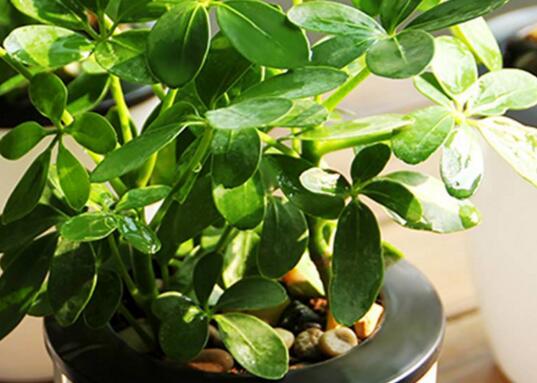
Before watering the umbrella tree, we first need to understand its environmental requirements. Through the umbrella tree growing method, we know that it likes a moist, humid environment, so when watering, it should be done reasonably according to the growth stage and climate changes. The watering frequency is obviously different at different times.
Umbrella tree watering method
1. Potting or repotting
When planting or repotting, water immediately after the umbrella tree is planted. This watering should not only soak through, but also test whether the soil drains well. If no water flows out of the drainage hole of the pot, the soil quality is too poor and needs to be adjusted promptly.
2. Spring and autumn growing season
In spring and autumn, the temperature is quite suitable for the umbrella tree's growth. So how do you water the umbrella tree at this time? The answer is to water 1-2 times per week, with the time and frequency depending on the moisture of the soil. When the temperature is relatively high, water twice; when it is below 18°C, water once a week.
3. Summer watering
In summer, you need to ensure the umbrella tree gets enough water and also keep the area around the leaves moist, so watering is generally done once a day. Depending on how hot the weather is, choose whether to spray water on the leaves. If the water evaporates quickly, spray more often. It is best to water in the morning.
4. Winter watering
In "How to care for an umbrella tree in winter," we emphasized that the soil should be kept slightly on the dry side and should not be watered heavily. The watering frequency can be once every 7-15 days; just make sure the soil does not become too dry. Also, when watering, the water temperature should not be below 8°C.
Umbrella tree watering precautions
1. Avoid waterlogging. The umbrella tree likes water but is not tolerant of waterlogging, so there should be no standing water when watering. Especially in summer when watering is more frequent, do not pour too much water each time, otherwise root rot will occur.
2. The water must be clean. The water used should be clean and hygienic; simply fill a watering can with tap water to water the plant. Avoid water that is too dirty, which allows microorganisms to breed, otherwise pests may appear.
[Flower Time] Common indoor flowering plant cultivation methods
AnthuriumCharacteristics: The flowering period can last up to 6 weeks; evergreen in all four seasons and can bloom year-round.
Care: Note not to mist the leaves in the evening; make sure there are no water droplets on the anthurium leaves at night. In hot seasons, water usually once every 2-3 days, and at noon also use a sprinkler system to spray the leaves to increase indoor relative humidity. In cold seasons, watering should be done between 9 a.m. and 4 p.m. to avoid freezing the roots.
Radermachera (China Doll)
Alias: Radermachera sinica
Temperature: Radermachera sinica likes warm, hot environments; the suitable growing temperature is 20-30°C. During winter, the minimum should not fall below 5°C, to avoid cold damage to leaves or leaf drop.
Light: Radermachera sinica is a light-loving plant and can also tolerate slight shade; full sun and semi-shade environments are both acceptable. When displayed indoors, it should be placed by a window with ample light or in a bright indoor spot.
Water: For potted plants displayed indoors, besides keeping the potting soil moist, in hot seasons the plant should also be sprayed with water 2-3 times a day. For plants placed indoors in winter, about every 2-3 days around noon on clear days, spray the plant once with slightly warm clean water to maintain its fresh appearance and also increase environmental humidity.
Phalaenopsis (Moth Orchid)
Growing medium: Common growing media for Phalaenopsis are mainly sphagnum moss and moss.
Temperature: When growing Phalaenopsis at home, temperature must first be ensured. Phalaenopsis likes high-temperature, high-humidity environments; the suitable growing temperature is 16°C to 30°C.
Watering: Phalaenopsis originates from primeval forests with a lot of mist and higher temperatures, and is suitable for cultivation and care in a ventilated, high-humidity environment. The suitable air humidity for Phalaenopsis growth is 50% to 80%. In summer, when the plant grows vigorously, water once each at 9 a.m. and 5 p.m. daily. In winter, with weak light and low temperatures, watering once every other week is enough, and it is best done before 10 a.m. But note: when misting during the flowering period, do not spray water mist onto the flowers. Tap water should be stored for more than 72 hours before use for watering.
Light: Although Phalaenopsis prefers shade, the orchid plant still needs to receive some light. Generally, it should be placed in a spot indoors with diffused light, and not exposed to direct sunlight.
Ventilation: Normal growth of Phalaenopsis requires flowing fresh air, especially during the high-humidity period in summer. Good ventilation must be used to prevent heat stress, and it can also help avoid infection by pests and diseases.
Fertilizing: Phalaenopsis should be fertilized year-round. Winter is the flower bud differentiation period for Phalaenopsis; stopping fertilizer can easily lead to no flowers or few flowers. Spring and summer are the growing period, and a dilute liquid fertilizer can be applied once every 7 to 10 days. In autumn and winter, during the flower stem growth period, phosphorus fertilizer can be used, but it should be dilute, applied about once every 2 to 3 weeks.
Areca Palm
Alias: Zi Kui, Arecaceae, Dypsis. Native to Madagascar; cultivated in Guangdong and Guangxi in China, often planted among flower beds in courtyards.
Propagation: At home, division can be used for propagation in spring, summer, and autumn. Garden soil mixed with some sand can be used as potting soil.
Cultivation: Likes warmth and has fairly good shade tolerance, but indoors it grows better if placed in a bright spot. Its cold resistance is not strong; in winter the temperature should preferably be kept above 8°C. Normally keep the soil moist; water as soon as the surface soil dries. In winter, wait until two-thirds of the potting soil is dry before watering. During dry weather, it is easy to spray water on the leaves. In spring, summer, and autumn, apply a compound fertilizer mainly based on nitrogen once a month. In addition, when kept as an indoor potted plant, the pot needs to be rotated regularly, because the plant has phototropism, so that it grows evenly and attractively on all sides.
Cultivation key points:
1. Temperature. The minimum winter temperature is 16-18°C; below this temperature the leaves turn yellow and fall off; below 10°C it easily dies.
2. Light. The areca palm is a strongly sun-loving plant and is grown in the open ground in places such as Hainan Island. But this plant has fairly strong shade tolerance and can be enjoyed indoors in a weak-light spot for 2-4 weeks continuously, then placed in a bright spot.
3. Water. During the high-temperature growing period, it needs sufficient water; but it has fairly strong drought tolerance and will not be harmed if not watered for several days. However, avoid standing water in the pot. Reduce watering in winter.
4. Air temperature. During the growing period it likes higher air temperature; you can frequently spray a small amount of water on the leaves.
5. Repotting. Repot in spring as needed.
Money Tree
The hand tree, commonly known as the money tree, is an evergreen shrub or small tree of the genus Pachira in the Araliaceae family. This plant is native to Australia and some islands in the Pacific. It is suited to warm, humid, well-ventilated environments; it likes sun and also tolerates slight shade, and grows best in loose, fertile, well-drained soil.
Potted hand trees should be repotted once every 1-2 years, carried out in spring when they are moved outdoors, and necessary pruning should be done on yellow leaves and thin, weak branches to encourage new shoots.
Watering: Watering should follow the principle of alternating dry and wet. In spring and autumn, control the watering frequency according to sunny or rainy weather and dry or wet conditions; generally water once a day. When the temperature exceeds 35°C, water at least twice a day. During the growing season, apply fertilizer twice a month. For newly grown leaves, also pay attention to misting to maintain relatively high environmental humidity. From June to September, shade is needed, maintaining 60%-70% light transmission or placing it in a spot with bright diffused light. After bringing it indoors in winter, the temperature should not be lower than 5°C; keeping it around 10°C is better. Water once every 5-7 days, and make sure to provide fairly ample light.
Ventilation: During the growing season, if ventilation is poor, red spider mites and scale insects are likely to occur, so observe carefully. If pests are found, remove them promptly or spray pesticide.
African Jasmine
African jasmine is an evergreen (climbing) shrub or small tree of the genus Fagraea in the Loganiaceae family, native to southern China and Southeast Asian countries.
African jasmine is an evergreen shrub or small tree. It likes warmth and sunlight, but requires avoiding direct strong summer sunlight; it likes environments with high air humidity and good ventilation, and is not tolerant of cold, dry freezing, or sharp drops in temperature; it grows best in loose, fertile, well-drained loam; it has strong budding and sprouting ability and is especially tolerant of repeated pruning.
Light: African jasmine likes sunlight. Its native environment is mostly semi-shade. In spring and autumn it can receive full light; in summer it requires shade from a canopy, or it can be moved under the dense shade of a large tree, at least avoiding direct sunlight for several hours around noon.
Water: Whether grown in the ground or in pots, it requires sufficient water, but the roots must not have standing water, otherwise root rot easily occurs. In spring and autumn, water enough to keep the potting soil moist; during the plum rain season, be careful to prevent waterlogging; in the scorching summer, spray water once each in the morning and afternoon to increase humidity and lower temperature; in winter, for indoor potted plants, keep the potting soil slightly moist, and around noon when the temperature is relatively higher, spray an appropriate amount of water on the leaves.
Soil: Use fertile loam or sandy loam as the cultivation soil.
Ventilation: Maintaining good ventilation can help avoid pest damage.
Queensland Umbrella Tree
Aliases: Queensland umbrella tree, Queensland shade tree, Australian schefflera, commonly known as the fortune tree.
Family and genus: A woody foliage plant of the genus Schefflera in the Araliaceae family, native to Australia. It is suited to warm, humid, well-ventilated environments; it likes sun and also tolerates shade, and grows well in loose, fertile, well-drained soil.
Soil: For potted umbrella trees, garden soil mixed with leaf mold can be used as the substrate. March to October is its vigorous growing period, with a relatively large amount of growth. Generally apply fertilizer once a month, while keeping the soil moist and ensuring sufficient water, and frequently mist the leaves to avoid dry air causing leaf chlorosis and yellowing.
Light: Indoor displays should be placed in a spot with some diffused light, and attention should be paid to ventilation.
In late autumn and winter, reduce the amount of watering and control the amount of fertilizer. In late autumn, foliar fertilization can be done by spraying 0.3-0.5% monopotassium phosphate or other phosphorus-potassium fertilizers to promote the aging of branches and leaves and improve cold resistance in winter. Under conditions of high temperature, high humidity, and poor ventilation in greenhouses and indoors, anthracnose or damage from scale insects and red spider mites may occur, so observe carefully and control promptly.
Bodhi Tree
The Bodhi tree is a plant of the genus Ficus in the Moraceae family, with a straight trunk and gray bark. Its crown is wavy and round, with hanging aerial roots. The Bodhi tree has many aliases: Sal tree, Alidoro, Indian Bodhi tree, Huangjiao tree, thinking tree, Pipala tree, and enlightenment tree, and it has deep ties with Buddhism. The original Sanskrit name of the Bodhi tree is "Pipala tree." Because the founder of Buddhism, Shakyamuni, attained enlightenment under the Bodhi tree, it came to be called the Bodhi tree, and "Bodhi" means "enlightenment." Buddhism has always regarded the Bodhi tree as a sacred tree. In jungle temples across India, Sri Lanka, and Myanmar, Bodhi trees are widely planted, and India has designated it as its national tree.
The Bodhi tree is native to India and is regarded as a sacred Buddhist tree. It is said that in the first year of the Tianjian era of Emperor Wu of Liang (502), the Indian monk Zhiyao Sanzang introduced the Bodhi tree from India and planted it in front of the altar at Guangxiao Temple in Guangzhou. Since then, Bodhi trees have grown in Guangdong and Yunnan in China.
Growing method: The care method for the Bodhi tree is basically the same as that for general flowering plants, with nothing special. It requires fertile soil, good aeration, and ample sunlight. Watering should follow "water when dry, and when watering, soak thoroughly." In summer, wait until the soil dries out for two or three days before watering; in winter, water once a week. Potted plants should be repotted once every two years. The soil can use field soil with leaf mold or pine needle soil.
Calathea
Calathea orbifolia, a perennial evergreen herbaceous plant of the genus Calathea in the Marantaceae family, also known as round-leaf calathea. It is named for its large leaves, fresh green leaf color, and round leaf shape that resembles an apple.
It is native to tropical American countries such as Brazil and was selected and bred by Europeans (Belgians and Dutch) from the original species of round-leaf calathea. It likes a high-temperature, humid, semi-shaded environment, fears cold, and avoids strong light. The suitable growing temperature is 18°C to 30°C. It requires relatively high air humidity and dislikes dry potting soil and environment.
Temperature: Calathea orbifolia likes a warm, mild environment, is not tolerant of intense heat, fears high temperatures, and has poor cold tolerance. Its suitable growing temperature is 18°C to 30°C.
Light: Calathea orbifolia likes semi-shade and avoids strong light exposure. Ordinarily, potted plants displayed indoors for viewing should be placed in a spot with ample diffused light or by a window.
Water: Calathea orbifolia likes moisture and avoids drought. Dry air easily leads to scorched leaf edges and poor growth. During the growing season, besides watering once a day, leaf and environmental misting should also be strengthened to keep relative air humidity at 85% to 90% or above.
Soil: Calathea orbifolia likes well-drained, loose, fertile, slightly acidic to acidic leaf mold or potting mix. The potting soil should preferably be made by mixing humus soil and compost with one-third river sand or wood chips, with the pH value preferably maintained between 5.5 and 7.2. When the pH value is above 7.5, its leaves easily show iron-deficiency chlorosis or yellowing and scorched leaf edges.
Fertilizer: During the growing period, Calathea orbifolia can be watered with dilute organic fertilizer once a week.
Large-flowered Cymbidium
Aliases: hybrid tiger orchid, tiger orchid, Cymbidium, cicada orchid
Large-flowered cymbidium is a ground-grown and semi-ground-grown type among the large-flowered and medium-flowered strains of the genus Cymbidium. It likes mild, high-humidity, well-lit, and well-ventilated environments.
1. Temperature. Large-flowered cymbidium likes mild winters and cool summers. It has strong adaptability to temperature and can grow at 10-35°C, and can withstand short periods of ultra-high temperatures of 48°C and short periods of low temperatures of 0°C. The suitable growing temperature is 10-25°C.
2. Humidity. During the vigorous growing season, large-flowered cymbidium requires sufficient water and relatively high air humidity. Generally, air humidity is required to reach 75%-90% for it to grow well.
3. Light. Light is an important factor affecting the growth and flowering of large-flowered cymbidium. Shade level is about 70%.
4. Water. Large-flowered cymbidium has relatively high requirements for water quality and likes slightly acidic water. Regarding calcium in the water,
5. Keep the room ventilated.
Belgian Azalea
Belgian azalea, also known as Belgian rhododendron, abbreviated as Western azalea. Belgian azalea is one of the excellent varieties of rhododendron and was first bred in Western Europe. It has many varieties, bright and varied flower colors, abundant flowers, and a long flowering period, with extremely high ornamental value.
Its flower characteristics are: it likes cool, humid conditions; fertilizing should be light rather than concentrated; it is cold-tolerant and fears stuffiness and heat.
Its repotting is best done in spring and autumn, once every two years, using an ordinary clay pot; the soil is best with high-quality mountain soil, and watering with tap water is fine. The water and soil in Shanghai tend to be alkaline, so it is best to apply ferrous sulfate once a month to keep the flowers and leaves evergreen year-round. Fertilizing must be done in spring and autumn: in spring after the flowers fade, in April and May; in autumn before flowering, in October to December. In spring, fertilize mainly with nitrogen fertilizer; in autumn, mainly with phosphorus fertilizer. The management of Belgian azaleas mainly means being careful in summer, especially in high-temperature weather: it must be placed in a cool, ventilated spot, watered once or twice a day, and just kept from drying out in the pot.
Snake Plant
Snake plant, also known as tiger skin plant or thousand-year plant, is a perennial herbaceous foliage plant of the genus Sansevieria in the Liliaceae family. The snake plant is relatively drought-tolerant. No matter what flower you water, you must stick to the principle of "do not water when not dry; when watering, soak thoroughly."
Its suitable growing temperature is 20-30°C, and the overwintering temperature is 10°C.
Snake plants can be propagated by division and cuttings. For golden-edged and spotted-leaf varieties, small seedlings propagated by leaf cuttings are green seedlings, and the golden edges and spots disappear, reducing ornamental value. Snake plant potting can use equal parts leaf mold and garden soil mixed with a small amount of decomposed base fertilizer as the substrate. It grows well under conditions of ample light; besides avoiding direct sunlight in midsummer, it should receive more sunlight in other seasons. If kept indoors for a long time, it should not suddenly be moved directly into sunlight, to avoid scorching the leaves.
Watering should be moderate, following the principle of preferring dry over wet. It does not have high fertilizer requirements. During the growing season, apply dilute liquid fertilizer 1-2 times a month to ensure the leaves are verdant and thick.
Dumb Cane (Dieffenbachia)
"Dripping Guanyin" is a commercial name; its real name is Alocasia (giant taro) - a perennial evergreen herbaceous plant of the genus Alocasia, native to the subtropics. It likes warm, humid, and semi-shaded environments and is not cold-tolerant.
Soil: Alocasia does not have high soil requirements, but it grows best in well-drained sandy loam or humus loam containing organic matter. Generally, the potting soil mostly uses a 2:2:1 mixed soil of leaf mold, peat soil, and coarse sand. During the growing season of Alocasia, be sure to keep the potting soil moist, and apply dilute N, P, K liquid fertilizer mainly based on N once or twice a month. In summer, place it in a semi-shaded, ventilated spot, and frequently spray water around it and on the leaves to increase air humidity, lower leaf temperature, and keep the leaves clean.
Temperature: Dumb cane likes warm, humid, and slightly shaded environments, but during the flowering period it needs ample sunlight and must be guaranteed 3-5 hours of light per day, otherwise the leaf stalks will elongate and affect ornamental value.
Fertilizing: Dumb cane likes moist, fertile soil, that is, what is commonly called "heavy fertilizer and heavy water." For topdressing, liquid fertilizers such as decomposed soybean cake water can be applied alternately with chemical fertilizers (compound fertilizer or diammonium phosphate), applying once every 2 weeks. When applying liquid fertilizer, never let the fertilizer water pour into the leaf sheaths, to avoid rot.
Golden Pothos (Philodendron 'Golden Diamond')
Golden diamond and peperomia belong to the same genus, and their care methods are similar. It likes warm, humid environments, but the potting soil must not be too wet. In winter, water once every two weeks; in summer, water daily. Do not let the summer sun scorch it, otherwise the leaves easily develop scorched spots. Also, if watered too frequently in winter, it easily loses leaves and rots stems, so remember this. The golden diamond philodendron is an evergreen plant of the Araceae family.
Winter care requires placing it in a spot with ample light, and the room temperature must be kept above 10°C! It also requires relatively good humidity. When spraying water on the leaves in winter, a certain water temperature is needed; do not spray cold water! The temperature should preferably be close to room temperature or slightly higher!
Watering should be done after the surface soil dries, and not too frequently! One or two days after watering, if the surface of the potting soil looks slightly dry, you can loosen the soil! Generally, no fertilizing is needed in winter. If the room temperature can be kept around 20°C, then fertilizing about once every half month is still needed! Normal management can be carried out!
Golden diamond likes warm, humid, semi-shaded environments, fears cold, and avoids strong light. It is suitable for growing in sandy loam rich in humus and well-drained. Frequently spray water on the leaves and sprinkle water on the ground to increase environmental humidity, and try to maintain a ventilated, warm, semi-shaded environment. In addition, golden diamond is best placed away from radiators and air conditioning vents, because the air in these places is too dry and water evaporates quickly, which very easily causes the leaves to dry up.
During the peak growing season of golden diamond from May to September, apply fertilizer water 1-2 times a month. The frequency and dosage must not be too much, otherwise the leaf stalks will become slender and weak and difficult to stand upright, thus affecting the ornamental effect. In other seasons, fertilize as little as possible. Watering should be flexible: in the dry seasons of spring and summer, keep the soil moist; in autumn and winter, follow "water when dry and wet alternately."
Cuilan (Cornflower)
+
Cuilan is robust, relatively cold-tolerant, likes sunlight, and requires fertile, loose, well-drained soil. Generally, it is sown directly in the seedbed in September. In areas south of central China, it can overwinter in the open ground, and no cold protection is needed in winter. It is transplanted in November or early March of the following year. During the growing period, apply liquid fertilizer once every 20 days, but note that too much nitrogen fertilizer should not be applied; appropriately apply more phosphorus and potassium fertilizers to make the stems firm and the flower colors bright. At the same time, watering should be moderate and not excessive. During the rainy season, be sure to drain promptly, otherwise root rot will occur and affect the normal growth of the plant.
Cuilan likes ample sunlight and a cool climate, avoids summer heat, and prefers fertile, loose soil. Because it has a taproot, direct sowing is preferable. For autumn sowing to bloom earlier, it can overwinter in a cold frame, and it can bloom in late spring. Because Cuilan does not tolerate transplanting, when transplanting it must be moved with a soil ball, otherwise it is not easy to recover. The potting soil should be loose and fertile; it is best to use a mixed soil of garden soil, leaf mold, and plant ash. In winter it can be continuously buried in soil to overwinter, then taken out in early March. Fertilize frequently, and stop fertilizing when flower buds appear.
It has strong cold tolerance; in East China it can be planted in the open ground, while in North China it must be covered to overwinter; it likes fertile and loose soil; it likes ample sunlight; it can self-sow; it has strong adaptability and is easy to cultivate. When cultivated as a cut flower, greenhouses are usually used to force flowering: sow in August, set out seedlings in September, and flowers can be produced in February of the following year. In warm areas within the pass, it is generally sown in August-September, overwintered in the open ground with cover, planted in early spring of the following year, and blooms in early summer. In Northeast China, it is sown in greenhouses in spring. Because the root of the cornflower is a taproot with few lateral roots, transplanting must be done with soil when the seedlings are small; larger seedlings are not easy to survive, so direct sowing in spring is often used.
Spider Plant
Spider plants like warm, humid, and semi-shaded spots and are not drought-tolerant. For home-grown spider plants, avoid sun exposure in summer and keep them indoors for viewing during the day. If conditions permit, place them outdoors in a windproof spot at night (but they must be ventilated). According to growth conditions, in April of spring, combine repotting with division propagation, and after repotting place them in semi-shade. The soil should be loose, rich in humus, and well-drained; soil that is too wet or too dry will cause the branches and leaves to yellow and wither. Usually, clean water can often be used to spray and water the leaves to keep them clean and moist. In winter, keep them indoors at around 15°C to protect them from cold damage.
For potted spider plants, under ordinary conditions, phenomena such as dry leaf tips and leaves gradually losing luster often occur. To care for and manage spider plants well, the following measures should be taken.
Appropriate light. Spider plants like semi-shaded environments. In spring and autumn, avoid direct strong sunlight. In summer, sunlight is especially strong, so they can only receive some slanted light in the morning and evening; during the day, 50%-70% of sunlight needs to be blocked, otherwise the leaf tips will dry up. Variegated varieties are especially afraid of strong sunlight. Golden-edged spider plants grow more beautifully in weak light, with the yellow golden edges more obvious and the leaves more glossy. But in winter they should receive more sunlight to keep the leaves tender and fresh green. Home-potted spider plants should be placed in front of a south-facing window, otherwise the leaves will lose luster or even wither.
Appropriate watering. Spider plants like humid environments, and the potting soil should often be kept moist. In summer, watering should be sufficient; around noon and in the evening, water should also be sprayed on the branches and leaves to prevent the leaves from drying up. Indoors there is often a lot of dust. If a lot of dust accumulates on the spider plant, it not only affects its growth but also damages the fresh, bright appearance of the branches and leaves, so the branches and leaves should often be sprayed and washed to keep them bright and beautiful. Dead lower leaves and yellow leaves should be removed at any time. Normally, maintain normal humidity; it should not be too dry, nor too wet. Changing soil and repotting: In managing potted spider plants, in order to achieve lush stems and leaves, the soil and pot should be changed once every year in March.
Asparagus Fern
Care: Asparagus fern is a perennial evergreen herbaceous plant that likes warm, humid, and semi-sunny environments, fears severe cold, and fears exposure to the sun. To keep an asparagus fern bonsai verdant in all four seasons and highly ornamental, the following points should be noted.
Location: An asparagus fern bonsai can be cared for indoors or on an enclosed balcony in all four seasons. Pay attention to air circulation.
Light: Asparagus fern likes warm, humid, and shaded environments and is not tolerant of direct strong light. In early spring, late autumn, and winter it can receive sunlight. At other times it should be shaded or receive diffused light.
Temperature: Asparagus fern can grow in all four seasons in an environment of 10°C-25°C. In winter, it can overwinter safely as long as the minimum temperature is above 5°C.
Watering: During the growing periods of late spring, summer, and early autumn, the potting soil can be appropriately on the wetter side. In winter, water evaporation is low, so watering should be appropriately reduced; just keep the potting soil moist.
Fertilizing: During the growing period, applying dilute organic liquid fertilizer once a month is enough. Too much fertilizer will promote excessive growth of the asparagus fern's branches and leaves, instead ruining its shape. Do not fertilize in winter.
Pruning: Asparagus fern grows quickly. During the growing period, new shoots often grow from the roots. Over time, old stems and leaves turn yellow. To keep the asparagus fern's stems and leaves emerald green and its posture graceful, old branches, leggy branches, and leaves that affect the shape should often be pruned away.
Parlor Palm
When potted, the parlor palm's plant height does not exceed 1 m. Its stem is slender, upright, unbranched, dark green, with irregular ring patterns. The leaves grow from the top of the stem; they are pinnate compound leaves, fully cleft, with wide lanceolate segments; the pinnate leaflets number 20-40, sickle-shaped, dark green, and glossy. The plant blooms in spring, with spicate inflorescences growing from the leaf axils, dioecious; the male flowers are slightly upright, and the female inflorescences droop slightly when nutritional conditions are good. The flowers are yellow and bead-like; the small berries produced are mostly orange-red or yellow.
Habits: It prefers a warm, humid and semi-shaded environment. The suitable temperature for growth is 20-30°C; it enters dormancy at 13°C, and the minimum wintering temperature in winter is 3°C.
Soil: For the cultivation substrate of the miniature coconut palm, a well-drained, moist and fertile loam is best. For pot cultivation, a substrate made by mixing leaf mold and peat soil with 1/4 river sand and a small amount of base fertilizer can generally be used.
Fertilizing: It does not have high fertilizer requirements. Generally, apply liquid fertilizer 1-2 times per month during the growing season, and apply little or no fertilizer in late autumn and winter. Repot once every 2-3 years in spring.
Watering: The principle for watering is to keep it dry rather than wet; keeping the potting soil consistently moist is sufficient. In summer and autumn when the air is dry, spray water on the plant frequently to increase the air humidity of the environment. This is beneficial to its growth and can also keep the leaf surface dark green and glossy; in winter, appropriately reduce the amount of watering to help it overwinter.
Sunlight: The miniature coconut palm prefers semi-shaded conditions and is afraid of direct sunlight. Under strong sunlight, its leaf color will fade or turn yellow, and scorched leaves and black spots will appear, causing it to lose its ornamental value.
Pests and diseases: Under high temperature and high humidity, the miniature coconut palm is prone to brown spot disease. If brown spot disease is found, promptly use 800-1000 times diluted thiophanate or baijunling for control. When the air is dry and ventilation is poor, scale insects are also likely to occur. If scale insects are found, in addition to manual scraping, they can also be controlled by spraying 800-1000 times diluted omethoate.
Golden Barrel Cactus
Golden Barrel Cactus, also known as Yellow-Spined Golden Barrel Cactus, is the most charming species of globe cactus in the Cactaceae family and the genus Echinocactus. Among cultivated palms there are also several main varieties, such as White-Spined Golden Barrel Cactus, Wild-Spined Golden Barrel Cactus, Short-Spined Golden Barrel Cactus, Golden Barrel Cactus Variegata, and Golden Barrel Cactus Cristata.
Origin and habits: The Golden Barrel Cactus originated in the desert regions of Mexico, and has now been introduced and cultivated in both southern and northern China. The Golden Barrel Cactus likes sufficient sunlight and mostly prefers fertile, well-drained sandy loam. During the hot high-temperature period in summer, it should be appropriately shaded to prevent the globe from being scorched by strong light.
Management techniques: The Golden Barrel Cactus likes calcareous sandy loam, which can be prepared by mixing equal amounts of coarse sand, loam, leaf mold and a small amount of old wall ash. It should be repotted and the soil changed once a year, and old roots should be trimmed.
Temperature: The Golden Barrel Cactus likes sufficient sunlight, but in summer it should be semi-shaded. When the temperature reaches above 35°C, it should be shaded around noon to avoid strong sunlight scorching the globe. The wintering temperature should be kept at 8-10°C, and the potting soil should be kept dry. If the temperature is too low, yellow spots will appear on the globe.
Watering: Summer is the peak growing season for the Golden Barrel Cactus, and its water requirement increases. If drought occurs, water frequently, preferably in the early morning and evening. Never water with very cold water at the hot midday, as this can easily cause "catching a chill" and lead to disease. If the potting soil is too dry at noon, a little spraying to moisten the pot surface is sufficient; do not spray water on the top of the globe or the grafted parts, to avoid water accumulation and rot.
Fertilizing: During the growing period, apply 1-2 times of dilute fertilizer solution containing nitrogen, phosphorus, potassium and other components about every half month, used together with watering. Organic fertilizer must be fully decomposed, and the concentration should be appropriate.
Pest and disease control: For red spider mites, use 40% dimethoate or 90% trichlorfon at 1000-1500 times dilution for spray control. When scale insects, whiteflies and other pests are found causing damage, they can be manually wiped off and killed.
Black Prince
Black Prince is a new variety derived from the rubber tree and is a common foliage plant. The leaves of the rubber tree Black Prince are graceful and substantial, and it is robust by nature, able to grow all year round. The name Black Prince sounds somewhat masculine, but its red leaf sheaths are like a shy young girl, bright red as if about to drip, revealing charm within its masculinity.
The rubber tree Black Prince grows quickly and has good adaptability. Usually, simple watering and fertilizing are enough, and no special management is needed. Since the rubber tree Black Prince has just been introduced, compared with ordinary rubber trees, farmers also have an advantage in price when planting it.
The rubber tree Black Prince can be potted or grown in the ground. In the north, it is more suitable for indoor cultivation.
Temperature: Shade it during high temperatures; if the light is too strong, it can easily scorch its leaves. The temperature must not be below zero; below zero it will suffer cold damage.
Watering: When watering normally, keep it on the wetter side as much as possible and water more.
Tree Philodendron
Tree Philodendron, also known as Spring Feather and split-leaf philodendron. It is a perennial evergreen plant of the Araceae family and the genus Philodendron, and is an excellent shade-loving indoor foliage plant. The following aspects should be noted in its care:
Pot and soil: A clay pot can be chosen for planting, and another pot can be placed outside it, which is both attractive and breathable. Since Tree Philodendron likes fertile, loose, well-drained, slightly acidic soil, household cultivation can use a mixture of leaf mold, peat soil, garden soil, etc. with a small amount of river sand. Depending on the plant's growth, repot once about every 2 years in spring.
Light and temperature: Tree Philodendron likes warmth, tolerates shade, and is not cold-resistant, and it avoids direct strong sunlight. In the hot summer, it should be kept in a shaded place. In winter, it can be placed in a sunny spot. Its suitable growth temperature is 18°C to 25°C, and the wintering temperature is preferably above 8°C.
Water and fertilizer: Tree Philodendron likes a humid environment; usually some rice-washing water can be poured on it, and during the growing period care should be taken to keep the potting soil moist. In summer, water can be sprayed on the leaves or around the flower pot every day to maintain a fresh and humid microclimate. In winter, as the temperature gradually decreases, the frequency of watering should be reduced. Although Tree Philodendron likes warmth and humidity, it has strong adaptability to the dry indoor environment of northern winters. When potting or repotting, place some hoof and horn pieces or oil residue at the bottom of the pot as base fertilizer, and afterward apply liquid fertilizer once a month (such as dilute cake fertilizer water). In winter, apply less or stop fertilizing.
Propagation: In household cultivation, the division method is commonly used. When the offsets sprouting from its base grow larger and develop adventitious roots, they can be separated and planted separately when repotting. The stem top can also be cut off in spring to promote axillary buds as propagation material. Using this method, the propagation rate is relatively high.
To make its plant shape compact, a support can be set up for guiding and tying, or by taking advantage of the phototropism of new leaves, the flower pot can be rotated to let the leaf blades of new leaves face the sun.
Golden Pothos
For potted Golden Pothos, fertile, loose, well-drained leaf mold should be chosen, preferably slightly acidic. Golden Pothos is extremely shade-tolerant and can be placed in a sunny indoor spot all year round. In dimly lit rooms, it should be moved every half month to a brighter environment for a period of recovery. Golden Pothos likes a hot and humid environment; the wintering temperature should not be lower than 15°C, the potting soil should be kept moist, and water should often be sprayed on the leaf surface to increase air humidity and favor the growth of aerial roots.
The following aspects should be noted during care:
Habits: It likes a humid, semi-shaded environment, is not cold-tolerant, and its suitable growth temperature is 15°C to 30°C.
Soil: For pot cultivation, loose, breathable, well-drained soil should be chosen. It can be mainly leaf mold mixed with 20-30% planting soil, or prepared by mixing peat soil and perlite.
Water and humidity: Midsummer is the growth peak. When the potting soil turns white, water thoroughly. It is appropriate to keep the potting soil moist regularly. Never let the potting soil dry out, otherwise it easily causes yellow leaves and poor plant shape. If too much watering causes water accumulation in the potting soil, it easily causes root rot and withered leaves.
Fertilizer: Fertilizing should be mainly nitrogen fertilizer, supplemented by potassium fertilizer. In spring, apply a 0.3% urea solution once about every 15 days, and use a 0.5‰-1‰ urea solution for one foliar feeding. During the growing season from June to August, apply liquid fertilizer once every 2 weeks; before winter begins, apply the above urea solution once by watering and spraying. After winter begins, when the room temperature is above 15°C, fertilize mainly by spraying a 0.5‰ urea solution on the leaves; the fertilizer is absorbed through the stomata on the leaf surface, and the fertilizer effect can act directly on the leaf surface.
Light: Place it indoors in a bright place with very little direct sunlight, where it can be kept for a long time. Put Golden Pothos in the brightest indoor spot, or move it to a sealed balcony to bask in the sun at noon. At the same time, when the temperature is low, open the windows as little as possible; in a very short time, the leaves may be frostbitten.
Temperature: Golden Pothos likes hot and humid conditions, and its optimal growth temperature is between 20°C and 25°C; in the north, with a room temperature above 10°C, Golden Pothos can overwinter safely, and with a room temperature above 20°C, Golden Pothos can grow normally.
Peperomia
Habits: It likes a warm, humid, semi-shaded environment, fears high temperatures, avoids strong light, and is afraid of cold. Its suitable growth temperature is about 25°C, and the wintering temperature should not be lower than 10°C. It requires loose, fertile and well-drained soil. The cultivation soil is best prepared by mixing peat, river sand and leaf mold at a ratio of 1:1:1.
Cultivation and care: Peperomia likes a cool and humid environment and grows better under scattered light. In spring and autumn, when the climate is mild and the sunlight is not too strong, the plant can be placed outdoors. But in summer it avoids direct strong light, and especially must not be placed in a spot with west-facing sun exposure, otherwise the branches and leaves will turn yellow. Therefore, after being moved outdoors in spring, it should be placed in a cool place such as a balcony or corridor, and in midsummer it needs appropriate shading.
During the spring and autumn growing period: Apply fully decomposed 20% cake fertilizer water once about every half month, and try to avoid contact with the leaves when fertilizing. In summer, when temperatures are high, avoid fertilizing to prevent fertilizer damage and root rot. Spring and autumn are its peak growing seasons, and the soil should be kept moist with sufficient air humidity, so the amount of watering can be greater. When temperatures are high in summer, Peperomia grows slowly; water once each morning or evening, and do not water frequently, otherwise high temperature and excessive moisture easily cause stem and leaf rot; the specifics depend on the weather and the potting soil.
Generally the potting soil can be on the drier side, because the stems and leaves are thick and fleshy, and excessive moisture easily causes root rot. Especially when it is in a dormant state in winter, the amount and frequency of watering should be controlled even more, and the potting soil should preferably be kept slightly dry. Potted plants placed indoors in winter should be put in a sunny place, and generally only need watering once a month.
Kalanchoe
1. The pot should preferably be small and well-ventilated, and loose sandy loam is good for planting
Kalanchoe grows best when planted in a well-ventilated clay pot, but it is not attractive indoors; a plastic or porcelain pot can be placed outside it, or it can be planted directly in a small purple clay pot or plastic pot. When planting, place a layer of crushed charcoal pieces or crushed hard plastic foam pieces at the bottom of the pot to enhance ventilation.
Although it is not very particular about soil, it easily rots in heavy clay, and grows best in loose, fertile, slightly acidic sandy loam. For household potting, it is advisable to mix equal amounts of leaf mold and garden topsoil, then add 5% to 8% sand as the culture soil. When planting, add a little bone meal or nitrogen-phosphorus-potassium compound fertilizer as base fertilizer.
2. Moderate water control makes the leaves lush, and more phosphorus and potassium fertilizer makes the flowers brightly colored
Kalanchoe is a succulent plant with a relatively high water content in its body, so it is fairly drought-tolerant and afraid of waterlogging, and grows well under the dry air conditions of high-rise buildings. In spring and autumn, water thoroughly once after the potting soil has been dry for about 3 days, and keeping it slightly moist is usually sufficient. In summer, water less; watering once every 5 to 7 days is best. For Kalanchoe placed outdoors, avoid rain during the rainy season; too much water easily causes root rot and leaf drop or even death. With appropriate water control so that the potting soil alternates between dry and wet, the branches will be luxuriant and the flowers plentiful. After moving indoors in winter, it is advisable to water at noon with water close to room temperature, about once a week.
Kalanchoe likes fertilizer. Half a month after young seedlings are potted and established, or half a month after old plants are divided, apply 2 to 3 times of nitrogen-based liquid fertilizer to promote stem and leaf growth, and after flowering apply once a nitrogen-based liquid fertilizer to promote rejuvenation. At other times, except for stopping fertilization in summer, only nitrogen-phosphorus-potassium compound fertilizer can be applied. When fertilizing, do not get fertilizer on the leaves, otherwise the leaves easily rot; if the leaf surface is accidentally soiled, rinse it off with water. Kalanchoe has a long flowering period, so the rule of not fertilizing during the flowering period should be broken: apply a dilute nitrogen-phosphorus-potassium fertilizer or 0.2% potassium dihydrogen phosphate solution once a month, so that the later flowers do not become smaller and paler due to lack of fertilizer.
3. It likes sunlight and tolerates semi-shade, fears intense summer heat and cold in winter
Kalanchoe likes a sunny environment. Except for slight shading at noon in midsummer, it should be placed in a sunny spot at other times. It needs at least 4 hours of direct light per day to grow robustly. On high-rise balconies, the flower pot should be turned 180 degrees every half month so that it receives even light and avoids a lopsided crown that lowers its ornamental value. Although it can also grow in semi-shade, the stems are thin, the leaves are thin, the flowers are few and the color is pale, far less luxuriant than in a sunny spot. If it is too shaded, it not only easily loses leaves and produces no flowers, but even a plant that has already bloomed, when placed in shade, will have its flower color become dull and then the flowers will drop and wither.
The most suitable temperature for Kalanchoe to grow is 15°C to 25°C. Above 30°C growth slows and it enters a semi-dormant state; below 10°C growth stagnates; below 8°C the leaf color turns red and flowering is delayed; below 0°C it easily freezes to death. Therefore, to grow Kalanchoe well, it is necessary to create a small environment that is warm in winter and cool in summer for it. At noon in midsummer, avoid strong sunlight exposure and place it in a semi-shaded spot with sufficient scattered light, such as under a large tree, under the eaves, or on a north-facing balcony. Pay special attention to ventilation and cooling; water can be sprinkled on the nearby ground, but not on the plant. After the Start of Autumn, from late August to early September, it can gradually be exposed to sunlight, and from October it should receive more sunlight to promote its transition from vegetative growth to reproductive growth. When the minimum temperature drops to about 10°C, move it indoors and place it in front of a south-facing or west-facing windowsill so that it receives more sunlight, keeping it at 10°C at night and 15°C to 18°C during the day; it can then bloom in December.
ZZ Plant
ZZ Plant, also known as Zamioculcas, Arum Fern and Cardboard Palm. There is no main stem above ground; adventitious buds sprout from the tuber to form large compound leaves. The leaflets are fleshy with short petiolules, firm and dark green; the underground part is a swollen tuber. Pinnate compound leaves emerge from the top of the tuber, the leaf rachis is strong, and the leaflets are opposite or nearly opposite on the rachis. The base of the petiole is swollen and woody; each compound leaf has 6-10 pairs of leaflets and has a lifespan of more than 5 years, being constantly renewed by new leaves.
Cultivation methods for ZZ Plant:
1. Note the temperature and burial depth when dividing. Division is best done when the temperature is above 18°C. A section can be broken off at a weak point where the tubers join and planted in a prepared pot. Do not bury it too deeply; burying the top of the tuber 1.5-2 cm below the soil is sufficient. It is best to apply sulfur powder or plant ash to the broken part.
2. The cultivation temperature is best at 20-32°C. When the temperature is relatively high in summer, it needs to be moved to a cool indoor place and more water should be sprayed on the plant leaves to lower the temperature. In winter, when the room temperature is below 5°C, it will harm the plant's growth, and antifreeze measures should be taken promptly.
3. It cannot be exposed to overly strong sunlight. The ZZ Plant is a plant that likes light and also tolerates shade. It is not suitable for growing under strong light. It is best placed beside a window in a spot with some obstruction, so that it can fully receive sunlight without the leaves being scorched by excessive exposure. The shading effect is best at 60%; excessive shade will cause the leaves to turn yellow.
4. It needs good soil for its growth. The soil should not only be loose, fertile and well-drained, but also rich in organic matter and preferably acidic to slightly acidic. When choosing soil, coarse sand, peat, washed coal cinder and a little garden soil can be mixed, and its pH adjusted to between 6 and 6.5 to make it slightly acidic.
5. Keep the soil slightly dry. Because the ZZ Plant has relatively high drought tolerance, it is usually best to keep the potting soil on the drier side. When the temperature is above 34°C, it is best to water once a day. In autumn and winter, water as little as possible, and spraying the plant leaves can replace watering.
6. When the temperature is above 15, fertilize twice a month. Because the ZZ Plant likes fertilizer relatively much, it can be fertilized twice a month during the growing season. The most convenient fertilizer choice is to buy fertilizer specially made for ZZ Plants, which is sold in flower markets. If chemical fertilizer is used, choose a mixed solution of 0.2% urea plus 0.1% potassium dihydrogen phosphate.
Precautions:
1. At noon or in late spring and early summer when it clears up after a long rain, pay attention to sun protection and give the plant appropriate shading.
2. In winter, the potting soil must not be too moist, otherwise under low-temperature conditions it will cause the plant's root system to rot; it is better to keep it on the drier side.
3. When the temperature is below 15°C, all fertilizing must be stopped, otherwise under low-temperature conditions the fertilizer will damage the roots and stems.
4. In winter when it is especially cold, pay attention to protecting the plant from the cold. At night, a double layer of plastic bags can be put over the plant, and when the temperature rises again, remove the plastic bags. 5. In summer, promptly listen to the weather forecast and prepare early to shade the plant.
Appreciation and Introduction of Common Foliage Plant Pictures
Appreciation and Introduction of Common Foliage Plant Pictures Part OneRubber Tree[Aliases] Large-Leaf Green, Red Burmese Tree, Red-Mouthed Rubber Tree, Indian Rubber Fig
[Family and Genus] Moraceae, Ficus
[Place of Origin] China
[Morphological Characteristics] Evergreen tree. Plant height 2-3 m. Stem hairless, with milky sap. Leaves thick, leathery, with long petioles; leaves are oblong or elliptical
[Cultivation Substrate] A sandy loam rich in humus should be chosen
[Watering] Keeping the soil on the drier or slightly moist side is sufficient. Summer is the period when the rubber tree needs the most water, so it can be watered more. Winter is the period when the rubber tree needs the least water, so supply less water
[Fertilizing] During the vigorous growing season, diammonium phosphate, potassium dihydrogen phosphate, etc. should be applied as topdressing
[Light] The rubber tree likes strong direct sunlight and also tolerates shaded environments. However, during cultivation it should receive no less than 4 hours of direct sunlight per day. If conditions permit, it is best to ensure the plant can receive full sun
[Ventilation] Keeping the environment properly ventilated is sufficient
[Temperature] The rubber tree likes high-temperature environments, so it grows fastest in summer and autumn. The environmental temperature should be kept between 20-30°C. When the environmental temperature is below 10°C, the rubber tree is basically in a state of growth stagnation. The wintering temperature should not be lower than 5°C
[Disease Control] The rubber tree is prone to anthracnose, whose pathogen is Gloeosporium elasticae. This disease mainly occurs in the high-temperature summer season, and the main affected part is the leaves. Its symptoms are round or elliptical gray spots appearing on both sides of the leaf veins, and in severe cases the lesions merge into one patch and spread to the entire leaf. Control methods are to avoid mechanical damage to the plant and reduce opportunities for the pathogen to infect the plant; promptly remove diseased leaves to prevent spread; prune reasonably so that the tree maintains a natural open-center form and achieves light penetration and ventilation.Asparagus Fern
Asparagus Fern, also known as Yunpian Bamboo and Mountain Grass, belongs to the Liliaceae family and the genus Asparagus.
Origin and habits: Asparagus Fern originated in South Africa. It likes warmth, humidity and semi-shade, and is not tolerant of drought or frost. It requires soil rich in humus and well-drained.
Morphological characteristics: Asparagus Fern is a perennial herbaceous plant with smooth, soft and slender stems in a climbing form. The leaves are fine and spread horizontally, small, about 3-5 mm long. True leaves are reduced to scales or spines. Flowers are small, bisexual, white. Berries are spherical and purple-black. The flowering period is mostly in February-March or June-July, and some bloom twice.
Propagation techniques: Asparagus Fern is mostly propagated by sowing and division. Sowing is carried out in March-April, and the seeds are soaked for 24 hours before sowing. Sow in spots in a 10 cm deep pot, cover with glass or plastic film, maintain a temperature of 20-25°C and keep the potting soil moist; germination can occur in 20-30 days. When the seedlings are 5-10 cm tall, they can be planted in a greenhouse or potted. Large plants 4-5 years old can be propagated by division in spring.
Management techniques: Asparagus Fern is a shade plant and should not be placed in a place with too strong light, otherwise the branches and leaves easily turn yellow and wither. Watering should be appropriate, keeping the potting soil alternately wet and dry; generally watering to moisten the surface soil is sufficient. In dry seasons, more clean water should be sprayed on the leaf surface. Asparagus Fern likes fertilizer; apply a fully decomposed dilute liquid fertilizer mainly containing nitrogen and potassium once every 10-15 days, or pour in leftover milk diluted with water. Asparagus Fern grows quickly, so weak, overly dense, old branches and dead stems should be thinned and pruned at any time, which helps ventilation and maintains a low posture. Asparagus Fern can also be planted in bamboo tubes, which have good water permeability and water retention, so there is no need to drill holes in the bottom.
Ornamental value: Asparagus Fern is mainly grown in pots for its foliage. It is fresh and elegant, and placing it in a study adds even more literary atmosphere. The roots, stems and leaves of Asparagus Fern can all be used as medicine and can be collected year-round. Its branches and leaves are fine, upright and elegant, with an open and dense fresh green, and a free and easy posture, making it a good accompanying material for cut flowers, bouquets and flower baskets.Areca Palm
Family and Genus: Arecaceae, genus Dypsis, evergreen shrub.
Origin and habits: Native to Madagascar Island in Africa, it is mostly potted in various parts of China. The Areca Palm likes a warm and humid environment, likes light and is also fairly shade-tolerant. Its height growth is slow while crown development is fast, and natural pruning is good. It requires slightly acidic, well-ventilated sandy loam and avoids alkaline soil.
Morphological characteristics: Plant height 3-4 m. Stems branch from the ground and have ring patterns; leaves spread in an arch shape, up to 2 m long, petioles smooth, yellow, pinnae lanceolate, 60 cm long, tips soft, with 3 raised main veins on the underside; flowers small, in strings, golden yellow, flowering period March-April.
Propagation techniques: Areca Palm can be propagated by sowing or division. Generally, pot cultivation mostly uses division propagation. Division propagation can be done in all four seasons, but autumn is best. Select well-developed shoots from a robust mother plant, cut them off from the mother plant at the root, and transplant them into a new pot to re-establish. Newly established plants, because their root systems have not yet developed well, should avoid long exposure to strong light. Water appropriately and spray water on the leaf surface several times a day to keep the leaves moist. Keep the temperature at about 20-25°C, and normal growth can occur in about 20 days.
Management techniques: For indoor potted Areca Palm, slightly acidic soil should be chosen; in the north, care should be taken to choose sandy loam with high humus content. Watering should follow the principle of “dry thoroughly, wet thoroughly” according to the season; water more appropriately in dry and hot seasons, and control watering in low-temperature rainy periods. In northern regions, especially where the water contains more salt and alkali, care should be taken to regularly use black alum to adjust soil acidity. Liquid fertilizer can be applied in all four seasons; in summer appropriately apply nitrogen-containing organic fertilizer as topdressing, and in winter organic flower fertilizer such as sesame paste residue can be applied. Rotate the flower pot regularly, often prune the lower and inner dead leaves, and pay attention to trimming the crown shape. In winter, the indoor temperature must be guaranteed to be above 10°C. When it is below 5°C for a long time, it will suffer cold damage.
Ornamental value: The Areca Palm is tall, with drooping green leaves and a free and easy posture, evergreen all year round. When potted to decorate conference venues, halls and rooms, it appears especially majestic and displays a tropical style. This species is a good material for park and courtyard landscaping in South China. In places such as Hong Kong, China and Macao, China, because its leaves grow radially in all directions, it is regarded as a symbol of a career “flourishing in all directions” and is highly favored.Alocasia (Dripping Guanyin)
Dripping Guanyin is a commercial name. When the soil water content is high, water will drip downward from the leaf tips or leaf edges, so many places call it Dripping Guanyin. This plant is a perennial evergreen herbaceous plant of the Araceae family, genus Alocasia - Alocasia macrorrhizos. It is native to the subtropics and likes a warm, humid and semi-shaded environment. It is not cold-tolerant, and in areas north of the Yangtze River basin in China it is all grown in pots and moved indoors before winter. Alocasia does not have high soil requirements, but grows best in well-drained, organic-matter-containing sandy loam or humus loam. Generally, the potting soil mostly uses a mixed soil of leaf mold, peat soil and coarse sand at 2:2:1. During the growing season, keep the potting soil moist and apply a dilute N, P, K liquid fertilizer mainly containing N once to twice a month. In summer, place it in a semi-shaded, ventilated place, and frequently spray water around it and on the leaf surface to increase air humidity, lower leaf temperature and keep the leaves clean. After winter begins, stop fertilizing and control the frequency of watering. Alocasia grows very fast, so during its growth process, fertilizer and water must be appropriate to avoid the lower part of the stem becoming bare, which affects its ornamental value.Malabar Chestnut (Money Tree)
[Aliases] Money Tree, Chinese-American Kapok, Chestnut Tree, American Peanut
[Family and Genus] Bombacaceae, genus Pachira
[Place of Origin] Central America, from Mexico to Costa Rica
[Soil] Well-drained sandy loam rich in humus is best
[Light] The Money Tree is not strict about light requirements and can adapt well whether in strong or weak indoor light. But full sun can make the leaf nodes shorter and the plant shape compact and full. Insufficient light makes the cultivated tree grow more slowly. Do not suddenly move the plant from shade to strong light, otherwise the leaves will be scorched, with burnt edges, affecting appearance
[Temperature] The Money Tree likes a warm and humid climate; generally 15-30°C is most suitable during the growth stage. In winter it should be moved indoors to overwinter, and the room temperature should preferably not be lower than 5°C
[Watering] The Money Tree should be kept regularly moist at ordinary times; remember not to let it be too wet, to avoid root rot. In summer, for a Money Tree placed indoors, water once every 3-5 days; in spring and autumn, water once every 5-8 days; in winter, watering should be restrained, and keeping the potting soil slightly moist is sufficient
[Fertilizing] Normally apply organic liquid fertilizer once every 2-3 months. A multi-element compound fertilizer with high phosphorus and potassium content can also be applied to promote thickening of the stem base and improve ornamental value. The high-temperature and high-humidity season in summer is very favorable to the growth of the Money Tree, so fertilizer and water management should be strengthened at this stage
[Economic Value] The Money Tree has a graceful plant shape and bright green leaves, and its tree shape is spindle-shaped. It can be woven into many shapes and can also be made into uniquely styled bonsai of various postures. Because its seeds contain oil, it was once widely promoted in tropical regions as a woody oil plantMiniature Coconut Palm
[Aliases] Dwarf Palm, Dwarf Coconut, Miniature Coconut Palm, Miniature Palm
[Family and Genus] Arecoideae, genus Chamaedorea
[Place of Origin] Mexico and Guatemala
[Growth Habits] It likes high temperature and high humidity and a semi-shaded environment, is not tolerant of strong light, and is not strongly cold-tolerant
[Soil] It requires well-drained, fertile and moist soil. Repot once every 2 years in spring. When repotting, because the roots are very fine, avoid damaging too many roots, which would affect its recovery and growth
[Temperature and Environment] The suitable growth temperature is 20-30°C; it enters dormancy at 13°C, and the wintering temperature is 10°C. It is afraid of direct sunlight and is not tolerant of drought. Under strong sunlight, its leaf color will fade or turn yellow, and in severe cases it causes sunscald, producing scorched leaves and black spots and losing ornamental value
[Fertilizing and Watering] This species has its growing period from March to September. Water promptly to keep the potting soil moist, but watering should follow the principle of keeping it dry rather than wet. In summer and autumn, when the air is dry and the temperature is high, water should also be sprayed on the leaf surface frequently to increase air humidity. During the dormant period, water less and keep the pot surface slightly dry. During the growing season, fertilize 1-2 times a month, and stop fertilizing at the end of September
[Economic Value] This species has a small and exquisite plant shape, graceful and elegant form, and emerald green and glossy leaves. It is highly shade-tolerant and full of tropical charmKing Coconut
[Family and Genus] Arecoideae, genus Ravenea
[Place of Origin] Eastern Madagascar
[Growth Habits] It grows in swampy areas and along riverbanks with sufficient rain and sunlight. It likes an environment with sufficient light and sufficient water, and is also fairly cold-tolerant and shade-tolerant
[Soil] It is not strict about soil requirements, but loose, fertile and well-drained soil is more favorable for its growth
[Temperature] It grows rapidly when sunlight and water are sufficient; the suitable growth temperature is 22-30°C. When potted, in cold regions it can be moved indoors to overwinter
[Fertilizing] It likes magnesium fertilizer; apply a top dressing once a month to keep the leaves emerald green. When magnesium is deficient, the leaves turn yellow.
[Economic value] This species has a thick trunk and a graceful, light and elegant plant form, beautifully green, with pinnate compound leaves resembling feathers. At the same time, because it adapts to a wide range of regions and grows well, it is an increasingly popular landscaping tree species. Grown in pots for indoor display, it has a distinctly tropical feel.Schefflera
[Aliases] Dwarf umbrella tree, hand tree
[Family and genus] Araliaceae, Schefflera
[Place of origin] New Hebrides Islands, South Pacific
[Growth habits] Likes high temperatures and high humidity
[Soil] The best growing medium is well-drained loam or sandy loam
[Temperature and environment] The optimum growth temperature is about 20-28°C. The temperature should generally not be lower than 12°C, nor higher than 30°C. If the winter temperature is too low, the leaves fall and the ornamental value is lost. When the temperature drops to 5°C, keep it warm. In summer, avoid direct strong sunlight all day long. It should be placed in a bright indoor spot, but not in direct sunlight. In a dark place, the yellow-white patches of variegated varieties will gradually disappear. After direct exposure to strong light, the leaves easily turn yellow and drop. When grown on a balcony, shade it in spring and summer, and give it light in autumn and winter.
[Watering and fertilizing] In spring and autumn, the potting soil should alternate between dry and moist; in summer, keep it mainly moist, and in winter, mainly dry. It is not selective about water quality. The growing period is mainly from April to October; fertilize once every half month.
[Economic value] The leaves of Schefflera are oily green, palmately compound, leathery and glossy; variegated varieties, with alternating yellow and green, are an ideal indoor ornamental plant. Schefflera tolerates pruning and sprouts vigorously; the plant has an elegant posture, and especially when used to beautify a room it can rival high-grade flowering plants. The flowers of Schefflera are a winter nectar source, and the root bark and leaves can also be used medicinally.Arenga engleri
[Aliases] Cluster fish-tail palm, wine coconut
[Family and genus] Arecaceae, Caryota
[Place of origin] Guangdong, Guangxi and Hainan, China; Indochina; India
[Growth habits] A semi-heliophilous tree species; it grows poorly under strong sunlight. It likes warmth, high humidity and a well-ventilated environment, and has fairly strong cold resistance, being one of the more cold-tolerant palm plants.
[Soil] It has strong growth vigor and a well-developed root system, and is not demanding about soil conditions. For pot cultivation, garden soil and humus soil mixed in equal amounts can be used as the substrate. Generally, repot once every 1-2 years; when repotting, remove part of the old soil, cut off some old roots, replant with new soil, and add a small amount of decomposed organic fertilizer.
[Temperature] The suitable growth temperature is 18-30°C, the wintering temperature is 3°C, and it can endure short periods of -1 to -2°C; being below this temperature for a long time will cause cold damage.
[Light] It is a light-loving plant and needs ample sunlight during the growing period. It has a fairly strong adaptability to light and is also suitable for cultivation and appreciation in brighter indoor spots.
[Watering] The roots are semi-succulent and have fairly strong drought resistance. During the growing period from March to October, water once a day; in other seasons, watering should keep moisture moderate, and never let water accumulate in the potting soil, so as to avoid root rot. During dormancy, just keep the potting soil moist; in dry climates, spray water on the leaves to keep them deep green and glossy.
[Fertilizing] During the growing period, generally apply liquid fertilizer or compound fertilizer 1-2 times a month to promote vigorous plant growth.
[Economic value] This species grows in clusters and is extremely vigorous, with a graceful and varied plant form, luxuriant branches and leaves, and a full, richly layered tree shape. Its leaf shape is unique and its leaf color deep green, making it an excellent indoor greenery decoration plant. It is often grown in medium or large pots and placed in lobbies, entrance halls, conference rooms and other places, where it looks extraordinarily imposing. The pith of the stem contains starch, which can be made into “sago” for eating. The sap of the inflorescence can be used to make sugar and brew wine.Pothos
Pothos, also known as Pothos, is a large evergreen climbing vine in the Araceae family. It is native to the Solomon Islands. In tropical regions it often climbs on rocks and tree trunks in fish forests and can grow into a huge vine. The green leaves have yellow patches.
Pothos is one of the very best indoor decorative plants. Its vines are slender and soft, and its leaves are delicate and elegant, like green reliefs. The bright-colored green decoration is full of vitality and adds a warm touch of charm to a room.
It has strong shade tolerance and is an excellent material for beautifying a room. Placed indoors, it can make the room full of life.
Temperature: Likes a warm environment; the minimum wintering temperature is 10-13°C; for variegated pothos, 16°C.
Light: Likes a semi-shady environment; it can grow well in a relatively bright room; excellent variegated varieties easily die under weak light conditions.
Water: In spring, summer and autumn, the potting soil should have sufficient moisture; water when the top 1-2 cm of the potting soil becomes dry; in winter, when the temperature is low, reduce watering.
Air humidity: Likes high temperature and high humidity; spray water on the plant regularly.
Repotting: Repot in spring as needed.
Propagation: In spring and summer, stem cuttings root easily; for making a totem pole, use tip cuttings with large leaves, as this shapes up relatively quickly.Brazilian wood
The scientific name of Brazilian wood is Dracaena fragrans, with aliases Brazilian iron tree, Brazilian millennium tree, and golden-edged fragrant dragon tree. It is a plant in the Liliaceae family and the genus Dracaena.
Origin and habits: Brazilian wood is native to tropical regions. It likes environments with ample light, high temperature and high humidity, and is also shade-tolerant and drought-tolerant. It also grows well in bright scattered light and in the relatively dry environment of northern rooms.
Morphological characteristics: Brazilian wood is an evergreen tree with a neat plant form and an upright stem. The leaves are clustered at the top of the stem, 40-90 cm long and 6-10 cm wide, with slightly blunt tips, curved into a bow shape, and have bright yellow or milky white stripes; the leaf margins are bright green, with wavy undulations, and glossy. The flowers are small, yellow-green, and fragrant.
Propagation technique: Brazilian wood is propagated by cuttings. Use the branches trimmed from poorer-shaped stems as cutting material, cut them into 5-10 cm sections, and insert them upright or flat in a cutting bed with coarse sand or vermiculite as the medium. They can also be rooted by water culture. The specific method is to insert the cut stem sections into water; the cut surface should be smooth, and the upper end can be coated with wax to prevent water evaporation, which is especially important in the dry season. The lower end is immersed 2-3 cm in water, the temperature is above 25°C, and the water and container should be kept clean. Tip cuttings with leaves root relatively quickly, and can root and be potted in 3-4 weeks; stem sections root more slowly, sometimes requiring 2-3 months to grow new roots and new shoots.
Management technique: As long as conditions such as temperature are suitable, Brazilian wood can grow all year round. In summer, when it is hot, it needs appropriate shading; in winter, the room temperature must not be lower than 5°C. But it is best to let it go dormant in winter; the dormancy temperature is 13°C. If the temperature is too low, yellow-brown spots will appear on the leaf tips and leaf margins. Brazilian wood placed indoors should be in a place with sufficient light. If the light is too weak, the markings on the leaves will turn green, and the basal leaves will yellow, losing their ornamental value. During cultivation, keep the water clean, and water 1-2 times a week; do not use too much water, to prevent the trunk from rotting. In summer, when it is hot, you can use spraying to increase air humidity and spray water on the leaves to keep them moist.
During the growing period, Brazilian wood should be given appropriate foliar top dressing, spraying the leaves with 100-fold diluted nutrient solution once every half month. After Brazilian wood has been cultivated for several years, when the plant is too tall or the lower leaves of the stem have fallen off and the plant form is poor, it should be pruned. Repot or change the soil every year in early spring. If the environment for potted Brazilian wood is unsuitable, it may be damaged by red spiders, thrips, scale insects, and so on. In addition, excessive ventilation, drought, irregular watering and excessive fertilizing can all cause the leaf tips to scorch.
Ornamental value: Brazilian wood is a rather popular large indoor potted flowering plant, especially when placed in relatively spacious living rooms, studies and sitting rooms, where it has an elegant, simple style with a southern-country feel. It is a world-famous new-generation indoor foliage plant with a beautiful and neat plant form.Peacock arrowroot
Also known as mosaic arrowroot, it is a foliage plant in the Marantaceae family and the genus Maranta. It has tubers at the base and is 20-30 cm tall. The leaves are long-elliptic, with a green-white leaf surface, brown markings along the edges of the midrib, and the leaves are evergreen all year round, with a unique metallic luster; the brown patches are like a peacock spreading its tail, with a fresh, gorgeous and soft color. It is a common indoor foliage plant. Many plants in this genus have relatively high ornamental value and are important plants used to decorate indoor environments around the world. Common varieties include:
(1) Maranta arundinacea var. variegata. Also known as variegated arrowroot, its leaves are long-elliptic, large and thin, the leaf surface is green like velvet, and there are zebra-stripe-like feather-like stripes on both sides of the midrib, with the leaf underside purplish red.
(2) Red-backed arrowroot. The leaves are broadly elliptic, the surface is green, the markings are not obvious, and the leaf underside is purplish red.
(3) Mosaic arrowroot. Also called arrow-feather-patterned arrowroot, the leaf surface is green, with pale yellow feather-like stripes on both sides of the midrib, the leaf underside is deep purple, and the flowers are pale yellow.
(4) White-spotted arrowroot. The plant is 50-60 cm tall, the stems are weak, the leaves are large and thin, ovate-lanceolate, with irregular white patches among the green leaves.
(5) Double-line arrowroot. Also called red-feather arrowroot, the leaves are long-elliptic, the surface is pale green, and there are white or peach-pink parallel double-line stripes on both sides of the midrib, which is very beautiful.
Peacock arrowroot is native to the Americas. It likes semi-shade and high-temperature, humid environments, and is not cold-tolerant. The suitable growth temperature is 20-30°C; above 35°C or below 7°C, growth is poor. The wintering temperature must not be too low, otherwise the leaves easily curl. It requires loose soil rich in humus and well drained.
Arrowroot plants are mainly propagated by division, mostly in spring from April to May in combination with repotting. Division should not be done too early, otherwise the low temperature easily damages the roots and affects survival and growth. When dividing, separate into 2-3 clumps as one plant; too few will affect growth. After planting, water thoroughly once and keep it in a semi-shady place for care. Before new roots emerge, control watering and do not make the soil too wet.
The potting soil can be made by mixing 3 parts leaf mold, 1 part peat or sawdust, and 1 part sand, with a small amount of soybean cake as base fertilizer. When potting, first place a 3 cm thick layer of coarse sand at the bottom of the pot as a drainage layer to facilitate drainage.
From May to September, shade the plant during growth or place it in semi-shade, maintaining a light transmission rate of 40%-60%, and avoid direct sunlight, otherwise the leaves are easily scorched or the edges scorch and curl. If kept indoors for a long time, with low temperature and insufficient light, growth will also weaken and the leaves will lose their unique luster. In winter, it can receive direct sunlight through glass.
Arrowroot has relatively high humidity requirements. During routine care, place the flowerpot on an inverted flowerpot and frequently spray water on the leaves and surrounding environment to keep the surroundings and ground moist, so as to increase environmental humidity. Water before the potting soil dries out completely, otherwise the leaves easily curl and scorch at the edges due to dryness. In the peak growing season, apply a light soybean cake fertilizer or slow-release chemical fertilizer once a week; do not use too much nitrogen fertilizer. In summer, when it is hot, apply a thin fertilizer once every half month, and stop fertilizing when the temperature is below 15°C. During care, maintain good ventilation conditions, otherwise scale insects easily occur, affecting stem and leaf growth and reducing ornamental value.
Peacock arrowroot is a perennial evergreen herbaceous plant. Its leaf surface has feather-like markings alternating between dark green and white or pale yellow, and it has a unique metallic luster, like a peacock's tail feathers, hence the name. Peacock arrowroot is small and beautiful, and its leaf color is fresh and gorgeous, making it outstanding among foliage plants. For pot cultivation, choose a culture soil mixed evenly from leaf mold, garden soil and a small amount of river sand. During the growing period, apply a dilute liquid fertilizer once every 3-4 weeks. When fertilizing, be careful not to apply too much nitrogen fertilizer; generally the ratio of nitrogen, phosphorus and potassium is 2:1:1, which can make the leaf color glossy and gorgeous. Soilless cultivation can also be used; during the growing period, simply apply nutrient solution 1-2 times a month. Water to the extent of keeping the potting soil moist. Peacock arrowroot likes humid air, so pay attention to using methods such as spraying and sprinkling water to increase air humidity, especially in summer, and pay even more attention to increasing humidity and lowering temperature to benefit growth. For home cultivation, it can be placed in a bright indoor spot, and must not be exposed to strong direct light, otherwise the leaf margins easily scorch. If kept for a long time in a dimly lit place, the leaves will lose their unique luster. In winter, place it in a bright spot, and at the same time pay attention to cold protection; the room temperature should preferably be kept above 13°C, stop fertilizing, and control watering. In northern winters, indoor air is dry, so in addition to spraying and washing the leaf surface with cool boiled water once every 3-5 days, it is best to cover it with a plastic film cover at night to keep it warm and moist. If conditions permit, a humidifier can be used to increase indoor humidity. To maintain its gorgeous leaf color, also gently wipe the leaves with clean water regularly. Peacock arrowroot is mostly propagated by division. When dividing, it is best to plant 3-5 plants per pot.
Image:Image:Peace lily (Spathiphyllum kochii)
Also known as white sail, spathe lily, Spathiphyllum kochii, and silver spathe. Araceae, Spathiphyllum. Native to tropical regions of the Americas.
Morphological characteristics: Perennial evergreen herbaceous plant. The plant is 30-40 cm tall. The leaves are basal, leathery, long-elliptic or broadly lanceolate, with long tips, and the leaf color is deep green. The leaves are 20-30 cm long and about 10 cm wide, the petioles are about 30 cm long, and the veins are obvious. Because the spathe curls into a spoon shape and is white like a snow lotus, shaped like palms joined together, it is called white sail; because its pure white spathe is like a white boat raising its sail on green water, in social interactions it carries the blessing meaning of smooth sailing, to encourage people to strive in life and for a flourishing career.
The peace lily is very similar to the white anthurium, and also has white bracts, but the leaves and the spathe of the flower are somewhat different. The spathe of the peace lily does not turn outward but curls inward, and the ovate bract is not as bright and leathery as that of the white anthurium.
Cultivated hybrids in the same genus include: Perfumed peace lily: its flowers have a faint fragrance. Green Giant peace lily: also called Green Giant, the plant is taller than the peace lily, and the leaves are larger than those of the peace lily, with the parallel feather-like lateral veins more obvious, thus appearing more vigorous and full of life; it is a trendy indoor potted plant.
Habits: Likes warm, humid and semi-shady environments; must not be exposed to direct sunlight; afraid of cold. Avoids heavy clay soil; suitable for sandy loam rich in humus.
Cultivation management: The peace lily is relatively shade-tolerant; as long as there is about 60% scattered light, its growth needs can be met, so it can be kept indoors all year round in a place with bright scattered light. In summer, 60%-70% of sunlight can be shaded off; avoid strong direct light, otherwise the leaves will turn yellow, and in severe cases sunscald will occur. In northern winter greenhouse cultivation, no shading or little shading is needed. If the light is too dim for a long time, it is not easy to flower. The peace lily is a high-temperature-loving type and should be cultivated in a high-temperature greenhouse. In winter, the minimum nighttime temperature should be 14-16°C, and the daytime temperature should be about 25°C. Long-term low temperature easily causes leaf drop or scorched-yellow conditions.
During the growing period, keep the potting soil moist regularly, but avoid overwatering and long-term wetness of the potting soil, otherwise root rot and plant yellowing and withering easily occur. In summer and dry seasons, frequently spray water on the leaf surface with a fine-nozzle sprayer and sprinkle water on the ground around the plant to keep the air moist, which is very beneficial to its growth and development. When the climate is dry and air humidity is low, new leaves will become smaller and yellow, and in severe cases wither, yellow and drop. In winter, control watering, and keep the potting soil slightly moist.
In the peak growing season, apply a dilute compound fertilizer or decomposed soybean cake fertilizer water once every 1-2 weeks; this is beneficial both for robust plant growth and for continuous flowering. In northern winters, when the temperature is low, stop fertilizing.
For potting soil, mix leaf mold or peat soil with about 1/4 river sand or perlite evenly, and add a small amount of bone meal or cake powder as base fertilizer. The potting soil should be loose and have good drainage and air permeability. Generally, before a large number of new shoots sprout in early spring each year, repot once; when repotting, remove part of the old soil, trim the root system, add new culture soil and plant in a pot one size larger, to facilitate root development and promote robust growth.
Propagation: It can be propagated by division and sowing, and can also be mass-propagated by tissue culture.
1. Division propagation: Because the peace lily easily produces suckers, this method is mostly used for propagation. Vigorously growing plants can be divided about once every 2 years. Before new shoots emerge in early spring, turn the whole plant out of the pot, remove the old soil, and cut the rhizome apart at the base of the clump. Each small clump should preferably have more than 3 stems and buds, and should carry as many roots as possible, so that the new plant can quickly send out new leaves and have a full plant form.
2. Sowing propagation: This method of propagation is not difficult either. In a greenhouse, seeds can be obtained after artificial pollination. After the seeds mature, sow them as soon as they are harvested; the sowing temperature should be about 25°C, as seeds easily rot at low temperatures.
Pests and diseases: With too much fertilizer or cold damage, the leaves easily yellow at the tips. At this time, change the soil immediately.Image:Dieffenbachia 'Marianne'
Dieffenbachia, also known as mosaic dieffenbachia and silver-spotted dieffenbachia, is native to tropical America. The plant is 30-90 cm tall, the flowers are upright, the internodes are short, the leaves are long-elliptic with slightly wavy margins, and the leaf surface is covered with various milky white or cream-yellow markings or spots. It is shade-tolerant, and its leaf color is elegantly green. The main cultivated varieties include Marianne, KIKI, Golden Sun, White Jade, Duozi Zebra, Golden Treasure, Heavenly Dieffenbachia, and so on.
The suitable growth temperature for Dieffenbachia is 25-30°C, with a daytime temperature of 30°C and a nighttime temperature of 25°C. The possible growth range is 18-30°C from February to September, and 13-18°C from September to February of the following year. In winter, the temperature must not be lower than 10°C, otherwise the leaves are prone to cold damage.
Dieffenbachia likes an environmental humidity of 80%. When the soil dries to 2 cm at the surface, it should be watered. During the growing period, water sufficiently and spray water on the leaves. If water is not sprayed for a long time, the leaf surface becomes rough and loses its luster. Soil moisture is best kept alternating between dry and wet; water more in summer, and control watering in winter.
Dieffenbachia is shade-tolerant and afraid of sun exposure. If the light is too strong, the leaf surface becomes rough, and the leaf margins and leaf tips easily scorch, or even large areas are burned. If the light is too weak, the color of the yellow-white patches turns green. It grows best under bright scattered light, and the leaf color is brighter and more beautiful.
The soil should preferably be fertile, loose and well-drained loam. The potting soil is a mixed soil of leaf mold and coarse sand.
[Propagation methods] Commonly propagated by cuttings, sowing and tissue culture.
Cutting propagation: Cuttings are best taken during the high-temperature period from July to August. Cut 7-10 cm from the top of the stem, remove part of the leaves to reduce water evaporation, insert into a sand bed or wrap the cut with water moss, maintain relatively high air humidity, and keep the room temperature at 24-30°C. Roots form 15-25 days after insertion. After new shoots sprout on the stem sections, transplant and pot them.
Sowing propagation: Dieffenbachia must be artificially pollinated before it sets fruit. After the seeds mature, sow them immediately; the seeds need to be cleaned to avoid mold and rot. Before sowing, the potting soil should be sterilized. After sowing, cover with 1 cm of soil, keep the room temperature at 24-29°C, and germination occurs 7-14 days after sowing. Transplant when the seedlings are 3 cm tall.
Tissue culture propagation: At present, lateral buds and terminal buds have been used as explants. After routine disinfection, inoculate them on MS medium supplemented with 3 mg/L 6-benzylaminoadenine and 2 mg/L naphthaleneacetic acid. After 45 days, when the adventitious buds grow to 2 cm, transfer them to 1/2 MS medium supplemented with 2 mg/L indoleacetic acid. Roots can form in about 20-25 days, forming complete small plantlets.
[Cultivation management] Dieffenbachia is commonly potted in 15-20 cm pots. During the growing period, fertilize once every half month, or use "Huiyou" 20-8-20 four-season high potassium nitrate fertilizer. When the room temperature is below 15°C, stop fertilizing. If the winter temperature is below 10°C and watering is excessive, leaf drop and stem tip rot will be caused. If the plant only drops leaves and the stem does not rot, then after the temperature rises again, it can still continue to sprout and spread leaves. After potted plants have grown for 1-2 years, there are more basal suckers, and division propagation can be carried out in combination with repotting. If the plant grows relatively tall, the aboveground part can be cut off leaving 2-3 nodes at the base; the remaining stem nodes can still sprout and branch, maintaining a relatively good plant form.
[Pest and disease control] It is mainly harmed by bacterial leaf spot, brown spot and anthracnose, which can be sprayed with 500-fold 50% carbendazim wettable powder. Sometimes root rot and stem rot occur; in addition to paying attention to ventilation and reducing humidity, 800-fold 75% chlorothalonil wettable powder can be sprayed for control.
[Post-production handling] Dieffenbachia has large leaves with beautiful color patches, and is suitable for potted appreciation, embellishing living rooms and studies, where it looks very comfortable and elegant. Used to place in public places with low light, Dieffenbachia still grows normally, with green leaves and luxuriant branches and leaves, full of vitality, and is especially suitable for placement in modern buildings. Dieffenbachia can endure 14 days in darkness, and can be stored and transported at 15°C and 90% relative humidity.
Image:Phoenix roebelenii
Phoenix roebelenii, also known as soft-leaved date palm, is a foliage plant in the Arecaceae family and the genus Phoenix.
Phoenix roebelenii is an evergreen shrub with a short, thick stem, usually solitary but sometimes clustered, and a plant height of 1-3 m. The leaves are pinnate, upright when young, and slightly curved and drooping when somewhat longer. There are long spines on both sides of the base of the petiole, with triangular protrusions, which is one of its characteristics; the leaflets are lanceolate, about 20-30 cm long and about 1 cm wide, relatively soft, and droop in an arc. The spadix is axillary, 20-50 cm long, and the species is dioecious. The fruit is about 1.5 cm long, pale green at first, and jujube-red when ripe.
Phoenix roebelenii is native to the Indochina region, and is widely cultivated in various provinces and regions of southern China. There are about 17 species in the same genus, mainly produced in the tropical and subtropical regions of Asia and Africa. It likes a high-temperature, high-humidity tropical climate, likes light and is also shade-tolerant, drought-tolerant, barren-tolerant, and likes well-drained, fertile sandy loam. It has relatively strong cold resistance, and in winter can safely overwinter at around 0°C.
Phoenix roebelenii is mostly propagated by sowing. After flowering, pollination easily results in fruit; the fruit matures from October to November, and can be sown immediately after harvest or in the following spring. Sow the seeds in river sand and keep the substrate moist. At 20-30°C, seedlings can emerge in 2-3 months or longer. When the cotyledons of the seedlings reach 5-10 cm, apply dilute liquid fertilizer, then divide and transplant into pots and strengthen water and fertilizer management.
For potted Phoenix roebelenii, 2 parts leaf mold, 1 part garden soil and 1 part river sand can be mixed as the substrate, and a small amount of base fertilizer added when planting. It has strong adaptability, and both cultivation and care are simple. During the vigorous growth period from April to September, apply liquid fertilizer 1-2 times a month, keep the potting soil moist, and in dry air spray the plant once a day to increase the environmental air humidity, which benefits plant growth; in other seasons, fertilize less or not at all, and keep the potting soil alternately dry and moist. From June to September, when the light is strong, shade it (a shading level of 50% is suitable) to prevent the leaves from turning yellow; in other seasons, give relatively ample light to promote robust plant growth. Phoenix roebelenii is prone to scale insects when the air is dry and ventilation is poor. If scale insects are found, control them; generally 800-fold omethoate can be sprayed to kill them; at the same time improve ventilation and air permeability conditions.
The branches and leaves of Phoenix roebelenii arch and droop like an umbrella, and the leaves are evenly distributed and green and glossy, making it an excellent potted foliage plant. Using it to decorate a room can fill it with a tropical feel. Generally, small and medium pots are suitable for living rooms, studies and other places, looking elegant and generous; large plants in pots are often used to decorate conference venues, halls and so on, looking solemn and majestic.
Image:Cast-iron plant
Scientific name: Aspidistra elatior
English name: Common Aspidistra
Aliases: Spider-embracing egg, bamboo-leaf plant
Family name: Liliaceae
Morphological characteristics:
Evergreen herb with rhizomes. The leaves are elliptic to narrowly lanceolate, deep green, with slightly wavy margins. The flowers are bell-shaped. The flowering period is April. The capsule is spherical. It likes shade and cannot tolerate strong light, likes warmth and is relatively cold-tolerant, likes moisture, and is suitable for well-drained, fertile sandy loam.Silver Queen
Latin name: Aglaonema commulatum cv.Silvcr Queen
Aliases: Silver Queen dieffenbachia, Silver Queen Chinese evergreen, Silver Queen aglaonema
Botanical characteristics: > It is a perennial herbaceous plant. The plant is 30-40 cm tall, the stem is upright and unbranched, and the internodes are obvious. The leaves are alternate, with long petioles that expand at the base into a sheath; the leaves are narrow and long, pale green, with gray-green streaks on the leaf surface, and the area is relatively large.
Silver Queen is famous for its unique air-purifying ability: the higher the concentration of pollutants in the air, the more it can exert its purifying ability! Therefore, it is very suitable for dark rooms with poor ventilation.
This plant with gray-white leaves likes to live in a constant-temperature environment. If watered with warm water, it can survive for a relatively long time.
Can remove: formaldehyde, nicotine
“Silver Queen can absorb the radiation from printers.”Snake plant
Snake plant, also known as tiger skin plant and thousand-year plant, is a perennial herbaceous foliage plant in the Liliaceae family and the genus Sansevieria.
The underground part of the snake plant has tough rhizomes, and it has no stem. The leaves are clustered, fleshy, linear-lanceolate, hard and leathery, upright, and slightly grooved at the base; dark green, with horizontal bands alternating between pale green and dark green on both sides, and slightly covered with white powder. The raceme has white to pale green flowers with a sweet, elegant fragrance; the flowering period is spring and summer. Common cultivated varieties include:
Golden-edged snake plant: similar in shape to the snake plant, but the leaf margins are bordered with broad golden-yellow bands.
Short-spiked snake plant: a dwarf variety, about 10-20 cm tall, a mutant of the golden-edged snake plant, with short and wide leaves that grow in a spiraling, overlapping manner.
Onion-leaf snake plant: also called cylindrical-leaf snake plant. The leaves are cylindrical, with roughly the same thickness from top to bottom, slightly tapering at the tip, and the leaf surface has longitudinal shallow groove-like depressions; each leaf grows independently.
The snake plant is native to arid Africa and southern Asia, and is cultivated in all parts of China. It has strong adaptability, likes warm and humid conditions, is drought-tolerant, and likes light while also tolerating shade. It is not demanding about soil, and sandy loam with good drainage is better. Its suitable growth temperature is 20-30°C, and the wintering temperature is 10°C.
The snake plant can be propagated by division and cuttings. After the temperature rises in spring each year, carry out division in combination with repotting, that is, take the whole plant out of the pot, remove the old culture soil, expose the rhizome, and cut it along its direction into several plants, so that each plant contains at least 3-4 mature leaves, then pot them separately with new culture soil. The propagation material for cuttings is the leaf (that is, leaf cuttings), which can be done whenever the temperature is above 15°C. Cut mature leaves crosswise into 7-8 cm long segments as cuttings, let them dry slightly, and insert them in river sand. When taking cuttings, be careful not to insert them upside down; maintain a certain humidity, but it should not be too wet, to avoid rot. In about one month, adventitious buds and adventitious roots can grow from the cut end, forming new plants. Small seedlings propagated by leaf cuttings from golden-edged and variegated varieties are green seedlings, and the golden edge and variegated patterns disappear, reducing the ornamental value, so these varieties are not suitable for leaf-cutting propagation and can only be propagated by division.
For potting the snake plant, equal amounts of leaf mold and garden soil mixed with a small amount of decomposed base fertilizer can be used as the substrate. It grows well under conditions of sufficient light. Apart from avoiding direct sunlight in midsummer, it should receive more sunlight in other seasons; if placed in a too dim indoor spot for too long, the leaves will darken and lack vitality. In addition, if it has been placed indoors for a long time, it should not suddenly be moved directly into the sunlight; it should first be moved to a brighter place and allowed to adapt before being exposed to sunlight, so as to avoid the leaves being scorched. Watering should be moderate, following the principle of preferring dryness to wetness. At ordinary times, wipe dust from the leaf surface with clean water to keep the leaves clean and glossy. In spring, when new plants sprout at the root crown, water somewhat more to keep the potting soil moist; in the hot summer season, also keep the potting soil moist regularly; after late autumn, control the amount of watering and keep the potting soil relatively dry, to enhance cold resistance. It is not demanding about fertilizer; during the growing season, apply dilute liquid fertilizer 1-2 times a month to ensure the leaves are green and thick.
The leaves of the snake plant are firm and upright, and the leaf surface has tiger-tail-like horizontal band markings alternating between gray-white and dark green, with a firm and resolute posture, strange and interesting; it has many varieties, and the plant form and leaf color vary greatly, exquisite and unique; it has strong adaptability to the environment and is a tenacious plant, widely cultivated and used, and is a common indoor potted foliage plant. It is suitable for decorating and arranging studies, living rooms, office places, and can be appreciated for a relatively long time.Lucky bamboo
Lucky bamboo, also known as Dracaena sanderiana, is a foliage plant in the Liliaceae family and the genus Dracaena. Lucky bamboo is an evergreen small tree, with no underground rhizome, and its roots are yellow-brown. The markings and colors on the leaf surface vary by variety. Common cultivated varieties include: Golden-edged lucky bamboo: the leaf margins are golden yellow, and the center is green. It likes high-temperature and high-humidity environments, is not strict about light requirements, likes light and can also tolerate shade. It is suitable for well-drained sandy loam. The suitable growth temperature is 20-30°C, and the wintering temperature is 10°C.
Lucky bamboo is propagated by cuttings. Cuttings are mostly taken in combination with shaping and pruning. As lucky bamboo grows taller over many years, the leaves at the base of the stem often fall off and the plant form deteriorates; during the growing season, the stem can be cut into 5-10 cm lengths as cuttings and inserted into vermiculite or river sand. Generally, roots and shoots form in 1-2 weeks.
Lucky bamboo potted plants can be grown in a mixture of equal parts leaf mold, garden soil, and river sand, or in a potting mix of coconut coir and leaf mold with a small amount of base fertilizer. In terms of care, the key is to manage humidity and temperature well. During the growing season, the potting soil should be kept moist at all times, and water should frequently be sprayed on the leaves to maintain high ambient humidity; excessive dryness will cause the leaf tips to dry up. In winter, the potting soil should not be too wet, but the leaves should still be sprayed frequently, and at the same time attention should be paid to cold protection to prevent the leaves from turning yellow, shrinking, and even dropping. During the vigorous growing period from May to September, apply liquid fertilizer or granular compound fertilizer 2-3 times a month to keep the leaves green and glossy. It is not demanding about light and is suitable for growing under bright, indirect light; direct scorching sunlight should be avoided. If exposed to strong sunlight or dryness, the leaf surface will become rough and scorched, lacking luster, reducing its ornamental value.Anthurium
Anthurium scientific name: Anthurium andraeanum
Anthurium aliases: flamingo flower, flamingo lily, painter's palette, tailflower.
Anthurium family and genus: Araceae, Anthurium.
Anthurium origin and distribution:
Anthurium is native to the tropical regions of the Americas and prefers a warm, humid climate. It likes warm, humid, and semi-shaded environments, but is not tolerant of shade; it enjoys sunlight but avoids direct sunlight, is not cold-tolerant, and likes fertilizer but avoids saline-alkaline conditions. At present, greenhouses with light, temperature, and water regulation systems are used for cut flower cultivation. In the frost-free hot areas of Yunnan, excellent cut flowers and potted flowers have also been cultivated using simple shade sheds. With rising economic levels, anthurium has good prospects as a high-end flower. The flowers of anthurium are unique, with bright and gorgeous spathes in rich and highly varied colors, and a long flowering period, blooming continuously throughout the four seasons, with a very long vase life; in water it can last up to 1 month, and as a potted plant a single flower can last 4-6 months. The optimum growing temperature is 25-28°C, and the overwintering temperature should be kept above 15°C. It requires loose, breathable, well-drained soil rich in humus with a pH of 5.5-6.5.
Anthurium morphological characteristics:
It is a perennial herb of the Araceae family, with a plant height of 30-70 cm. Leaves emerge from the short stem, are leathery, long heart-shaped, entire, with hard and slender petioles 30-40 cm long and about 10 cm wide. The flower is terminal, about 50 cm long, with a heart-shaped spathe 10-20 cm long and 8-10 cm wide, with a wavy wrinkled surface; the spathe has a bright waxy luster. The spadix is cylindrical, upright, about 6 cm long, yellow, and at first glance looks like an artificial flower. The flower form is peculiar and beautiful, and the cut flower life is more than 30 days, making it a high-grade flower material for flower arranging. There are many similar varieties, with flower colors including red, peach red, vermilion, white, red with green stripes, green, orange, and others; the flowering period is long, and it can bloom throughout the year. It is a perennial epiphytic evergreen herbaceous flower. The plant height can reach 1 m, with short internodes. Leaves emerge from the rhizome, have long petioles, are solitary, oblong-cordate or ovate, deep bright green, and glossy. Flower buds emerge from the leaf axils; the spathe is upright and spreading, leathery, perfectly round-ovate, orange-red or scarlet. Its variant varieties include those with milky white spathes, white-green mosaic, multicolored, and those with delicate red edges, and are extremely variable. The spadix is sessile, cylindrical, upright, and slightly leaning outward. The flowers are bisexual, with a perianth of four lobes, 4 stamens, and a 2-loculed ovary with 1-2 ovules per locule. The small berry contains 2-4 seeds, pink, densely clustered on the spadix. It is one of the most precious cut flower varieties today, and because its flowers are bright and eye-catching, covered with wax, and have a long fresh-keeping period, it has become an important flower arrangement for high-end occasions.
Anthurium ecological habits:
It prefers an environment with high air humidity and good drainage, and likes shade and warmth. In an environment where the daytime temperature is not higher than 28°C and the nighttime temperature is not lower than 20°C, it can bloom and bear fruit year-round; above 35°C it will suffer sunscald, below 14°C growth will be affected, and sustained low temperatures below 0°C will freeze the plant to death. It requires air humidity of 80%, soil pH of 5.5, and an EC value of 1.2 is suitable. It requires loose, fertile soil, and soilless cultivation is best.
Anthurium propagation and cultivation
The optimum growing temperature for anthurium is 20-30°C; the maximum temperature should not exceed 35°C, and the minimum temperature is 14°C; below 10°C there is a risk of cold damage at any time. The optimum relative air humidity is 70%-80%, and it should not be lower than 50%, because maintaining relatively high air humidity in the cultivation environment is the key to successful anthurium cultivation. Therefore, leaf spraying should be carried out many times throughout the year. Anthurium is not tolerant of strong light, and year-round cultivation should be in an appropriately shaded environment, that is, greenhouse cultivation with protective facilities. In spring, summer, and autumn, appropriate shading should be provided, especially in summer when 70% shading is needed. Direct sunlight will make the leaf temperature higher than the air temperature; if the leaf temperature is too high, symptoms such as scorching, leaf burn, fading of spathes, and slowed leaf growth will occur.
1. Anthurium propagation: usually by division, but at present tissue culture is mostly used for mass propagation, and seed propagation is used in breeding. For division, in spring the tiller buds at the rhizome of the mature mother plant can be separated and planted separately; tissue culture mostly uses young leaves as explants, inducing callus to differentiate into clustered shoots, then inducing rooting to form plantlets. From inoculation to seedling transplanting takes about 4 months, and after planting it takes 2-3 years to bloom.
2. Anthurium cultivation: Anthurium is mostly cultivated as a cut flower in greenhouses, and can also be grown in pots for ornamental display. It requires a greenhouse with heating, ventilation and cooling, and shading conditions. Soilless cultivation is often used, and the cultivation substrate is preferably a mixture of 1/3 vermiculite, 1/3 perlite, and 1/3 peat. Planting is usually from January to May, when the seedlings have grown to 6-7 leaves and are about 30 cm tall; ridges are made 30 cm high, and planting is done on the ridges with a spacing of 30×40 cm, using drip irrigation, with nutrient solution applied twice a week. During the growing period, pay attention to temperature, humidity, and light regulation. The optimum temperature is 27-28°C; during the high-temperature period in summer, spray water and ventilate to cool down; in winter keep the nighttime temperature at 15°C. Adjust the light to 20000-25000 lux, and provide shading when it is too strong. Strong light and high temperature in summer easily cause leaf scorch. Excessive watering or poor drainage easily causes root rot. The suitable time for harvesting cut flowers is when the yellow part of the spadix accounts for 1/4-1/3; cut from the base of the flower stalk. After harvesting, immediately place in water. When transport is needed, fix each stem individually and lay them flat in layers in a box. Anthurium lasts a long time in water; when kept in water, change the clean water once every 2-3 days, and cut off 1 cm from the base of the flower stalk to keep the cut fresh and facilitate water uptake. It can be stored for 3-4 weeks at 13°C and still remain fresh; below 7°C cold damage occurs. For pot cultivation, the potting soil can be peat or leaf mold plus decomposed horse manure plus an appropriate amount of perlite, or 2/3 leaf mold plus 1/3 river sand. Pot up when there are 5-6 leaves; use small pots for small seedlings and gradually move them into larger pots as they grow, placing more broken tiles at the bottom of the pot to facilitate aeration and air exchange. Repot once every 1-2 years; watering is best done by spraying the leaves to keep the leaf surface moist. During the growing period, apply dilute alum fertilizer water once a week.
Anthurium pest and disease control
The main pests of anthurium are red spider mites and scale insects; the main diseases are anthracnose and leaf spot, which can be controlled by spraying omethoate and thiophanate-methyl 1000-fold solution respectively.
Because of its unique flower shape, brilliant colors, and year-round blooming, anthurium is welcomed by people both as a cut flower and as a potted ornamental. The spathe of anthurium used as a cut flower is exceptionally bright red with a waxy shine, and has a long vase life. When grown as a potted ornamental, the green leaves paired with the bright red spathe when it blooms in spring are very beautiful; when there are flowers you enjoy the flowers, and when there are no flowers you enjoy the leaves, making it an excellent small indoor potted flower. It is often used to beautify and decorate family rooms, living rooms, and meeting rooms. In the global tropical flower trade, anthurium sales rank second only to orchids. Anthurium is mainly used as a cut flower. In recent years, due to the continuous breeding of new multi-flowered varieties.Emerald philodendron
Emerald philodendron, also known as long heart-leaf philodendron and emerald, is a perennial evergreen climbing foliage plant of the Araceae family, Philodendron genus.
Emerald philodendron is a climbing species with thick, sturdy stems and aerial roots at the nodes. The leaves are long heart-shaped, 25-35 cm long and 12-18 cm wide, with an abruptly pointed tip and a deep heart-shaped base, green, entire, and glossy. The young shoots and leaf sheaths are both green. Related excellent varieties of the same genus include:
Red emerald philodendron: also known as red emerald, with leaves and stems dark red.
Red-stem philodendron: the petioles, leaf undersides, and young new growth are often dark red.
Fiddle-leaf philodendron: also called split-leaf philodendron, with fiddle-shaped leaves, 5-lobed, with wide ear-shaped basal lobes, narrow in the middle, and a long oval tip, dark green and glossy.
Heart-leaf philodendron: also known as sharp heart climbing philodendron and round-leaf philodendron, with green stems and leaves and heart-shaped leaves.
Emerald philodendron and most others are native to the tropical and subtropical regions of the Americas, climbing and growing on tree trunks and rocks. They like warm, humid, and semi-shaded environments. The optimum growing temperature is 20-28°C, and the overwintering temperature is 5°C.
Emerald philodendron is mostly propagated by cuttings, and roots very easily in the hot season. Generally from April to August, cut 3-4 nodes from the stem, remove the lower leaves, and insert the cuttings into a substrate of half leaf mold and half river sand, keeping the substrate and air moist. After 2-3 weeks they will root and can be potted up.
The best potting substrate for emerald philodendron is loam rich in humus and well drained; generally it can be prepared with 1 part leaf mold, 1 part garden soil, 1 part peat soil, and a small amount of river sand and base fertilizer. When planting, a support pole can be placed in the center of the pot, and 3-5 small plants planted around it to let them climb and grow. It likes a high-temperature and humid environment, and the potting soil must be kept moist, especially in summer when it must not lack water, and the leaves should also be sprayed frequently; but water accumulation in the potting soil should be avoided, otherwise the leaves easily turn yellow. Generally, water once a day in spring and summer, and every 3-5 days in autumn; in winter the amount of watering should be reduced, but the potting soil must not be allowed to dry out completely. During the growing season, topdressing should be done regularly, generally fertilizing 1-2 times a month; in late autumn and winter, when growth slows or stops, fertilization should be stopped. It likes bright light and avoids strong direct sunlight; generally during the growing season 50%-60% shading is needed; however, it can also tolerate dark indoor environments, but too weak light for a long time easily causes leggy growth, longer internodes, and weak, slender growth, which is unfavorable for ornamentation.
The leaves of emerald philodendron are broad, large, and deep green; when grown climbing, it can form a green round shape, with a neat and robust plant form full of tropical style. It has strong shade tolerance and is very suitable for indoor decorative cultivation. It is often grown as medium to large plants and placed in halls, meeting rooms, offices, and other places, where it is extremely spectacular.Spider plant
Spider plant is a perennial evergreen foliage plant of the Liliaceae family, Chlorophytum genus. Spider plant is a perennial herb with clustered cylindrical fleshy fibrous roots and rhizomes. The biggest characteristic of spider plant is that mature plants will from time to time produce runners, and small plantlets will grow at the tips of the runners. The flower scapes are slender, longer than the leaves, and arching; the flowers are white, in clusters of several, sparsely scattered along the inflorescence axis. The flowering period is between spring and summer, and it can also bloom indoors in winter. At present, in addition to the pure green-leaved horticultural variety, there are also three kinds: large-leaved spider plant, golden-centered spider plant, and golden-edged spider plant. It likes warm, humid, and semi-shaded environments. It has strong adaptability and is relatively drought-tolerant and cold-tolerant. It is not choosy about soil, and grows better in loose sandy loam. It is not demanding about light, and is generally suitable for growing under medium light conditions, and also tolerates weak light. The optimum growing temperature is 15-25°C, and the overwintering temperature is 5°C.
Spider plant can be propagated by division. Except in winter when the temperature is too low for division, it can be done in other seasons. For plants that have been potted for 2-3 years, when repotting in spring, divide the dense potted plants into two to several clumps and pot them separately as new plants. Spider plant can also be propagated using the small plantlets on the runners. During the growing season, cut off the small plantlets on the runners and plant them in potting soil or water; after the small plantlets have grown roots, transplant them into pots.
For potted spider plant, a substrate of equal parts leaf mold or peat soil, garden soil, and river sand mixed with a small amount of base fertilizer is commonly used. Repot once every 2-3 years, remixing the potting soil. Its fleshy roots have well-developed water-storage tissue and strong drought resistance, but during the vigorous growing period from March to September it needs a larger amount of water, so it should be watered and misted frequently to increase humidity; after autumn, gradually reduce the amount of watering to improve the plant's cold resistance. During the vigorous growing period, apply dilute liquid fertilizer twice a month. Fertilizer should be mainly nitrogenous, but golden-centered and golden-edged varieties should not be given excessive nitrogen fertilizer, otherwise the linear markings on the leaves will become less obvious. Spider plant likes semi-shaded environments; if the light at the placement location is too strong or insufficient, the leaves easily turn pale green or yellow-green, lose vitality, and lose their proper ornamental value, or even dry up and die; if exposed to direct sunlight and dry air, spider plant is most likely to become scorched, so it should be placed in a cool, ventilated place, and attention should be paid to maintaining environmental humidity. Spider plant is not prone to pests and diseases, but if the potting soil is waterlogged and ventilation is poor, in addition to causing root rot, root rot disease may also occur, and attention should be paid to spraying chemicals for control.
Spider plant has stems and leaves like orchids, evergreen throughout the four seasons, and when suspended indoors can be called an “air flower”. The stolons it sends out from the leaf axils produce many small plantlets with roots that hang down along the pot, very elegant. Spider plant is also called an indoor air “purifier”; it can absorb carbon monoxide, nitrogen peroxide, and other volatile gases, purifying the air in the room and benefiting human health. However, spider plant often easily has withered leaf tips, affecting its appearance, so attention must be paid to prevention and control. The methods of prevention and control should begin with the causes: there are more than 200 kinds of spider plant, and common ones include golden-edged, silver-edged spider plant, golden-centered spider plant, and entire-leaved spider plant, among others. Spider plant is native to South Africa, South America, and the tropical regions of Asia; it likes warmth, semi-shade, and humidity, and is not cold-tolerant. If there is insufficient water in summer and autumn, or heavy frost in winter, the leaf tips often easily wither. Specific prevention and control methods can be as follows: (1) Always pay attention to watering and spraying to keep the potting soil and surrounding air moist. Because it has many leaves and is suspended in the air, or placed in a ventilated place on a balcony, it needs a relatively large amount of water. This requires frequent watering and spraying of the potting soil, leaf surfaces, and the area around the pot. Generally in summer and autumn, water and spray 1-2 times a day in the morning and evening; in winter and spring, water once every 4-5 days, less in winter and slightly more in spring. Only in this way can the potting soil be kept moist and the air humid; at the same time, the leaves of spider plant should also be cleaned of dust in time to keep them fresh and enhance their ornamental appeal. (2) Place the flower pot in a semi-shaded place to prevent strong light exposure. Although spider plant needs an appropriate amount of light, it avoids direct sunlight, otherwise the leaves also easily wither. (3) Spider plant is suitable for a large pot with few plants, and likes sandy loam with good drainage and air permeability. For a medium-sized flower pot, generally planting 2-3 plants is suitable. If there are too many plants, the water demand is also greater; if the pot is small and the soil water supply is insufficient, the leaves also easily wither. Attention should also be paid to frequently cutting off withered and declining leaves. You can also combine this with repotting in spring or autumn each year, moving smaller pots into larger pots for planting, and removing excess branches and leaves at the same time.Golden barrel cactus
Golden barrel cactus, also known as yellow-spined golden barrel, is the most charming cactus ball species in the Cactaceae family, Echinocactus genus. Among cultivated forms there are also several main varieties, such as white-spined golden barrel, wild-spined golden barrel, short-spined golden barrel, golden barrel variegata, and golden barrel cristata.
Origin and habits: Golden barrel cactus is native to the desert regions of Mexico, and has now been introduced and cultivated in both southern and northern China. Golden barrel cactus likes sufficient sunlight and mostly prefers fertile, well-drained sandy loam. During the high-temperature hot period in summer, it should be appropriately shaded to prevent the body from being scorched by strong light.
Morphological characteristics: The stem of the golden barrel cactus is spherical, the body is dark green, densely covered with yellow hard spines, and the top of the ball is densely covered with golden-yellow wool; the flowers are yellow, terminal among the wool, of equal size, very beautiful and spectacular; the fruit is covered with scales and wool, and the seeds are black and smooth.
Propagation techniques: Golden barrel cactus is propagated by seed propagation and offset grafting. 1. Sowing method: seeds harvested in the same year have a high germination rate. Sowing is carried out from May to September; 30-40 days after germination, the seedling bodies are already the size of a grain of rice or a mung bean, and can be transplanted or grafted onto rootstock to accelerate growth. 2. Offset grafting method: this is grafting seedlings that have been cultivated for more than 3 months onto tender Hylocereus undatus to accelerate growth. When the scion has grown to a certain size or the rootstock can no longer support it, it can be cut off, and after the wound is dried, it can be rooted as a cutting and potted. In a good environment with fertile soil and air circulation, seedlings that have not been grafted also grow quickly. After potting, the seedlings or grafted offsets should be placed in semi-shade, avoiding direct sunlight; after 7-10 days, if the body has not shrunk, they have survived.
Management techniques: Golden barrel cactus likes sandy loam containing lime, and can be prepared by mixing equal amounts of coarse sand, loam, leaf mold, and a small amount of old wall ash. Once a year, the pot should be turned and the soil changed, and old roots cut off. In mid-March, take the ball out of the pot, cut off the old roots, and do not damage the main root. After cutting, place the ball in a ventilated place to dry for 4-5 days so that the cut dries; the new potting soil used for repotting should use fermented livestock and poultry manure as base fertilizer, mixed evenly with coal ash, plant ash, and a small amount of animal bone meal; the pot should be disinfected by sunlight exposure, boiling, and spraying chemicals to prevent rot of the ball.
Golden barrel cactus likes sufficient sunlight, but in summer it should be semi-shaded; when the temperature reaches above 35°C, shading should be provided around noon to avoid strong sunlight scorching the body. Before 10 a.m. or after 5 p.m., it can be placed in the sun to encourage more flower buds, and can also avoid excessive shading that makes the body elongate and reduces its ornamental value. The overwintering temperature should be kept at 8-10°C, and the potting soil should be kept dry. If the temperature is too low, yellow spots will appear on the body. In summer, protect it from rain.
Summer is the peak growing season for golden barrel cactus, and the water requirement increases. If there is drought, water frequently, preferably in the early morning and evening; never water with too-cold water at the hot noon, as this easily causes “chilling” and disease. If the potting soil is too dry at noon, a small amount of spraying to moisten the pot surface is enough; do not spray water on the top of the ball or the grafted area, to avoid water accumulation and rot. During the growing period, apply a dilute fertilizer solution containing nitrogen, phosphorus, potassium, and other components 1-2 times about every half month, used together with watering. Organic fertilizer must be fully decomposed and appropriately diluted.
Golden barrel cactus is robust by nature and highly disease-resistant, but in summer, due to factors such as humidity, heat, and poor ventilation, it is susceptible to pests and diseases such as red spider mites, scale insects, and whiteflies, and control should be strengthened. For harm from pests and diseases such as red spider mites, scale insects, and whiteflies, control should be strengthened. For red spider mites, spray 40% dimethoate or 90% trichlorfon 1000-1500-fold solution for control. When scale insects, whiteflies, and other pests are found causing damage, they can be removed manually.
Ornamental value: Golden barrel cactus has a very long lifespan and is easy to cultivate. Adult large golden barrel cacti have abundant flowers and robust bodies, splendid and golden, with high ornamental value. Moreover, it is small in volume and takes up little space, making it a very ideal ornamental plant for urban household greening.Ping'an tree (cinnamon)
Ping'an tree is an elegant name for plants of the cinnamon group in the Lauraceae family, Cinnamomum genus. It is an evergreen small tree, with green branchlets, smooth and without down, opposite or nearly opposite leaves, ovate-oblong, with pointed tips, thick leathery, leaves about 10 cm to 22 cm long and 5 cm to 8 cm wide, bright green on the upper side with a metallic luster, grayish green to yellow-green on the underside, with obvious triplinerved veins, and is a relatively popular foliage plant.
It likes warm, humid, and sunny environments, is relatively shade-tolerant, likes warm and hot, frost-free, foggy, and highly humid environments, and is not tolerant of drought, severe cold, or saline-alkaline conditions. For cultivation, loose, fertile, well-drained acidic sandy loam rich in organic matter should be used. Its optimum growing temperature is 22°C to 30°C, and it is not tolerant of low temperatures below 5°C; it should be brought indoors before Frost's Descent and moved outside after Qingming. Its light requirements are that from mid-May to mid-October, 40% to 50% shading should be provided; too strong light easily causes leaf scorch, but it can also grow well if placed in a bright indoor spot for a long time. During the growing season, the potting soil must always be kept moist, and the leaves and environment should be sprayed frequently so that the relative air humidity in the environment is maintained at about 80%. In the water used for irrigation in northern regions, 0.1% ferrous sulfate powder should be added, or a small amount of edible vinegar can be dripped in, to increase the acidity of the water quality and meet its need for an acidic soil environment. For potted plants during the growing season, it is suitable to loosen the soil once a month, always keeping the root system in a well-aerated state. After the plant sends out new leaves, apply dilute cake fertilizer water once a month; after autumn begins, apply 2 consecutive topdressings of 0.2% potassium dihydrogen phosphate solution to increase the plant's cold resistance. When fertilizing, avoid raw fertilizer, concentrated fertilizer, and heavy fertilizer, and especially prohibit high-concentration chemical fertilizer solutions, otherwise fertilizer damage is very likely to scorch the roots, causing the leaves to turn yellow and scorched and the plant to die.
Under conditions of poor indoor ventilation, high temperature and high humidity, and insufficient light, the leaves are prone to brown spot disease, but it usually occurs mostly from April to May. Its symptoms are as follows: it mostly occurs on new leaves, first appearing on the leaf surface as oval yellow-brown lesions, which then continuously expand, and more small black dots appear within the lesions on the upper side of the leaf; the underside of the lesions is purple, and after the whole leaf turns yellow it withers and falls off. Control methods: if a small number of diseased leaves are found, promptly pick them off and burn them. In the early stage of the disease, spray 50% carbendazim wettable powder 500-fold solution, once every 10 days, for 3 to 4 consecutive times. For a small number of lesions on household potted plants, clotrimazole cream can be applied, which can inhibit the expansion of the lesions.
Leaves appearing withered, yellow, and falling off may be due to the following reasons: first, it is a newly potted plant bought back from the south, with severely damaged roots, plus long-distance transport, cold weather, and other reasons. Second, the indoor temperature in winter is below 5°C, and yellowing and leaf drop are caused by cold damage. Third, excessive watering causes root rot, leading to yellowing and leaf drop. Fourth, the water quality is alkaline, causing the leaves to slowly turn yellow. Fifth, improper fertilization, with too much or too concentrated fertilizer, causes the fine nutritional roots to lose water, shrink, and necrose. For plants whose leaves have turned yellow and fallen off, check their root system; if part of the root system has already rotted, cut off the rotted part and replant it with clean, fresh potting soil. Around the cut near the root system, surround it with a ring of moist fine sand, which can promote wound healing and the sprouting of new roots. For branches and leaves that have already died, cut them all off. After repotting, spray more and water less, maintaining moist potting soil. After mid-April, when the outdoor temperature is not lower than 15°C, it can be moved outdoors, and only after new leaves have grown can normal fertilization be resumed.Zebra dieffenbachia
Zebra dieffenbachia, also called giant dumb cane and dumb sugarcane, is a perennial herbaceous plant of the Araceae family. The stem is cylindrical and fleshy, and the stem often has white ring markings, which are the traces left after leaves fall off. The leaves of zebra dieffenbachia are long oval, and on both sides of the green main vein, irregular white or pale yellow spots and stripes are scattered on the leaf surface, appearing especially graceful and elegant, like the stripes on a zebra, hence the name zebra-leaf dieffenbachia.
Zebra dieffenbachia is native to Colombia and likes a warm, humid climate. The optimum growing temperature is 25°C to 30°C, and the indoor temperature in winter should also be maintained at around 15°C, with a minimum of 10°C. The potting soil can be prepared by mixing 7 parts leaf mold, 3 parts loam, and 1 part sand. Zebra dieffenbachia likes semi-shaded environments and avoids direct sunlight, and can be cultivated indoors all year round. It is tolerant of waterlogging; a water tray can be placed at the bottom of the pot, with water in the tray, so that water continuously seeps through the small holes at the bottom of the pot to moisten the potting soil. In winter, watering should be controlled, and the lower the temperature, the more attention should be paid to watering less. In winter, some leaves may turn yellow and fall off, but as long as they are not frozen, new leaves can still emerge again the following spring. If it is placed indoors for the winter and grows weakly with a tendency to become leggy, it can be placed outdoors in semi-shade for a period during the growing season, and moved back indoors after its vitality recovers. Fertilization can be carried out during the growing season, depending on the growth vigor, once or twice a month, mostly applying decomposed liquid fertilizer or compound fertilizer to promote a green and verdant leaf color, but nitrogen fertilizer should not be used too much.
Its “flower” is the typical spathe and spadix inflorescence of the Araceae family. It rarely or never sets seeds, so it is difficult to propagate by seed. Propagation is basically asexual, and the main methods are tissue culture and cuttings. Tissue culture propagation has a high success rate and low cost, but requires certain equipment and conditions. The cutting method is to cut the old stem into 10 to 15 cm segments in spring, insert them obliquely into sandy soil, keep them moist, and transplant them into pots after they root and grow leaves. It is also possible during the peak growing season to cut the stem into small segments with one or two nodes, about five or six cm long, let them dry for a few days until the cut surface is dry, and then plant them directly in pots, keep them moist, and they will soon root and grow leaves. You can also cut stem segments with leaves and insert them into a transparent glass water bottle, fixing them with white rice stone used for architectural decoration, and in about half a month you can see them grow pure white, jade-like fibrous roots, so you can enjoy both the leaves and the roots. Because its sap is toxic, care should be taken during handling not to let it touch the skin, mouth, or eyes. There are more than 30 varieties in the same genus as zebra dieffenbachia, which also have certain ornamental value, but this species is the largest; its leaves are thick and hard, with elegant and beautiful markings and luster, the plant is tall, and the stem is sturdy, making it an ideal indoor ornamental treasure.Maidenhair fern
Maidenhair fern: also known as wire grass and iron wire grass, it is a perennial herbaceous foliage plant of the Adiantaceae family, Adiantum genus.
Maidenhair fern is a small to medium-sized terrestrial fern, with a plant height of 10-40 cm. The rhizome is horizontal, densely covered with brown scales, and the petioles are slender and hard, like iron wire, hence the name maidenhair fern. Its ecological habit is to like warm, humid, and semi-shaded environments.
Maidenhair fern is mainly propagated by division. Division is best done in spring before new buds have sprouted, in combination with repotting. Turn the plant that has filled the pot out of the pot, remove most of the old potting soil, cut its rhizome, divide it into two to several clumps, and pot them separately. In addition, after the spores of maidenhair fern mature, they scatter in warm, humid environments and reproduce and grow on their own; when they have grown to a certain size, they can also be potted.
Maidenhair fern likes loose, permeable, fertile calcareous sandy loam; when potting, the potting soil can be made by mixing equal parts loam, leaf mold, and river sand. During the growing period, apply liquid fertilizer once a week, and take care to always keep the potting soil moist and the air humidity relatively high. In dry seasons, water can often be sprinkled on the ground around the plant to increase air humidity. Maidenhair fern likes bright, indirect light and avoids direct sunlight. If the light is too strong, the leaves turn yellow and may even die. It likes warmth and is also cold-tolerant. The optimum growing temperature is 13-22°C, and the overwintering temperature in winter is 5°C.Shanhai dai (dragon's blood tree)
Shanhai dai (Dracaena draco) is a species in the dragon's blood tree group, Agavaceae family, Dracaena genus.
Shanhai dai was originally a wild plant in the tropical forests of Hainan Island, and after artificial domestication and cultivation, it has now become a shade plant suitable for indoor display.
Morphological characteristics: Evergreen tree. The plant height can reach 10 m, slightly branched. The leaves are mostly densely borne on the flat crown, sword-shaped, 45 cm-60 cm long and 3 cm-4 cm wide, hard and upright, bright green. The panicle is white with green. What is commonly seen in cultivation is a stemless or short-stemmed young foliage plant.
Key propagation and cultivation points: It can be propagated by cuttings, layering, and sowing. For cuttings, in early spring use mature thick branches, remove the leaves, cut into 5 cm-10 cm segments, and lay them flat in a hotbed with bottom heat, maintaining a temperature of 25°C-30°C and relatively humid air; they will root in about 1 month. For outdoor cuttings in summer, a shade shed is needed for shading. For sowing, seeds can be collected from older large plants and sown in spring. The cultivation soil should be a mixed fertile soil prepared from leaf mold, clay loam, and sand.
Application value: The dragon's blood tree is both a foliage flower and a flowering flower, suitable as background material for decorating the rostrum of large conference venues, and is extremely spectacular. Traditional Chinese medicine can be extracted from the leaf bases, stems, and branches, and it has a hemostatic effect.Bamboo palm
[Aliases] Guanyin bamboo, palm bamboo
[Family and genus] Palmae, Rhapis
[Origin] Southeastern, southern, and southwestern China, Japan
[Growing habits] Likes warm, humid, semi-shaded, and well-ventilated environments; drought-tolerant; afraid of blazing sun; the optimum growing temperature is 25-30°C; the nighttime temperature in winter is best not lower than 5°C, but it can tolerate short-term low temperatures of around 0°C; avoid long periods of cold wind, frost, and snow; generally potted plants can overwinter safely indoors.
[Soil] Likes fertile, well-drained sandy loam, and grows well in slightly acidic sandy loam rich in humus.
[Temperature and environment] Likes warm, humid, semi-shaded, and ventilated environments. It grows well in semi-shaded environments; in summer and autumn, direct sunlight should be avoided, and about 70% shading is best; in summer especially avoid direct scorching sunlight, otherwise the leaves turn yellow and the plant grows slowly; in winter and spring, more light is preferable.
[Water and fertilizer] During the peak growing period from May to September, water more to keep the soil moist, preferring wet over dry, but it must not be waterlogged, otherwise it easily rots the roots. During high-temperature periods, also frequently spray water on the leaves and ground to increase air humidity; in autumn and winter, appropriately reduce the amount of watering. During the growing period, apply liquid fertilizer 1-2 times a month to promote a deep green and verdant leaf color; stop fertilizing in winter.
[Pest and disease control] In a well-ventilated environment there are few pests and diseases; if ventilation is poor, scale insects and aphids are easily produced. If only a small number occur, promptly remove them manually, pay attention to ventilation and air permeability, and prune dead branches and fallen leaves in time.
[Economic value] This species is a traditional excellent foliage plant in China. Its plant form is compact and elegant, its leaf shape is delicate and pretty, full of tropical charm, and it also has the unrestrained elegance of bamboo. It is suitable for pot cultivation for display and appreciation in family rooms, offices, meeting rooms, entrance halls, and other places.Lacy tree philodendron
English name: Lacy tree philodendron
Family and genus: Araceae, Philodendron
Scientific name: Philodendron selloum Koch
Lacy tree philodendron was originally named split-leaf philodendron (Philodendron bipinnatifidum), and is native to Brazil, Paraguay, and other places. It is a perennial herb. The plant height can reach 1 m, the stem is thick and upright, with a diameter of up to 10 cm, and the stem has obvious leaf scars and wire-like aerial roots. The leaves extend in all directions from the top of the stem, with petioles about 40-50 cm long; the leaf blade is bright and glossy, ovate-cordate, up to 60 cm long and 40 cm wide, but generally potted ones are only about half that size, with the entire leaf deeply pinnatifid and leathery. The leaves of seedlings in the juvenile stage are relatively thin and triangular, and as they grow, the leaves gradually become larger, with more numerous and deeper pinnatifid incisions. Lacy tree philodendron likes high-temperature and humid environments, is not strict about light, is not cold-tolerant, and tolerates shade. It can be grown in pots in places indoors where the light is not too weak. It likes fertile, loose, well-drained, slightly acidic soil, and the winter temperature should not be lower than 5°C. It is commonly propagated by cuttings. The best time is from May to September; cut robust stem sections with 2-3 nodes and insert them directly into sphagnum moss or coarse sand, keep moist, and they will root in about 20 days. During the growing period, keep the potting soil moist; especially in summer it must not lack water, and frequently spray the leaves, fertilizing once a month. The plant grows quickly and needs repotting every spring; in winter growth slows, so fertilization should be stopped and the amount of water reduced. For household cultivation, it should be renewed every 3-4 years. Common problems are leaf spot disease and scale insect damage. For leaf spot disease, spray 50% carbendazim 1000-fold solution for control; for scale insects, spray 50% 1000-fold solution to kill them. Lacy tree philodendron has a peculiar leaf form and is very shade-tolerant, suitable for indoor hall display, and especially suitable for decorating music tea houses and hotel lounges. Related species in the same genus include red-stem philodendron.Jade plant, also known as jade tree, Crassula arborescens, and others, is a plant of the Crassulaceae family, Crassula genus.
Native to South Africa, it is now cultivated in various places. It is an evergreen small shrub. The stem is cylindrical, gray-green, and jointed. The leaves are opposite, flat, fleshy, elliptical, entire, with slightly pointed tips and a rounded, stem-clasping base. The flowers are red. It likes warmth and dryness, and prefers sufficient sunlight and ventilation. It likes loose sandy potting soil. Avoid overly wet soil. Propagation is mainly by cuttings. Soft branches or leaves can be used for cuttings. Before inserting, the cuttings need to be dried in the shade. They can be inserted in spring or autumn into moist yellow sand or perlite.
The cultivation and management of jade tree is simple and extensive, but to achieve a full and robust plant form and full bloom on schedule, there is indeed some work to be done. First, jade tree grows relatively quickly, so it needs repotting every spring, adding fertile soil, and placing it in a sunny place for care. Apply dilute fertilizer water once every 10 days to half a month, and water once every 2 to 3 days, following the principle of watering when dry and stopping when wet. In the high temperatures of midsummer, jade tree enters a semi-dormant state and is afraid of strong light scorching the leaves, so shade care should be done at this time. Stop fertilizing in summer, pay attention to ventilation, and prevent the leaves from turning yellow and falling off. If there is continuous heavy rain, avoid torrential rain washing, so as to prevent water accumulation at the roots causing root rot and death. From August to October, as autumn arrives and it turns cooler, jade tree begins to recover growth, so strengthen light again, remove the shading equipment; at this time, fertilization and watering are in principle the same as in spring. Before Frost's Descent, move it into the greenhouse and place it in a sunny indoor spot, stop fertilizing, and control watering; basically water once every half month, with the amount of water being one half of that in summer. Jade tree is not cold-tolerant in winter, and the temperature should be kept above 7°C. Shape and prune once every year, carried out when repotting in spring or when moving into the greenhouse in late autumn, so that the plant form remains simple and elegant all year round.
Jade tree has relatively few pests and diseases, but sometimes suffers from anthracnose and leaf spot. It can be sprayed with 70% thiophanate-methyl wettable powder 1000-fold solution. If indoor ventilation is poor, the stems and leaves are easily harmed by scale insects. When pests are found, immediately wash them off manually; when the damage is severe, spray 40% omethoate emulsifiable concentrate 1000-fold solution for control.
In the leaves of jade plant there is euphol; when human skin comes into contact with the sap flowing from the leaves, it causes skin redness, swelling, and pain, and if it splashes into the eyes it can also lead to blindness.
Although jade plant is not striking in appearance, because this succulent plant has a robust posture, is drought-tolerant, easy to cultivate, and full of branches and leaves, with leaves as green as jade all year round, and because the swollen stem nodes on its stem have the posture of an ancient tree stump, potted jade plants are relatively commonly seen on the balconies of urban and rural residences in the Jiangnan region today.
Although jade plant is easy to propagate, easy to plant, and easy to manage, it is still common for some residents' balcony jade plants to be “jade-like in the wind” in spring, summer, and autumn, but once winter passes they become wilted and lose color, or even become “bare chickens.” This is mainly because growers only see the easy-to-cultivate side of jade plant and ignore its fragile side; after entering severe cold, they still place it on an open balcony and let it suffer from cold wind and freezing invasion, causing the jade plant to suffer cold damage. After cold damage, the fleshy leaves and tender stems of the jade plant begin to show wounds as if scalded by boiling water, then gradually soften, shrivel, and finally fall off; in severe cases only the bare main stem remains.
Therefore, doing a good job of overwintering balcony-potted jade plants is very important, and the following aspects should mainly be addressed:
1. Move the pot indoors in time. After entering winter, move the jade plant to an indoor place where 7°C to 10°C can be maintained for warmth. On relatively warm days, at noon the jade plant can be moved to the balcony to bathe in sunlight, and at night it should still be moved indoors.
2. Control the dryness and wetness of the potting soil. In winter, the potting soil should be mainly slightly dry, and fine mist should be sprayed on the leaves at appropriate times to supplement water. Under normal circumstances, there is no need to water the potting soil directly.
3. Move it into a warm shed for warmth. If conditions permit, the pot can be moved into a warm shed; if not, a plastic film cover can also be used, but attention should be paid to the humidity inside the cover. If excessive moisture is found, uncover the cover in time for ventilation to prevent leaf rot.
4. If, due to earlier mistakes in cold protection measures, the jade plant has already suffered cold damage, do not easily discard the plant. As long as the frozen leaves and tender branches are removed and the plump main stem is preserved, and fertilizer is appropriately applied the following spring, new branches and leaves can still sprout from the main stem. Generally after 1 to 2 years of cultivation, it can develop into a perfect jade plant again.Yemeni iron
Latin name: Dracaena
The leaves of Yemeni iron are broadly linear, dark green, sessile, with slightly wavy leaf margins. The leaves can reach 80 cm long. It is suitable for high-temperature and high-humidity environments. Both sufficient light and shade are acceptable. A dormancy temperature of 13°C is relatively suitable, and it must not be lower than 5°C. It is evergreen throughout the four seasons, highly adaptable, easy to manage, slow-growing, and long-lived. It is an excellent foliage plant for both indoor and outdoor use, especially indoors.
The care method for Yemeni iron is the same as that for Shanhai dai (dragon's blood tree).ZZ plant
A foliage plant of the Araceae family, Zamioculcas genus, native to tropical Africa, evergreen perennial, with underground tubers. There is no main stem above ground; adventitious buds sprout from the tubers to form large compound leaves, and the leaflets are fleshy with short petiolules, firm and deep green, with a bright luster, and high ornamental value. It is suitable for growing under different light intensities and has strong shade tolerance, and is known as the “king of shade tolerance,” making it a newly introduced high-grade indoor ornamental plant. The ZZ plant has large tubers, which sprout numerous buds and form many small tubers; the compound leaves have a lifespan of more than 2-3 years and are constantly renewed by new leaves. ZZ plant seedlings do not grow quickly and can be grown in small and medium pots for ornamental appreciation, and are also suitable for large combined plantings.
Ecological habits
The ZZ plant is native to the tropical (savanna) climate zone of eastern Africa with relatively low rainfall. It likes warm, hot, slightly dry, semi-shaded environments with small annual average temperature variation. It is relatively drought-tolerant, but afraid of cold, avoids strong direct sunlight, and fears heavy, sticky soil and water accumulation in the potting soil. If the potting soil is poorly aerated, it easily causes its tubers to rot. It requires loose, fertile, well-drained soil rich in organic matter, acidic to slightly acidic. It has strong sprouting ability; after cutting off the thick large compound leaves, new leaves will quickly sprout from the top of the tuber.
Propagation techniques
Division: In April, when the outdoor temperature reaches above 18°C, take the large ZZ plant out of the pot, shake off most of the old soil, separate it from the weak points where the tubers join, and smear sulfur powder or plant ash on the wounds, then pot and plant separately. Note that when planting, do not bury it too deep; burying the top of the tuber 1.5-2 cm below the soil surface is sufficient. In addition, based on the characteristic that ZZ plant tubers have latent buds, a single large tuber can be divided into small pieces each with 2-3 latent buds; after the wounds have dried, first bury and plant them in slightly moist fine sand, and after the divided small tubers have grown into independent plants, pot and plant them.
Cuttings: The cuttings can use a single small leaflet, a section of leaf rachis with 2 leaflets, or a separate section of leaf rachis. From the perspective of rooting effect, cuttings using a leaf rachis with leaflets root faster, have a higher sprouting rate, and more easily form larger tubers. Insert a single leaf into a mixed substrate of river sand and vermiculite; after 10-14 days, a small rooted bulbous stem will form at the leaf base, and after 2-3 months of cultivation it can grow into a small plant, but under normal circumstances the seedling formation rate is not high. If a leaf rachis or a leaf rachis with leaflets is used as the cutting, the substrate can be ordinary fine sand, or a substrate prepared by mixing peat soil, perlite, and river sand in a ratio of 3:1:1. The insertion depth of the cutting is 1/3-1/2 of the cutting length, leaving only the leaves outside the substrate. After spraying thoroughly with water, place it in a shaded place, maintain an environmental temperature of 25°C-27°C, and depending on the dryness and wetness of the substrate, spray the leaves 1-2 times a day, keeping the substrate slightly moist; it must not be overly moist, otherwise the cuttings will rot and cause cutting failure. When the cuttings have formed a certain root system, the middle of the roots gradually swells to form small bulbous tubers, and the tubers gradually enlarge. Some relatively tender cutting leaves, after potting, will wither, turn yellow, and die due to high temperature or poor water management, but the tubers can survive; old mature leaves and cuttings with whole petioles can also remain green and vigorous. A small number of tubers can sprout and grow new leaves in the same year, but the growth vigor is weak and growth is slow; the next year the tubers will grow robust new shoots and grow normally.
Cultivation management
Temperature: The optimum growth temperature is 20-32°C. Whether grown in pots or in the ground, it requires only small annual temperature fluctuations; for commercial cultivation, it is best grown in a temperature-controlled greenhouse. Every summer, when the temperature reaches above 35°C, the plant grows poorly, so measures such as adding black shade netting and spraying water around the surrounding environment should be used to lower the temperature and create a suitable environment with an appropriate ambient temperature that is also relatively dry. In winter, it is best to maintain a greenhouse temperature above 10°C; if the room temperature falls below 5°C, the plant is prone to cold damage, which can seriously threaten its survival. In late autumn and early winter, when the temperature drops below 8°C, it should be moved promptly to a well-lit indoor location, and throughout the wintering period the temperature should be kept between 8°C and 10°C, which is relatively safe and reliable.
Light: The money tree (Zamioculcas zamiifolia) likes light but also has strong shade tolerance, so it should be given an environment with good sunlight but a certain degree of shade. It dislikes direct strong light, and especially should avoid the scorching sun after long rain and sudden clearing in late spring and early summer, as well as the 5-6 hours of unobstructed intense light around midday in summer, otherwise the newly emerging tender leaves are very easily scorched. For commercial cultivation, from late spring to mid-autumn, it should be placed under a shade shed with 50-70% shading, but it must not be too dark, otherwise the newly emerging tender leaves will become slender, the leaf color will turn yellow and dull, and the leaflets will be sparsely spaced, thus affecting the compact and graceful form of the plant. For potted plants moved indoors in winter, supplementary lighting should be provided. If the potting soil is kept on the dry side, the plant can remain disease-free year-round. In addition, the newly emerging pinnate compound leaves do not show obvious phototropism, and the plant form remains good.
Water: To care well for a potted money tree, one should strive to create an environment that is both moist and on the dry side. For commercial cultivation, for plants kept in a greenhouse, when the room temperature reaches above 33°C, the plant should be sprayed with water once a day. Because this plant has strong drought tolerance, it is best to keep the potting soil slightly moist and on the dry side, but an occasional excess of water or fertilizer will not cause root rot. In winter, pay attention to spraying water on the leaf surfaces and the surrounding environment so that the relative air humidity reaches above 50%. After mid-autumn, watering should be reduced, or spraying water should replace watering, so that the newly emerging tender leaves can safely pass the winter. In addition, in winter special attention should be paid to keeping the potting soil from being too moist; it is better to keep it on the dry side, otherwise under low-temperature conditions, overly wet potting soil is more likely to cause root rot, or even the death of the whole plant.
Soil: Because of the special climatic conditions of the money tree's place of origin, it has developed strong drought resistance, so the basic requirement for the growing medium is good permeability. The basic requirement for the growing medium is good permeability. The growing medium is mostly a mix of peat, coarse sand or washed coal cinders with a small amount of garden soil, and its pH value should be adjusted to between 6 and 6.5, in a slightly acidic state. Because its tubers are large, its root system is well developed, and its pinnate compound leaves are relatively long, during the growing season its growth should be observed promptly to decide whether to repot and change the soil. Always keep the growing medium well aerated, so as to create a root environment with good air and water drainage. During the plum rain season, inspect frequently, and when water accumulation is found in the pot, repot and change the soil promptly.
Fertilizer: The money tree relatively likes fertilizer. In addition to adding an appropriate amount of decomposed cake fertilizer or a multi-element slow-release compound fertilizer to the growing medium, during the growing season a mixed solution of 0.2% urea plus 0.1% monopotassium phosphate can be applied as a liquid feed 2-3 times a month, or a balanced fertilizer 20-10-20 (20-20-20) can be applied at a concentration of 200-250 ppm in combination with calcium nitrate. After mid-autumn, to help it pass the winter safely, nitrogen fertilizer should be stopped, and 0.3% monopotassium phosphate solution should be applied as a top dressing 2-3 times in succession, to promote the hardening and filling out of the young leaf rachises and newly emerged leaves. After the temperature drops below 15°C, all forms of top dressing should be stopped, to avoid fertilizer damage to the roots under low-temperature conditions.
Pest and disease control
Cold damage: When the winter temperature drops below 5°C, combined with damp potting soil, the plant's tender leaves are prone to freezing and collapsing, and in severe cases the tubers may rot, making it very difficult to restore vitality.
Control method: For commercial cultivation, during the wintering period the greenhouse temperature should be maintained at no lower than 10°C, and the potting soil should be kept in a slightly dry state.
Sunscald: In the hot summer, or in clear weather after long rain and sudden clearing, or for potted plants that have been kept indoors for a long time and have just been moved outdoors for restorative care, direct exposure to sunlight can easily scorch their plump tender leaves, causing part of the leaf to lose green and turn white, or the entire leaf to be scorched, with the necrotic part later turning brown and black.
Brown spot disease: This disease mostly occurs on the leaves. The lesions are nearly round, grayish brown to yellowish brown, with a slightly darker margin. This disease occurs easily under conditions of high temperature and high humidity with poor ventilation. Control method: When a small number of diseased leaves are found, remove and destroy them promptly. In the early stage of the disease, spray the leaves with a 600-fold dilution of 50% carbendazim wettable powder or a 500-fold dilution of 40% chlorothalonil suspension, once every 10 days, for 3-4 consecutive times, and the control effect is relatively good.
Control method: After summer begins, move the plant promptly to a semi-shaded environment; in late spring and early summer after long rain and sudden clearing, shade the potted plant early.
Scale insects: In environments with poor ventilation and insufficient light, the leaves of the money tree are easily harmed by the piercing-sucking feeding of scale insects.
Control method: For commercial cultivation, during the peak hatching period of the nymphs, spray a 1000-fold dilution of 20% buprofezin wettable powder, which gives a good insecticidal effect.
Radermachera sinica
Generally refers to the "Radermachera sinica" of the Bignoniaceae family and the genus Radermachera.
Radermachera sinica, also known as chili tree and jiegu liangsan, is a deciduous tree native to southern China, belonging to the Bignoniaceae family and the genus Radermachera. From the collected pictures, "Radermachera sinica" mainly refers to Radermachera sinica, whose scientific name is Radermachera sinica. The young branches are mucilaginous, with 1- to 3-pinnate compound leaves; the leaflets are entire and stalked; the bark is light gray with deep longitudinal fissures. The capsule is long and slender, leathery, 85 cm long and about 1 cm in diameter. It is mainly distributed in Taiwan, China, Guangdong, Hainan, Guangxi, Guizhou, Yunnan and other places, and is also distributed in Bhutan. Because its leaves are emerald green and glossy with a metallic sheen, and it both likes light and is extremely shade-tolerant, young potted plants are a high-grade foliage plant.
Radermachera sinica likes a high-temperature and humid environment, and can be propagated by cuttings, sowing, layering and other methods. Sandy loam is best for cultivation; it can take full sun or semi-shade. The optimum growth temperature is 18°C to 28°C, and a pruning and shaping should be carried out before spring growth begins. During indoor display, in addition to keeping the potting soil moist, the leaf surfaces should also be sprayed with water frequently, and it should be placed in a well-lit spot.
It should be specially noted that in winter the greenhouse temperature should be kept no lower than 8°C, otherwise cold damage easily occurs, or even the death of the whole plant; watering should be controlled, and the rule is not to water until the surface soil is dry. If the room is too dry, water can be sprayed on the plant and the surrounding environment; do not apply fertilizer.False aralia
False aralia (Plerandra elegantissima) is an evergreen small tree or shrub of the Araliaceae family and the genus Plerandra. It can reach 3 m in height. The leaves are alternate; the palmately compound leaves have 7-11 leaflets, shaped like slender fingers, with coarsely serrate leaf margins, arranged radially and staggered. The leaf surface is leathery, dark green, and the leaves have a coppery metallic sheen. When it grows above 2 m, the fine leaves will turn into broad leaves, which is its special characteristic. It is suitable for placement in relatively spacious meeting rooms, restaurants and other brighter places, and can also be used as a decoration for the foyers of hotels and buildings, full of southern charm. The specific measures for cultivation and management are described separately as follows:
1. It likes humus-rich loam, best a potting soil made by mixing leaf mold, garden soil and river sand. From April to August, apply a dilute liquid fertilizer once every half month.
2. It likes bright light and dislikes scorching sun. The optimum growth temperature is about 20-28°C. With high air humidity, it grows more robustly. In summer, if outdoors, it must be shaded at 50%; indoors the temperature is generally kept at 20°C to 30°C, and the wintering temperature should not be lower than 15°C; if below 8°C, it is prone to cold damage.
3. It requires moist potting soil, and dislikes both dryness and waterlogging. If too dry, the leaf tips easily wither. Spray the leaf surfaces and around the plant frequently to maintain air humidity. In winter, watering should be reduced as much as possible; cold and damp conditions easily cause leaf drop.
4. For plants that grow too weak and spindly, heavy pruning can be carried out when new leaves sprout, leaving about 10 cm at the base; if the upper branches dry up, heavy pruning is also advisable, to promote the growth of branches and leaves.
5. It is mostly propagated by cuttings. From May to June each year, cut one-year-old woody branches and insert them in an environment of 20°C; they can root and survive in about 30 days or more. Seed propagation can also be used, but seeds are not easy to obtain and must be kept fresh.
6. For potted plants, repot and change the soil once every 2-3 years, and prune the branches after changing the soil. After many years of cultivation, if the plant ages and its vitality declines, heavy pruning should be carried out in spring, followed by sufficient fertilizer, to promote the sprouting of new branches and leaves and make the tree form more beautiful.Monstera deliciosa
Monstera deliciosa, also known as Penglai banana and wire orchid, is an evergreen large climbing vine of the Araceae family and the genus Monstera.
Origin and habits: Native to Mexico and Central America. It likes warm, shaded and humid conditions, dislikes direct sunlight, and requires fertile soil with good drainage.
Morphological characteristics: The vines of Monstera deliciosa can reach more than 10 m in length. The stem is thick and sturdy; the aerial roots can reach 1-2 m, grow horizontally, are slender and columnar, and brown. The leaves are heart-shaped and without holes when young; after growing up they become pinnately deep-lobed, with perforations between the veins, leathery, and drooping.
Propagation techniques: Monstera deliciosa is propagated by layering and cuttings. Layering is carried out from May to August, and after about 3 months it can be separated from the mother plant. Cuttings are carried out from April to May; cut the scions from the tips of the stem nodes, each segment with 2-3 stem nodes, remove the aerial roots, and insert them with or without leaves into a sand bed, maintaining a certain temperature and humidity; after rooting, move them into pots.
Management techniques: For potted Monstera deliciosa, leaf mold is best. During the growing period, water must be sufficient. When potting and repotting, a rim of 5-6 cm in depth should be left to facilitate more watering. The potting soil must be kept moist at all times, watering once every 2-3 days; in dry weather, water should also be sprayed on the leaf surfaces to keep the air humid. Grasp the watering principle of preferring moist over dry, to facilitate the growth of branches and leaves and keep the leaves bright. In autumn and winter, the amount of watering can be gradually reduced. Excessive watering causes root rot, but the air should still be kept relatively humid; spray the leaf surfaces every 7-10 days to keep the plant and leaves fresh and evergreen. Monstera deliciosa relatively likes fertilizer; to make it grow vigorously, apply a dilute liquid fertilizer twice a month from April to September. During the growing season, pay attention to shading; semi-shade is best. It dislikes direct strong light, and especially in midsummer it must not be placed in direct sunlight, otherwise the leaves are easily scorched and burned, affecting their ornamental value.
For large potted plants, insert 1 wooden stick 1.3-1.5 m long into the pot, plant the Monstera deliciosa, first to prevent lodging, and second so that it grows luxuriantly attached to the pole. Alternatively, cut the overly tall stems for propagation, letting the mother plant sprout new stems and new leaves again. In winter it needs to be placed indoors at above 10°C, but at least maintain a temperature above 5°C, otherwise the leaves will freeze and scorch, and the potting soil should be on the dry side. During the growing period, Monstera deliciosa often suffers from brown spot disease and anthracnose, which can be controlled by promptly spraying a 1000-fold dilution of 50% thiophanate and 75% chlorothalonil, or an 800-1000-fold dilution of 50% carbendazim. In summer and winter, when ventilation is poor, scale insects and noctuid larvae often occur on the back of the stems, sucking sap and eating tender leaves; the insects can be caught by hand or brushed off, and it is best to spray and kill them with a 1500-fold dilution of 40% omethoate emulsifiable concentrate, or a 2000-fold dilution of 40% isocarbophos emulsifiable concentrate, or a 1500-fold dilution of 40% profenofos emulsifiable concentrate.
Monstera deliciosa is a shade-tolerant foliage plant. Generally speaking, it can be kept indoors for a long time, but during the growing period it is best placed in a ventilated spot near a window indoors, to receive outdoor air and light. In the peak growing seasons of summer and autumn, if ventilation is poor, its growth will be affected; the newly grown leaves will be rather thin, pale and lusterless, reducing its ornamental value.
Keeping Monstera deliciosa at home has a certain air-purifying effect. It is commonly grown in small and medium pots and placed in indoor living rooms, bedrooms and studies; it can also be grown in large pots and placed in hotels, restaurants, lobbies and indoors, or beside garden ponds and under large trees, giving quite a tropical flavor. The leaves can also be used as cut-flower foliage material. Monstera deliciosa has been relatively widely introduced and cultivated in China; the beautiful, peculiar and varied Monstera deliciosa is a famous indoor potted foliage plant that people love. Monstera deliciosa is renowned for its shade tolerance and is suitable for decoration and accent placement in indoor living rooms and corridors. In the south it is often planted in courtyards, scattered beside park ponds, streams and ditches, rocks and in stone crevices. The holes and notches on the leaves of Monstera deliciosa, some solid and some empty, are novel and interesting; the aerial roots hanging at the pot mouth are simple and elegant.Guzmania
Also known as star bromeliad. A perennial epiphytic herbaceous plant. Potted plants are about 30 cm tall, with a crown spread of up to 80 cm. The leaves are arranged in a somewhat loose rosette. The flower scape usually rises more than 20 cm above the leaf cluster; the flower scape, bracts and several leaves at the base of the flower scape are all red, very brilliant; among the bracts there are small yellow flowers; the flowering period is in spring; although the true flowers bloom for a relatively short time, the colorful flower scape and bracts remain for a very long time, with an ornamental period of about 2 months. It is suitable for cultivation indoors under bright diffused light, and can be placed by a bright window to be enjoyed year-round. If the light is too dim, it is not easy to flower. There are 'Red Star' guzmania, 'Torch' guzmania, and 'Denise' guzmania.
Temperature: The normal growth temperature is above 20°C during the day and above 15°C at night; when forcing flowers, the temperature is 25-30°C; the minimum wintering temperature is above 10°C.
Light: It likes bright light. It dislikes direct sunlight in summer, with about 50% shading; in winter, no shading.
Water: Always keep water in the leaf cup, replacing it once every 2 weeks; water when the surface 1 cm of the potting soil becomes dry; water with soft water or rainwater.
Air humidity: Spray water frequently on the leaf surfaces and around the plant, and foliar fertilizer can be applied by spraying.
Repotting: After flowering, if division propagation is not carried out, wait until the clump grows very dense before repotting.
Propagation: When the offshoots at the base grow to about 10 cm or more in height, cut them off from the base, let the wounds dry slightly, and pot them in fertilizer-free peat soil. Keep them slightly moist, and they can root in about a month.Chamaedorea seifrizii
[Aliases] Hawaiian bamboo palm, Seifriz's bamboo palm, bamboo palm
[Family and genus] Ceroxyloideae, Chamaedorea
[Place of origin] Tropical regions such as Mexico and Guatemala
[Growth habits] It likes high temperature and high humidity, is shade-tolerant, fears direct sunlight, and can tolerate short periods of low temperature of 1-2 degrees
[Soil] For potting, a loose, well-aerated, well-drained sandy loam rich in humus is suitable
[Temperature and environment] This species likes a high-temperature, high-humidity environment. The optimum growth temperature is 20-30 degrees. In winter, keeping the temperature above 10 degrees allows normal growth, and it can also tolerate short periods of low temperature of 0 degrees. It has strong shade tolerance and can grow for a relatively long time in a dim indoor environment. However, bright diffused light is beneficial to growth. Avoid direct strong light, otherwise the leaf color will fade or turn yellow
[Watering and fertilizing] During the growing period, the potting soil must be kept moist at all times. When the air is dry, spray the leaf surfaces frequently to increase the air humidity of the environment, which is beneficial to plant growth and can keep the leaf surfaces dark green and glossy; in late autumn and winter, appropriately reduce the amount of watering and keep the potting soil moist, to enhance the plant's cold resistance for wintering. During the growing season from March to October, apply a liquid fertilizer or granular compound fertilizer once every 1-2 weeks, to promote leaf growth and dark green leaf color
[Pest and disease control] Under conditions of high temperature and high humidity, this species may suffer from brown spot disease and downy mildew, which can be controlled by spraying a 1000-fold dilution of carbendazim or thiophanate
[Economic value] This species has stems like emerald bamboo, dense branches and leaves, and dark green, glossy leaves; the pinnae are elegant, giving a sense of uprightness, refinement, lightness and grace, and delicate beauty. Because of its extremely strong shade tolerance, it is very suitable for courtyard landscaping and indoor potted displayBlack bean tree
Original name: Castanospermum australe
Other names: Australian chestnut, green ingot, pistachio
Scientific name: Castanospermum australe
Origin of the name: It is called green ingot because its seeds resemble the shape of a sycee, so this name was chosen for good luck.
Distribution: Native to Australia
Family and genus: One account: Fabaceae; another account: Fabaceae, genus Castanospermum
Form: It is a medium-sized tree, with odd-pinnate compound leaves and alternate leaflets; the leaf shape is lanceolate to long elliptic, about 8-12 cm long, entire, leathery. The pod is up to 20 cm long; the seed (that is, the green ingot) is oval, as large as an egg, and can be roasted for eating.
Uses: The young plants of Castanospermum australe can be used as small potted plants and as indoor plants; mature plants can grow to more than 12 meters and are suitable as ornamental garden plants or street trees.
Sunlight: Young plants are shade-tolerant, with about 50-70% sunlight; mature plants need sufficient sunlight
Management: It likes high temperature; the most suitable growth temperature is 22-30 degrees.
The ornamental focus of Castanospermum australe seedlings is the swollen basal seed ball and the sprouts that grow from it, so it must be kept clean and glossy; when watering daily, be careful not to splash muddy water, and keep the pot surface level.
Water: It is suitable for planting in loose, fertile loam or sandy loam, and drainage must be good. In winter, avoid long-term dampness.
Fertilizing: Apply fertilizer once every 2-3 months during the growing period
Propagation: Propagated by sowing; spring and autumn are the most suitable seasonsCyclamen
Cyclamen: also known as rabbit ear flower, radish begonia, etc., scientific name Cyclamen persicum, is a perennial herbaceous plant of the Primulaceae family and the genus Cyclamen, with a peculiar flower shape. The leaves grow from the top of the tuber, heart-shaped, ovate or kidney-shaped, with finely serrate leaf margins; the leaf surface is green with white or gray mottling, and the leaf back is green or purple; the petiole is relatively long, reddish brown, and fleshy. The flowers are solitary at the top of the flower stem, drooping, with the petals rolled upward, just like rabbit ears; the flowers come in white, pink, rose red, bright red, purplish red, snow blue and other colors, often with dark red markings at the base; the petal margins are varied, including entire, notched, wrinkled and wavy forms.
Cyclamen is native to southern Europe, the Mediterranean coast and other places. It likes a warm, humid, cool environment with soft light. The optimum growth temperature is 15°C-20°C; it is not cold-tolerant and dislikes high temperatures and scorching sun. It is suitable for well-drained, humus-rich, slightly acidic sandy loam.
Cyclamen is a light-loving flower, and winter and spring are also its vigorous growth and flowering periods. To make the flower buds abundant, during the bud stage it should be given sufficient sunlight and placed in a sunny indoor spot, and phosphorus fertilizer should be applied once every week, best by watering with a 0.3% monopotassium phosphate compound fertilizer solution (containing zinc, boron, molybdenum, manganese, magnesium, copper, iron, sulfur and other medium and trace elements), about 150 ml per pot. At ordinary times, water once every one or two days to keep the potting soil moist; never water heavily, and follow the rule of watering only when the potting soil is dry. But by no means let the potting soil become too dry; excessive dryness will damage the root hairs and cause the upper part of the plant to wilt, and even heavy watering afterward will make it difficult to recover. When watering, the water temperature should be close to room temperature.
During the flowering period, nitrogen fertilizer should not be applied, otherwise it will cause excessive growth of branches and leaves and shorten the life of the flowers. If the leaves are too dense, they can be thinned appropriately, so that nutrients are concentrated and flowering is abundant. When removing leaves or removing spent flowers, to prevent infection by soft rot, spray once immediately with a 1000-fold dilution of carbendazim.
When cyclamen begins to bloom and continues to form flower buds, the room temperature should be kept at 15°C to 18°C, and must not be lower than 10°C; too high a temperature shortens the flowering period, and above 28°C the leaves turn yellow. Never place the flower pot on a radiator.Umbrella tree
Umbrella tree, also known as Queensland umbrella tree, Queensland shade tree, Australian schefflera, commonly called money tree, is a woody foliage plant of the Araliaceae family and the genus Schefflera.
The umbrella tree is a shrub with an upright stem and few branches; the young stem is green and gradually becomes woody later; the bark is brown and smooth. The leaves are palmately compound; the number of leaflets varies greatly with growth, 3-5 when young, 9-12 when grown, and up to 16. The leaflets are long elliptic, with an obtuse apex and a short abrupt tip, and an obtuse base; the leaf margin is wavy, leathery; when young they are densely covered with stellate short pubescence, and when slightly larger they are clean and hairless; the leaves are 15-25 cm long and 5-10 cm wide; the leaf surface is dense and glossy, the leaf back is light green, and the petiole is reddish brown. The inflorescence is umbellate, with terminal small white flowers; the flowering period is in spring, but potted plants rarely bloom.
The umbrella tree is native to Australia and some small islands in the Pacific, and is also distributed in the tropical regions of southern China. It is suitable for growing in a warm, humid and well-ventilated environment; it likes sunlight and is also shade-tolerant, and grows well in loose, fertile, well-drained soil.
The umbrella tree can be propagated by sowing and cuttings. When sowing, it is best to sow the seeds immediately after collection, as this gives a high germination rate. Cuttings can be taken in spring, summer and autumn; generally cutting is combined with shaping: cut the branches of a plant with an irregular shape from 10-15 cm above the pot soil surface, letting the mother stem sprout several branches to cultivate a good tree form. Cut the removed semi-lignified branches into stem segments 8-10 cm long with 2-3 nodes, and insert them into a cutting bed of river sand or perlite, maintaining a certain substrate humidity and air humidity, and paying attention to shading. Generally they can root in about a month. For thick large branches with a high degree of lignification, air layering can also be used.
For potting the umbrella tree, a mix of garden soil and leaf mold can be used as the substrate. March to October is its vigorous growing period, with a relatively large amount of growth; generally apply fertilizer once a month, while keeping the soil moist and ensuring sufficient water, and spray the leaf surfaces frequently, so as to avoid dry air and leaf chlorosis and yellowing. In summer, by all means avoid direct sunlight, and pay attention to appropriate shading, generally 30-40% shading, to avoid the leaves losing their gloss or being scorched and turning yellow due to scorching sun. For indoor display, it should be placed in a spot with a certain amount of diffused light, and attention should be paid to ventilation. In late autumn and winter, reduce the amount of watering and control the amount of fertilizer; in late autumn, a 0.3-0.5% monopotassium phosphate or other phosphorus-potassium fertilizer can be sprayed for foliar feeding, to promote the aging of branches and leaves and improve cold resistance in winter. Under conditions of high temperature and high humidity with poor ventilation in greenhouses and indoors, anthracnose or damage by scale insects and red spider mites may occur; pay attention to observation and timely control.
The leaves of the umbrella tree are broad and soft and drooping, shaped like an umbrella; the branches and leaves are layered, the plant form is elegant, and the posture is light yet not thin, very rich in layers, so in recent years it has been widely cultivated in all provinces and regions of China. The umbrella tree is shade-tolerant and easy to manage and care for, and can be placed indoors continuously for a long time. It is an excellent medium-to-large foliage plant suitable for decoration in hotels, meeting rooms, living rooms, corridors and other places, and is also a quite ideal accent plant for corners of family living rooms, studies and bedrooms.Greater periwinkle
Scientific name: Vinca major
Aliases: trailing periwinkle, periwinkle
Family and genus: Apocynaceae, genus Vinca
Native to the Mediterranean coast, India and tropical America. It is cultivated in Jiangsu, Zhejiang, Taiwan, China and other places. An evergreen trailing subshrub, clump-forming. The vegetative stems lie prostrate or flat on the ground. The flowering branches are upright, 30-40 cm tall. The leaves are opposite, elliptic, with an acute apex, green and glossy; the petioles on the flowering branches are short. The whole plant is hairless except for hairs on the leaf margins, petioles, calyx and the throat of the corolla. The flowers are solitary in the leaf axils of the flowering branches; the corolla is salverform, blue, with 5 lobes. The fruit is paired and upright. The flowering period is April-May. The cultivar Variegata has slightly smaller leaves with yellow markings.
Greater periwinkle likes a warm, humid, semi-shaded and well-ventilated environment. It has strong adaptability and grows rapidly; June-August and October each year are the growth peaks. It is not strict about light, and grows best especially in a semi-shaded environment.
Greater periwinkle is commonly propagated by cuttings and division. Propagation can be carried out in spring, summer and autumn, and it roots easily. When taking cuttings, cut 3-4 nodes of semi-lignified stems as cuttings. Because root buds grow from the nodes, when cutting, 1-2 nodes must be buried in river sand soil, pressed firm and tamped down, and watered promptly to keep moist. Generally they can root and sprout in 1-2 weeks. When the plant grows to 20-30 cm, it can be transplanted for planting. Transplanting can be carried out throughout the year except in severe winter. In addition, during the growing season, dense clumping plants can be divided along the rhizome for division propagation.
Cultivation of greater periwinkle requires loose, humus-rich sandy loam; for potting, a mix of leaf mold, garden soil and river sand can be used as the substrate. Several plants can be planted in each pot at the same time, and pinching should be done in a timely manner, so that it can quickly take shape. To promote more branching, pinching can be carried out several times during the growing season; mounding soil at the nodes can produce more adventitious roots and promote the growth of trailing stems. Because it grows fast, during the growing period it should be watered sufficiently, and at the same time a liquid fertilizer should be applied 1-3 times a month, to ensure rapid growth of the stems and dark green, glossy leaves. It is suitable for a bright environment. But in midsummer, avoid direct strong light, so as not to scorch the leaves; appropriate shading is necessary, and a semi-shaded environment is best. Although greater periwinkle relatively likes warmth when growing, it is also cold-tolerant, and in winter it can withstand a low temperature of around 0°C.
Greater periwinkle is an excellent groundcover plant material, and can be planted in mass at forest edges or under forests; it is especially suitable for planting at building foundations and on slopes, helping to conserve soil and water.