How do you care for Cymbidium orchids? Growing methods and precautions, water a bit more
Cymbidium orchids, if you have seen them, should have left an impression - their flowers are huge and their colors are gorgeous, making people like them at first sight. In daily life, many people want Cymbidium orchids, but many of them are beginners, so how to care for Cymbidium orchids is a question everyone wants to know. On this point, the editor has carefully compiled the growing methods and precautions for Cymbidium orchids, very detailed, and anyone who wants to grow them must take a look.
1. How to care for potted Cymbidium orchids, understand their habits
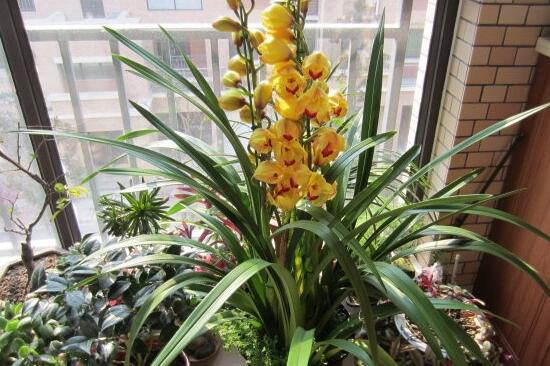
Growing Cymbidium orchids indoors is not the same as outdoors; their growing environment needs to be created by us, so for how to care for Cymbidium orchids at home, we first need to understand their growing habits, and then meet them as much as possible. On this point, the editor brings you the growing methods and precautions for Cymbidium orchids from the aspects of soil, light, water and fertilizer, and so on. Let us continue reading below.
2. Growing methods and precautions for Cymbidium orchids
1. Pot and soil selection
To grow Cymbidium orchids indoors, you first need to choose the pot and soil. Of course, many people directly buy potted plants, but if you want Cymbidium orchids to grow well, you should still prepare the flower pot and soil yourself. The specific pot and soil selection is as follows:
Soil: according to the growing habits of Cymbidium orchids, we should choose loose, breathable, well-drained soil. The editor recommends using a mixed soil of moss, charcoal scraps, fern roots, wood charcoal, bark chunks, broken bricks, etc. It is best not to use ordinary potting soil.
Flower pot: the pot for planting Cymbidium orchids should preferably be a ceramic flower pot with many holes on all four walls and a diameter of 15 cm, and 3-4 plants can be planted per pot.
2. Light
For how to care for Cymbidium orchids, light is naturally indispensable. Compared with other orchids, Cymbidium orchids prefer light, but cannot be exposed to direct sunlight, so when growing indoors, the flower pot should be placed in a place with bright scattered light.
Precautions: Cymbidium orchids avoid strong light. In spring and autumn, shade 40%-50% is suitable; in summer, shade 60%; and after late autumn, more light is suitable to help Cymbidium orchids bloom.
3. Temperature
In the growing methods for Cymbidium orchids, temperature is also very important. It is understood that Cymbidium orchids like a warm environment, and the indoor temperature should be kept at 15-25°C, which is beneficial to plant growth.
Precautions: once the temperature is below 10°C or above 35°C, Cymbidium orchids will enter a dormant state. And if you want Cymbidium orchids to overwinter safely, it is best to adjust the indoor temperature to above 10°C.
4. Watering
Cymbidium orchids like a humid environment, so they require more water, especially in summer. Not only should the watering amount be sufficient, 2-3 times a day, but the leaves should also be sprayed with water. This can both prevent yellow leaves from appearing and effectively lower the temperature, and at the same time ventilation should be kept good.
Precautions: when watering Cymbidium orchids, grasp the watering principle of “water thoroughly after drying out.” Once watering is insufficient, the swollen pseudobulbs will shrink, and normal growth will be affected. In addition, watering should be reduced during the flowering period, otherwise brown spots will appear on the flowers.
5. Fertilizing
After watering, let us talk about fertilizing, which is also a very key part of the growing methods for Cymbidium orchids. It is understood that Cymbidium orchids like fertilizer. In spring and summer, fertilize once every 5-7 days; in autumn, fertilize once every 10-15 days; in winter, fertilizing can be stopped.
Precautions: during the seedling stage and in low-temperature seasons, apply less or no organic fertilizer; in addition, the plant must not lack nutrients, otherwise Cymbidium orchid leaves are likely to turn yellow or even fall off.
6. Pest and disease control
If during the growing process you do not strictly follow the growing methods for Cymbidium orchids to care for them, Cymbidium orchids are prone to pest and disease attacks. Among them, diseases include: leaf blight, anthracnose, soft rot, leaf spot; pests include: aphids, red spiders, scale insects, etc. Once discovered, everyone should spray pesticide for control. As for exactly what pesticide to spray, there is a detailed introduction in the pest and disease control for Cymbidium orchids, so it will not be said much here.
7. Potting and repotting methods
In the process of growing Cymbidium orchids, in addition to paying attention to pests and diseases, everyone should also repot them at the appropriate time. When the plant is too large, it should be repotted or divided and potted (carried out after flowering or when new shoots just sprout in early spring), to promote growth and flowering.
Repotting method: ① Take the Cymbidium orchid out of the old pot, cut off rotten roots and yellow leaves, and wash off the old soil; ② At the bottom of a large new pot, place a layer of broken tiles or broken bricks to facilitate drainage and aeration; ③ Put the treated Cymbidium orchid plant into the pot, fill in new substrate, press firmly with your hands, and then water thoroughly.
How to care for Cymbidium orchids, growing methods and precautions for Cymbidium orchids
Friends who often visit flower markets should know that there is a kind of flower that is very attractive from a distance and is also very popular with everyone, namely the Cymbidium orchid. Cymbidium orchid leaves are long and emerald green, and the flower posture is rugged, bold and magnificent. It has the delicate fragrance and elegance of Chinese orchids, is very popular in the international flower market, and is deeply loved by flower enthusiasts. But do you know how to care for Cymbidium orchids, and the growing methods and precautions for Cymbidium orchids? Today the editor will introduce them to you:
Growing methods and precautions for Cymbidium orchids: 1. Propagation:The division propagation method is often used. The division time is mostly after the plant flowers and before the new shoots have grown large, carried out during this short dormant period. Before division, it should be properly dried, and the operation is done when the roots are slightly white and soft. Vigorous growers are usually divided once every 2-3 years. After division, each orchid clump should carry 2-3 pseudobulbs, of which 1 must have been newly formed in the previous year.
2. Temperature:It likes strong light, and the suitable growth temperature is 10°C-25°C. In winter it should be moved to a low-temperature greenhouse for cultivation.
3. Humidity:It very much likes humidity, but pay attention to ventilation, otherwise it is prone to anthracnose. The humidity for small seedlings should be 80%-90%, and the humidity for medium and large seedlings should be 60% to 85%.
4. Fertilizing:During the growth period, the ratio of nitrogen, phosphorus and potassium is 1:1:1; during the flowering promotion period, the ratio is 1:2:2 to 3. A fertilizer solution pH of 5.8-6.2 is suitable.
5. Watering:In production, sprinkler irrigation is usually used. Water once a day in May and September, water 2 times a day in July-August, and water once every 2 to 3 days from October to April of the following year. The number of waterings should be adjusted at any time according to seedling size and weather conditions.
Through the above sharing by the editor, I believe you have gained some understanding of how to care for Cymbidium orchids, and the growing methods and precautions for Cymbidium orchids! I also hope the editor's sharing is of some help to you!
How to care for Jiuzi Cymbidium orchids, growing methods and precautions for Jiuzi Cymbidium orchids
Jiuzi Cymbidium orchids are very unfamiliar to many people, and they do not know what they are. Today we will share the growing methods and precautions for Jiuzi Cymbidium orchids.
Growing methods for Jiuzi Cymbidium orchids:
1. Culture substrate: in the cultivation of Jiuzi Cymbidium orchids, some culture substrates with larger particles should be selected; generally vermiculite, coconut husk, broken brick granules, ceramic-fired soil and sphagnum moss, etc. can be selected for planting.
2. Watering: in winter, water once every 3-5 days, and the pot soil is better kept slightly dry; because the temperature is lower at this time, lower water content in the plant cells will be more conducive to the overwintering of Jiuzi Cymbidium orchids. Starting in spring, the watering amount should gradually increase; by early summer, water once a day, continuing until autumn, then gradually reduce.
3. Light: compared with traditional Chinese orchids, Jiuzi Cymbidium orchids have higher light requirements. Insufficient light will lead to thin and small plants and weak disease resistance, and will also significantly affect the reproductive growth of Jiuzi Cymbidium orchids; in spring, shade 20%-30%; in summer, shade 40%-50%; from late September to December, during the flower bud growth period, light can begin to be increased. In midsummer, shade 50%-60%; in autumn, more sunlight is beneficial to flower bud formation and differentiation. For greenhouse planting of Jiuzi Cymbidium orchids in winter rain and snow, increasing supplementary light is extremely beneficial to flowering.
4. Temperature: Jiuzi Cymbidium orchids should be moved into a greenhouse to overwinter in winter, and a temperature above 5-8°C should be maintained.
5. Fertilizing: the cultivation of Jiuzi Cymbidium orchids mostly uses non-soil substrates, which have fertilizer efficacy, so the application of fertilizer in the cultivation of Jiuzi Cymbidium orchids is very important. Generally from March to September, fertilizers containing more nitrogen should be selected, such as urea; in October, types containing more phosphorus and potassium should be applied, such as monopotassium phosphate. Special fertilizer for orchids can also be used. The concentration is generally 0.1%-0.3% as good. At the same time, after flowering in April-May and in autumn in September-October, topdressing should be applied 1-2 times each month; the topdressing types can mainly use newly composted cake fertilizer, and bone meal, fish meal, grass compost water, etc. can all be selected.
Precautions for growing Jiuzi Cymbidium orchids:
1. Although Jiuzi Cymbidium orchids are relatively cold-tolerant, they cannot withstand lower temperature conditions. On the way home after purchase, they may be exposed to cold air, causing damage to leaves or flowers.
2. It is recommended not to water too much or too frequently. Watering with clear water close to room temperature is sufficient. Do not water with fertilizer solution during the flowering period. Apply fertilizer only after the flowering period ends, otherwise the flowering period will be shortened, and improper fertilizer use can also cause fertilizer damage.
3. Jiuzi Cymbidium orchids are afraid of direct strong light. Generally, scattered light is best. Too weak light will also cause poor growth and some diseases. Generally, indoor appreciation determines the placement position of the flower based on the indoor location, but at this time attention should also be paid to whether the flower adapts to the small environment of this position.