Are Freesia and Xiangxuelan the same plant, and what is the difference between the two
Freesia is one of the most popular ornamental flowering plants, and in the flower market, Xiangxuelan is also often mentioned by flower enthusiasts; in some places Xiangxuelan and Freesia look very similar, so what exactly is the difference between the two? What is the difference between Freesia and Xiangxuelan? Let us take you through it.
What is the difference between Freesia and Xiangxuelan
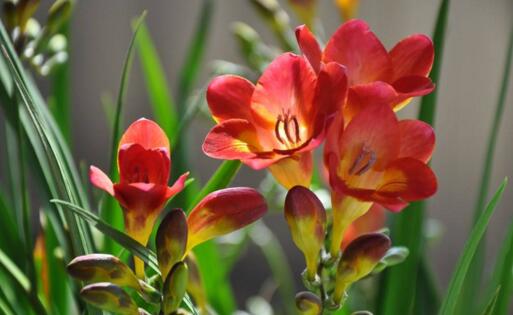
In fact, Freesia and Xiangxuelan refer to the same plant. It belongs to the monocotyledon class, order Asparagales (Liliales), family Iridaceae, genus Freesia; it is just that among the general public there are two names for it, one is Freesia, and many people like to call it Xiangxuelan.
How to grow Freesia
1. Soil conditions
Generally, peat soil and fine sand are mixed into a nutrient soil; of course, garden soil, leaf mold and so on can also be used. Any loose, well-drained sandy soil will do, and the most basic condition is that it is healthy and non-toxic; it can be sterilized before use.
2. Light conditions
When growing Freesia, the light must be sufficient, and the environment it is in must not lack light, but the light must not be too strong either; especially when the temperature is high, it must not be exposed to direct sunlight, and it should be shaded appropriately at noon.
3. Suitable temperature
The most suitable temperature for Freesia growth is 15-25 degrees, but most places cannot guarantee that the temperature is always kept within this range, so as long as the temperature is kept above 7 degrees in winter, it can survive smoothly, and once the temperature rises it can grow.
4. Fertilizer and water supply
Watering is generally once a week, not too much, but it must not be allowed to lack water. Fertilize once every 10-15 days during the growing period, stop fertilizing in summer, and water after each fertilization so that the fertilizer can be absorbed more easily by the Freesia.
Freesia flower meaning
The flower meaning of Freesia is purity, deep affection, delicate fragrance, happiness, and fresh comfort. Its flowers are very rich in color, and giving them to others represents the hope that the recipient will gain happiness; especially its characteristic of blooming in early spring gives people a slow-growing sense of happiness.
How to plant Freesia (Xiangxuelan) corms, completed in 8 steps
How to plant Freesia corms. No matter what kind of flower you plant, the preparatory work must be done well first; prepare all the materials needed in the planting process, such as Freesia corms, sandy soil for planting Freesia, disinfectant, flower pots, etc. Below is a summary of the Freesia corm planting method.
Freesia corm planting method 1. Material preparationFor Freesia corm preparation, be sure to choose high-quality, healthy bulbs; do not use corms that carry pathogens or have been bored by insects, to avoid affecting the development of the Freesia corms. Common specification: 5/+.
Peat soil/coco coir soil/sandy loam, disinfectant, flower pot, watering tools.
2. Planting timeThe planting time of Freesia corms varies with the type of production and the market demand for fresh flowers. For forcing cultivation, it is from early to mid-September to mid-to-late November; for retarding cultivation, it is from January to March.
3. Soil selectionFor general home planting of Freesia, an artificial culture soil made of 2/3 peat soil plus 1/3 fine sand is usually used. Sandy loam or coco coir soil can also be used directly.
4. Corm planting methodAfter washing and disinfecting the prepared soil and corms, planting can be carried out. A depth of about 1 cm to 2 cm from the top of the corm to the soil surface is the most suitable and most appropriate for the growth and sprouting of Xiangxuelan corms.
5. Corm planting depthFor Freesia corm planting depth, generally the top of the bulb should be 1-2 cm from the soil surface, with 2-3 cm of soil covering it.
6. Temperature control after plantingAfter Freesia corms are planted, flower bud differentiation requires a low temperature of 8-13 degrees C, and the suitable temperature during the flower bud development stage is 13-18 degrees C; below 18 degrees C will delay the flowering period and shorten the flower stem. Higher temperatures can promote earlier flowering, but the plant grows weakly.
7. Sufficient light after plantingShort-day conditions are favorable for the flower bud differentiation of Xiangxuelan, and after flower bud differentiation, long-day conditions can promote earlier flowering.
8. Sufficient fertilizer and water after plantingDuring the growing period, Freesia requires sufficient fertilizer and water; apply organic liquid fertilizer once every two weeks, and a moderate amount of compound chemical fertilizer may also be applied. The potting soil should be kept alternately dry and moist, and must not be waterlogged or too dry.
How to propagate Freesia (Xiangxuelan), seed sowing/corm division propagation methods
How to propagate Freesia (Xiangxuelan). Generally, the propagation methods for Freesia usually use seed sowing or corm division. Both propagation methods are acceptable, and flower enthusiasts can choose a suitable propagation method according to their own conditions. Next, the Freesia seed sowing and Freesia corm division propagation methods are introduced separately.
Freesia propagation method 1. Seed sowing propagation methodFreesia (Xiangxuelan) usually has its seeds mature in May to June, and the seeds should be collected promptly; otherwise the capsules will split open and the seeds will be lost. The seeds have no dormancy habit and can be sown immediately after collection.
Specific operation method:
Sowing temperature: during sowing, control the temperature at 15-20 degrees C, sow the current-year seeds collected in May to June immediately in a greenhouse, maintain the temperature at 15-20 degrees C, and water thoroughly. Keep the environment dark, and generally after more than 20 days they will germinate.
Seed germination: generally after about 20 days, Freesia seeds will germinate and emerge one after another. Control the temperature at 15-18 degrees C and apply sufficient water and fertilizer. In the second year, the diameter of the daughter corm can reach more than 1 cm and it can be directly transplanted for planting. Generally, with good care, Freesia can bloom in the same year.
2. Corm division propagation methodFreesia (Xiangxuelan) generally can produce 4-6 daughter corms around the mother corm. Dig them up during the summer dormancy period, separate the daughter corms from the mother corm and store them, and sow them in autumn.
Specific operation steps:
Preparation for corm division: during the summer dormancy period, dig out the corms and directly break off the daughter corms by hand. Store the mother corm and daughter corms separately, and wait until autumn to sow them.
Corm division planting: generally in early August, plant the corms in flower pots and apply sufficient base fertilizer. When planting, cover the top of the daughter corms with 1-1.5 cm of soil. Water thoroughly, and after 10 days they will germinate and grow.
In May of the second year, the daughter corms grow larger and develop into corms. If cultivated as a cut flower variety, the corms should directly grow to more than 8 cm to ensure the quality of the cut flowers.