Tuberose blooms in July; care for it this way and it will flower more
Many flower lovers are certainly familiar with tuberose, because it is the night-blooming jasmine, a flower that blooms at night and has a rich fragrance. Rumor has it that tuberose's fragrance has a mosquito-repelling effect, so everyone looks forward to tuberose blooming. So when does tuberose bloom? How should tuberose be grown to produce more flowers? On this, let the editor answer your questions.
I. When does tuberose bloom? July to November
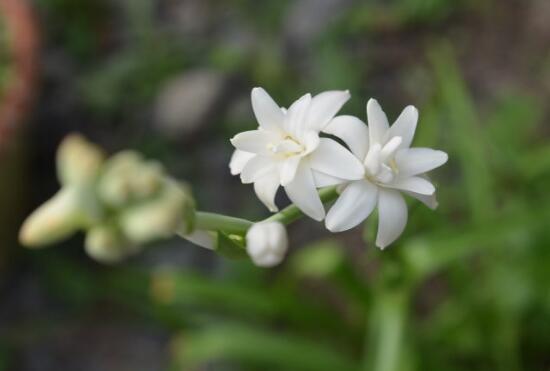
On this question, flower lovers who have grown it should know that tuberose generally begins in July, and this continues until November. So when does tuberose bloom? The answer is July to November. And very unusually, tuberose only opens at night, releasing a rich fragrance.
Reason tuberose blooms at night: Tuberose is native to tropical regions, where daytime temperatures are high and insects such as moths only come out at night. Tuberose relies on moths that appear at night for pollination, so this also determines that tuberose's blooming time is at night. At night, tuberose uses the strong fragrance it releases to lure nocturnal insects to pollinate it.
II. Tuberose blooming period, 8-10 pm
Tuberose has a long blooming period, flowering continuously from July to November, and is much loved as a fine potted flower. According to the growing experience of flower lovers, tuberose usually opens at 8-10 pm, when the temperature is just right. So how long does tuberose's blooming period last? Overall it is 4 months, and for a single flower it is 2 hours.
III. How to grow tuberose so it produces more flowers
Tuberose is beautiful after blooming, with white flowers that look pure and elegant. And we already know tuberose has a long blooming period; if it could bloom even more, it would be even more beautiful. So how should tuberose be grown to produce more flowers? On this, the editor suggests everyone do the following three things:
1. Soil
Before tuberose's blooming period, you should place some coarse sand at the bottom of the flower pot. This is to increase the soil's drainage and aeration, which can help tuberose's growth and development and promote blooming. In addition, according to tuberose's cultivation methods, when choosing soil, it is best to use sandy soil.
2. Fertilizing
How should tuberose be grown to produce more flowers? This naturally requires the support of sufficient nutrients, so proper fertilizing is very important. You should do the following: apply topdressing during the bud stage and throughout the entire blooming period; the fertilizer can simply be potassium dihydrogen phosphate and decomposed cake fertilizer water.
3. Light
Plant growth cannot do without light, so if you want tuberose to produce more flowers, sufficient light is indispensable. During tuberose's blooming period, you should ensure it has sufficient light, and pay attention to sprinkling water around the plant; you can simply sprinkle water on the leaves and around the potting soil.
About tuberose's blooming period and blooming time, after reading the introduction above, everyone should know! Overall, tuberose is very beautiful, and with careful care it will produce more flowers. However, everyone should note that tuberose is toxic; its fragrance can make patients with high blood pressure and heart disease feel dizzy, depressed and uncomfortable, causing symptoms such as chest tightness and difficulty breathing, so tuberose is not suitable for placement indoors.
How to grow tuberose so it produces more flowers, with a rich fragrance
Care for tuberose to produce more flowers
Soil chosen for cultivation
When caring for tuberose, you should first place some coarse sand at the bottom of the flower pot. This is to increase the soil's drainage and aeration, which can help tuberose's growth and development and promote blooming.
It is best to choose sandy soil, and also pay attention to frequently loosening the soil; otherwise, over time the potting soil will become compacted, hindering root growth and thereby hindering blooming.
Fertilizer management
During the blooming period, tuberose consumes a great deal of nutrients, so nutrients need to be replenished. During this period you must fertilize, and also apply topdressing during the bud stage and throughout the entire blooming period; the fertilizer can simply be potassium dihydrogen phosphate and decomposed cake fertilizer water;
Light management
Tuberose must be given sufficient light during the blooming period, so during the blooming period ensure sufficient light. At this time, to produce more flowers, also pay attention to sprinkling water around the plant; you can simply sprinkle water on the leaves and around the potting soil.
Care for tuberose to bloom with a strong fragrance
1. Planting period
If you want tuberose to bloom with a strong, fragrant scent, the first thing is choosing the planting period; choose April;
First soak the seeds in clean water overnight, then plant them;
When planting, use garden soil or sandy loam, then also apply base fertilizer, which is beneficial for later blooming. After planting well, place it in a sunny spot for care.
2. Fertilizing
In order to make tuberose bloom with a strong fragrance, you must apply topdressing and fertilizer;
Especially during tuberose's growth period, generally apply liquid fertilizer 3~4 times as topdressing to promote flower growth;
Also ensure sufficient light; all of these greatly help tuberose's flowers open and, after opening, their growth and release of fragrance.
What to do if tuberose does not bloom, analysis of the reasons tuberose does not bloom / do not fertilize too much
Tuberose blooms at night, its flowers are pure white, and its fragrance is rich. It has a certain ornamental value and is grown in the homes of many flower lovers. However, in the process of growing tuberose, quite a few flower lovers encounter a headache-inducing problem, and that is that it does not bloom! So what should be done if tuberose does not bloom? On this, the editor found 4 reasons; let's take a look together.
I. If tuberose does not bloom, find the cause
Tuberose's fragrance at night is extremely rich and has a mosquito-repelling effect, so it is loved by many people. However, this is all in the situation where tuberose blooms; but what should be done if tuberose does not bloom? According to the editor's research, there are 4 reasons tuberose does not bloom: not old enough to bloom, digging up the bulbs too early, tubers too small, and excessive fertilizing. For the specific solutions, let's continue reading below.
II. Reasons tuberose does not bloom and solutions
1. Not old enough to bloom
For tuberose to bloom, its tuber diameter must grow to at least 2.2 cm or more; only then can flower buds form inside and bloom. If the tuberose planted is a small tuber, less than 2 cm, then because it has not reached blooming age, tuberose naturally will not bloom.
Solution: If it is a large bulb, plant it shallowly so that the entire terminal bud is exposed above the soil surface; this can promote the large bulb to bloom. If it is a small bulb, plant it deeply, covering with soil and leaving only the tip of the small sprout exposed.
2. Digging up the bulbs too early
As for the reasons tuberose does not bloom, it may also be that everyone digs up the bulbs at the wrong time; simply put, digging up the bulbs too early! The reason is that digging up the bulbs too early affects the formation of flower buds within the tuber, causing it not to bloom the following year.
Solution: As long as it will not suffer freeze damage, you should dig up the bulbs as late as possible; this is one of the methods to increase tuberose's blooming rate.
3. Dampness and freezing
If tuberose's tubers are stored improperly in winter, becoming damp and frozen, the main flower buds within the tubers will suffer freeze damage or rot; then when planted the following year, tuberose naturally cannot bloom.
Solution: At this point, if you want tuberose to bloom, you should fully dry the tuber surfaces in the sun and then store them in a dry, warm place. Besides preventing the main flower buds from molding and rotting, you should also plant early and harvest as late as possible.
4. Excessive fertilizing
Besides the above points, excessive fertilizing is also a reason tuberose does not bloom. Especially if too much nitrogen fertilizer is used, it will cause excessive vegetative growth, that is, spindly stems and leaves, which inhibits flower bud growth, leading to few or even no flowers.
Solution: During tuberose's growth period, you should strictly control the fertilizer concentration, especially the amount of nitrogen fertilizer; this is an important measure to prevent tuberose from failing to bloom. Generally, apply once 1 month after planting, once before blooming, and afterward once every 1.5 or 2 months.