How to prevent water rot in orchids? Sharing practical control methods
Around the start of summer (Lixia) is the peak sprouting period for orchids. The orchid seedlings produced during this time are sturdy and grow fast. However, if you do not pay attention to reasonable watering and controlling the moisture of the potting soil, the seedlings are prone to water rot, which can even cause seedling death. The methods to prevent this disease are as follows:
(1) Plant the orchid in a mound shape, that is, pile the soil higher in the middle and let the soil at the edge of the pot sink lower, so that water drains downward.
(2) When the young leaves of the orchid seedlings are elongating and opening, do not spray water, and do not let water droplets fall into the young leaves, so as to keep the center of the young leaves clean and uncontaminated.
(3) Water from the edge of the pot, do not water toward the center of the orchid. At the same time, control the amount of watering; when soaking the pot or flood irrigating, the water line only needs to reach halfway up the pot.
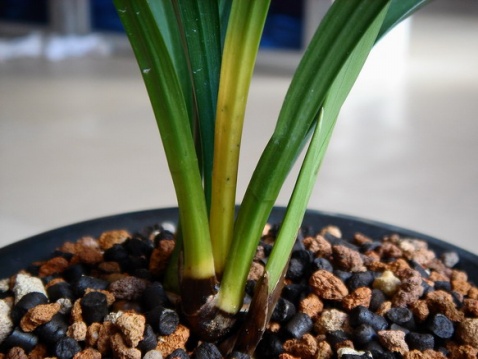
The widespread outbreak of any plant disease is caused by the interaction of the plant's disease resistance, the amount of pathogens, and environmental conditions, and it occurs when all three conditions favor the disease. In orchids, the widespread outbreak of orchid stem rot in recent years can also be analyzed through the relationship among these three factors. The specific factors are:
1. The strength of the orchid's disease resistanceDifferent types of orchids differ greatly in disease resistance. Generally speaking, orchids with thicker, harder leaves have stronger disease resistance, such as Cymbidium hookerianum types and Tiegusu among Cymbidium ensifolium, where stem rot generally occurs less; while orchids with tightly structured leaf sheaths and small spreading width are more severely affected. For orchids of the same variety, different cultivation sites will certainly differ in disease resistance. Naturally cultivated orchids and balcony-grown orchids generally have stronger disease resistance, while greenhouse seedlings in high temperature and high humidity generally have weaker disease resistance. The disease resistance of orchids also has a certain relationship with the orchid's growth condition and division condition (whether division is reasonable). In short, naturally cultivated, robustly growing orchids generally have stronger disease resistance, while greenhouse seedlings with fewer plants per pot have weak disease resistance and are prone to disease. In the past two years, the losses caused by disease have mainly been in this type of orchid.
2. The amount of pathogensOrchid gardens with more severe orchid stem rot are generally orchid gardens with large orchid transaction volumes and strong mobility. The large-scale movement of orchids (orchid gardens engaged in professional orchid buying and selling) makes it easy to spread pathogens artificially, greatly increasing the chance of plant infection in the orchid garden. In the same orchid garden, after there are diseased orchid plants, if prevention is not paid attention to, under suitable environmental conditions (temperature and humidity), a large number of pathogens can reproduce and accumulate in a short time, easily causing a widespread orchid disease outbreak. Generally, within 15---30 days, most orchids in an orchid garden can be destroyed, and after the orchid disease outbreak, a large number of pathogens remain, providing enough pathogens for orchid disease outbreaks in subsequent years and easily causing a vicious cycle. Therefore, cutting off the sources of pathogen transmission and regularly preventing pests and diseases are necessary. For orchid gardens with high mobility, orchids should at least be placed separately in different places where they can be isolated from one another, to reduce the chance of infection for most orchids.
3. Environmental conditionsThe most important environmental conditions for the outbreak of orchid stem rot are high temperature (average temperature 25---30) and high humidity (air relative humidity above 80%, potting soil water content above 90% of the soil's maximum water-holding capacity), lack of ventilation, and unbalanced orchid nutrition, with the core being excessive application of nitrogen fertilizer in autumn and indiscriminate application of various growth hormones, causing orchid plants to be weak and low in disease resistance. It can be said that all orchid gardens with more severe orchid stem rot meet the above conditions to varying degrees.
Symptoms of orchid stem rotIt usually first damages the mature orchid leaf sheaths and the tissue near the base of the leaves, from the inside outward. In severe cases, it causes deep rot of the pseudobulbs, and then causes leaf wilting. The diseased area and cut surface sometimes appear dark brownish red. After infection, the initial symptoms are not obvious. In summer high temperatures it appears acute, while at low temperatures the disease course becomes very long, several months or even longer, and the death is very miserable. It is the most damaging disease for Cymbidium faberi.
1. Early stage of disease: Stem rot is also called wilt disease and blight disease. The cause is Fusarium oxysporum of the Deuteromycotina and Erwinia carotovora. The two bacteria coexist, mutate to produce second-generation hyphae, and because of the coexistence of soft rot bacteria, the disease incidence has been high in recent years and it is an orchid disease with severe losses.
2. Pathogen: The pathogen belongs to Fusarium oxysporum of the Deuteromycotina. Its hyphae are segmented and produce two kinds of spores, large and small. The small spores are spindle-shaped to long oval, and the large spores are generally sickle-shaped, hence the name. The colonies are white, peach-red to purplish red, and the diseased tissue sometimes appears brownish red.
3. Disease conditions and transmission routes: Wounds, acidic materials, and high temperature easily spread this disease. Wild-collected orchids carrying disease are also very common. The spores overwinter in diseased residual tissue and contaminated substrate, and invade through water, wounds, and manual operations.
Control of orchid stem rot1. Pay attention to diseased wild-collected orchids.
2. Use Dexon 800-fold solution to irrigate once as prevention during high temperature and peak disease seasons.
3. When potting wild-collected orchids, irrigate with Dexon 800-fold solution.
4. For diseased orchids, change to a new pot and soil, use Dexon 800-fold solution as water for irrigation, and after drying, alternate one watering and one medication, repeating three times continuously as one treatment course. Generally they can be cured. Dexon: yellow-brown powder, the aqueous solution is red-brown, sensitive to light and decomposes under direct sunlight. It is a soil fungicide, and when used on plants it has systemic and penetrating properties. After being absorbed by plant roots and leaves, it can maintain its efficacy for a relatively long time. It is harmless to plants. It is harmful to humans and livestock, so wash hands with soap after use. It is generally available in agricultural supply stores.
Season when stem rot occursThe peak incidence is from May to September each year, and the earliest cases can appear in February; high temperature and high humidity environments are more conducive to the rapid development of the disease. The typical symptom is yellowing and withering starting from old plants (it differs from soft rot; soft rot starts rotting from new seedlings, and soft rot has an abnormal strong foul smell). It appears as follows: the core leaves of old plants begin to yellow from the base, then rapidly develop from bottom to top and from inside to outside. One old plant yellows, withers, and dies within 1-2 days. If touched by hand, the whole plant will break at the ring of the leaf stalk. Inexperienced orchid friends often think it is just old plants fading; but when the disease continues to develop and more robust plants collapse, it is often already untreatable. The root system of the diseased plants is still intact, and there may even be crystal tips present, and the new shoots produced that year are also intact. But if you cut open the pseudobulb of a diseased plant, you will find that the inside of the bulb has already turned brown, or even rotted. If you continue cutting downward, you can also find that those plants with green leaves that look intact have pseudobulbs that have already been infected and discolored inside, and their collapse from disease is only a matter of time. It can be seen that the spread of this disease is extremely hidden.