How to grow golden camellia? Cultivation methods and precautions, use acidic water for watering
Golden camellia, the twin sister of camellia sasanqua, has a beautiful flower shape, golden petals, crystalline and glossy, looking extremely lovely. In daily life, because of the beauty of golden camellia, and also because of its amazing efficacy, it is grown in pots at home by many people. So how do you grow golden camellia? In this regard, the editor has carefully compiled the cultivation methods and precautions for golden camellia, very detailed, friends who want to grow it must take a look~
I. How to grow golden camellia, understand its habits
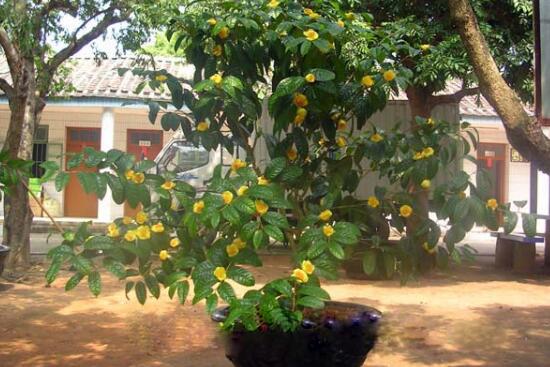
Wanting to grow golden camellia indoors is not a simple matter. First, we must understand the growth habits of golden camellia, and then create the most favorable growing environment for it at home. So how do you grow golden camellia? The editor will explain in detail from aspects such as soil, water and fertilizer, and temperature. Let's read on.
II. Cultivation methods and precautions for golden camellia
1. Pot soil
How to grow golden camellia - if it is indoors, pot soil is naturally indispensable. According to its growth habits, there are strict requirements for choosing flower pots and soil, as follows:
Soil: Golden camellia prefers loose, fertile, well-drained acidic soil, so the editor recommends using: soil mixed with leaf mold/peat soil, garden soil and river sand.
Flower pot: It is best to use a clay pot for planting golden camellia, because this kind of pot has good drainage and air permeability, which is beneficial to root development. As for the size of the pot, it should be determined according to the size of the seedling being potted.
2. Watering
In the cultivation methods of golden camellia, watering is certainly indispensable. It is understood that golden camellia prefers a semi-shaded, semi-cool environment with humid air, so while watering daily, you should also sprinkle water around the flower pot to increase humidity.
Precautions: Because golden camellia prefers acidic soil, when watering, a small amount of ferrous sulfate must be added, so that the growing environment of golden camellia always remains weakly acidic, which is very beneficial to its growth.
3. Fertilizing
To make golden camellia grow well, besides watering, fertilizing is naturally indispensable. After research, golden camellia likes fertilizer, but it should not be too much. Generally speaking, fertilize once every other week. Fertilizer options include: diluted sour milk, or fertilizer water made from fermented soybeans, etc. Apply them directly to the flower pot.
Precautions: In addition to daily fertilizing, before and after flowering, apply once each of fully decomposed thin cake fertilizer water or compound chemical fertilizer; besides this, when fertilizing golden camellia, raw fertilizer must never be applied, otherwise it will cause the plant to develop root rot.
4. Temperature
How to grow golden camellia - temperature regulation is also very important. It is understood that golden camellia is a shade-tolerant tree species that likes a high-humidity, low-light and mild ecological environment. Within 20~25°C, it will grow very well, so you can control plant growth by adjusting the temperature.
5. Pruning/pests and diseases
In the process of growing golden camellia, pruning is generally rarely needed. If pruning is needed, only water sprouts and diseased or pest-infested branches need to be cut off. Besides this, pests and diseases need to be prevented and controlled. When encountering diseases such as anthracnose, and pests such as small green leafhoppers, pesticides should be sprayed immediately. As for what pesticide to spray, it is introduced in detail in the pest and disease control of golden camellia, so I will not say more here.
How to grow golden camellia - cultivation and care methods for golden camellia
Golden camellia is an ancient plant, extremely rare, with an extremely narrow distribution. 90% of the world's wild golden camellia is distributed only in the area of the Lanshan branch range in Fangchenggang City, Guangxi, China. How do you grow golden camellia? In this article, the editor will share with you the cultivation and care methods for golden camellia.
How to grow golden camellia
1. Soil: It has no strict requirements for soil and can grow in slightly acidic to neutral soil. It prefers well-drained acidic soil.
2. Temperature: To achieve high yield in planting golden camellia, its most suitable temperature must be maintained between 20-30 degrees, and the lowest temperature cannot be lower than minus 5 degrees.
3. Light: It likes shade at the seedling stage, and after entering the flowering stage, it quite likes transmitted sunlight.
Cultivation and care methods for golden camellia
4. Watering: It has strong waterlogging tolerance. It is best to water to keep the pot soil moist. The water used for watering flowers must be mixed with 1% ferrous sulfate each time, so that the water always maintains a certain weak acidity.
5. Fertilizing: Golden camellia does not like fertilizer very much. Generally, it only needs to be applied 1-2 times each of liquid fertilizer and alum water fertilizer before flowering (between August and September) and after flowering (between March and April of the following year).
6. Pruning: It grows slowly and is not suitable for intense pruning; the crown develops evenly, so special pruning is not needed either. It is only necessary to cut off diseased and pest-infested branches, overly dense branches, weak branches and water sprouts. For newly planted seedlings, moderate pruning can also be done to ensure survival.
7. Pests and diseases: Common diseases of golden camellia include anthracnose, sooty mold, leaf blight, bud blight, etc. A 70% thiophanate-methyl 800-fold dilution can be used for foliar spraying in the early stage of onset, once every 5~7 days, for 3 consecutive sprays.
How to grow golden camellia? The cultivation and care methods for golden camellia are shared here. In Natao Mountain, Ningming County, individual small-petal golden camellia can still be seen, with an extremely small number. It is a rare and precious plant in the world.
Cultivation methods and precautions for money tree - cultivation methods and precautions for money tree
???Related recommendations:
? Golden camellia pictures ? Balloon flower pictures ? Ginkgo tree planting ? Uses of cactus
??? Indoor plants, this article originates from [Decoration Information]
The money tree not only has an auspicious name, but is also particularly beautiful as a very good decorative plant placed indoors. It can also regulate indoor temperature and humidity, and has the effect of a natural "humidifier." So the money tree is the best choice for home decoration green plants. The money tree can also carry out photosynthesis, absorb excessive harmful gases, and provide sufficient oxygen, which is of great help to the human body. For the cultivation methods of the money tree, friends interested in the money tree can learn about them.
[Money tree cultivation methods]
1. Sunlight
In the cultivation methods of the money tree, sunlight is very important. During cultivation, the money tree should be placed in a place with sufficient indoor sunlight. When placing it, attention should be paid to facing the leaf surface toward the sunlight. It should not be kept in shade for a long time, otherwise the branches and leaves will become distorted and deformed. Also, note that it is best to spray water on the leaves of the money tree once every 3 to 5 days. Only in this way is it more conducive to photosynthesis and can also make the branches and leaves of the money tree more beautiful and verdant.
2. Watering
The money tree does not have very high water requirements. Generally, if it is not watered for more than ten days indoors, waterlogging and drought will not occur. However, it should still be noted that if the water amount is too little, branch and leaf development is likely to stagnate. However, if the water amount is too large, the roots may rot and it may die; the water amount must be moderate, then the branches and leaves will be plump. Indoors, it should still be watered once about every 10 days. During the vigorous growth period, water more; small plants and newly planted ones should be watered less.
3. Fertilizing
The money tree has a somewhat greater demand for fertilizer than other plants. Fertilizer soil includes decomposed fallen leaves, mixed bone meal, soybean cake residue, etc. These fertilizer soils have high effectiveness and are convenient and easy to obtain. But attention should be paid to fully decomposing them, so as not to "burn" the leaves yellow. But special attention should be paid to the fact that during the growth period of the money tree, that is, from May to September, a decomposed liquid fertilizer or flower-growing fertilizer should be applied once every 15 days. Only in this way can the effect of deep roots and lush leaves be achieved.
4. Temperature and humidity
Money tree cultivation has relatively high requirements for temperature and humidity. If the temperature is too low or the humidity is insufficient, leaf drop may occur. In severe cases, the branches may become bare, which is unfavorable for viewing, and may even cause the plant to die. For money tree cultivation, attention should be paid to maintaining a temperature above 15°C. However, in winter, attention should be paid to doing a good job in cold protection and freeze protection. For indoor cultivation in summer, water once every 3~5 days. Its most suitable growth temperature is 18~30°C.
5. Repotting
For newly planted money tree plants, there is no need to repot in the same year, to prevent the tree shape from becoming deformed. The suitable season for repotting is spring, or it can also be done in July or August, using the semi-dormant state of the plant during the high-temperature period for repotting. The money tree has relatively strict requirements for pot soil. The pot soil should preferably be slightly moist and well-drained. The pot soil can use acidic sandy loam soil containing humus.
[Precautions for money tree cultivation]
1. Pay attention to ventilation.
2. Avoid direct sun exposure (diffused light is best).
3. Watering should be determined according to your own pot, soil, and dry-wet conditions, not by time.
4. Fertilizing should be done with thin fertilizer.
5. Control your hands, and do not casually move the money tree to a new position or water it when there is nothing to do.
Conclusion:The money tree is a plant with very good meaning placed at home. It also has a very good purifying effect on the air, and also has a great decorative and aesthetic effect. It is also the best choice for gifts. The above is the cultivation method of the money tree exclusively shared by the editor, hoping it can help everyone. To learn more plant cultivation methods, please follow Aiyouwo Decoration Information.
▓ Recommended reading
? Lucky bamboo ? Money plant? Forget-me-not? Daphne odora? Water-cultured tulip? Small potted plants ? Cactus flower? Pine bonsai? Parlor palm? Clerodendrum thomsoniae pictures