How to fertilize and water Cymbidium sinense? Fertilize lightly, avoid heavy doses, and keep the potting soil half-dry
During the growth of Cymbidium sinense, nutrients are very important to it. Only by maintaining sufficient nutrients can it grow strong and healthy and thus produce beautiful flowers. Among its nutrients, fertilizer and water are the most important. So how do you fertilize and water Cymbidium sinense? Below, the editor will walk you through it.
1. How to fertilize Cymbidium sinense
1. Fertilizer selection
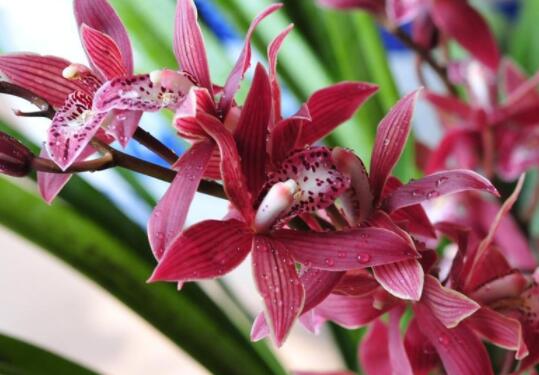
The leaves and rhizomes of Cymbidium sinense are rich in phosphorus, so we do not need to choose a fertilizer containing this element. When choosing fertilizer, we can choose one containing nitrogen and potassium, as Cymbidium sinense has a relatively high demand for these two elements, and such fertilizer can make Cymbidium sinense grow more robustly.
2. Fertilization method
After Cymbidium sinense enters its growing period, its demand for fertilizer is very high, so it basically needs fertilizing once every 20 days. The best temperature when fertilizing is around 20°C. If rainy weather occurs, we should reduce the use of fertilizer.
3. Precautions for fertilizing
Before fertilizing Cymbidium sinense, we should first dilute the fertilizer with water, which can lower the fertilizer concentration, because its fertilization requirement is “light is preferred, strong is avoided.” If we directly apply concentrated fertilizer, it can easily burn the plant, causing its leaves to turn yellow and dry up, so everyone must keep this in mind.
2. How to water Cymbidium sinense
1. Watering frequency
We generally keep Cymbidium sinense indoors, and in this environment air circulation is relatively slow, so water does not evaporate very quickly either. Therefore, we can choose to water once every 10 days, and of course this is only under normal conditions. If the weather is too hot or too cold, this frequency still needs to be adjusted. We only need to remember to keep the soil of Cymbidium sinense in a half-dry state.
2. Watering method
Usually when we water plants, we have a habit, which is to pour water directly from the top of the plant. In fact, this is wrong. The correct watering method should be to pour water along the edge of the flowerpot onto the surface of the soil and let the soil absorb it. When we see a small amount of water seeping out from the bottom of the pot, we can stop watering. Only in this way will it not affect the growth of Cymbidium sinense.
3. Precautions for watering
When watering Cymbidium sinense, we must remember to avoid water accumulating in the pot, because this can easily lead to root rot. At the same time, when watering, we must not pour water directly into the center of Cymbidium sinense, as this will cause its flower center to rot, so everyone must remember this point.
Summary: After reading the above content, I believe everyone has gained some understanding of how to fertilize and water Cymbidium sinense. In fact, in the process of growing it, besides watering and fertilizing, there are still many points that need attention. If you want to grow it well, you can read more of the article on Cymbidium sinense cultivation methods, which contains detailed cultivation instructions.
How to grow orchids best, and how to fertilize and water orchids
Since ancient times, orchids have given us a symbol of nobility and elegance, and together with plum, bamboo and chrysanthemum they are called the Four Gentlemen. Chinese orchids are very different from tropical orchids. They do not have a striking, showy appearance, nor large flowers and leaves, but they possess a simple, quiet, elegant and noble temperament, which is also very much in line with Eastern aesthetic standards. So how do you grow orchids best, and how do you fertilize and water orchids?
How to grow orchids best, and how to fertilize and water orchids:
Orchid growth habits:
Orchids like a shady environment and are afraid of direct sunlight. By nature they like moisture and avoid dryness, and they also like fertile loam soil rich in a large amount of humus. They are most suitable for growing in an environment with air circulation.
How to fertilize and water orchids:
Fertilizing: Newly potted orchids cannot survive if the potting soil is too fertile, and even if they can survive, their flowering rate is very low. If there is too much fertilizer, they will grow too vigorously in autumn, which will also lead to poor flowering the following spring, while too little will also affect the formation of flower buds. In fact, the safest way is that when you see its leaves turning yellow, that means it lacks fertilizer, and you should apply additional fertilizer for it; while scorched leaf tips mean too much fertilizer, and at this time you need to stop fertilizing it. The fertilizer applied for it must be decomposed; undecomposed fertilizer cannot be used, and human excrement and urine especially must be avoided.
Watering: Practice has proved that orchids need eight parts dry and two parts wet. During its flowering period and the period when it sprouts leaf buds, watering should be less. During the plum rain season, it should be moved indoors or a rain shed should be built to shelter it from rain. In summer, it needs to be watered in the early morning and in the evening. Watering must not be excessive either. In autumn, watering can be appropriately increased. If it is a dry season, it needs to be misted every evening to make the ground moist and increase air humidity. In winter, watering can be appropriately reduced, but it must not be omitted entirely; be careful not to let the potting soil dry out completely. In short, water when dry and stop watering when moist, with the principle of keeping it appropriately on the dry side.
Light: Light is an important factor for many plants in forming flower buds. Although orchids like cool conditions, if they are kept in a shaded place all year round, they will also bloom very little. Friends who love orchids have long discovered that orchid leaves in shady places are long and the flowers are sparse, while orchid leaves in sunny places are short and the flowers are numerous. Therefore, when cultivating orchids, attention must be paid to the issue of light. In spring and summer, we had best use reed curtains to shade them, or place them at an indoor window facing east or south with ventilation. Orchids under the curtain should have their pots turned once every half month, so that the orchids receive light on all sides, which is beneficial to balanced plant growth. When the autumn cool arrives, the potted orchids should be moved out from the shaded place and allowed to bask in the morning sun for half a day, but also be careful that autumn does not become dry.
That is all for sharing on how to grow orchids best and how to fertilize and water orchids. I hope this article is helpful to everyone, and I wish everyone good luck.
What to do when Cymbidium sinense leaves turn yellow: control the amount of watering / avoid direct sunlight
Cymbidium sinense is a beautiful-looking flower with high ornamental value, but no matter how beautiful the flower is, if it turns yellow it will also greatly affect its beauty. So what should be done when Cymbidium sinense leaves turn yellow, and how should it be solved? Below, the editor will walk you through it.
1. What to do when Cymbidium sinense leaves turn yellow
To know what to do when Cymbidium sinense leaves turn yellow, we first need to understand what causes it. There are many causes of this phenomenon, such as improper watering and fertilizing, long-term exposure to the sun, and the appearance of pests and diseases, all of which may cause this phenomenon. The specific solutions are introduced in detail below. Let us take a look.
1. Improper fertilizing
Fertilizer is one of the main nutrients in the growth of Cymbidium sinense, but fertilizing requires skill. If too much fertilizer is applied or concentrated fertilizer is applied directly, it can easily cause the leaves of Cymbidium sinense to turn yellow, because Cymbidium sinense does not need heavy fertilizer.
Solution: In terms of fertilizing Cymbidium sinense, thin fertilizer should be applied skillfully, and concentrated fertilizer, heavy fertilizer and undecomposed liquid fertilizer must be avoided. Before fertilizing, we need to first dilute the fertilizer with clean water, so that it can be absorbed better.
2. Improper watering
Although Cymbidium sinense likes to grow in a warm and moist environment, this refers to air humidity, not the soil. It likes the soil to be slightly dry. If too much water is given and water accumulates, it will cause the leaves of Cymbidium sinense to turn yellow, and in severe cases it will also cause its roots to rot.
Solution: When watering Cymbidium sinense, we must do it in the right amount, keeping the soil in a half-dry state. Generally, under normal conditions, watering once every 10 days is enough. If the climate changes greatly, the watering frequency can also be adjusted appropriately.
3. Too much light
Cymbidium sinense relatively likes to grow in a shady environment, but it cannot lack sunlight during growth either, so it is quite particular about light. If it is placed in direct sunlight to grow, it can easily cause the leaves of Cymbidium sinense to turn yellow.
Solution: In the process of growing Cymbidium sinense, we had best place it in a spot with diffused sunlight, so that it can carry out photosynthesis without being sunburned.
4. Pests and diseases
In the process of growing Cymbidium sinense, if cultivation is improper, problems such as pests and diseases can easily appear. Such problems are extremely harmful to the plant, not only causing the leaves of Cymbidium sinense to turn yellow, but in severe cases also causing the plant to wither and die.
Solution: If this problem is caused by pests and diseases, we must deal with it in time. The specific treatment methods are introduced in detail by the editor in the article on pest and disease control for Cymbidium sinense, and everyone can take a look.
5. Metabolism
During the growth of Cymbidium sinense, as it grows, the new replaces the old. Because of the need to develop new leaves, the old leaves will not continue to grow, and thus gradually turn yellow and fall off.
Solution: If the yellowing of Cymbidium sinense leaves is caused by metabolism, everyone does not need to worry too much, because this is a normal phenomenon and will not have any impact on the plant.
Summary: After reading the above content, I believe everyone has gained some understanding of the problem of Cymbidium sinense leaves turning yellow. As long as everyone solves it according to the above methods, your Cymbidium sinense will definitely get rid of the yellowing problem.